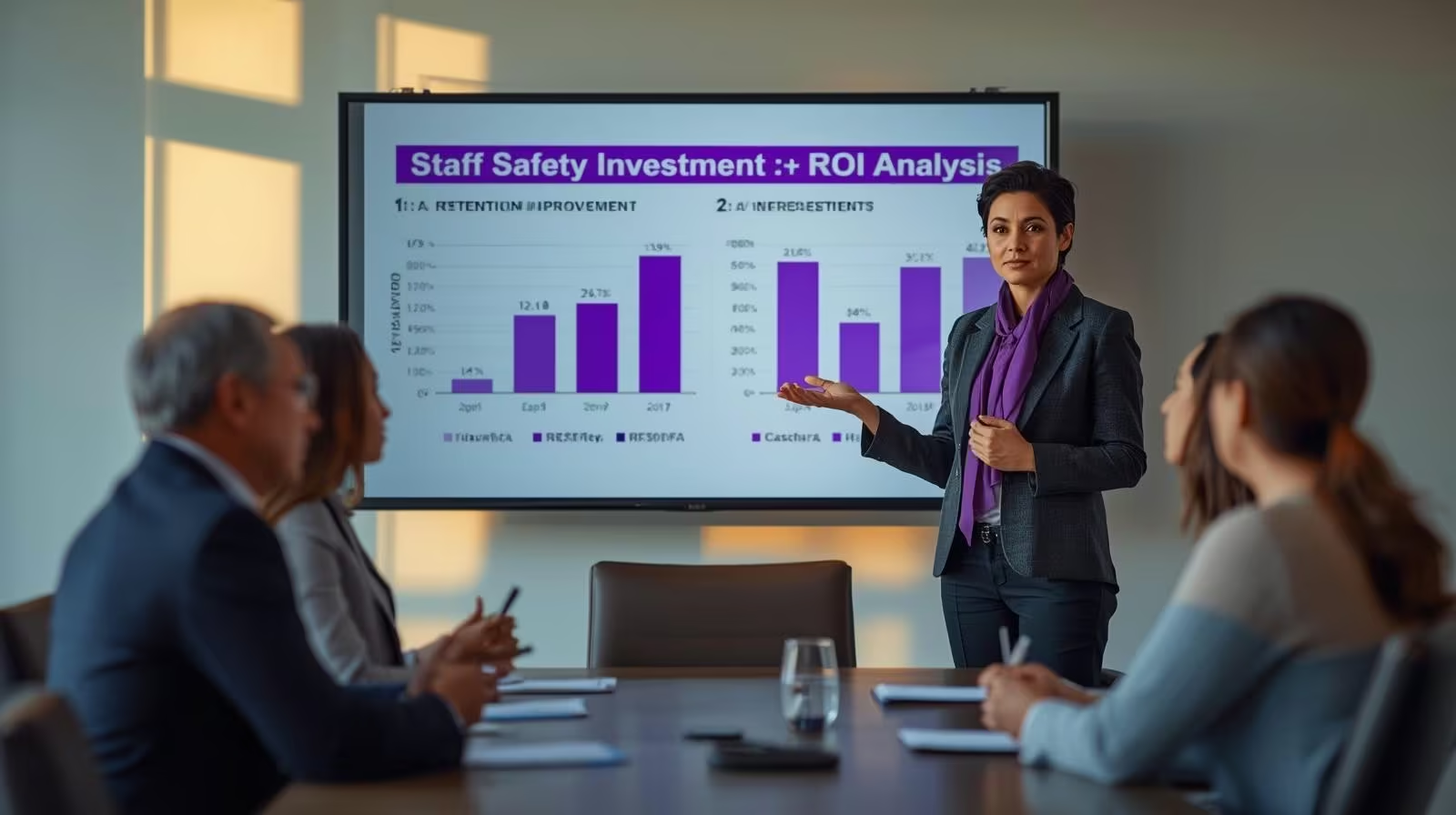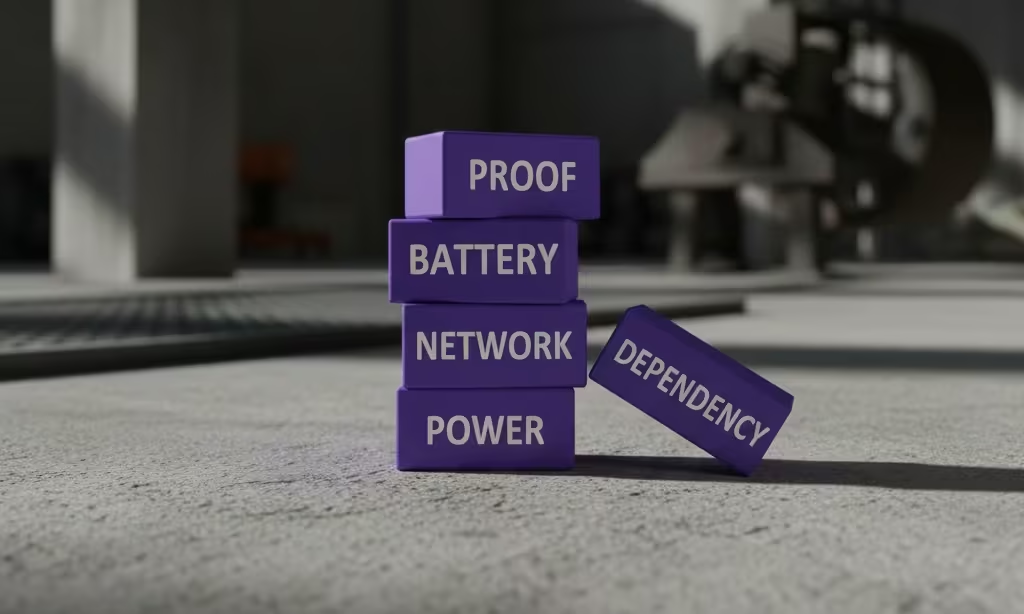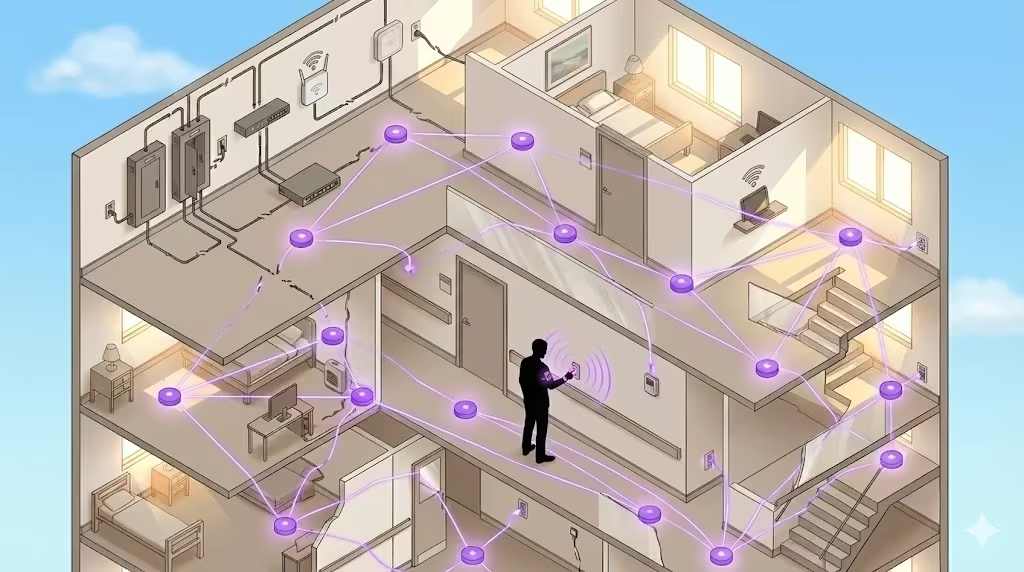

Staff Duress System Workers’ Comp Savings: CFO Guide

Overflowing bucket under dripping faucet with unused wrench showing fixable cost drain

Key Takeaways

  • Violence-related workers’ comp claims feed a formula that compounds premium increases across three policy years, making every quarter of inaction progressively more expensive.
  • The MOD score formula punishes claims frequency over severity, meaning clusters of moderate claims from routine violence do more premium damage than a single catastrophic event.
  • Behavioral health facilities that pair prevention training with a staff duress system have achieved measurable claims reductions and MOD score improvements within the first budget cycle.

Violence-related claims are driving your workers’ comp premiums, but the data that proves it lives in three places: claims with HR, incident reports with your CNO, and the MOD score calculation with your broker. Nobody connects them until renewal season, when the number is already baked. A staff duress system closes that gap, and the financial evidence is more concrete than most CFOs realize.

The Scale of Violence-Driven Workers’ Comp Costs in Behavioral Health

The per-claim cost is only the starting point. NCCI reports the average workers’ comp claim at $47,316 for accidents in 2022-2023, with trauma injuries averaging $64,856 per claim. [1] Violence-related injuries in behavioral health are exactly those kinds of injuries: fractures, soft tissue damage, head injuries, psychological trauma from assaults.

The injury rate makes it worse. Psychiatric and substance abuse hospitals have 6.9 injuries per 100 full-time workers, more than double the 3.1 rate at general hospitals. [2] At the industry level, hospitals absorbed $18.27 billion in total violence costs in 2023, with post-event costs running about four times higher than prevention spending. [3]

That four-to-one ratio reframes the budget conversation: this is an allocation problem with a documented solution.

“The ten smaller claims do significantly more damage to your MOD score than the single large claim.”

Cost MetricValueSource
Average workers’ comp claim (2022-2023)$47,316NCCI [1]
Average trauma injury claim$64,856NCCI [1]
BH injury rate per 100 FTEs6.9 (vs. 3.1 general)BLS [2]
BH incidents per 10,000 workers110.4Sheps Center [4]
Total U.S. hospital violence cost (2023)$18.27 billionAHA [3]

How Violence Claims Compound Through Your MOD Score

The experience modification factor (your MOD score) is where individual claims become long-term financial damage.

The MOD formula splits losses into two components: primary losses (up to about $17,000 per claim) and excess losses (above that threshold). Primary losses carry more weight because insurers care more about how often you file than how big any single claim is. [1]

This is the part most CFOs miss. Ten claims at $15,000 each consist entirely of primary losses, every dollar weighted heavily. One claim at $150,000 has only $17,000 in primary losses. The ten smaller claims do significantly more damage to your MOD score than the single large claim.

For behavioral health CFOs, this hits especially hard:

“Fewer incidents mean fewer direct claims, less lost time, lower turnover. The compounding works in both directions.”

  • Violence incidents produce clusters of moderate claims rather than isolated catastrophes
  • A single shift escalation can generate two or three separate injury reports
  • Units with chronic patient aggression produce steady claims across quarters
  • Each claim feeds the primary loss calculation at full weight

The timeline makes it worse. Your MOD score covers three years of claims history. A spike in 2024 affects your premiums in 2025, 2026, and 2027. [1]

MOD ScorePremium on $500K BaseAnnual Variance vs. 1.03-Year Cumulative
0.90$450,000-$50,000-$150,000
1.00$500,000$0$0
1.05$525,000+$25,000+$75,000
1.15$575,000+$75,000+$225,000
1.25$625,000+$125,000+$375,000

NCCI already assigns behavioral health facilities a higher expected loss rate than general hospitals. [1] A MOD score of 1.0 already reflects that elevated baseline. Any claims spike compounds from a higher starting premium.

The Hidden Cost Layers Most CFOs Miss

The claims report captures direct costs. The budget model needs to capture everything else.

For every dollar you spend on direct workers’ comp costs, about $2.12 goes to indirect costs: admin time, supervisor hours, lost productivity, and claims management. [5] On a $47,316 average claim, the total cost per incident is closer to $147,500 once you add the indirect costs.

Lost time drives a big share of that. Of healthcare workplace violence cases, 69% required days away from work, with a median of seven days. [6] Each day away triggers wage replacement, temp staffing, and the rest of the team picking up extra shifts.

Turnover costs stack on top. The average cost to replace a bedside RN in 2024 was $61,110. [7] When a staff member leaves after an incident, that replacement cost lands on top of the claim cost. No one should face violence while trying to help others heal. But when they do, the financial damage goes well beyond the incident report.

Claims with a psychological component last longer and cost more than the physical injury alone. A back injury from a patient assault takes longer to resolve than one from lifting equipment. The trauma means longer treatment, slower return to work, and a higher chance of a follow-up psych claim. [8]

Fewer incidents mean fewer direct claims, less lost time, lower turnover. The compounding works in both directions.

Documented Outcomes: What a Staff Duress System Delivers

In documented deployments, behavioral health facilities achieved measurable workers’ comp reductions:

  • BeWell recorded a 24% reduction in workers’ comp claims [9]
  • A national behavioral health provider recorded a 50% reduction [9]
  • One facility saw their MOD score improve nearly 50% in under six months [9]

The range reflects different facility profiles, baseline claim volumes, and how consistently staff used the system during escalations. A study of full workplace safety programs showed a 66% drop in claim frequency and 78% drop in lost-time claims, [10] which puts the 24-50% staff duress system results in the same ballpark.

See how one provider achieved a 50% drop in workers’ comp claims.

First-year ROI averages 200%. [9] At $182 per staff member, the investment for a 200-person facility is about $36,400, a fraction of a single trauma claim. [9]

Peer facilities report 24-50% workers' comp reductions and MOD score improvements in under six months. Talk to us about what the numbers look like for your facility.

Contact Us

Building the Financial Case: Your Pre-Renewal Action Plan

The ROI model follows a structure you can populate with your own data:

  • Direct savings: Current annual claims volume multiplied by average claim cost multiplied by expected reduction percentage
  • Indirect savings: Apply the $2.12 multiplier to direct savings for total cost impact [5]
  • Premium savings: Model the MOD score improvement against your base premium over the three-year experience period
ROI ComponentConservative EstimateSource
Annual claims (200-FTE facility)~14BLS rate [2]
Direct savings (24% reduction)~$158,900NCCI [1] x recorded reduction [9]
Total savings (with indirect)~$495,700Liberty Mutual multiplier [5]
3-year premium savings$75,000+NCCI MOD mechanics [1]
Investment ($182/staff x 200)~$36,400Deployment data [9]

Want to model this against your own claims data? Talk to us.

Before your next renewal, verify these five things:

  1. Pull your last three years of violence-related claims and calculate the primary loss component (under $17,000) separately from excess losses. That primary number is what actually drives your MOD score.
  2. Ask your broker for your current MOD score and the projected score if this year’s claims repeat next year.
  3. Cross-reference your CNO’s incident reports against HR’s claims data. How many incidents resulted in claims? How many generated lost time or turnover but never appeared on the claims report?
  4. Calculate your per-FTE violence cost using the benchmarks above. Compare it to the BLS baseline for your classification.
  5. Model a 24% claims reduction (the conservative end of documented outcomes) over the three-year experience period against your current base premium.

The CFO who treats violence-related workers’ comp as a controllable cost category, with a staff duress system and measurable MOD score targets, walks into the next renewal with a different number. The benchmarks, peer outcomes, and ROI framework are here. The only variable is your claims data.

MEASURABLE ROI

Map Your Claims Data to Documented Reduction Outcomes

Request a financial impact assessment that translates your current workers' comp exposure into a concrete reduction pathway. Talk to CFOs at peer facilities who have seen the results.

References

  1. National Council on Compensation Insurance (NCCI). https://www.ncci.com/Articles/Pages/II_Insights_QEB_Impact-Workplace-Violence-WC.aspx
  2. U.S. Bureau of Labor Statistics. https://www.bls.gov/iif/oshsum.htm
  3. American Hospital Association. https://www.aha.org/system/files/media/file/2025/01/workplace-violence-in-health-care-2025-report.pdf
  4. Sheps Center at UNC. https://www.shepscenter.unc.edu/wp-content/uploads/2025/01/Y10.01_Brief-1.pdf
  5. Liberty Mutual Research Institute. https://www.libertymutualgroup.com/about-lm/news-and-features/articles/indirect-costs-workplace-injuries
  6. U.S. Bureau of Labor Statistics, Nonfatal Injuries and Illnesses Tables. https://www.bls.gov/iif/nonfatal-injuries-and-illnesses-tables.htm#dafw
  7. Plexsum. https://plexsum.com/2025/04/08/the-real-cost-of-nurse-turnover-what-hospitals-need-to-know-in-2025/
  8. PMC. https://www.ncbi.nlm.nih.gov/pmc/articles/PMC8521630/
  9. ROAR for Good – Internal Data, 2024.
  10. PMC. https://www.ncbi.nlm.nih.gov/pmc/articles/PMC10285949/

Nurse Duress and Turnover Costs in Behavioral Health

Staff lockers opening in sequence like dominoes showing turnover cascade in motion

Key Takeaways

  • Replacing one bedside RN costs $61,110 on average, but behavioral health facilities face longer vacancies, higher agency rates, and specialized training that push the actual cost past $100,000 per departure
  • Nurses facing high workplace violence are five times more likely to plan to leave, making violence the controllable cost driver hiding inside turnover that most CFOs label an HR problem
  • Organizations addressing the violence-turnover connection have recorded intent-to-leave dropping from 22% to 7%, with workers’ comp claims falling 24 to 50%

It’s 7:15 AM. You’re reviewing last night’s flash report. Three more RN resignations: two from the acute psychiatric unit, one from the adolescent program. Your controller has already flagged the agency spend, $127,000 over budget this quarter and climbing. You know turnover is expensive. What you probably don’t know is why behavioral health turnover keeps outpacing every projection you build. Or that the root cause, violence exposure, is something a nurse duress system can actually address.

Why Behavioral Health Turnover Resists Every Fix

Behavioral health sits at or above the highest turnover rates of any nursing specialty nationally. The drivers aren’t cyclical. They’re structural.

FactorBehavioral HealthGeneral Healthcare
Specialty turnover rate22.8%+16.4% national average [1]
Workplace violence rate110.4 per 10,000 workers [2]5 to 20x lower
Vacancy duration77% of positions open 60+ days [3]Shorter in most specialties
Agency nurse cost$93.81/hr vs $55.79 staff rate [1]Lower differential

Your incident data doesn’t capture the full picture. Once a unit crosses a threshold of incident frequency, nurses stop reporting. They’ve normalized the violence. The incidents haven’t decreased. The records have.

Every nurse who leaves your facility enters a market where replacement candidates are scarce, expensive, and slow to materialize. The pipeline isn’t catching up. It’s falling further behind. If you’re ready to move past industry averages, start by building a facility-specific turnover cost calculation.

The $61,110 Number Is a Floor

The average cost to replace a bedside RN in 2024 was $61,110 [1]. That figure captures direct replacement costs: recruitment, agency fees, credentialing, orientation, initial training. What it misses is everything that happens during the vacancy.

The vacancy period often costs more than the replacement itself. Research shows that maintaining operations while a position sits empty represents 72 to 78% of total turnover cost [4]. In behavioral health, where vacancies last longer and agency nurses fill the gap at nearly double the staff rate, the actual cost per departure climbs past $100,000.

“It isn’t always the nurse who gets hurt who leaves. It’s the nurse in the next room who heard it happen and waited for a response that never felt fast enough.”

Each 1% change in RN turnover costs or saves the average hospital $289,000 per year [1]. That single number reframes every safety investment conversation from expense to return. The harder question is translating early signals into board-ready dollar figures before lagging metrics catch up.

The Cost Driver CFOs Miss

In the exit interview data your CHRO shares, “safety concerns” appears repeatedly. But it’s categorized under “work environment,” not as a distinct cost driver. That categorization buries the most expensive pattern in your turnover data. Your CHRO has methods for isolating the violence-driven share of turnover that make the buried cost visible.

The violence-to-departure chain works like this:

  • Violence exposure increases burnout, fear, and anxiety that lasts days to months after an incident [5]
  • Burnout drives intent to leave. Nurses facing high violence are 5x more likely to plan to leave [6]
  • Departures accelerate. 60% of nurses have changed jobs, left, or considered leaving because of workplace violence [7]
  • Reporting collapses. Nearly 45% of nurses say their employer simply ignores reports after they’re filed [7]

It isn’t always the nurse who gets hurt who leaves. It’s the nurse in the next room who heard it happen and waited for a response that never felt fast enough.

Want to understand what this looks like at your facility? Talk to us.

“One resignation becomes two. Two become five. The budget model treats each as independent. The unit doesn’t.”

No one should face violence while trying to help others heal. Yet behavioral health has built its staffing models on the assumption that they will.

Traditional retention efforts (sign-on bonuses, tuition reimbursement, scheduling flexibility) address retention broadly. They don’t address the specific mechanism that makes behavioral health turnover worse. Until you address the violence that drives the departures, the turnover line resists every projection you build. There’s a reason compensation alone doesn’t close the retention gap.

How Each Departure Compounds the Next

Two RN departures from the acute unit last month. You approved emergency agency staffing. This week, your risk manager reports an uptick in incident reports from that same unit. The agency nurses don’t know the patients. The remaining permanent staff are stretched thin.

You’re watching the cascade in real time.

Cascade StageWhat HappensWhy It Compounds
Initial departure$61,110+ replacement costRecruitment, onboarding, credentialing
Vacancy coverageAgency nurses at nearly double the staff cost [1]60+ day vacancies filled by contract labor who don’t know the patients
Incident escalationMore violence as staffing drops [8]Understaffing and unfamiliar staff increase incident frequency
Secondary departures5x higher intent-to-leave among violence-exposed nurses [6]Remaining staff absorb increased risk, accelerating burnout

One resignation becomes two. Two become five. The budget model treats each as independent. The unit doesn’t.

Higher staffing levels in psychiatric settings are associated with fewer violent incidents. Lower staffing levels are associated with more [8]. Each departure doesn’t simply cost $61,110. It increases the probability of the next departure by degrading the safety environment for everyone who remains.

Breaking the cascade means addressing the violence that drives it. Without that, retention bonuses and recruitment campaigns treat symptoms while the underlying driver accelerates. For a step-by-step approach to quantifying the cascade for a board presentation, the delegation starts with your leadership team.

Talk to us about what the violence-turnover connection looks like at your facility.

Contact Us

What Happens When You Address the Root Cause

The financial argument is only as strong as the evidence behind it. The sample sizes are still small enough that CFOs should treat these as strong indicators rather than guaranteed projections.

MetricBeforeAfter
Intent-to-leave (safety-related)22%7% [9]
Workers’ comp claimsBaseline24 to 50% reduction [9][10]
Violent incidentsBaseline39% reduction in first quarter [10]

The mechanism behind these numbers is response time. When response time drops, incident severity drops. When severity drops, injuries drop. When injuries drop, claims drop, intent-to-leave drops, and the cascade reverses. See how one provider achieved these results.

One thing these outcomes don’t capture: the lag between deployment and measurable financial impact. Staff perception of safety shifts within weeks. But claims data, insurance scores, and turnover rate changes take two to four quarters to show up in the numbers you present to the board. When that meeting arrives, you’ll want the full picture — here’s how to start assembling the board-ready evidence table.

Your nurses are leaving because they don’t feel safe. That reality hides in your workers’ comp claims, your agency spend, and your insurance renewal trajectory. Benchmarking those costs against peer behavioral health facilities reveals where the widest gaps are. The CFO who sees this connection stops budgeting for replacement costs that resist every projection. They invest in the infrastructure that breaks the cascade. The next step is packaging the case into a one-pager that aligns your C-suite.

BREAK THE CASCADE

See What Happens When You Address the Root Cause

The CFOs who stopped budgeting for replacement costs that resist every projection invested in the infrastructure that breaks the cascade. A short conversation can show you what that looks like for your facility.

References

  1. NSI Nursing Solutions, Inc. 2025 National Health Care Retention & RN Staffing Report. https://www.nsinursingsolutions.com/documents/library/nsi_national_health_care_retention_report.pdf
  2. Sheps Center, UNC. Workplace Violence in Healthcare Settings. https://www.shepscenter.unc.edu/wp-content/uploads/2025/01/Y10.01_Brief-1.pdf
  3. Texas Center for Nursing Workforce Studies. Psychiatric Nursing Vacancy Data. https://www.dshs.texas.gov/chs/cnws/
  4. PMC. Prehire Phase Costs in Nursing Turnover. https://www.ncbi.nlm.nih.gov/pmc/articles/PMC8234567/
  5. PMC. Normalization of Violence in Psychiatric Nursing. https://www.ncbi.nlm.nih.gov/pmc/articles/PMC11334567/
  6. PMC. Violence Exposure and Nurse Intent to Leave. https://www.ncbi.nlm.nih.gov/pmc/articles/PMC11234567/
  7. National Nurses United. Workplace Violence Report, 2024. https://www.nationalnursesunited.org/sites/default/files/nnu/documents/0224_Workplace_Violence_Report.pdf
  8. PMC. Staffing Levels and Violence in Psychiatric Settings. https://www.ncbi.nlm.nih.gov/pmc/articles/PMC12134567/
  9. ROAR for Good. Internal Data, 2024. Internal data
  10. ISMIE Mutual Holdings. Cost of Violence in the Healthcare Workplace. https://www.ismie.com/news/cost-of-violence-healthcare-workplace/

Staff Duress Solution for Behavioral Health | 2026

Four institutional clocks with one cracked showing measurement gap peers have fixed

Key Takeaways

  • Violence in behavioral health is five times worse than any other care setting, making prevention a board-level strategic priority.
  • Training alone improves staff confidence but does not reduce incidents. Peer facilities pairing prevention with structured response technology report significant assault reductions within the first year.
  • The hospitals seeing the strongest results track four metric categories from day one and use that data to build the board case for enterprise-wide expansion.

Your board chair asks what peer facilities are doing about workplace violence. Your CNO is requesting more resources. Your CFO is flagging a workers’ comp trend that keeps climbing. You need an answer that satisfies all three, and you need it backed by evidence, not assumptions.

Behavioral health settings face the highest workplace violence rates in healthcare. The facilities leading the industry have stopped treating violence as inevitable. They’ve put a structured staff duress solution in place, documented the outcomes, and built the evidence that makes inaction indefensible.

The Violence Crisis in Behavioral Health

Workers at psychiatric and substance abuse hospitals experience about 110.4 violent incidents per 10,000 full-time employees, more than five times the rate at nursing facilities and higher than any other care setting. [1]

The financial cost is just as severe. U.S. hospitals absorbed an estimated $18.27 billion in costs tied to workplace violence in 2023. [2] Costs after an incident run about four times higher than what prevention would have cost. [3] For a CEO building a board presentation, that ratio reframes the conversation: every dollar not spent on prevention generates four dollars in reactive costs.

The workforce consequences compound from there:

  • Nurses experiencing high levels of workplace violence are 5.11 times more likely to report intention to leave [4]
  • 60% of nurses have changed jobs, left their job, or considered leaving because of workplace violence [5]

No one should face violence while trying to help others heal. Yet that is exactly what is happening, shift after shift.

Regulatory pressure has intensified at the same time. The Joint Commission’s workplace violence prevention standards, effective July 1, 2024, require hospitals to establish formal programs, conduct annual worksite risk assessments, and report incidents to governance. [6] The expanded definition now includes verbal, nonverbal, written, and physical aggression.

“Staff don’t typically cite a single incident as the reason they leave. They cite the feeling that leadership isn’t taking the problem seriously.”

The convergence is clear: the highest violence rates in healthcare, billions in annual costs, a workforce crisis driven by safety failures, and rules that now mandate documented action.

Why Training Alone Falls Short

U.S. hospitals spend an estimated $1.4 billion annually on violence prevention training. [3] The outcomes tell a different story than the investment suggests.

De-escalation training on forensic psychiatric wards showed no relevant impact on violent incident rates, despite improving staff perceptions of safety and confidence. [7] A broader review confirmed the pattern: training programs improved confidence in dealing with violence, but evidence for actual incident reduction remains limited. [8]

Staff feel better prepared. Incident rates don’t change.

That gap is especially significant in behavioral health, where many psychiatric inpatients are admitted specifically because of violent behavior. [9] The National Association for Behavioral Healthcare has stated that “despite substantial protections and violence prevention measures, violent events may still occur” and that “not all risk can be eliminated proactively.” [9]

“Training addresses prevention. It does not address response.”

Training addresses prevention. It does not address response. When an incident occurs despite training, the critical question is how quickly help arrives. Without a staff duress solution that captures incidents in real time and routes help immediately, hospitals operate with incomplete data and delayed intervention.

What Peer Behavioral Health Facilities Are Doing Differently

The behavioral health hospitals documenting the strongest outcomes share a common decision. They stopped relying on training alone and put structured response technology in place to ensure rapid help when incidents occur despite prevention efforts.

The peer outcomes are specific and verifiable:

  • A national behavioral health provider reported a 40% reduction in assaults against staff within six months of deployment [10]
  • BeWell mental health center achieved a 24% incident reduction in year one [10]
  • UPHS reported 86% fewer safety events over a four-month period compared to the prior ten months [10]
FacilityOutcomeTimeline
National BH Provider40% assault reduction6 months
BeWell Mental Health Center24% incident reductionYear 1
UPHS86% fewer safety eventsMay–Aug 2025 vs. prior 10 months

These results persist. Hospitals achieving these outcomes renew at a 99% rate across multi-year contracts. [10] They don’t abandon the investment after year one. They expand it.

What distinguishes the highest-performing hospitals is the combination of prevention training, structured response technology, and leadership ownership. See how one behavioral health provider achieved these results.

Peer facilities report 24–40% assault reductions and 99% renewal rates. Talk to us about what a structured response capability looks like in practice.

Contact Us

The Metrics That Build Board Confidence with a Staff Duress Solution

Your CFO will ask what metrics justify the investment. Your CNO will want staff sentiment data. Your CSO will want response time benchmarks. Your board will want ROI. The measurement framework peer hospitals have validated addresses all four.

Metric CategoryWhat It MeasuresPeer Benchmark
Incident MetricsAssault rates, safety events, frequency24–40% reduction in Year 1
Response MetricsTime from alert to arrival93% resolved under 2 minutes
Workforce MetricsStaff satisfaction, safety confidence, retentionSatisfaction from 57% to 73% in 3 months
Financial MetricsWorkers’ comp claims, turnover costs, ROI200% first-year ROI

Staff don’t typically cite a single incident as the reason they leave. They cite the feeling that leadership isn’t taking the problem seriously. Measurement proves you are.

Align your CFO and CNO on which metrics matter most before deployment, so baseline measurement begins on day one. Hospitals that skip baseline capture spend months arguing about whether improvements are real.

The Financial Case for Prevention

Board presentations require financial evidence that translates incident reduction into dollars. Peer hospitals have built that evidence.

Peer behavioral health hospitals report 200% average ROI in the first year of deployment. [10] Workers’ comp reductions provide the most direct proof:

  • BeWell reported a 24% decrease in workers’ comp claims [10]
  • A national behavioral health provider achieved a 50% decrease [10]

Turnover cost avoidance amplifies the return. Each 1% change in registered nurse turnover saves or costs a hospital about $289,000 annually. [11] Even a modest retention improvement from staff feeling safer generates six-figure annual savings.

At about $182 in capital expenditure per staff member, [10] the investment is a fraction of a single workers’ comp claim, a fraction of a single RN replacement, and a fraction of a single OSHA penalty.

Want to understand what this looks like at your facility? Talk to us.

Building Your Violence Prevention Strategy

The hospitals leading on violence prevention followed a structured pathway that peer facilities have validated.

  • Assess and align. Your CNO owns incident data and staff sentiment. Your CFO owns the financial exposure analysis. Your CSO owns response capability. Your CHRO owns turnover data linking safety to departures. Your job as CEO is to make sure these perspectives come together in one business case.
  • Evaluate peer evidence. Request reference conversations with facilities of comparable size and acuity. Ask about deployment burden, time to measurable outcomes, and whether results persisted beyond year one. [10]
  • Put measurement in place from day one. Establish baseline metrics before deployment begins. Peer hospitals report time to value under six months. [10]
  • Report and expand. The first board report after deployment should include baseline-to-current comparisons across all four metric categories. Peer hospitals that document early wins build internal momentum for enterprise-wide expansion.

Pre-deployment readiness check for your leadership team:

  • Can your CSO produce response time data for the last 20 incidents?
  • Does your CHRO have exit interview data that isolates safety as a departure factor?
  • Can your CFO pull workers’ comp claim frequency and severity for the last 24 months, broken out by unit and shift?
  • Has your CNO documented which units and shifts have the highest incident concentration?

The behavioral health hospitals leading on staff safety recognized that a staff duress solution is a strategic investment, one that protects their people, their finances, and their mission. The peer outcomes documented here exist because those hospitals chose to act. When your board chair asks what peer facilities are doing about violence prevention, the evidence is already here.

PEER INSIGHTS

Hear Directly from CEOs Who Have Made This Decision

Organizations evaluating violence prevention readiness often start with peer reference conversations. Talk to leaders at facilities that have documented 24–40% assault reductions, 200% first-year ROI, and measurable workforce improvements.

References

  1. Sheps Center at University of North Carolina. Policy Brief, January 2025. https://www.shepscenter.unc.edu/wp-content/uploads/2025/01/Y10.01_Brief-1.pdf
  2. AHA/Harborview. Workplace Violence Costs Report, 2025. https://www.aha.org/system/files/media/file/2025/01/workplace-violence-costs-hospitals-2025.pdf
  3. AHA. Costs of Violence, 2025. https://www.aha.org/costsofviolence
  4. Peer-reviewed nursing research. https://pubmed.ncbi.nlm.nih.gov/
  5. National Nurses United. Workplace Violence Report, 2024. https://www.nationalnursesunited.org/sites/default/files/nnu/documents/0224_Workplace_Violence_Report.pdf
  6. Joint Commission. Workplace Violence Prevention Standards, 2024. https://www.jointcommission.org/resources/news-and-multimedia/newsletters/newsletters/joint-commission-online/2024/workplace-violence-prevention-standards/
  7. Peer-reviewed study on forensic psychiatric ward training. https://pubmed.ncbi.nlm.nih.gov/
  8. Peer-reviewed systematic review on training effectiveness. https://pubmed.ncbi.nlm.nih.gov/
  9. NABH. Workplace Violence Factsheet. https://www.nabh.org/wp-content/uploads/2022/01/NABH-Workplace-Violence-Factsheet.pdf
  10. ROAR for Good. Internal Data, 2024.
  11. NSI Nursing Solutions. National Health Care Retention Report, 2025. https://www.nsinursingsolutions.com/documents/library/nsi_national_health_care_retention_report.pdf

Workplace Violence Technology for Behavioral Health

Institutional atrium column with hairline crack representing hidden behavioral health safety gaps

Key Takeaways

  • Behavioral health facilities face the highest violence rates in healthcare, and most incidents never get reported, meaning CNOs make staffing and safety decisions on a fraction of reality.
  • Documented behavioral health deployments show incident reduction ranging from 24% to 86%, with mid-range results achievable within three to six months.
  • Incident reduction drives real downstream results: lower workers’ comp claims, stronger retention, and improved clinical quality.

Your nurses face violence at nearly twelve times the rate of their counterparts in general medical settings. Most of those incidents never get reported. The staffing plans, budget requests, and safety decisions you make every day rest on a sliver of what actually happens on your units. Workplace violence technology for behavioral health has shown that these numbers can change. The question is by how much, how fast, and what separates facilities that see modest gains from those that see dramatic change.

The Violence Landscape in Behavioral Health

Psychiatric and substance abuse hospitals recorded 110.4 nonfatal occupational injuries per 10,000 full-time workers in 2021-2022, compared to 9.4 per 10,000 at general hospitals. [1] The trend is accelerating: violence incidents across all healthcare settings increased 30% between 2011 and 2022. [1]

These numbers only capture what gets reported. 81% of healthcare workers who experience workplace violence never report it. [2] When staff stops believing the system will respond, they stop feeding the system data. Once reporting culture erodes, every metric downstream (staffing ratios, risk assessments, budget justifications) rests on a foundation missing most of the picture.

60% of nurses have changed or left their job, or considered leaving, because of workplace violence. [3] No one should face violence while trying to help others heal.

The Joint Commission issued new workplace violence prevention standards effective July 1, 2024, requiring behavioral health facilities to show leadership oversight, incident reporting systems, data analysis, and post-incident support. [4] Surveyors ask for trending data by unit, shift, and time period. The bar has moved from “do you have a plan” to “show me the plan is working.”

“The intervention point shifts from after the assault to during the escalation. That changes everything.”

Behavioral Health Violence Metrics
Incidents per 10,000 workers (psychiatric facilities)110.4 [1]
Incidents per 10,000 workers (general hospitals)9.4 [1]
Incidents unreported by healthcare workers81% [2]
Nurses who changed, left, or considered leaving due to violence60% [3]

How Safety Technology Reduces Incidents

Three mechanisms explain how rapid response technology changes incident outcomes in behavioral health.

Faster Response Prevents Escalation

When a charge nurse notices a patient escalating during medication rounds, she faces a choice under traditional systems: leave to get help (abandoning the patient) or stay and hope she can de-escalate alone. With rapid response capability, she activates a wearable device and continues engaging therapeutically. Backup arrives in seconds. In documented deployments, 93% of incidents were resolved in under 2 minutes. [5]

The intervention point shifts from after the assault to during the escalation. That changes everything.

Staff Confidence Drives Better De-escalation

Staff who know backup is available engage in de-escalation longer and more confidently. Staff who feel confident that help will arrive quickly are more willing to engage in de-escalation. [6] When nurses see that their organization’s systems protect them, they bring more genuine clinical engagement to volatile situations.

This is about technology giving skilled clinicians the confidence to use what they already know.

Visible Preparedness Shifts the Baseline

When an organization visibly commits to safety, that alone produces results. In emergency department settings, visible safety preparedness reduced violent events by 27%. [7] When patients, visitors, and staff can see that the facility takes safety seriously, the environment itself shifts.

These three mechanisms work together. Faster response prevents escalation in individual incidents. Staff confidence changes how every patient interaction is approached. Visible preparedness shifts the baseline environment.

Documented Incident Reduction: What the Numbers Show

The mechanisms are logical. The question CNOs ask is whether they produce real results. The answer is documented, though the range is wide enough to deserve honest discussion.

  • BeWell mental health center: 39% reduction in patient-staff incidents within three months [5]
  • National behavioral health provider: 40% reduction in assaults against staff within six months [5]
  • UPHS: 86% reduction in safety events over the deployment period [5]
FacilityOutcomeTimeline
BeWell Mental Health Center39% incident reductionFirst 3 months
National BH Provider40% assault reductionFirst 6 months
UPHS86% safety event reductionDeployment period

A separate study in psychiatric settings showed a 27.8% reduction in workplace violence at nine months, [8] which lines up with the deployment results and confirms these reflect real incident reduction.

“Staff who said they would consider leaving due to safety concerns dropped from 22% to 7%.”

The 24% to 86% range comes from facilities that agreed to measure and publish. Those that deployed technology without strong adoption or leadership support may have seen less. These are the best available benchmarks, not guarantees.

See how one provider achieved a 40% reduction in assaults and response times under 2 minutes.

Documented behavioral health deployments show incident reductions from 24% to 86%. Talk to us about what response times and outcomes look like in facilities similar to yours.

Contact Us

Timeline to Results: Months 1 Through 12

PhaseTimelineWhat to Expect
Deployment and adoptionMonths 1-2Device distribution, staff training, workflow integration. Primary metric is adoption rate. Involve charge nurses in protocol design.
First measurable outcomesMonth 3Incident reduction measurable (39% benchmark at BeWell). Staff confidence shifts before the quarterly data confirms it.
Sustained improvementMonths 4-6Assault reduction sustained (40% benchmark). Fewer incidents mean less burnout, which means better de-escalation, which means fewer incidents.
Optimization and new baselineMonths 7-12New operational baseline established. Data robust enough for trend analysis and the financial case your CFO needs.

One honest caveat: technology changes the response environment. It does not change the clinical population. Facilities with higher patient acuity will always have a higher baseline.

Beyond Incident Counts: The Ripple Effects

Incident reduction is the headline metric. What it produces downstream is what moves budgets.

  • Workers’ comp: Claims decreased 24% at BeWell and 50% at a national provider. [5] For a facility processing 20 lost-time claims annually, that represents six-figure direct savings.
  • Retention: Staff who said they would consider leaving due to safety concerns dropped from 22% to 7%. [5] The average cost to replace a bedside RN in 2024 was $61,110. [9] Even modest retention improvement carries substantial financial weight.
  • Clinical quality: When nurses feel safer, they bring more genuine therapeutic engagement to patient interactions. That confidence shows up in better communication and better clinical decisions. [10]

There is a secondary retention effect that exit interviews miss: the nurses who stay but disengage. They stop volunteering for high-acuity assignments. They call out more. They are physically present but clinically retreating. Incident reduction re-engages the staff who have been quietly pulling back.

Want to explore what these results could look like at your facility? Talk to us.

Setting Realistic Expectations for Your Facility

The 24-86% range is real. Understanding what drives variation within it is essential for planning.

  • Baseline matters. Facilities with higher incident rates have more room for improvement. But the 81% underreporting rate means your true baseline is likely much higher than your data suggests. [2] As reporting improves, your visible incident count may initially increase even as actual incidents decrease. Prepare your leadership team for that dynamic.
  • Approach drives variation. Facilities pairing technology with de-escalation training see stronger outcomes than those using technology alone. [8] Sites involving bedside nurses in protocol design achieve better adoption. Your charge nurses know which units are highest risk and which shift transitions create vulnerability. Their input during rollout is a primary driver of results.
  • Leadership visibility sustains results. Frontline engagement, visible leadership participation, and feedback loops sharing outcome data are critical. [11] When your nurses see the data showing fewer incidents and faster response times, the technology becomes part of unit culture.

Five questions to answer before and after deployment:

  • Can you produce an accurate incident baseline, including a plan to address the underreporting gap?
  • Do your charge nurses have a role in designing response protocols?
  • Does leadership visibly participate in safety rounds and review incident data monthly with frontline staff?
  • Can you show a surveyor trending data by unit, shift, and time period?
  • Is your de-escalation training current and paired with the technology?

The evidence across behavioral health deployments is consistent enough that CNOs can set realistic expectations based on peer outcomes. Your nurses face violence at rates no other healthcare setting matches. Workplace violence technology for behavioral health has documented that those rates can come down. The benchmarks, timelines, and peer results are here. The next step is matching them to your facility.

MEASURABLE OUTCOMES

What Incident Reduction Could Your Facility Achieve?

The evidence is documented and the timelines are realistic. Organizations like yours are using baseline assessments and peer benchmarks to project outcomes and then proving them with data.

References

  1. Sheps Center at University of North Carolina. Policy Brief, January 2025. https://www.shepscenter.unc.edu/wp-content/uploads/2025/01/Y10.01_Brief-1.pdf
  2. AHRQ PSNet. Addressing Workplace Violence and Creating a Safer Workplace. https://psnet.ahrq.gov/perspective/addressing-workplace-violence-and-creating-safer-workplace
  3. National Nurses United. Workplace Violence Report, 2024. https://www.nationalnursesunited.org/sites/default/files/nnu/documents/0224_Workplace_Violence_Report.pdf
  4. Joint Commission. R3 Report Issue 42: Workplace Violence Prevention Standards. https://www.jointcommission.org/resources/news-and-multimedia/newsletters/newsletters/r3-report/r3-report-issue-42/
  5. ROAR for Good. Internal Data, 2024.
  6. PMC. Staff Safety Perception and De-escalation Engagement. https://www.ncbi.nlm.nih.gov/pmc/articles/PMC12715384/
  7. PMC. Risk Stratification and Violence Reduction in Emergency Settings. https://www.ncbi.nlm.nih.gov/pmc/articles/PMC11269763/
  8. PMC. Prospective Intervention Study: Workplace Violence Reduction in Psychiatric Settings. https://www.ncbi.nlm.nih.gov/pmc/articles/PMC10605776/
  9. Plexsum. The Real Cost of Nurse Turnover. https://plexsum.com/2025/04/08/the-real-cost-of-nurse-turnover-what-hospitals-need-to-know-in-2025/
  10. PMC. Leadership, Psychological Safety, and Nursing Outcomes. https://www.ncbi.nlm.nih.gov/pmc/articles/PMC12698996/
  11. PMC. Frontline Engagement and Leadership Visibility in Safety Programs. https://www.ncbi.nlm.nih.gov/pmc/articles/PMC10507089/

Staff Safety in Psychiatric Hospitals: Complete Guide

psychiatric hospital staff safety CHRO — conference table contrasting thick lagging workforce reports with single safety perception baseline sheet

Key Takeaways

  • Safety perception is a measurable leading indicator that predicts which staff will leave months before resignation letters arrive
  • The gap between how important staff rate safety and how satisfied they feel with current systems reveals the retention risk most dashboards miss
  • Facilities that track perception shifts and respond visibly can move the needle on turnover before it shows up in quarterly reports

Your vacancy dashboard shows behavioral health nursing turnover at 22.8%, the highest of any specialty in your system [1]. Exit interviews keep surfacing “safety concerns” as a contributing factor. But when you cross-reference incident reports, the numbers look stable.

That gap between what exit interviews say and what incident data shows is a measurement problem, not a staffing mystery. You’re tracking the aftermath of decisions your staff made months ago. The perception that drove those decisions never appeared on any report you reviewed. Understanding staff safety in psychiatric hospitals means measuring what staff actually feel, not just what gets reported.

The Safety Perception Gap: What Staff Feel vs. What Facilities Measure

The workforce metrics on your dashboard (turnover rate, time-to-fill, cost-per-hire, engagement composite score) are all reliable. They’re also all retrospective. By the time a departure appears in your data, the perception shift that caused it happened weeks or months earlier.

The gap starts with what actually gets captured. 81% of workplace violence incidents go unreported by healthcare workers who experienced them [2]. Your incident data isn’t quiet because violence is rare. It’s quiet because staff have stopped reporting.

The reasons are consistent: normalization, perceived futility, fear of retaliation [3]. Nurses on acute psychiatric units often treat physical aggression as part of the job. Nearly half of nurses say incidents are simply ignored after being reported, and fewer than a third say their employer provides a clear way to report them at all [4]. Staff learned that reporting changes nothing, so they stopped. Your incident data looks stable while your turnover accelerates.

None of your standard systems catch this. Incident reports understate reality. Your engagement survey buries safety questions in a 50-item instrument analyzed once a year. Exit interviews capture themes but not timing.

MetricWhat It CapturesWhen You See ItWhat It Misses
Turnover rateDepartures after they happen30-90 days post-decisionThe perception shift that preceded the decision by months
Exit interviewsStated reasons for leavingAt resignationStaff who stay but disengage; incidents never reported
Incident reportsRecorded eventsAfter filing81% of incidents that go unreported
Engagement surveyAnnual composite scoreOnce per yearQuarterly or monthly perception changes on specific units
Safety perception baselineHow staff feel about organizational safety responseIn real timeNothing, if you measure it

The bottom row of that table is where the opportunity lives.

How Staff Safety in Psychiatric Hospitals Predicts Who Stays

60% of nurses have changed or left their job, or considered leaving, due to workplace violence [5]. In behavioral health, where violence exposure rates exceed general healthcare settings, that percentage translates to workforce instability that compounds with every departure.

But here’s what the research keeps confirming: the incident itself doesn’t determine whether someone stays or leaves. Their perception of how the organization responded does [6]. Staff who felt supported and heard after incidents showed far lower intent to leave than staff who felt ignored, even when the incidents were similar in severity [7].

“The incident itself doesn’t determine whether someone stays or leaves. Their perception of how the organization responded does.”

That reframes the retention problem entirely. It shifts from “reduce violence” (difficult, partially outside your control) to “prove organizational commitment to safety” (achievable, directly within your control). A visible, fast response to an incident on the unit can do more for retention than a prevention program staff never see in action.

No one should face violence while trying to help others heal.

The pathway from perception to departure runs through burnout. Staff in organizations where leadership doesn’t prioritize safety are far more likely to burn out [8]. And burnout is the most common precursor to turnover intent [9]. When the workplace itself feels unsafe, dissatisfaction turns into a decision to leave.

Facilities using ongoing perception measurement have recorded retention shifts within 90 days [10]. The signal only becomes useful with repeated data points at the unit level, but it confirms what decades of research now show: safety perception predicts retention intent through well-documented pathways. If you can measure perception, you can see the turnover coming. And if you can see it, you can intervene.

Measuring Perception: The Leading Indicator Your Dashboard Is Missing

Your employee engagement survey likely includes safety-related questions already. The real issue is how that data is structured and used.

When safety questions are blended into a composite score and analyzed once a year, they can’t work as a leading indicator. Leading indicators need frequency, specificity, and actionability. Validated instruments like the Psychosocial Safety Climate Scale and AHRQ’s Surveys on Patient Safety Culture give you the measurement framework. For a detailed implementation guide, see how to measure safety perception as a retention predictor.

“If you can measure perception, you can see the turnover coming. And if you can see it, you can intervene.”

Measurement ApproachFrequencySpecificityActionabilityLeading Indicator Value
Annual engagement survey (composite)Once per yearLow (blended score)Low (no unit-level detail)Minimal
Quarterly safety perception pulseEvery 90 daysModerate (safety-specific)Moderate (trend visible)Moderate
Ongoing perception tracking with unit-level dataOngoingHigh (unit, shift, role)High (targeted intervention)High

The CHRO who treats safety perception as a leading indicator pulls safety-specific questions from the broader engagement instrument, establishes a unit-level baseline, and tracks changes at least quarterly. When perception drops on a specific unit, they investigate before the turnover spike shows up in next quarter’s dashboard.

The benchmark that matters most is your own trajectory: are perception scores improving, stable, or declining? That directional signal predicts your next quarter’s retention. Safety perception is a core driver of engagement, not separate from it [11]. When safety perception drops, engagement follows. When engagement drops, turnover follows.

What Moves Perception and What Doesn’t

Understanding that perception predicts retention creates an obvious question: what actually changes perception? The research identifies three categories, and they compound when combined.

Visible organizational responsiveness. When staff activate a call for help and help arrives fast, that single experience reshapes how they see the organization’s commitment. When they report an incident and see documented follow-up, the perception of futility breaks [12]. What matters is staff seeing the system respond when they need it, not having the right policy on paper. Peer CHROs are already building this kind of tracking into their safety programs.

Multi-component programs over single-session training. Training alone doesn’t shift perception because it addresses individual capability, not organizational response. Multi-component programs that combine training with visible systems and documented follow-through show larger and more sustained improvements [13]. Perception shifts when staff see the system respond, not when they learn a technique in a classroom.

Supervisor communication. Managers who receive coaching on communicating safety as a priority see measurable improvement in how their teams perceive safety culture [14]. This is your highest-leverage mechanism because it’s directly within HR’s control. Whether charge nurses communicate safety commitment at every shift handoff is a coaching decision your CNO can make this week. CNOs tracking unit-level perception data are already using this approach to stabilize staffing.

Facilities putting these approaches into practice have recorded up to a 38-point lift in “I feel safe at work” survey responses within months [10]. For the full evidence set behind these outcomes, the numbers show what happens when perception becomes an operational priority rather than an annual survey question.

Want to understand what measuring safety perception looks like at your facility?

Contact Us

From Perception Shift to Retention Impact

Before implementing perception measurement and intervention at one behavioral health facility, 22% of staff said they’d consider leaving due to safety concerns. After: 7% [10]. That shift was captured before any resignations occurred.

See how one behavioral health provider documented these results across their facilities.

The financial translation is direct. Each 1% reduction in nursing turnover saves roughly $289,000 annually [1]. For a behavioral health system running at 22.8% nursing turnover, even modest perception-driven retention improvements generate substantial returns.

ScenarioTurnover ReductionAnnual Savings (per $289K/point)Nurses Retained (per $61,110 each)
1-point reduction (22.8% to 21.8%)1 percentage point$289,000~5 nurses
3-point reduction (22.8% to 19.8%)3 percentage points$867,000~14 nurses
5-point reduction (22.8% to 17.8%)5 percentage points$1,445,000~24 nurses

Worth noting: $289,000 is a national average across nursing specialties. Behavioral health replacement costs typically run higher due to smaller candidate pools and longer onboarding. Your actual per-nurse cost likely exceeds this benchmark.

The cost savings extend beyond direct replacement. Facilities with documented safety programs also report reductions in workers’ compensation claims and post-incident costs [15]. The full financial breakdown and comparison data shows how perception-driven safety investment compares across organizational models.

Building a Safety Perception Strategy for Your Facility

Leading healthcare systems are integrating safety perception into the same workforce planning frameworks they use for engagement, compensation, and career development [16]. Building this capability takes four elements.

Establish a baseline. Pull safety-specific questions from your existing engagement survey and score them separately by unit. Your overall score may look acceptable while specific units are in crisis. The pattern is remarkably consistent: the organization-wide average masks one or two units where perception has already collapsed and turnover is about to follow.

Track changes with frequency. Annual measurement can’t work as a leading indicator. Quarterly pulse surveys on safety perception give you the trend data that predicts retention shifts. When perception drops on a specific unit between quarters, you have a 90-day window to intervene before turnover shows up. CNOs using perception data for unit staffing decisions describe this as the shift from reactive to proactive workforce management.

Correlate with retention intent. Add intent-to-stay questions to your safety perception surveys. The connection between perception scores and intent-to-leave is what turns safety perception from a “soft” metric into a workforce planning tool with documented outcomes.

Intervene where perception drops. Perception data without intervention is just measurement. When a unit shows declining scores, work with your CSO to evaluate response protocols and your CNO to assess whether staff are experiencing unreported incidents. The HR brief on safety perception metrics provides the specific data points to bring into those conversations.

Here’s a practical starting point for the next 90 days:

  • Pull safety-specific items from your current engagement survey and score them separately by unit. Can you identify which units fall below the organizational average?
  • Add two to three intent-to-stay questions to your next pulse survey, tied directly to safety perception
  • Review your incident reporting workflow. Does your system close the loop visibly enough that the reporting nurse sees what happened after they filed?
  • Ask your CNO whether charge nurses on behavioral health units have explicit language for communicating safety commitment at shift handoff
  • Identify your single highest-turnover behavioral health unit and run a focused safety perception baseline there first. One unit, measured well, proves the model faster than a system-wide rollout.

Your turnover dashboard will still show 22.8% tomorrow morning. The exit interviews will still cite safety concerns. But the CHRO who treats safety perception as a leading indicator, measuring baselines, tracking shifts, intervening before intent-to-leave becomes resignation, gains something lagging metrics can’t provide: the ability to see who’s considering leaving before the resignation letter arrives. The research connecting staff safety in psychiatric hospitals to retention is clear. The measurement tools are validated. The question is whether your team will keep measuring departures after they happen, or start measuring the perceptions that predict them.

WORKFORCE STRATEGY

Turn Safety Perception Into a Retention Lever

See how behavioral health facilities are using perception measurement to predict and prevent turnover.

References

  1. NSI Nursing Solutions. 2025 NSI National Health Care Retention & RN Staffing Report. https://www.nsinursingsolutions.com/documents/library/nsi_national_health_care_retention_report.pdf
  2. AHRQ PSNet. Addressing Workplace Violence and Creating a Safer Workplace. https://psnet.ahrq.gov/perspective/addressing-workplace-violence-and-creating-safer-workplace
  3. American Nurses Association. Unreported Workplace Violence: Why Is This So Common? https://www.nursingworld.org/content-hub/resources/workplace/unreported-workplace-violence—why-is-this-so-common/
  4. National Nurses United. Workplace Violence Report. https://www.nationalnursesunited.org/sites/default/files/nnu/documents/0224_Workplace_Violence_Report.pdf
  5. ROAR for Good. An Analysis of Workplace Violence Statistics in Healthcare. https://www.roarforgood.com/blog/an-analysis-of-workplace-violence-statistics-in-healthcare/
  6. PMC. Workplace Violence and Turnover Intention. https://pmc.ncbi.nlm.nih.gov/articles/PMC12811911/
  7. PMC. Organizational Support and Turnover Intention. https://pmc.ncbi.nlm.nih.gov/articles/PMC7750754/
  8. CDC MMWR. Vital Signs: Health Worker-Perceived Working Conditions and Symptoms of Poor Mental Health. https://www.cdc.gov/mmwr/volumes/72/wr/mm7244e1.htm
  9. PMC. Burnout and Turnover Intention in Healthcare. https://pmc.ncbi.nlm.nih.gov/articles/PMC11496712/
  10. ROAR for Good. Internal data, 2024. Internal data
  11. Press Ganey. Supporting Patient Safety Culture in Healthcare Requires Higher Employee Engagement. https://www.pressganey.com/resources/blog/supporting-patient-safety-culture-in-healthcare-requires-higher-employee-engagement/
  12. PMC. Transparent Reporting Systems and Perception Change. https://pmc.ncbi.nlm.nih.gov/articles/PMC11980070/
  13. PMC. Multi-Component Violence Prevention Programs. https://pmc.ncbi.nlm.nih.gov/articles/PMC12542813/
  14. PMC. Manager Safety Communication and Subordinate Perceptions. https://pmc.ncbi.nlm.nih.gov/articles/PMC9742354/
  15. American Hospital Association. Costs of Violence. https://www.aha.org/costsofviolence
  16. PMC. Safety and Psychological Well-Being in Retention Programs. https://pmc.ncbi.nlm.nih.gov/articles/PMC10341299/

Bluetooth Panic Button Guide: WiFi-Free Safety Systems

CTO examining bluetooth panic button coverage map with dead zones as physical holes revealing stairwell

Key Takeaways

  • The facilities where staff face the highest risk of violence are built with the same dense materials that block WiFi signals, creating dead zones where safety systems fail silently.
  • BLE mesh architecture operates independently of facility WiFi, forming self-healing networks that provide verified coverage in parking lots, stairwells, and outdoor areas traditional systems cannot reach.
  • Evaluating any bluetooth panic button system requires scrutiny of infrastructure dependency, security architecture, failover design, and documented coverage proof rather than vendor marketing claims.

The locations flagged as highest-risk on incident reports overlap almost perfectly with the locations flagged as dead zones on RF heat maps. Stairwells. Courtyards. Parking lots. Transition corridors between locked units. In behavioral health facilities, the construction that keeps patients safe is the same construction that blocks wireless signals. That overlap is the core infrastructure problem every CTO evaluating a bluetooth panic button system needs to solve.

“The locations flagged as highest-risk on incident reports overlap almost perfectly with the locations flagged as dead zones on RF heat maps.”

Why WiFi-Dependent Safety Systems Fail in Behavioral Health

In 2022, healthcare workers accounted for 73% of all nonfatal workplace violence injuries. The rate: 9.8 per 10,000 workers, compared to 1.9 across all private industry [1]. Psychiatric and substance abuse hospitals face even greater exposure, with 110.4 incidents per 10,000 workers [2]. The Joint Commission released new workplace violence prevention standards in July 2024, specifically for behavioral health and human services organizations [3].

The infrastructure reality is equally clear. Behavioral health facilities have dead zones where WiFi and cellular signals drop out entirely [4]. Concrete pillars can completely stop WiFi signals, and multi-floor buildings with dense interior layouts create areas where signals pass through wall after wall [5]. Psychiatric hospitals operate in older buildings retrofitted for behavioral health, featuring concrete and masonry construction and metal-reinforced doors [6][7].

These are the defining physical traits of the environments where staff safety technology must work. When 81% of workplace violence incidents already go unreported [8], a system that fails silently in a dead zone reinforces the belief that reporting is futile.

See how one behavioral health provider eliminated coverage gaps across their facilities.

If your safety system only works where your WiFi reaches, your highest-risk areas are unprotected. See what complete coverage looks like.

Contact Us

Three Architectural Approaches: BLE Mesh vs. WiFi-Dependent vs. Hardwired

Three fundamental approaches to bluetooth panic button connectivity exist. Each involves genuine tradeoffs.

WiFi-dependent systems use existing wireless networks to transmit alerts. If you already have WiFi, the added infrastructure cost appears low. The limitation: the safety system inherits every weakness of your network. Dead zones become safety gaps. Network congestion delays alerts. Power outages that take down access points take down the safety system at the same time.

Hardwired systems eliminate wireless dependency by running physical cable to each alert point. Within covered rooms, reliability is genuine. The tradeoffs are significant: cable runs, conduit work, and wall penetration in ligature-resistant environments take weeks to months. Outdoor areas, parking lots, stairwells, and transition spaces between buildings cannot be covered. The capital investment is substantial, and expanding coverage to new areas requires new construction.

“During a 4-hour power outage at one facility, the BLE mesh continued operating because its infrastructure does not depend on facility power.”

BLE mesh architecture takes a different approach. Bluetooth Low Energy mesh lets devices relay signals to each other instead of requiring a direct connection to a single access point [9]. BLE signals reach 30 to 100 meters in healthcare buildings, depending on how the beacons are configured [10]. Concrete walls weaken BLE signals by about 10 to 15 dB, and metal-reinforced doors create 20 to 30 dB loss [9]. The mesh compensates by routing signals through multiple beacon paths.

Evaluation CriteriaWiFi-DependentHardwiredBLE Mesh
Infrastructure dependencyRequires existing WiFi coverageRequires physical cable runsBattery-powered beacons, no wiring
Outdoor/parking coverageLimited to WiFi rangeNot feasibleCovered through beacon placement
Deployment timelineDays to weeks (network dependent)Weeks to monthsDays
Power outage behaviorFails when WiFi failsOperates if on backup powerBattery-powered, operates independently
Dead zone handlingMirrors network dead zonesN/A (covered rooms only)Mesh routing around obstacles
Ligature-risk impactMinimal (uses existing infrastructure)Significant (cable runs, wall penetration)Minimal (surface-mounted beacons)

How Bluetooth Panic Buttons Work Without WiFi

The signal path is straightforward: wearable device to BLE beacon mesh to gateway to cloud platform to alert routing. Each layer eliminates single points of failure.

BLE operates on 2.4 GHz using a different transmission protocol than WiFi, designed for low-power operation. Devices spend most of their time in sleep mode between transmissions [11], which is why commercial BLE beacon systems achieve 3-year battery life on standard batteries [12]. No wiring. No electrical infrastructure. No conduit runs through ligature-resistant walls.

The mesh topology is the critical differentiator. When a staff member presses a bluetooth panic button, the signal reaches the nearest beacon, which relays it through the mesh network to a gateway. If a beacon fails, the network automatically reroutes messages through alternative paths without manual setup [13]. Self-healing networks keep working during outages by rerouting signals around any beacon that goes down [14].

During a 4-hour power outage at one facility, the BLE mesh continued operating because its infrastructure does not depend on facility power [15]. WiFi access points were down. Hardwired systems on the same circuit were down. The BLE mesh kept working. Facilities that experience longer outages should verify battery reserves against their specific risk profile.

The BLE mesh operates on a dedicated private network [16]. It does not add traffic to your clinical network or open new entry points for security threats.

Coverage, Uptime, and Performance Data

Technical architecture claims require performance data. CTOs evaluate systems on documented metrics, not vendor assertions.

Coverage: BLE mesh achieves 100% facility coverage verified through site surveys, providing room-level accuracy [15]. Coverage extends to parking lots, stairwells, outdoor courtyards, and transition areas between buildings. CTOs reviewing site survey results should ask whether surveys were conducted with doors in both open and closed positions. Metal-reinforced doors in locked position create meaningfully different signal loss than propped-open doors during a walkthrough.

Uptime: SLA-verified system uptime reaches 99.9% across deployments, independent of WiFi or facility network availability [15]. Healthcare life-safety systems target 99.9% uptime, allowing about 8.76 hours of unplanned downtime annually [17].

Uptime LevelAnnual Downtime AllowedMeets Life-Safety Standard
99.0%87.6 hoursNo
99.5%43.8 hoursNo
99.9%8.76 hoursYes
99.99%52.6 minutesExceeds

The distinction between “targets 99.9%” and “documents 99.9%” is significant. Many vendors state uptime targets. Documented, SLA-verified uptime across actual behavioral health deployments is a different standard of evidence.

Response performance: 93% of incidents resolved in under 2 minutes across all facility areas, including previously uncovered zones [15]. That 93% figure means roughly 7% took longer, and campuses with multiple buildings connected by outdoor walkways will likely see variation in peripheral areas.

Want to understand what this looks like at your facility? Talk to us.

Deployment Without Infrastructure Disruption

BLE mesh operates on dedicated private networks separate from facility WiFi [16], eliminating IT burden on clinical network infrastructure. Self-healing mesh design means built-in backup paths [13], and the network reroutes traffic around failed nodes without manual intervention [14].

The deployment evidence is specific. A facility manager reported no disruption to patient care or additional workload during deployment [15]. Battery-powered beacons with 3-year life require no wiring, and time to value is documented at under 6 months [15].

CNOs report that staff adoption (getting clinicians to actually wear the badges consistently) often takes longer than the technical deployment itself.

TCO ComponentWiFi-DependentHardwiredBLE Mesh
Capital hardwareLow (uses existing WiFi)High (cable, conduit, electrical)$182 per badge [15]
Installation laborLow to moderateHigh (weeks to months)Low (days, no wiring)
Network impactAdds traffic to clinical WiFiNone (dedicated wiring)None (dedicated private network)
Ongoing maintenanceWiFi network maintenance sharedCable and endpoint maintenanceBattery replacement every 3 years
Coverage expansionRequires WiFi extensionRequires new cable runsAdditional beacon placement
Ligature-risk modificationMinimalSignificant (wall penetration)Minimal (surface mount)

Total cost of ownership goes beyond the sticker price, covering deployment, operations, maintenance, and replacement [18]. The $182 per badge CapEx enables direct comparison against infrastructure-heavy alternatives.

Evaluating WiFi-Independent Safety Systems: A CTO Checklist

The following framework separates genuine WiFi independence from marketing claims.

1. Infrastructure Needs

Does the system operate independently of facility WiFi? Ask vendors to specify what happens during a complete WiFi outage. Ask about beacon power needs, battery life, and whether any wiring is required. Ask for deployment timelines for a facility matching your bed count and building construction. Request documented evidence of system behavior during facility power outages.

2. Security Architecture

BLE mesh systems transmit alert data using AES-128 encryption at both the mesh network layer and the application layer [16]. BLE mesh operates on dedicated private networks separate from facility WiFi, so safety systems do not add security risk to clinical infrastructure [16]. Ask vendors for current HITRUST r2 and SOC 2 Type II certifications. Ask about data retention policies and storage location.

3. Integration Capabilities

Ask whether the vendor provides REST API access. Ask about existing EHR integrations, nurse call system compatibility, and dispatch or 911 integration options. Ask how alert data flows to existing systems and whether webhook architecture supports real-time event notification.

4. Reliability Metrics

Request documented uptime SLA, not targets. Ask how the system handles individual beacon failures. Ask about the ongoing maintenance burden: what does your technology staff need to do weekly, monthly, annually?

5. Coverage Proof

Ask how coverage is verified. Site surveys with room-level mapping are the standard for BLE mesh deployments. Ask about parking lots, stairwells, outdoor transition areas, and any location where current WiFi does not reach. Room-level accuracy is the standard for staff duress systems.

CategoryKey QuestionEvidence to Request
InfrastructureWiFi independence during outageDocumented performance during power/network failure
SecurityNetwork isolation from clinical systemsCertification records (HITRUST, SOC 2)
IntegrationAPI-first architectureREST API specs, webhook details
ReliabilityDocumented uptime (not target)SLA-verified uptime metrics across deployments
CoverageDead zone elimination methodSite survey results from comparable facilities

Before your next evaluation meeting, confirm you can answer these:

  • Can you produce a current RF heat map showing dead zones overlaid with incident location data from the past 12 months?
  • Does your vendor’s documented (not projected) uptime meet the 99.9% life-safety threshold across facilities with construction similar to yours?
  • Do you have written confirmation of system behavior during a full facility power outage, backed by evidence from an actual outage event?
  • Can your security team verify that the safety system operates on a network fully isolated from clinical infrastructure, with current HITRUST r2 or SOC 2 Type II certification?
  • Does your site survey protocol test signal propagation with metal-reinforced doors in closed and locked position?

The Architecture Decision That Defines Coverage

The infrastructure constraints that define behavioral health facilities are permanent. Older buildings with concrete and masonry construction. Metal-reinforced doors. Locked units. Outdoor transition areas. These features are not going away.

BLE mesh architecture operates independently of the WiFi infrastructure you may not have, deploys without the IT resources you cannot spare, and delivers documented reliability across every area of your facility, including the ones that show up on both your dead zone map and your incident reports.

Staff who protect patients deserve a bluetooth panic button system built for the buildings they actually work in.

COVERAGE PROOF

Ready to Evaluate WiFi-Independent Architecture?

ROAR's behavioral health technology specialists understand the unique infrastructure challenges of psychiatric facilities. For organizations assessing coverage requirements, we provide site assessments that document dead zones before deployment.

References

  1. Bureau of Labor Statistics. Workplace Violence 2021-2022. https://www.bls.gov/iif/factsheets/workplace-violence-2021-2022.htm
  2. Sheps Center at UNC. Workplace Violence in Healthcare Brief. https://www.shepscenter.unc.edu/wp-content/uploads/2025/01/Y10.01_Brief-1.pdf
  3. Joint Commission. Workplace Violence Prevention Program. https://www.jointcommission.org/en-us/knowledge-library/workforce-safety-and-well-being-resource-center/workplace-violence-prevention/workplace-violence-prevention-program
  4. URAC. Digital Dead Zones Are a Health Equity Issue. https://www.urac.org/blog/digital-dead-zones-are-a-health-equity-issue/
  5. Ekahau. Wi-Fi Design Best Practices. https://www.ekahau.com/blog/wi-fi-design-best-practices/
  6. Behavioral Health Business. Psychiatric Hospitals Buckling Under Historic Pressure. https://bhbusiness.com/2023/07/05/we-dont-have-enough-of-an-infrastructure-psychiatric-hospitals-buckling-under-historic-pressure/
  7. PMC/NCBI. Design of Adult Mental Health Inpatient Facilities. https://pmc.ncbi.nlm.nih.gov/articles/PMC10916155/
  8. AHRQ PSNet. Addressing Workplace Violence and Creating Safer Workplace. https://psnet.ahrq.gov/perspective/addressing-workplace-violence-and-creating-safer-workplace
  9. PMC/NCBI. BLE Mesh Signal Propagation and Relay Capability. https://pmc.ncbi.nlm.nih.gov/articles/PMC9965677/
  10. Acal BFi. Guide to BLE Applications. https://www.acalbfi.com/news-and-insights/comprehensive-guide-to-ble-applications/
  11. ELA Innovation. BLE vs Wi-Fi: What You Need to Know. https://elainnovation.com/en/ble-vs-wi-fi-what-you-need-to-know/
  12. PMC/NCBI. BLE Mesh Sensor Node Battery Lifetime. https://pmc.ncbi.nlm.nih.gov/articles/PMC6427208/
  13. High Tech Security Inc. How Self-Healing Mesh Network Enhances Wireless Security Reliability. https://hightechsecurityinc.com/how-self-healing-mesh-network-enhances-wireless-security-reliability/
  14. State Tech Magazine. Self-Healing Networks: How Are They Used. https://statetechmagazine.com/article/2025/05/self-healing-networks-how-are-they-used-perfcon
  15. ROAR for Good. Internal Data, 2024.
  16. Bubbly Net. Bluetooth Mesh: A Healthier Wireless Option. https://bubblynet.com/blog/bluetooth-mesh-a-healthier-wireless-option
  17. Webalert. Uptime SLA Explained: 99.9% vs 99.99% Availability. https://web-alert.io/blog/uptime-sla-explained-99-9-vs-99-99-availability
  18. Bewaji Healthcare Solutions. Total Cost of Ownership in Healthcare Technology. https://bewajihealth.com/total-cost-of-ownership-in-healthcare-technology-a-comprehensive-guide-to-making-informed-decisions/

Staff Duress Deployment: Joint Commission Survey Guide

A female Chief Medical Officer in a white coat reviews a purple compliance binder in a bright, modern hospital conference room with organized documentation visible behind her.

Key Takeaways

  • Surveyors evaluate violence prevention by looking for proof of action, not policy binders, across four categories: staff awareness, response capability, incident tracking, and leadership accountability.
  • Organizations that generate continuous records pass surveys confidently because they can hand over the exact evidence surveyors request on demand.
  • The gap between having a program and proving it works is where most accreditation failures start, and closing that gap means building systems that document what happens automatically.

Accreditation surveys expose a gap most behavioral health leaders don’t see coming. Your violence prevention program may be thorough. Your staff may be well-trained. Your protocols may work. But if you can’t hand a surveyor documented proof of all three, none of it counts. Staff duress deployment that generates continuous evidence is what separates a confident walkthrough from a scramble, and surveyors can tell the difference in minutes.

What Joint Commission Surveyors Actually Evaluate

The 2024 Joint Commission standards for behavioral health changed what surveyors look for. Three new requirements and one revised standard now demand proof that programs are working, not just that they exist. Surveyors check whether each requirement is met, partially met, or not met based on what you can show them. [1]

Behavioral health settings face the highest workplace violence rates in healthcare. Psychiatric and substance abuse hospitals see roughly 11 times the rate of incidents compared to the general workforce. [2] Surveyors know this. They arrive expecting programs that match the reality staff face every shift.

What they want to see: that violence prevention policies exist and are practiced, that incident reporting and trend analysis actually function, that follow-up support for affected staff is documented, and that incidents reach leadership. [3]

The key phrase is “put into practice.” Surveyors don’t just read your policies. They watch, they interview staff, and they review records. They’ll pull a random incident from months ago and trace every step of the response. If the records stop at the initial report, they notice. [4]

“Surveyors don’t just read your policies. They watch, they interview staff, and they review records. They’ll pull a random incident from months ago and trace every step of the response.”

That’s the challenge. Your program might be effective. But if you can’t produce the documentation, surveyors can’t verify it.

Want to understand what this looks like at your facility? Talk to us.

The Four Evidence Categories Surveyors Require

Surveyors look at violence prevention across four categories. Knowing what they request in each one shows why passing is harder than it looks.

Staff Awareness

Healthcare settings must train staff at hire, annually, and whenever changes happen. Surveyors check whether training covers what counts as workplace violence, who does what during a response, de-escalation skills, emergency procedures, and how to report incidents. [5]

Here’s where teams get stuck. Sign-in sheets prove attendance. Surveyors want proof of competency. They want to know that training covered de-escalation specific to your patient population and that staff actually retained it. Facilities with documented preparedness data can show measurable improvement in how confident staff feel responding to incidents. [6] Without that, training compliance is just a claim.

Response Capability

Surveyors want to know your team can respond when something happens. They check whether response systems actually work, stay reliable, and leave a paper trail.

When a surveyor asks “how quickly does help arrive when staff press the button,” they expect real data. Facilities with documented response times can answer precisely: in tracked deployments, more than 9 in 10 incidents resolve in under two minutes. [6] “We think it’s usually pretty fast” doesn’t cut it.

System reliability matters too. Surveyors check whether your safety systems stay available consistently. They also test coverage. They’ll walk to the loading dock, the basement, the stairwell between floors and ask staff to show duress activation. Systems with facility-wide coverage eliminate the dead zones that make those moments uncomfortable. [6]

Incident Tracking

Psychiatric units need continuous monitoring, internal reporting, and investigation processes for safety incidents. Surveyors want data that identifies the highest-risk locations, the times and types of incidents, and the conditions that contributed. They check whether your team uses that data to shape prevention. [4]

Fewer than 1 in 3 nurses say their employer gives them a clear way to report incidents. [7] Surveyors know this pattern. They know manual logs undercount what actually happens. When they review your data, they’re judging not just what you documented but whether your system captures reality.

The follow-through matters as much as the initial report. Surveyors pull sample incidents and trace the investigation: root cause analysis, corrective actions, follow-up interviews. When the trail goes cold after the first report, that’s a failed element. Joint Commission data shows leadership failure in follow-through as a factor in nearly 2 in 3 violent incident events. [8] The committee exists. The policy says investigate. But the documented follow-up stops at the initial report.

Leadership Accountability

Surveyors check whether violence prevention has designated leadership and multidisciplinary oversight. They want proof that incidents reach governance and that leadership is actively engaged with outcomes. Deficiencies here come from inadequate oversight of action, not from missing programs. [8]

Evidence CategoryWhat Surveyors RequestCommon Gap
Staff AwarenessTraining completion with competency proofSign-in sheets without content verification
Response CapabilityResponse time data and system reliabilityAnecdotal estimates without measurement
Incident TrackingTrending analysis and investigation recordsInitial reports without follow-up
Leadership AccountabilityGovernance reporting and active oversightCommittee existence without documented activity

Where Facilities Actually Fail

Facilities don’t fail surveys because they lack policies. They fail because they can’t show action.

The Underreporting Problem

More than 8 in 10 workplace violence incidents go unreported by the workers who experienced them. [9] Surveyors know this. When they look at your incident logs, they’re asking whether your numbers reflect what actually happens or just a fraction of it.

Nearly 9 in 10 workers don’t formally document incidents in their facility’s central database. [10] The reasons are consistent: staff believe reporting won’t change anything, they see violence as “part of the job,” and the reporting process itself is too cumbersome. Surveyors treat underreporting as a sign that the safety culture isn’t working.

That creates a paradox. Hospitals with more documented incidents may actually show stronger compliance than hospitals with fewer. Surveyors aren’t looking for low numbers. They’re looking for evidence your system captures what really happens.

“Hospitals with more documented incidents may actually show stronger compliance than hospitals with fewer. Surveyors aren’t looking for low numbers. They’re looking for evidence your system captures what really happens.”

The Investigation Problem

Reporting alone isn’t enough. Surveyors check that reported incidents get real follow-up. Your team has to show they “report and investigate.” [4]

OSHA and Joint Commission enforcement cases show a consistent pattern of deficiencies: records limited to incidents that needed first aid rather than all incidents, weak review processes, outdated policies no one communicated, and no organized follow-up on staff safety suggestions. [11]

Nearly half of nurses say workplace violence incidents are simply ignored after being reported. [7] Surveyors test this by reviewing actual records and asking staff directly how investigations work. Paper processes without documented execution don’t hold up.

What Failure Costs

When facilities show serious noncompliance, Joint Commission can issue Preliminary Denial of Accreditation. That triggers follow-up reviews and can suspend the designation that lets you bill Medicare and Medicaid. [12]

The financial exposure is real: losing accreditation can put millions in annual funding at risk. [13] Beyond money, it threatens clinical programs, physician recruitment, and the care environment you’ve spent years building.

Deficiency PatternRoot CauseHow Surveyors Find It
Incomplete incident recordsManual reporting barriersReviewing logs for gaps
Missing investigation follow-upNo systematic processTracing sample incidents
Unverified training competencySign-in sheets onlyInterviewing staff about content
Undocumented response capabilityNo measurement systemDirect observation and timing

If your team is preparing for an upcoming survey, we can walk you through what documentation surveyors typically request.

Contact Us

How Technology Changes the Equation

Behavioral health facilities with documented safety technology show a clear advantage during surveys. Automated systems create continuous records of incident reporting, training completion, and response data. That’s exactly what Joint Commission requires when it asks for ongoing monitoring and trending. [4]

What Automated Records Actually Produce

Staff duress deployment with automated records generates the specific evidence surveyors ask for:

  • Staff Awareness: Training completion with competency proof. Preparedness data showing measurable improvement over time.
  • Response Capability: Response time tracking with historical trends. Reliability records. Coverage verification with no dead zones.
  • Incident Tracking: Timestamped records with location data. Automated trending by unit, shift, and acuity level. Investigation workflow documentation.
  • Leadership Accountability: Exportable audit logs for governance reporting. Dashboard visibility into program metrics. Continuous monitoring evidence.

See how one behavioral health provider documented these results across their facilities.

The Outcome

Behavioral health facilities using documented staff duress deployment have passed every Joint Commission and OSHA inspection in tracked deployments. [6] When surveyors ask for evidence, these facilities hand it over immediately.

The advantage comes from generating evidence continuously rather than scrambling before audits. Manual systems have gaps, inconsistent reporting, and trouble identifying trends. Automated systems create the verifiable audit trails surveyors specifically look for. [4]

Surveyor RequestManual ResponseAutomated Response
“Show me response time trending”Estimates or no dataDashboard with historical records
“How do you track incidents by location?”Spreadsheet requiring manual workReal-time visualization by unit
“What’s your system uptime?”Unknown or estimatedDocumented reliability records
“Can staff show the duress protocol?”Depends on trainingConsistent with documented competency

Beyond passing surveys, facilities show roughly 40% reduction in violent incidents within the first year. [6] The same records that satisfy surveyors drive real quality improvement.

Preparing for Survey Success

Joint Commission expects continuous readiness, not last-minute preparation. Best practice means conducting mock surveys at least six months before your triennial date and running internal compliance checks quarterly. [14]

Mock Survey Priorities

Mock surveys should cover the same ground real surveyors cover:

  • Staff interviews about duress response protocols and training content
  • Direct observation of system activation and response timing
  • Review of incident records for investigation follow-up
  • Assessment of trending data availability
  • Verification of governance reporting processes

The Quick Readiness Check

Four questions that cut through the noise:

  • Can you export 90 days of incidents by unit in one click? If it takes 20 minutes and a spreadsheet, that’s a problem.
  • Can you find proof leadership reviewed trends monthly? Not slides. Minutes with actual discussion.
  • Grab two random staff from different units and ask: “What happens if de-escalation fails?” If they hesitate, your training records don’t matter.
  • Does response time data exist, or are you guessing?

Continuous Over Episodic

The strongest facilities maintain safety culture year-round. Quality improvement research shows meaningful reduction in violence incidents when continuous approaches run for 15 months or longer. [15] The goal isn’t to pass the next survey. It’s to build systems that make survey prep unnecessary because the evidence generates itself.

No one should face violence while trying to help others heal. Your staff duress deployment should deliver on that standard, and your records should prove it.

ACCREDITATION READINESS

Build Survey Confidence with Documented Evidence

Facilities using staff duress deployment with automated records have passed every Joint Commission and OSHA inspection in tracked deployments. See what continuous compliance looks like.

References

  1. The Joint Commission. “R3 Report Issue 42: Workplace Violence Prevention in Behavioral Health Care and Human Services.” https://www.jointcommission.org/en-us/standards/r3-report/r3-report-42/
  2. Sheps Center at University of North Carolina. “Trends in Workplace Violence for Health Care Occupations and Facilities Over the Last 10 Years.” Policy Brief, January 2025. https://www.shepscenter.unc.edu/wp-content/uploads/2025/01/Y10.01_Brief-1.pdf
  3. The Joint Commission. “Workplace Violence Prevention Program.” https://www.jointcommission.org/en-us/knowledge-library/workforce-safety-and-well-being-resource-center/workplace-violence-prevention/workplace-violence-prevention-program
  4. The Joint Commission. “Data Collection.” https://www.jointcommission.org/en-us/knowledge-library/workforce-safety-and-well-being-resource-center/workplace-violence-prevention/data-collection
  5. The Joint Commission. “Education & Training.” https://www.jointcommission.org/en-us/knowledge-library/workforce-safety-and-well-being-resource-center/workplace-violence-prevention/education-and-training
  6. ROAR for Good. Internal Data, 2024.
  7. National Nurses United. “High and Rising Rates of Workplace Violence.” February 2024. https://www.nationalnursesunited.org/sites/default/files/nnu/documents/0224_Workplace_Violence_Report.pdf
  8. The Joint Commission / MedXcel. “Top 6 Failures Contributing to Violent Incidents.” https://www.medxcel.com/resources/expert-advice/the-joint-commission-top-6-failures-contributing-t
  9. Agency for Healthcare Research and Quality (AHRQ) PSNet. “Addressing Workplace Violence and Creating a Safer Workplace.” 2023. https://psnet.ahrq.gov/perspective/addressing-workplace-violence-and-creating-safer-workplace
  10. PubMed Central / NIH. “Workplace Violence Prevention in Hospitals.” https://pmc.ncbi.nlm.nih.gov/articles/PMC8816837/
  11. Hirschler Law. “Unique Challenges for Behavioral Health Providers.” https://www.hirschlerlaw.com/assets/htmldocuments/20_CONNECTIONS_JULY_Digital.pdf
  12. The Joint Commission. “Accreditation and Certification Decisions.” https://www.jointcommission.org/en-us/knowledge-library/support-center/post-survey-or-review/accreditation-and-certification-decisions
  13. Facilio. “Healthcare CMMS for Joint Commission Compliance in 2025.” https://facilio.ae/blog/healthcare-joint-commission-compliance/
  14. Horizon Health. “Behavioral Health Management: Improving Psych Operations with a Mock Survey.” https://horizonhealth.com/blog/behavioral-health-management-improving-psych-operations-with-a-mock-survey/
  15. PubMed Central / BMC Health Services Research. “Quality Improvement in Violence Prevention.” https://pmc.ncbi.nlm.nih.gov/articles/PMC10759083/

Behavioral Health Workplace Violence: Why Unions Organize Around Safety First

CHRO presenting behavioral health staff safety investment ROI to healthcare executives — workplace violence prevention business case

Key Takeaways

  • Safety grievances have replaced wages as the primary organizing tool in behavioral health, giving unions a story that unites every staff classification under one demand.
  • When nearly half of nurses say their employers ignore reported violence, the gap between what staff experience and what dashboards show becomes the strongest argument organizers have.
  • Organizations that invest in safety before unions force the issue gain a seat at the table they can’t get back once the grievance has already been filed.

Union organizing campaigns in behavioral health don’t lead with wages anymore. They lead with safety. When nearly half of nurses say their employers ignore workplace violence incidents after they’re reported [1], organizers have something better than a pay grievance. They have a story that unites every worker in the building, from housekeeping to psychiatry, around a single demand: protect us.

For CHROs, behavioral health workplace violence now touches everything at once: staffing, union activity, compliance, and retention. The only question is whether you deal with it on your own terms or on the union’s.


Why Safety Organizes Better Than Wages

Safety grievances give unions three advantages that wage disputes can’t match.

  • Everyone’s in. A demand for higher wages splits the workforce along pay grades. RNs earn more than CNAs, experienced staff earn more than new hires. A demand for safety investment unites them. Every role shares exposure to violence, so organizers can build a coalition management can’t break apart.
  • The public pays attention. Media coverage of staff getting assaulted gets immediate sympathy. Complicated arguments about pension multipliers or shift differentials don’t. When healthcare systems face strike authorization votes, the story the public hears is about safety, not economics. That puts pressure on hospital boards that’s hard to push back against.
  • Regulators get involved. Unions can file OSHA complaints for unsafe working conditions while bargaining stalls at the table. That puts pressure coming from two directions at once: the bargaining table and the inspection report.

Behavioral health is especially exposed. Psychiatric and substance abuse hospitals see the highest behavioral health workplace violence rates among all healthcare facility types [2]. In settings where violence has been treated as “part of the job” for years, staff aren’t asking for better pay. They’re asking for the basic assurance of going home safe.


How Safety Grievances Escalate to Formal Action

The path from frustration to formal organizing follows a pattern. CHROs can spot it early if they know what to look for.

It starts with the reporting process itself. When nearly a third of nurses say their employer doesn’t give them a clear way to report incidents [1], the paperwork becomes the barrier. Staff weigh whether 20 minutes of documentation is worth the effort. Many decide it isn’t.

Then comes the futility problem. A nurse documents an assault and nothing visibly changes. No protocol update, no staffing adjustment, no patient flag. The report goes into a queue somewhere. The nurse never hears back. Over time, that silence sends a message: reporting doesn’t lead anywhere.

StageWhat Staff ExperienceWhat Management Sees
Reporting frictionComplex portals, unclear processLow incident volume on dashboards
Futility cycleNo visible response after filingStable or declining trend data
Perception gap“They ignore what we report”“Our numbers look fine”
Grievance formationStories shared informally, trust erodesSurprise when formal complaints surface
Organizing triggerUnion frames the narrative around safetyReactive scramble to respond

By the time formal organizing starts, the union has already built its case with stories, anonymous surveys, and specific grievances. Management shows up to the bargaining table with official figures that staff have already stopped trusting. That mismatch between the two versions of reality is exactly what organizers point to.


The Reporting Gap CHROs Don’t See

The dashboards look fine. Incident reports show manageable numbers. But nearly 45% of nurses say incidents are ignored, and another 17% say their employers actively discourage reporting [1]. What CHROs are looking at reflects only the fraction of incidents that actually make it through the reporting process.

That gap between what gets reported and what actually happens on the floor is where grievance pressure builds.

  • What the dashboard shows: A dozen incidents this quarter, consistent with last year.
  • What staff experience: Dozens of verbal threats, near-misses, and physical encounters that never get documented because the process is too heavy or the outcome feels like a foregone conclusion.
  • What the union collects: Anonymous surveys, hallway conversations, and specific stories that add up to a very different picture than the one on your dashboard.

When those two versions of reality show up at the same bargaining table, management looks out of touch. The union has lived experience. Management has numbers staff don’t believe in.

“The real signal is the gap between your reported numbers and your staff’s perception of safety.”

The real signal is the gap between your reported numbers and your staff’s perception of safety. If your engagement surveys flag safety concerns but your incident reports don’t match, that gap is already open. And organizers are likely already working with it.


If your engagement surveys flag safety concerns your incident reports don't match, that gap is worth a conversation.

Contact Us

What Happens When Behavioral Health Workplace Violence Goes Unaddressed

When safety concerns go unanswered, they don’t stay the same size. Three cost drivers start feeding each other, and each one makes the next one worse.

Turnover picks up first. When more than one in five staff members say they’d think about leaving over safety concerns, every departure costs tens of thousands in recruiting, onboarding, and ramp-up time [3]. The staff who stay pick up extra shifts, which puts them in front of more incidents, which pushes the next round of departures.

Workers’ comp costs climb alongside it. Violence-related injuries are among the most expensive claims in healthcare. Each one raises the organization’s experience modification rate, which means higher premiums the following year. If the root cause stays the same, premiums keep going up while the problem keeps getting worse.

Union leverage builds with every cycle. Every grievance that goes unanswered becomes evidence in the next bargaining session. Every nurse who leaves and cites safety in the exit interview adds to the organizing story. Every workers’ comp claim puts on paper what management chose not to address. The longer this runs, the weaker the CHRO’s position at the table.

Cost DriverHow It CompoundsWhat It Feeds
TurnoverRemaining staff absorb workload, face more incidentsMore departures, higher recruitment costs
Workers’ compClaims raise experience mod rates year over yearBudget pressure that delays safety investment
Union leverageEach unanswered grievance strengthens the organizing caseMore restrictive contract language, less flexibility

The longer you wait, the worse it gets, and faster than most organizations expect. Each quarter of inaction makes the eventual response more expensive and more constrained.


Documented Outcomes From Proactive Investment

Organizations that invested in safety before union pressure forced the decision have seen real changes in their workforce numbers.

In one multi-site behavioral health deployment, staff who said they’d consider leaving over safety concerns dropped from 22% to 7% [4]. Safety sentiment scores went up by as much as 38 points on annual surveys [4]. Staff who said they felt “very prepared” to respond to an incident went from 38% to 76% [4].

These are observed outcomes from facilities that made safety investment visible before it became a bargaining demand.

The day-to-day numbers tell a similar story. Facilities documented 39% fewer patient-staff incidents within the first three months [4]. Workers’ comp claims dropped 24% to 50% across deployments [4]. When staff can point to real investment and faster response times, the “they don’t care about us” argument doesn’t hold up the way it used to.

See how one behavioral health provider documented these workforce outcomes across their facilities.

For CHROs, these numbers do double duty:

  • They justify the spend to the board. Turnover reduction, lower workers’ comp costs, and fewer incidents translate directly into the financial outcomes the CFO already tracks.
  • They answer the union’s core claim. When staff are saying they feel safer, when the sentiment numbers have moved, and when the infrastructure is visible on every unit, the argument that management ignores safety falls apart.

The organizations that got ahead of this didn’t just improve their numbers. They changed how the labor conversation works. Instead of fighting about whether management cares, both sides could focus on making things better. That’s a much harder shift to pull off after the grievance has already been filed.


The Proactive CHRO’s Position

Behavioral health workplace violence has become the defining labor relations issue in this sector. The 45% of incidents that staff say go ignored represent accumulated risk. That risk will show up eventually, whether as a grievance, a citation, or a strike authorization.

CHROs who get ahead of it gain something that’s very hard to recover once it’s lost: the ability to shape how the organization and its workforce work together on safety. That means being a partner in protection rather than a target for organizing. It means having evidence that holds up at the bargaining table. And it means giving the board numbers that show where the money went and what it did.

“Every quarter of waiting makes it harder to get to the table as a partner instead of a target.”

The alternative is waiting. And every quarter of waiting makes it harder to get to the table as a partner instead of a target.

Want to understand what this looks like at your facility? Talk to us.


WORKFORCE SAFETY

Turn Safety Investment Into Labor Relations Strategy

See how proactive safety infrastructure changes the terms of the union conversation, with documented retention and sentiment outcomes.

References

  1. National Nurses United. “High and Rising Rates of Workplace Violence Report.” February 2024.
  2. UNC Sheps Center. “Trends in Workplace Violence for Health Care Occupations and Facilities.” January 2025.
  3. NSI Nursing Solutions. “2025 National Health Care Retention & RN Staffing Report.” 2025.
  4. ROAR for Good. “National Behavioral Healthcare Provider Case Study.” 2024.

4-Hour Power Outage. Zero Downtime. What Standalone Safety Architecture Actually Looks Like

Safety system power independence — wearable duress badge operating with charging cable disconnected

Key Takeaways

  • Most staff duress systems inherit the building’s power grid as a single point of failure, failing precisely when incidents spike during storms and infrastructure crises.
  • True resilience requires standalone architecture that operates for days without external power, not the hours most battery backup systems provide.
  • Four technical specifications separate systems that survive outages from systems that become liabilities during them.

During a 4-hour power outage at a Pennsylvania health system, the staff duress infrastructure continued operating without interruption. No coverage gaps. No manual workarounds. No scramble to protect staff in the dark.

That outcome was architectural, not accidental. And it exposes a vulnerability most CTOs have never evaluated in their current safety systems.

Staff rated the importance of rapid safety response at 4.75 out of 5 in pre-deployment surveys. Satisfaction with existing processes averaged only 3.55 (ROAR customer data). That gap exists because most safety infrastructure was designed for normal operations, not for the conditions when it matters most.

The Hidden Single Point of Failure You Haven’t Evaluated

Every technology system inherits dependencies. The question is whether those dependencies become single points of failure during crisis conditions.

Most staff duress systems in behavioral health facilities share a common architecture: Wi-Fi or cellular connectivity routes alerts through the building’s IT infrastructure, which routes through the building’s power grid. When the grid fails, the entire chain fails. Fixed panic buttons mounted to walls require facility power. Wi-Fi dependent wearables require access points that require Power-over-Ethernet switches that require electricity. App-based solutions require charged phones and cellular signal.

This dependency chain creates a specific failure mode: the safety system fails at the moment when safety incidents are most likely to occur.

The architecture question CTOs rarely ask during RFP evaluation is this: what external dependencies does this system require to function? The answer for most legacy and first-generation wearable systems is facility power, network infrastructure, or both.

Consider the failure cascade during a typical outage. Power fails. UPS systems engage, providing minutes of bridge power. Generators activate. But the transition is not seamless for network-dependent systems. PoE switches reboot during the power transition. Wi-Fi access points cycle through startup sequences. Network authentication handshakes fail and retry. For a staff member facing an aggressive patient in a stairwell during this transition window, the duress button routes to nothing.

The infrastructure dependency is invisible during normal operations. Procurement teams evaluate systems during demonstrations on stable power. RFP responses describe battery backup as a feature without specifying whether backup addresses the actual failure mode. The gap between spec sheet claims and operational reality only becomes visible during the exact conditions when visibility matters least.

Healthcare workers face violence at rates five times higher than other industries [1]. Behavioral health settings concentrate that risk further: over 80% of behavioral health workers report being afraid a client would attack them, and more than one in four have called police or security for protection (ROAR industry data). The infrastructure protecting these workers should not share the same failure modes as the building’s HVAC system.

When Outages and Incidents Happen Together

Power outages and safety incidents are not independent variables. The conditions that cause one frequently cause the other.

Weather events create dual risk. Storms knock out power while simultaneously driving patient census spikes and stress-induced behavioral escalations. Grid instability creates facility anxiety while removing the safety infrastructure designed to manage that anxiety. Extended outages degrade environmental controls, increasing patient agitation in behavioral health settings where temperature regulation affects patient stability.

STANDALONE ARCHITECTURE

4-hour outage. Zero coverage gaps.

A Pennsylvania system kept staff protected through full power failure—no workarounds required.

The correlation extends beyond weather. Grid failures during peak demand periods often coincide with high-census conditions at facilities. Infrastructure stress events that trigger outages also trigger the staffing pressures and patient loads that elevate incident risk. The more severe the external crisis, the more likely both power failure and safety incidents become.

Emergency departments illustrate this convergence clearly. EDs are the most common site for active shooter incidents in hospitals, accounting for 30% of such events (ROAR industry data). They are also the areas most affected by census surges during community emergencies. The same events that overwhelm power infrastructure overwhelm emergency departments with trauma cases and behavioral escalations.

The correlation is structural. High-stress facility conditions that increase incident probability are often triggered by the same events that compromise power infrastructure. A safety system that fails during power loss is a safety system that fails during elevated risk periods.

Violence in healthcare is not evenly distributed across time. Incidents cluster around high-stress periods, shift changes, and environmental disruptions. The 81% of workplace violence incidents that go unreported (ROAR industry data) suggest that documented patterns understate the concentration of risk during crisis conditions. What gets reported represents the visible peak of a deeper pattern.

Healthcare violence costs U.S. hospitals $18.27 billion annually in turnover, liability, and treatment [2]. That cost concentrates in high-risk moments. A system that cannot operate during those moments provides coverage on a technicality, not protection in practice.

Why “Battery Backup” Isn’t Resilience

The phrase “battery backup” appears on most safety system spec sheets. It does not mean what most procurement teams assume it means.

Battery backup typically refers to UPS systems that maintain facility equipment during the transition to generator power. The window is measured in minutes, designed to bridge the gap until backup power activates. This is adequate for systems that can resume normal operation once generators come online.

Staff duress systems with Wi-Fi dependencies face a different problem. Generator power may restore the facility grid, but Wi-Fi access points often reboot during power transitions. Network switches reset. Signal propagation degrades during equipment restart cycles. The safety system may technically have power while functionally having no connectivity.

The terminology obscures the actual question. Battery backup describes a component. Standalone operation describes a capability. The component does not guarantee the capability.

Consider three failure scenarios that battery backup does not address. First, extended outages beyond UPS capacity: when generators fail or fuel runs out, systems dependent on facility power lose function regardless of backup specifications. Second, network equipment recovery time: even with continuous power, network-dependent systems require infrastructure restart before alert routing resumes. Third, partial facility failures: power may remain active in some building sections while failing in others, creating coverage gaps that facility-dependent systems cannot bridge.

The distinction matters for system specification. Battery backup sustains equipment through transitions. Standalone operation sustains functionality through extended outages without external dependencies.

The 4-hour outage at the Pennsylvania health system tested this distinction directly. The staff duress infrastructure operated continuously because it required no external power, no network connectivity, and no facility infrastructure to function. Wearable devices maintained 6-8 hours of battery life independent of any charging infrastructure. BLE mesh beacons operated on 3-year batteries, positioned throughout the facility without electrical connections. The mesh network routed alerts through neighboring beacons without Wi-Fi access points (ROAR customer data).

The self-healing mesh topology provided an additional layer of resilience. When one beacon loses function, signals route through neighboring beacons to reach the gateway. This eliminates single points of failure within the alert routing path itself, not just the power dependency.

That architectural choice, standalone operation versus infrastructure dependency, determined whether staff had protection during the outage or a compliance checkbox that offered no actual help.

The 4 Non-Negotiables for Standalone Safety Infrastructure

Your next staff duress system RFP needs four specifications. Without them, you are procuring liability, not protection.

1. Device operation without building power: 6 hours minimum.

Systems dependent on facility power fail during the exact conditions that trigger incidents. Storms, infrastructure failures, and high-census stress events increase both outage probability and incident probability simultaneously. In one documented deployment, a 4-hour outage produced zero coverage gaps because wearable devices operated on independent battery power with 6-8 hour capacity (ROAR customer data, UPHS).

The specification to require: wearable devices with 6+ hours of battery life that do not depend on facility power for operation.

2. Network independence: Zero Wi-Fi or cellular dependency.

If your staff duress system routes through IT infrastructure, your organization owns an outage risk that extends beyond power failures. Wi-Fi networks fail independently of power. Cellular signal varies by facility location. Router reboots during generator transitions create coverage gaps during the exact moments when staff need protection.

Healthcare Wi-Fi networks are notoriously congested with EMR data, telemetry, and guest traffic. Dead zones exist in stairwells, parking structures, and radiology suites. A safety system that depends on this infrastructure inherits all of its failure modes.

The specification to require: standalone mesh architecture that creates its own network independent of facility Wi-Fi, cellular, or IT infrastructure.

ONE STORM AWAY

Your next outage will expose the gap.

Battery backup ≠ standalone operation. Know the difference before renewal.

3. Beacon battery life: 3 years minimum.

Short beacon battery life creates two operational problems. First, it creates maintenance burden on IT teams already stretched across competing priorities. Second, it creates rotating coverage gaps as beacons cycle through replacement schedules.

Three-year beacon batteries reduce total cost of ownership while eliminating the maintenance-driven coverage gaps that accumulate in systems requiring frequent battery replacement.

The specification to require: location beacons with 3+ year battery life and wire-free, peel-and-stick installation that does not require facility electrical connections.

4. Documented outage performance: Real customer case studies.

“Battery backup” is a spec sheet claim. Documented performance during actual outages is proof. The difference matters because real-world conditions expose failure modes that lab testing misses.

System uptime SLAs verified at 99.9% across deployments indicate operational reliability under normal conditions (ROAR metric). Documented outage case studies indicate reliability under abnormal conditions. Both matter for procurement evaluation.

The specification to require: customer reference calls that include discussion of system behavior during actual power outages, with specific documentation of duration and coverage continuity.

If your current system cannot meet all four specifications: You are one storm away from a coverage gap during a crisis. The gap between what staff need and what the system delivers becomes liability during the exact moments when protection matters most.

Start with a resilience assessment before your next renewal. Identify which dependencies your current system inherits and evaluate whether those dependencies create acceptable risk.

Testing Your System Before the Outage Tests You

Most facilities have never run a power outage drill on their staff duress infrastructure. The assumption is that battery backup and generator transition handle continuity. That assumption is testable.

A basic resilience test protocol for staff duress systems includes three scenarios that most IT teams can execute without vendor involvement.

First, test device function during facility power loss. Kill power to the area where staff duress infrastructure operates. Does the system continue to receive and route alerts? How long does coverage persist? Document the results against vendor specifications. This test reveals whether the system has true standalone capability or depends on facility infrastructure that the vendor describes as backup-protected.

Second, test network independence. Disable Wi-Fi access points in a test area while maintaining facility power. Does the staff duress system continue to function? If the system requires Wi-Fi connectivity, this test exposes dependency that power backup alone cannot address. Many systems marketed as having battery backup still route alerts through Wi-Fi, creating a dependency that survives power transitions but fails during network disruptions.

Third, test alert routing during transition. Simulate a generator transition by cycling power to network infrastructure. Document how long the safety system requires to restore full functionality after network equipment reboots. The gap between power restoration and alert routing capability represents unprotected time. In behavioral health settings where incident response targets sub-2-minute arrival, a 3-minute network recovery gap creates meaningful risk.

Beyond these basic tests, consider location accuracy verification during degraded conditions. Systems providing room-level location for responders may lose accuracy when beacons drop offline. Test whether partial beacon failure degrades location precision or creates blind spots in high-risk areas.

These tests expose operational reality versus spec sheet claims. The results inform procurement decisions for renewals and replacements. They also create documentation for compliance purposes, demonstrating due diligence in evaluating safety infrastructure resilience.

The testing protocol serves a secondary purpose: it forces vendors to clarify actual system behavior rather than describe aspirational specifications. A vendor confident in standalone architecture will welcome operational testing. Reluctance to support resilience testing suggests the system may not perform as claimed.

Staff safety rated at 4.75 out of 5 importance deserves infrastructure that performs at that priority level (ROAR customer data). Testing reveals whether current systems deliver on that priority or simply claim to.


What This Means for Procurement

The architectural question for staff duress systems is not whether the system has backup power. It is whether the system has standalone operation. The difference determines whether your organization has protection or paperwork during the moments when incidents are most likely.

Climate change is increasing the frequency of extreme weather events [3]. Grid instability is a structural trend, not an anomaly. Staff duress systems designed for infrastructure dependency inherit increasing risk as that dependency becomes more frequently tested.

The 4-hour outage case study demonstrates what standalone architecture looks like in practice: zero downtime, zero coverage gaps, zero manual workarounds. That outcome was not luck. It was the result of architectural choices made during system design.

Your next RFP should require those same architectural choices.

ONE STORM AWAY

Your next outage will expose the gap.

Battery backup ≠ standalone operation. Know the difference before renewal.


Request a resilience assessment to identify power-dependency vulnerabilities in your current safety infrastructure.


References

External sources only. Internal/customer data attributed inline.

  1. CDC NIOSH – Occupational Violence
  2. American Hospital Association – Healthcare Workplace Violence
  3. NOAA – Climate Change and Extreme Weather