
Staff Duress Solution Data: Board-Ready Evidence Brief

Balance scale with incident report outweighed by invisible mass in healthcare office showing underreporting data gap

Key Takeaways

  • Most cost estimates boards review reflect a fraction of actual incidents, meaning the real financial exposure from workplace violence is far larger than anyone in the room assumes.
  • Peer behavioral health organizations have documented 40% assault reductions within six months of deploying structured safety technology.
  • You can build a solid financial model using inputs from your own facility: current workers’ comp claims, annual nursing turnover, and open position count.

Your board wants staff duress solution data. Your CNO has made the safety case. Your CFO wants sourced numbers. But when a skeptical director asks what comparable behavioral health organizations have actually measured, most CEOs can’t produce a consolidated evidence brief.

What Inaction Costs Behavioral Health Organizations

Workplace violence costs U.S. hospitals $18.27 billion annually [1]. That figure includes $13.1 billion in treatment for violent injuries and $584 million in infrastructure repairs.

For behavioral health, the exposure is worse. Psychiatric aides experience a workplace injury rate of 543.6 per 10,000 workers, the highest in the Bureau of Labor Statistics dataset [2].

The number that changes the conversation: 81% of workplace violence incidents go unreported [3]. Your board is making decisions based on the visible portion of the problem. The financial exposure underneath is roughly four times larger than what anyone in the room can document.

When incidents do surface, the penalties stack. OSHA maximum fines for willful violations reach $165,514 per violation in 2025 [4].

Staff Duress Solution Data: Documented Outcomes Across Peer Facilities

Peer behavioral health organizations have documented enough outcomes to move past anecdotes. The strongest results, with methodology context a skeptic can evaluate:

Organization TypeMetricResultTimelineMethodology
National behavioral health providerAssaults against staff40% reduction6 monthsROAR customer data, pre/post measurement [5]
Behavioral health center (BeWell)Workers’ comp claims24% decreasePost-deploymentROAR customer data, pre/post measurement [5]
National behavioral health providerWorkers’ comp claims50% decreasePost-deploymentROAR customer data, pre/post measurement [5]
Hospital intervention units (RCT)Violent incident rates52% lower vs. controls6 monthsPeer-reviewed RCT (non-U.S.; comprehensive program, not technology alone) [6]

A note on methodology: customer outcomes are pre/post measurements at individual facilities. The peer-reviewed finding used a randomized controlled design with a comprehensive intervention program. Concurrent interventions like training or staffing changes may contribute to outcomes at any facility. This transparency matters. A CFO who spots the distinction will trust the compilation more because of it.

Building the Financial Case Without Guesswork

The financial model requires no vendor calculator. Three cost-avoidance categories give your CFO something to stress-test with your own numbers:

  1. Turnover cost avoidance. Replacing one bedside RN costs $61,110 [7]. At one customer facility, staff who said they’d consider leaving due to safety concerns dropped from 22% to 7% [5]. Apply that shift to your own headcount and replacement costs. Each percentage point of nursing turnover change saves or costs the average hospital $289,000 per year [8].
  2. Workers’ comp reduction. Use your facility’s average annual claims count. Apply the 24% to 50% reduction range documented above. Multiply by your average cost per claim.
  3. Vacancy cost avoidance. Industry analysis estimates each vacant behavioral health clinician position generates roughly $30,000 in unbillable appointment costs per quarter [9]. Count your current open positions.

These ranges reflect outcomes at specific peer facilities; your results will depend on your current claims volume, turnover rate, and baseline incident frequency.

The model is yours to adapt. Plug in your numbers, share the inputs with your CFO, and let them challenge the assumptions.

See how one behavioral health provider documented these results across their facilities.

Effort Versus Return in Real Deployments

U.S. hospitals spend $1.4 billion annually on violence prevention training [1]. The question is whether that spend produces measurable outcomes.

ApproachStaff Hours RequiredTimeline to ResultsDocumented Outcome
De-escalation training (150 staff)1,200 to 2,400 hours (estimates vary by program)VariesVaries by program
Technology deployment (duress system)Minimal staff hours; no disruption to patient care reportedUnder 6 months to measurable value [5]40% assault reduction; up to 50% workers’ comp decrease [5]

Behind every data point is a staff member who went home safer. That’s what rapid response time means in practice: the gap between pressing a button and getting help nearly disappears.

These gaps are common. Most organizations start here. Peer organizations that built their case from evidence like this found the board conversation went better than expected.

A behavioral health safety specialist can walk you through how these numbers apply to facilities like yours.

Contact Us

Your Board-Ready Evidence Summary

This summary lifts directly into a board memo or executive briefing.

CategoryKey FindingSourceMethodology Note
Cost of inaction$18.27B annual cost to U.S. hospitals; 81% of incidents unreportedAHA 2025; AHRQIndustry-wide estimates; underreporting inflates true exposure
Peer outcomes40% assault reduction in 6 months; 24% to 50% workers’ comp decreaseROAR customer dataPre/post measurement at customer facilities
Financial model inputs$61,110 per RN replacement; $289,000 per 1% turnover changePlexsum 2025; NSI 2025Published industry benchmarks
Regulatory compliance100% Joint Commission and OSHA inspection pass rate post-deploymentROAR customer data [5]Facilities with automated duress systems

Board members typically ask three questions:

  • Where did these numbers come from? Every figure above includes its source.
  • Could something else explain the improvement? The methodology notes flag where concurrent factors may contribute.
  • What’s the timeline? Peer outcomes were measured within six months.

This evidence brief on staff duress solution data is built to be reused. Save it. Return to it before your next board meeting, your next CFO conversation, your next budget cycle. The data points are sourced, the methodology context is included, and the financial model is yours to adapt.

PEER EVIDENCE

Ready to Build Your Evidence Brief?

See the documented outcomes from behavioral health organizations comparable to yours.

References

  1. American Hospital Association. (2025). New AHA Report Finds Workplace and Community Violence Cost Hospitals More Than $18 Billion. https://www.aha.org/press-releases/2025-06-02-new-aha-report-finds-workplace-and-community-violence-cost-hospitals-more-18-billi
  2. Bureau of Labor Statistics. (2025). Workplace Violence 2021-2022 Fact Sheet. https://www.bls.gov/iif/factsheets/workplace-violence-2021-2022.htm
  3. Agency for Healthcare Research and Quality. Addressing Workplace Violence and Creating a Safer Workplace. https://psnet.ahrq.gov/perspective/addressing-workplace-violence-and-creating-safer-workplace
  4. Safety+Health Magazine. (2025). OSHA and MSHA Civil Penalty Amounts Going Up. https://www.safetyandhealthmagazine.com/articles/26317-osha-and-msha-civil-penalty-amounts-going-up
  5. ROAR for Good. Internal Data, 2024.
  6. National Center for Biotechnology Information. Hospital Violence Prevention Intervention Study. https://pmc.ncbi.nlm.nih.gov/articles/PMC5214512/
  7. Plexsum. (2025). The Real Cost of Nurse Turnover: What Hospitals Need to Know in 2025. https://plexsum.com/2025/04/08/the-real-cost-of-nurse-turnover-what-hospitals-need-to-know-in-2025/
  8. NSI Nursing Solutions. (2025). National Health Care Retention Report. https://www.nsinursingsolutions.com/documents/library/nsi_national_health_care_retention_report.pdf
  9. Continuum Cloud. True Cost of Turnover in Behavioral Health. https://continuumcloud.com/blogs/true-cost-of-turnover-in-behavioral-health-how-hr-leaders-can-reduce-it/


Safety Board Presentation: Slides That Get Approved

Board safety presentation structure comparison: origami crane and crumpled paper on boardroom table

Key Takeaways

  • Most safety board presentations fail because of structure. Directors need regulatory obligation, peer outcomes in governance language, and a bounded ask they can approve in one meeting.
  • Your board decides based on a fraction of actual incidents. Naming that data gap on your first slide reframes the conversation from operational request to governance risk.
  • A bounded pilot at defined facilities with quarterly success metrics gives directors a small, specific commitment to approve rather than an open-ended investment to debate.

Your next safety board presentation will probably get tabled. The evidence won’t be the problem. Your slides won’t match how directors make governance decisions. Three structural mistakes kill board approval before your strongest data point lands:

  • Leading with incident stories instead of regulatory obligation
  • Presenting operational metrics instead of governance language
  • Closing with a general recommendation instead of a specific ask

Fix the structure, and the evidence you already have starts working.

Why Safety Board Presentations Fail

The core problem is a data gap your directors can sense but can’t name. 81% of workplace violence incidents in healthcare go unreported [1]. Directors recognize when data feels incomplete. Their response is predictable: defer.

Directors protect the organization from decisions they can’t fully assess, and deferral is how they do it [2].

The cost of that deferral is concrete. Loss of Joint Commission accreditation puts Medicare and Medicaid funding at risk [3]. Your board is choosing between a planned investment and an unplanned loss. Safety should be a promise, not just a priority, and that promise starts with giving directors the full picture.

Boundary condition: This slide sequence works when the board is evaluating a safety investment for the first time. If a prior proposal was rejected, address that history directly before slide one.

Your Safety Board Presentation: Slide Architecture That Moves Directors

Boards typically expect capital proposals in a specific sequence: strategic alignment, performance review against plan, and corrective action when needed [2]. Your slides should follow that same logic.

SlideWhat Goes On ItWhat Directors Conclude
1. Regulatory ObligationJoint Commission 2025 standards; your current gap; the 81% underreporting reality“We have a compliance exposure we haven’t fully measured.”
2. Violence ScaleBehavioral health incident rates: 110 per 10,000 workers, five times the rate at nursing facilities [1]“Our setting carries disproportionate risk.”
3. Peer OutcomesA behavioral health facility cut incidents 39% in one quarter; two peer facilities reduced workers’ comp claims 24% and 50% [3]“Comparable organizations acted and measured the results.”
4. Financial ImpactWorkforce retention trends tied to safety investment, framed in your organization’s turnover cost per role“The math supports the investment.”
5. The AskBounded pilot: defined sites, 90-day timeline, quarterly review“This is a decision I can make today.”

This sequence matters. Regulatory obligation establishes why the board must act. Scale establishes why behavioral health specifically. Peer outcomes prove it works. Financial impact proves it pays. The ask gives directors something small enough to approve.

Framing Peer Evidence for Governance

Directors carry three governance duties that Joint Commission’s 2025 behavioral health workplace violence prevention standards implicate directly [2]:

  • Duty of care: ensuring the organization takes reasonable steps to protect staff from foreseeable harm
  • Duty of loyalty: acting in the organization’s best interest rather than deferring out of personal caution
  • Duty of obedience: complying with regulatory requirements, including new Joint Commission standards

Your peer evidence slide needs to speak that language. An operational metric like “40% assault reduction” becomes a governance statement: “Peer facilities demonstrated measurable risk reduction within the board’s quarterly review cycle.”

Facilities using automated duress systems passed 100% of Joint Commission and OSHA inspections with zero citations [3]. That’s governance duty satisfied in a single line.

Two in five healthcare workers have considered leaving over safety concerns [1]. Frame that as workforce risk your directors own. Your directors need to hear that framed as liability they can act on.

See how one behavioral health provider documented these results across their facilities.

Board Objections and Ready Responses

Your directors will ask five questions. Here are the answers, in governance language.

  1. “Can’t we just improve training?” Training reduces how often incidents start. It can’t stop an incident already in motion, and that gap is where staff get hurt.
  2. “What’s the real exposure?” OSHA penalties reach $165,514 per willful violation in 2025, with multiple violations possible per inspection [4]. Joint Commission accreditation loss puts Medicare and Medicaid funding at risk.
  3. “Who else is doing this?” A national behavioral health provider cut assaults 40% in six months [3].
  4. “What if it doesn’t work?” Organizations that deploy safety technology stay with it. Retention among facilities that implement runs above 99%.
  5. “Why now?” Joint Commission’s behavioral health standards took effect January 2025. Your next survey could include these requirements.

A behavioral health safety specialist can help you build the peer evidence slide for your next board meeting.

Contact Us

Defining the Ask That Gets Approved

The difference between a safety board presentation that gets tabled and one that gets approved is the final slide. Directors approve bounded pilots with clear evaluation criteria.

Structure your ask around four elements:

  • Defined scope: your highest-risk facilities
  • 90-day timeline with specific milestones
  • Success metrics the board reviews at the next quarterly meeting
  • A clear decision point to expand, modify, or stop

A peer facility manager reported zero disruption to patient care and zero added workload during deployment [3]. That’s the risk reduction your directors need on the final slide.

You have the evidence. You have the slide sequence. You have responses to every question your directors will ask. Pick the next board meeting on the calendar. Print the slide architecture. Read your five objection responses out loud. The difference is 15 minutes of preparation built for the people in the room.

BOARD READINESS

Ready to Build Your Board Presentation?

See what peer behavioral health organizations documented and get the evidence your directors need.

References

  1. AHRQ. Addressing Workplace Violence and Creating a Safer Workplace. https://psnet.ahrq.gov/perspective/addressing-workplace-violence-and-creating-safer-workplace
  2. PwC. Annual Corporate Directors Survey: Health Industries. https://www.pwc.com/us/en/services/governance-insights-center/library/annual-corporate-directors-survey/health-industries.html
  3. ROAR for Good – Internal Data, 2024. Internal data
  4. Safety+Health Magazine. (2025). OSHA Penalty Amounts for 2025. https://www.safetyandhealthmagazine.com/articles/25870-osha-penalty-amounts-for-2025

Peer CEO Safety Insights: 3 Signals You’re Behind

Boardroom table with quarterly safety report showing repeated governance meeting wear patterns

Key Takeaways

  • Since July 2024, leading behavioral health CEOs moved from evaluating safety technology to deploying it and reporting outcomes to their boards, while most peers are still deciding
  • A significant governance gap separates organizations keeping pace from those falling behind, visible in how boards treat safety as a governed priority versus a delegated task
  • Three signals reveal where your organization stands relative to peers: board briefing history, incident capture rates, and staff safety sentiment trends

How does your organization’s safety governance compare to peer behavioral health systems?

If you assume your peers are still weighing options, the field has already moved past you. Since the Joint Commission raised workplace violence prevention standards in July 2024, behavioral health split quietly into organizations that acted and organizations that didn’t notice. The peer CEO safety insights that matter now center on how far the gap has grown.

The Field Moved Without Announcing It

Behavioral health facilities face the highest violence rates in healthcare: 110.4 incidents per 10,000 workers [1]. That number alone put safety on board agendas. Then the Joint Commission made it unavoidable.

Effective July 2024, new standards require accredited behavioral health organizations to show functional violence prevention programs. That means demonstrated response capabilities, continuous data collection, post-incident support, and documented leadership accountability [2].

The American Hospital Association puts the industry-wide cost of workplace violence at $18.27 billion annually [3]. Boards started asking a simple question: what’s our share of that number?

Most organizations are further behind than they expected. The pressure arrived fast. The response has been uneven. And the gap between those who moved and those still evaluating is now visible in:

  • Accreditation outcomes
  • Workforce stability
  • Board confidence

What Leading CEOs Prioritized First

The organizations ahead of the curve share a pattern. They treated safety technology as a board-governed commitment with executive ownership.

Boards that set strategic goals for safety and demand progress reports are associated with better outcomes, research suggests [4]. Leading CEOs turned that research into four specific board-level commitments.

Governance BehaviorWhat Leaders Did
1. Board-level safety briefingPresented measurable goals and outcome data quarterly
2. Dedicated budget line itemMoved safety from discretionary to committed spending
3. Executive accountabilityNamed a C-suite owner with direct board reporting
4. Outcome reporting cadenceReported results to the board every quarter

Organizations that followed this governance model passed 100% of Joint Commission and OSHA inspections with zero citations after deployment [5].

Those are board-reportable outcomes from organizations comparable to yours.

Where Most Organizations Stall Out

Think of these stalling patterns like a slow leak in your roof. You don’t notice the damage until something important gets ruined.

Stalling PatternWhat It Looks LikeWhat Peers Did Instead
The accountability gapSafety stays on the executive discussion list but never reaches the board as a governed priority. Without a named owner reporting outcomes, progress fragments across departments.Named a C-suite owner and added safety to the quarterly board agenda within 60 days.
The data illusionOrganizations assume their incident reports reflect reality. 81% of workplace violence incidents go unreported [6]. You’re making governance decisions based on a fraction of what’s actually happening.Deployed technology-enabled capture that surfaces incidents manual systems miss entirely.
The disruption assumptionCEOs delay because they expect technology deployment will strain operations. At one organization, the manager reported zero disruption to patient care and no additional workload during rollout [5].Committed to deployment and found the operational strain they feared was absent.

Most organizations share these blind spots. They’re common across the field.

A behavioral health safety specialist can help you benchmark your governance position against peer organizations.

Contact Us

Three Signals Peer CEO Safety Insights Reveal

You can check your position against peer behavioral health organizations this week. Three signals tell you where you stand.

SignalWhat Leaders ShowWhat Lagging Organizations ShowYour Check
Board briefing historyQuarterly safety briefings with outcome dataNo board-level safety discussion in the past 12 monthsHas your board received a safety technology briefing this year?
Incident capture rateTechnology-enabled capture far exceeding manual reportingRelying on manual systems where only 31.7% of staff have a clear way to report [7]Does your system capture more than half of actual incidents?
Staff safety sentimentSignificant lifts in “I feel safe at work” scores [5]No baseline measurement takenHave you measured staff sentiment, and has it improved?

These benchmarks are drawn from ROAR customer outcomes and industry reporting data. No single published survey of behavioral health safety technology adoption rates exists.

Top-performing peers cut assaults by 40% within six months of deploying safety technology [5]. That’s the benchmark. If you haven’t measured your own trajectory, you can’t compare. And your board will eventually ask.

See how one behavioral health provider documented these results across their facilities.

Closing the Gap Before Boards Notice

The distance between your current position and the leader tier is closable. Here’s what peer organizations chose:

  • Organizations that closed this gap started with a board safety briefing. Even acknowledging the gap demonstrates leadership.
  • They requested peer reference conversations. Comparable behavioral health systems that deployed safety technology are available to share their experience.
  • They defined measurable outcomes before deployment. Peer organizations that measured staff preparedness saw it double, from 38% to 76%, within a pilot period [5].

Picking metrics before deployment gives your board the before-and-after story.

Boards are asking about workplace violence prevention with more specificity than they did a year ago. The peer CEO safety insights are clear. The CEOs answering with documented outcomes and accreditation-ready evidence committed early and built their results over time.

You don’t need to fix everything by next quarter. One board briefing. One peer conversation. One set of baseline metrics. That’s how organizations ahead of you started.

PEER BENCHMARKS

Ready to Close the Gap?

See where your safety governance stands relative to peer behavioral health organizations and what closing the gap looks like.

References

  1. Sheps Center, University of North Carolina. Workplace Violence in Healthcare, 2021-2022. https://www.shepscenter.unc.edu/wp-content/uploads/2025/01/Y10.01_Brief-1.pdf
  2. The Joint Commission. New and Revised Workplace Violence Prevention Requirements, July 2024. https://www.jointcommission.org/en-us/knowledge-library/newsletters/joint-commission-online/17-jul-24
  3. American Hospital Association. Workplace and Community Violence Cost Hospitals More Than $18 Billion, 2025. https://www.aha.org/press-releases/2025-06-02-new-aha-report-finds-workplace-and-community-violence-cost-hospitals-more-18-billi
  4. Jiang HJ, Lockee C, Bass K, Fraser I. Board oversight of quality: any differences in process of care and mortality? Journal of Healthcare Management. https://pmc.ncbi.nlm.nih.gov/articles/PMC3876189/
  5. ROAR for Good. Internal Data, 2024.
  6. Agency for Healthcare Research and Quality. Addressing Workplace Violence and Creating a Safer Workplace. https://psnet.ahrq.gov/perspective/addressing-workplace-violence-and-creating-safer-workplace
  7. National Nurses United. Workplace Violence Report, 2024. https://www.nationalnursesunited.org/sites/default/files/nnu/documents/0224_Workplace_Violence_Report.pdf

Safety Investment Confidence: Why It Comes After You Commit

CEO desk with worn outline around unsigned safety investment document and purple pen at night

Key Takeaways

  • The hesitation most behavioral health CEOs feel before approving a safety investment comes from professional identity risk, and peer leaders describe the same private doubt before every commitment
  • Peer CEOs consistently report that safety investment confidence arrived after they committed, sparked by visible staff behavior shifts they could observe within months
  • You can transform the decision from an uncontrollable leap into a structured test by defining your own markers of success before you sign

You’ve read the outcome reports. You’ve heard peer references. You’ve reviewed the projections. And you still haven’t committed. The evidence supporting your safety investment confidence is solid. The real barrier is a question you haven’t asked out loud: what happens to your reputation, your board standing, and your career if the outcomes disappoint?

The Decision That Keeps You Up

That question lives in a place no spreadsheet reaches. It surfaces at 11pm when you open the proposal one more time, scan the same numbers, and close the laptop without signing. The data is strong. You know that. The hesitation is personal.

You’re calculating something no vendor deck addresses: the professional cost if this becomes the investment the board remembers you championing and the outcomes fall short.

You’re not alone in this pattern. Organizations routinely delay safety technology deployment despite available evidence, with hesitation driven by executive decision anxiety rather than data gaps [1]. The evidence exists. The confidence lags behind.

And while you weigh the decision, nearly two in five healthcare workers are considering leaving their positions over safety concerns [2]. Your workforce is making its own timeline.

No one should face violence while trying to help others heal. Yet every week you delay, that’s exactly what your staff absorbs.

Why More Data Fails to Settle It

The instinct is to request one more reference call. One more financial model. One more site visit. Each confirms what you already know. None resolves what you actually feel.

U.S. hospitals already spend $1.4 billion annually on workplace violence prevention training [3]. The industry has the information. It lacks the confidence. One study of healthcare executives found something counterintuitive: access to more case studies extended evaluation periods rather than shortening them [4]. Every new data point opens a new question rather than closing the last one.

The gap between knowing and committing is emotional. Behavioral health leaders themselves say the barriers to technology adoption center on peer recommendations from trusted leaders and reduced personal risk [5].

More analysis won’t bridge this gap. The strategy of “one more data point” is the very thing keeping you stuck.

What Peer CEOs Noticed After Committing

Peer CEOs describe something over dinner they skip in conference presentations: they felt exactly what you feel now when they signed.

Their confidence arrived later. It arrived when charge nurses started wearing the panic buttons without reminders. When staff stopped asking whether the system worked and started describing how it changed their shift. In one study, staff who were skeptical before deployment began recognizing value during it [6].

Peer CEOs describe a consistent sequence after committing:

  • Voluntary adoption appeared within weeks, before any formal outcome data
  • Staff language shifted from skepticism to ownership during the first quarter
  • The CEO’s own anxiety dropped as observable signals replaced abstract projections

ROAR customers report the same trajectory. Roughly eight in ten team members reported increased confidence in handling safety concerns after deployment [7]. That shift took months.

Staff engagement and safety culture scores track closely together [8]. Voluntary adoption is a meaningful signal the investment is working.

The peer CEOs who sound confident today committed before the confidence arrived and watched it build through signals they could see from their chair.

See how one behavioral health provider documented these results across their facilities.

When Your Organization Tells You It Worked

The signals come in three layers, and you’ll notice them from your chair without digging into operational dashboards.

Signal TypeWhat You’ll Notice From Your Chair
Staff behaviorAt one ROAR deployment, employees considering leaving due to safety concerns dropped from 22% to 7% [7]. That movement shows up in quarterly retention data and exit interview themes that change.
Board toneAnnual staff surveys at facilities with safety technology show up to a 38-point lift in “I feel safe at work” [7]. That’s the kind of number a board member cites without being prompted.
CultureStaff who feel organizationally valued show lower turnover intention even under high work demands [9]. When you invest in their physical safety, they interpret it as evidence that leadership values them. The retention benefit compounds beyond the direct safety improvement.

Management commitment scores lowest among safety culture dimensions in psychiatric settings [10]. Your visible endorsement directly addresses the area your organization is weakest. Safety should be a promise, not just a priority.

A behavioral health safety specialist can show you what these signals look like at organizations similar to yours.

Contact Us

Building Your Safety Investment Confidence Before You Decide

The CEOs who describe the most confidence today share one practice: they defined what “working” would look like before they committed. They built certainty before it arrived.

One behavioral health leadership publication describes leaders who navigate uncertainty well as staying anchored in mission rather than perfect metrics [11]. You don’t need to predict exact results. You need to name what “on track” looks like so you can evaluate with clarity rather than dread.

You’re sitting with the proposal open again tonight. Before you close the laptop, define what you’ll watch for:

  • Staff signal, first 90 days. Will your charge nurses use the system voluntarily? Will incident reporting trends shift in your quarterly safety data?
  • Board signal, first two quarters. Will a director mention the investment unprompted? Will the safety line item shift from a question to a citation of leadership strength?
  • Personal signal. The moment you stop checking the data anxiously and start citing it confidently.

Those peer organizations started exactly where you are now. The CEOs who feel most certain today chose to build their safety investment confidence one observable signal at a time, starting before they signed.

PEER EVIDENCE

Ready to Define Your Confidence Markers?

See what peer behavioral health organizations documented after committing to safety technology.

References

  1. ASIS International. (2024). Companies Slow to Deploy Safety Technology. https://www.asisonline.org/security-management-magazine/latest-news/today-in-security/2024/july/companies-slow-to-deploy-safety-technology/
  2. Verkada. Healthcare Safety Research. https://www.verkada.com/blog/healthcare-safety-research/
  3. American Hospital Association. Costs of Violence. https://www.aha.org/costsofviolence
  4. Censinet. Leading Through Uncertainty: Executive Decision-Making in Healthcare. https://censinet.com/perspectives/leading-through-uncertainty-executive-decision-making-healthcare-ai
  5. PMC. Barriers to Technology Adoption in Behavioral Health. https://pmc.ncbi.nlm.nih.gov/articles/PMC4362852/
  6. PubMed. WardSonar Implementation in Acute Mental Health Settings. https://pubmed.ncbi.nlm.nih.gov/38279658/
  7. ROAR for Good – Internal Data, 2024. Internal data
  8. PMC. Staff Engagement and Safety Culture Correlation. https://pmc.ncbi.nlm.nih.gov/articles/PMC10209723/
  9. PMC. Organizational Value and Turnover Intention. https://pmc.ncbi.nlm.nih.gov/articles/PMC10756926/
  10. PMC. Safety Culture in Psychiatric Clinics. https://pmc.ncbi.nlm.nih.gov/articles/PMC12523074/
  11. Healthcare Executive. Tough Decisions in Tough Times. https://www.healthcareexecutive.org/archives/july-august-2025/tough-decisions-in-tough-times

Executive Safety Guide: Structured Peer References for Safety Investment

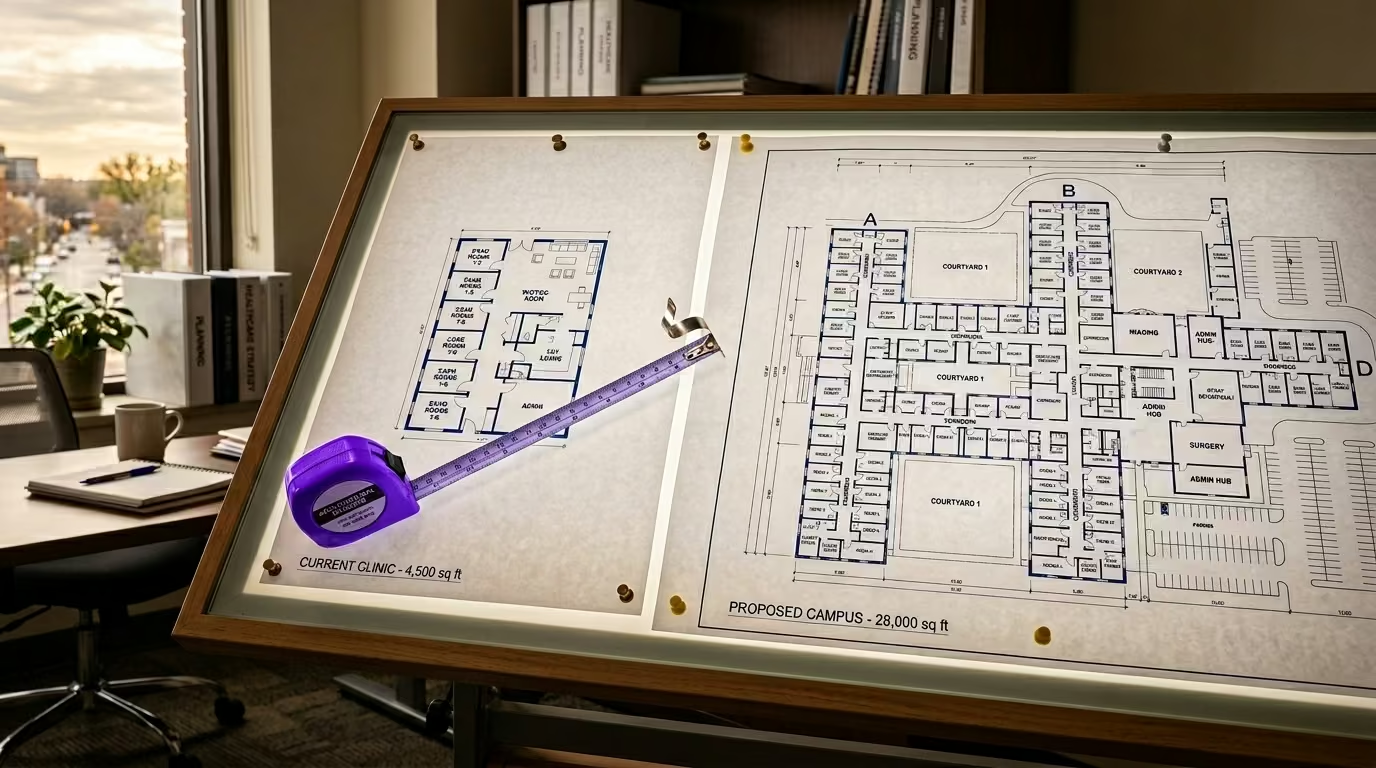
Two mismatched healthcare facility floor plans on drafting table with measuring tape falling short between them

Key Takeaways

  • A structured peer reference process turns conversations into board-ready data your CFO can translate into dollars, replacing the impressions that informal calls produce
  • Matching reference organizations by acuity, bed count, and staffing model matters more than volume. Two calls with the right peers beat five calls with the wrong ones.
  • The CEO who hands the board a one-page comparison matrix with quantified peer outcomes moves safety technology from discussion to decision.

Your board won’t approve a safety technology investment based on “peers liked it.” They need matched organizations, specific outcomes, and documented findings. This executive safety guide gives you a repeatable reference process you can delegate. Every peer conversation produces comparable data instead of reassuring anecdotes.

What Structured References Deliver

Structured references produce specific numbers tied to organizations that match yours. Incident reduction percentages. Response times. Staff retention changes. Implementation timelines compared to vendor promises.

Think of it like checking a contractor’s work on a house similar to yours. A glowing review from someone who renovated a studio apartment tells you little about your four-bedroom project. Behavioral health facilities face a violence profile that makes matched references essential.

Matched references give you:

  • Quantified outcomes you can compare across organizations
  • Implementation realities (timeline accuracy, staff burden, surprises)
  • Accreditation results tied to the technology
  • Honest assessments of what the vendor promised vs. what happened

Preparing Before the Reference Call

Before scheduling a single call, get three things in place.

  1. Matching criteria. Healthcare procurement guidance suggests peer references are most useful when organizations match on bed count, acuity level, and staffing model [1]. For behavioral health, acuity and bed count are the strongest predictors. A 40-bed residential treatment center and a 200-bed psychiatric hospital will have different outcomes with the same technology.
  2. Stakeholder questions. Direct your CFO to submit two or three financial questions (cost accuracy, hidden fees, budget surprises). Ask your CNO for clinical workflow questions (training time, staff adoption). Have your CTO provide technology integration questions (system reliability, deployment workload). Collect these before the first call.
  3. Reference source diversity. ROAR’s customer base spans 350+ behavioral health facilities, which makes finding a matched reference practical. But also source at least one reference through your own peer network.

Roughly four in five workplace violence incidents go unreported [2]. Reference organizations that share actual incident data have better measurement systems. That’s a matching signal worth noting.

Quick verification:

  • Do your reference organizations match on at least three criteria?
  • Have your CFO, CNO, and CTO each submitted specific questions?
  • Do you have at least one reference sourced outside the vendor?

Five Questions That Surface Real Outcomes

Each question targets a different dimension. Together, they produce the data points your board summary needs.

  1. “What specific changes did you see in incident rates, response times, or staff retention after deployment?” This forces numbers. One behavioral health facility reported a 39% drop in violent incidents within three months [3]. That’s the kind of answer a structured question produces.
  2. “How long did deployment take, and what was the actual burden on your clinical and technology teams?” A manager at a reference organization reported no disruption to patient care or additional workload during deployment [3]. If your reference can’t speak to operational burden, that’s a gap worth noting.
  3. “What percentage of your staff actively use the system, and how did you get there?” Nearly two in five healthcare workers have considered leaving over safety concerns [4]. Adoption rates determine whether the investment changes that number.
  4. “Have you been through a Joint Commission or OSHA survey since deployment, and what was the result?” Facilities with automated duress systems have passed 100% of Joint Commission and OSHA inspections with zero citations [3]. Ask for the specific survey outcome.
  5. “If you were starting over, what would you change about the evaluation or implementation process?” This bypasses coached talking points. The answer reveals implementation realities vendors won’t volunteer.

See how one behavioral health provider documented these results across their facilities.

Verification check: Can each question produce a specific, comparable data point rather than a yes-or-no answer?

When References Reveal Red Flags

Three patterns warrant attention.

Red FlagWhat It SignalsYour Response
Vague answersThe organization may not be measuring results, or the technology hasn’t delivered measurable onesRequest an additional reference
Repeated issues across referencesThree references reporting the same timeline overruns or adoption struggles may signal a vendor patternTrack patterns across calls and raise directly with the vendor
Restricted reference accessVendors who resist providing complete client lists may be filtering out problem deployments. ROAR maintains 99% customer retention [3], meaning nearly every customer is available as a referenceAsk for the full client list

Unsolicited advice during reference calls (“get everything in writing,” “budget more time than they estimate”) signals real implementation challenges. Each one warrants a follow-up question.

A behavioral health safety specialist can walk you through what peer organizations are documenting from their reference processes.

Contact Us

Documenting Findings: Your Executive Safety Guide to Board Review

Your board needs a one-page summary they can read in five minutes.

FieldWhat to IncludeExample Entry
Organization ProfileBed count, acuity, payer mix, staffing model60-bed psychiatric hospital, 70% Medicaid, unionized
Implementation TimelineVendor estimate vs. actualPromised 2 weeks, completed in 10 days
Key OutcomesIncident rates, response times, retention93% of incidents resolved in under 2 minutes
ChallengesHonest implementation difficultiesStaff training took one extra day beyond plan
Vendor Support QualityResponsiveness, problem resolutionSame-day response to technical issues

Delegation table: who owns what

TaskOwner
Define matching criteriaCEO reviews and approves
Collect stakeholder questionsCOO or Chief of Staff coordinates
Conduct reference callsCOO or Chief of Staff executes; CEO joins 1-2 peer CEO calls
Interpret red flagsCEO makes judgment calls
Populate board summaryChief of Staff drafts from call notes
Present to boardCEO owns presentation and Q&A

The average cost to replace a bedside RN is $61,110 [5]. When a reference organization reports retention improvements, that number translates peer data into the financial language your board speaks.

Compressed timeline: If your board meeting is less than two weeks away, prioritize matching criteria and the five questions. Conduct a minimum of two calls with organizations matched on acuity and bed count. Two matched references with documented outcomes give your board a defensible interim finding. Present with this framing: “We have preliminary peer data from two matched behavioral health organizations. Full documentation will be complete by [date].”

Archive your reference notes for at least 12 months. They become institutional memory for your next technology evaluation.

Hand this process to your COO or Chief of Staff. Schedule the first reference call this week. Your matching criteria are set, your five questions are ready, and your documentation template is built. Present peer evidence alongside your CFO’s financial analysis. That’s the board meeting where this executive safety guide becomes a decision.

REFERENCE PROCESS

Ready to Start Your Peer Reference Calls?

Get matched with behavioral health organizations similar to yours and hear their documented safety outcomes.

References

  1. School Health Centers. Vendor Reference Checks & Site Visits: Tips for Success. https://www.schoolhealthcenters.org/wp-content/uploads/2011/06/3-Vendor-Reference-Checks-Site-Visits-Tips-for-Success.pdf
  2. AHRQ Patient Safety Network. Addressing Workplace Violence and Creating a Safer Workplace. https://psnet.ahrq.gov/perspective/addressing-workplace-violence-and-creating-safer-workplace
  3. ROAR for Good. Internal Data, 2024.
  4. Verkada. Healthcare Safety Research. https://www.verkada.com/blog/healthcare-safety-research/
  5. Plexsum. The Real Cost of Nurse Turnover: What Hospitals Need to Know in 2025. https://plexsum.com/2025/04/08/the-real-cost-of-nurse-turnover-what-hospitals-need-to-know-in-2025/

16 Staff Duress Solution Questions for Behavioral Health

Healthcare admin corridor with three active office doors and one closed door with piled unopened mail

This FAQ covers the most common questions behavioral health executives ask when evaluating how peer organizations address workplace violence. Whether you are a CEO building a board case, a CNO advocating for nursing safety, a CMO weighing clinical evidence, or a CSO benchmarking your security program, these answers draw from documented peer outcomes and industry data.

What makes behavioral health settings more dangerous than other healthcare environments?

Behavioral health workers face the highest violence rates in healthcare. Psychiatric hospitals report about 110 violent incidents per 10,000 full-time employees, more than five times the rate at nursing facilities. Many patients are admitted specifically because of violent behavior, so prevention alone cannot eliminate risk. Close physical contact with high-acuity, unpredictable patients creates conditions no other care setting matches.

How much does workplace violence cost behavioral health organizations?

U.S. hospitals absorbed an estimated $18.27 billion in violence-related costs in 2023. Reactive costs after an incident run about four times higher than what prevention would have cost. Those dollars show up in workers’ comp claims, agency staffing, legal exposure, and turnover, all hitting the same budget at once.

Why does training alone fail to reduce violent incidents?

Training improves how confident staff feel, but it does not reduce how often violence happens. Studies in psychiatric settings found no meaningful drop in incident rates, even when staff reported feeling better prepared. U.S. hospitals spend an estimated $1.4 billion annually on this training. Training addresses prevention. It does not address what happens when an incident occurs despite that preparation.

What results are peer behavioral health facilities reporting with structured safety programs?

Peer facilities that paired prevention training with response technology are documenting major reductions. One national provider reported a 40% assault reduction within six months of deploying a staff duress solution. Another facility achieved 86% fewer safety events over four months compared to the prior ten months. These organizations renew at a 99% rate across multi-year contracts, which signals the results hold over time.

What metrics should we track from day one of a safety investment?

Peer hospitals track four categories: incident rates, response times, workforce sentiment, and financial impact. The most important step is capturing baselines before deployment begins, because hospitals that skip this step spend months debating whether improvements are real. One peer facility found that 93% of incidents resolved in under two minutes, a metric only visible because they measured response times from day one. Align your CFO and CNO on which metrics matter most before anything goes live.

What does the financial return look like in the first year?

Peer behavioral health hospitals report 200% average first-year ROI. Workers’ comp claim reductions are the most direct proof, with peer facilities documenting 24% to 50% decreases in claims. Each 1% change in nurse turnover saves or costs a hospital about $289,000 annually, so even modest retention gains from improved safety generate six-figure savings.

Why do CEOs hesitate on safety investments even when the data supports them?

The hesitation is about professional identity, not evidence. CEOs fear being the leader who spent resources on something that does not deliver. Peer CEOs describe this as a reputational concern, not an analytical one. Most report that confidence arrived after they committed, triggered by signals like voluntary staff adoption and unsolicited board praise. Defining your own success markers before deciding turns the commitment from a leap of faith into a structured test.

What fear holds CMOs back from championing safety technology?

CMOs worry that staking their clinical credibility on peer outcomes will damage their reputation if results do not hold up locally. This is a professional identity threat, not an evidence gap. Peer CMOs describe their confidence shifting when medical staff began voluntarily using safety devices during early implementation. That moment of organic adoption moved them from cautious evaluation to active sponsorship.

Why do CNOs delay reaching out to peers about safety outcomes?

Many CNOs quietly fear that asking peers about safety will expose how far behind their own program has fallen. That reluctance feels protective, but every week of delay is a week their nurses wait for advocacy only the CNO can provide. Peer CNOs who receive reference calls consistently view the caller as proactive, not behind. A single honest conversation about nursing outcomes produces more internal confidence than months of solo data gathering.

How far ahead are peer organizations on safety adoption?

The field has moved faster than most executives realize. The majority of peer behavioral health organizations have shifted from evaluation into active deployment. Since the July 2024 Joint Commission standards took effect, boards ask about violence prevention with increasing specificity based on documented peer benchmarks. Organizations still debating whether to invest are becoming visible outliers at the board level.

What do Joint Commission standards now require for workplace violence prevention?

Standards effective July 1, 2024 require hospitals to establish formal violence prevention programs, conduct annual worksite risk assessments, and report incidents to governance. The definition of violence expanded to include verbal, nonverbal, written, and physical aggression. Roughly 81% of incidents go unreported, which means most organizations face a significant gap between actual violence and what reaches their board. A documented, measurable safety program is now a compliance obligation, not an optional initiative.

How should I structure peer reference calls to get useful answers?

Match reference organizations by acuity level, bed count, and staffing model first. That single step determines whether the comparison will hold up in a board conversation. Ask about deployment burden, time to measurable outcomes, and whether results persisted beyond year one. A structured reference process with standardized documentation lets you present peer evidence alongside financial data at the board table.

What separates top-performing security programs from average ones?

The gap is about how the program is structured, measured, and reported to leadership. Top-performing security directors track response time, coverage, false alarm rates, and staff adoption, not just incident counts. Staff rate the importance of rapid response at 4.7 out of 5, but satisfaction with current processes averages only 3.5. Programs without a formal benchmarking practice are falling behind peers without realizing it.

How do I get my board to approve a safety investment?

Most safety presentations fail because the structure does not match how directors make fiduciary decisions. Lead with regulatory obligation, then present peer outcomes framed in governance duty language, then make a specific ask. Request a time-limited pilot with clear success metrics rather than full enterprise commitment. Boards approve bounded pilots faster because it aligns with how directors manage risk.

What objections will executives raise, and how do I handle them?

The three most common pushbacks are budget timing, competing priorities, and past technology failures. Budget timing loses force when you show that reactive costs run four times higher than prevention. Competing priorities shift when you connect safety to retention, compliance, and liability in a single brief. Past failures dissolve when you present peer renewal rates above 99% and multi-year outcome data.

How do I build internal consensus across my leadership team?

Each executive needs different evidence. Your CNO owns incident data and staff sentiment. Your CFO owns financial exposure. Your CSO owns response capability. Peer hospitals that aligned their leadership team before deployment reached measurable outcomes faster than those that treated safety as one department’s project.

Staff Duress Solution Comparison: 5 Dimensions That Matter

Three rulers with mismatched markings on desk illustrating violence prevention approach comparison

Key Takeaways

  • Most behavioral health organizations compare staff duress solutions using criteria chosen by vendors, leading to decisions shaped by the last sales presentation rather than organizational priorities
  • Peer organizations that make faster, stronger choices score solutions against fixed dimensions: network independence, deployment burden, behavioral health fit, outcome documentation, and vendor stability
  • A scored comparison matrix gives your board consistent evaluation criteria they can revisit for every future vendor conversation, turning a one-time purchase into a governance standard

Every vendor selling a staff duress solution comparison will show you the dimensions where they win. When each vendor controls the criteria, your evaluation team ends up comparing three different arguments instead of three solutions against one standard. Peer behavioral health CEOs who avoid costly replacements take a different approach: they fix the comparison dimensions first, then score every option against them.

How Peer CEOs Actually Compare Solutions

Most behavioral health organizations lack a consistent method for evaluating duress solutions. The evaluation team collects demos, stacks feature lists, and picks the option that performed best in the last presentation. That process produces a recommendation shaped by recency, not by what your organization actually needs.

One emergency department installed a complex duress alarm system that failed to reduce violence [1]. Staff refused to wear it because of bulky design, poor training, and unreliable security response. The organization evaluated the technology’s capabilities without asking the question that determined success: would frontline staff actually use it?

Behavioral health settings make this gap more consequential. Psychiatric and substance abuse hospitals face the highest violence rates in healthcare [2]. A duress system that staff refuse to wear creates active liability, signaling a safety program exists while leaving staff unprotected.

Vendor presentations do surface useful evaluation dimensions. The risk comes when those vendor-selected dimensions become the only scoring criteria, crowding out what matters most in your environment.

DimensionWhat It Measures
Network ArchitectureWhether the system operates independently of facility WiFi and maintains accuracy during outages
Deployment BurdenTime, technology staff dependency, and care disruption required to install and activate the system
Behavioral Health SpecializationCoverage of BH-specific high-risk areas and wearable design suited to clinical settings
Outcome DocumentationAutomated incident capture and compliance-ready reporting across regulatory categories
Vendor StabilityCustomer retention, behavioral health market commitment, and multi-year track record

Staff Duress Solution Comparison: Scoring Against Peer Benchmarks

Joint Commission workplace violence prevention standards (effective January 2025) require documented evidence across four categories: staff awareness, response capability, reporting effectiveness, and continuous incident trending [3]. Your comparison matrix should score each solution against these requirements.

Important boundary condition: This framework applies to dedicated duress solutions. Organizations evaluating duress as a feature within broader RTLS platforms should add an integration burden dimension to account for the additional complexity those platforms introduce.

DimensionLeading (Score: 3)Adequate (Score: 2)Gap (Score: 1)
Network ArchitectureIndependent infrastructure (dedicated wireless mesh); room-level accuracy; functions during outagesFacility WiFi with backup plan; zone-level accuracyWiFi-dependent; no outage resilience; hallway-level accuracy only
Deployment BurdenDays to deploy; no wiring; zero technology staff dependency; no care disruptionWeeks to deploy; moderate technology coordination; some workflow adjustmentMonths to deploy; extensive wiring; significant care disruption
BH SpecializationDesigned for behavioral health; covers hallways, patient rooms, nurse stations; discreet wearableHealthcare solution with BH adaptations; partial coverage of high-risk areasEnterprise or general solution; coverage gaps in BH-specific locations
Outcome DocumentationAutomatic incident capture; Joint Commission-ready reports; trending across all four JC categoriesPartial automation; manual report generation; trending in some categoriesManual reporting only; no automated compliance documentation
Vendor Stability95%+ customer retention; behavioral health is primary market; multi-year track recordRetention data available; BH is growing segment; stable leadershipRetention data unavailable; BH is secondary market; recent leadership changes

How to read the scores: A solution scoring 13-15 meets peer benchmarks across all dimensions. A solution scoring 9-12 has addressable gaps. Below 9 signals a fundamental mismatch with behavioral health requirements.

Outcome documentation deserves extra weight. An estimated 81% of workplace violence incidents in healthcare go unreported [4]. Solutions that capture incidents automatically close this documentation gap. Facilities with automated duress systems have passed 100% of Joint Commission and OSHA inspections with zero citations [5].

Where Your Current Approach Likely Falls Short

Most organizations discover gaps only after a surveyor visit or a critical incident. These five questions surface them earlier.

  1. Network independence: During your last power or network outage, did your duress system keep working? If the answer is unknown, that gap is confirmed.
  2. Deployment burden: How long did your last safety technology deployment take? Did it require technology staff to reroute other projects?
  3. Behavioral health fit: Was your duress solution designed for behavioral health, or adapted from another setting? Hallways account for 42% of behavioral health duress alerts [6]. Your comparison should verify coverage matches these patterns.
  4. Outcome documentation: Can you produce a 90-day incident trend report for a surveyor within 30 minutes? If the answer requires calling three departments, the documentation dimension is a gap.
  5. Vendor stability: What is your vendor’s customer retention rate? How many behavioral health facilities do they serve?

Staff rate the importance of rapid response at 4.7 out of 5, but satisfaction with current processes averages only 3.5 [7]. That gap shows where frontline trust begins to erode.

Nearly two in five healthcare workers have considered leaving their positions over safety concerns [8]. At one facility with an automated duress system, the share of staff considering leaving over safety dropped from 22% to 7% after deployment [5].

Two or more gaps in your honest answers likely place your current approach below peer benchmarks. These gaps are common, and most organizations start here.

See how one behavioral health provider documented these results across their facilities.

Prioritizing Gaps for Board Discussion

When a board director asks how you evaluated your duress solution, the answer needs to sound like governance, not a vendor recommendation.

GapPriority Rationale
Network IndependenceHighest failure risk; a system that goes dark during a crisis leaves staff with false confidence and no protection
Outcome DocumentationRegulatory requirement; industry estimates suggest Joint Commission accreditation loss risks Medicare and Medicaid funding worth $2 to $5 million annually [9]
Behavioral Health SpecializationMission alignment; a solution designed for your environment performs differently than one adapted for it
Deployment BurdenOrganizational capacity; a solution your team can’t absorb won’t get adopted
Vendor StabilityLong-term viability; 99%+ customer retention signals that organizations stay after deployment [5]

Present this framework to your board as a standing evaluation tool. Use it to score your current vendor, benchmark new options, and document why you chose the solution you chose. The framework becomes the standard your organization uses every time a safety technology decision reaches the board.

Your Evidence Assessment Checklist

Before presenting your staff duress solution comparison to the board, verify you can answer each of these:

  • You scored every solution against the same fixed dimensions, not against each vendor’s preferred criteria
  • Your scoring matrix includes documented peer benchmarks, not just vendor claims
  • You matched each dimension to a Joint Commission evidence category
  • You identified your organization’s highest-priority gap and can explain why it ranks first
  • You have at least one peer reference from a comparable behavioral health facility
  • Your comparison document is formatted for board governance, not for an operational meeting

The staff duress solution comparison framework gives behavioral health CEOs something most lack: evaluation criteria that belong to the organization. When the next board question comes, the answer is a scored matrix built on peer benchmarks.

SAFETY EVALUATION

Ready to Score Your Safety Program?

Use peer benchmarks to evaluate your current duress solution against the dimensions that matter in behavioral health.

References

  1. Morphet, J., et al. (2023). Implementation of a personal duress alarm system in emergency departments. Journal of Advanced Nursing. https://pubmed.ncbi.nlm.nih.gov/37150562/
  2. Sheps Center for Health Services Research. (2025). Workplace Violence in Healthcare Brief. https://www.shepscenter.unc.edu/wp-content/uploads/2025/01/Y10.01_Brief-1.pdf
  3. Joint Commission. (2024). Workplace Violence Prevention Standards, effective January 2025. https://www.jointcommission.org/en-us/knowledge-library/newsletters/joint-commission-online/17-jul-24
  4. Agency for Healthcare Research and Quality. Addressing Workplace Violence and Creating a Safer Workplace. https://psnet.ahrq.gov/perspective/addressing-workplace-violence-and-creating-safer-workplace
  5. ROAR for Good. (2024). Internal deployment and customer outcome data.
  6. Campus Safety Magazine. (2025). Healthcare Duress Alert Trends and RTLS Technology Comparison. https://www.campussafetymagazine.com/insights/5-healthcare-duress-alert-trends-from-2025/177012/
  7. ROAR for Good / UHS. (2024). Internal staff survey data.
  8. Verkada. (2024). Healthcare Safety Research. https://www.verkada.com/blog/healthcare-safety-research/
  9. Facilio. (2024). Healthcare Joint Commission Compliance. https://facilio.ae/blog/healthcare-joint-commission-compliance/

Safety Board Presentation: A 3-Question Pitch Framework

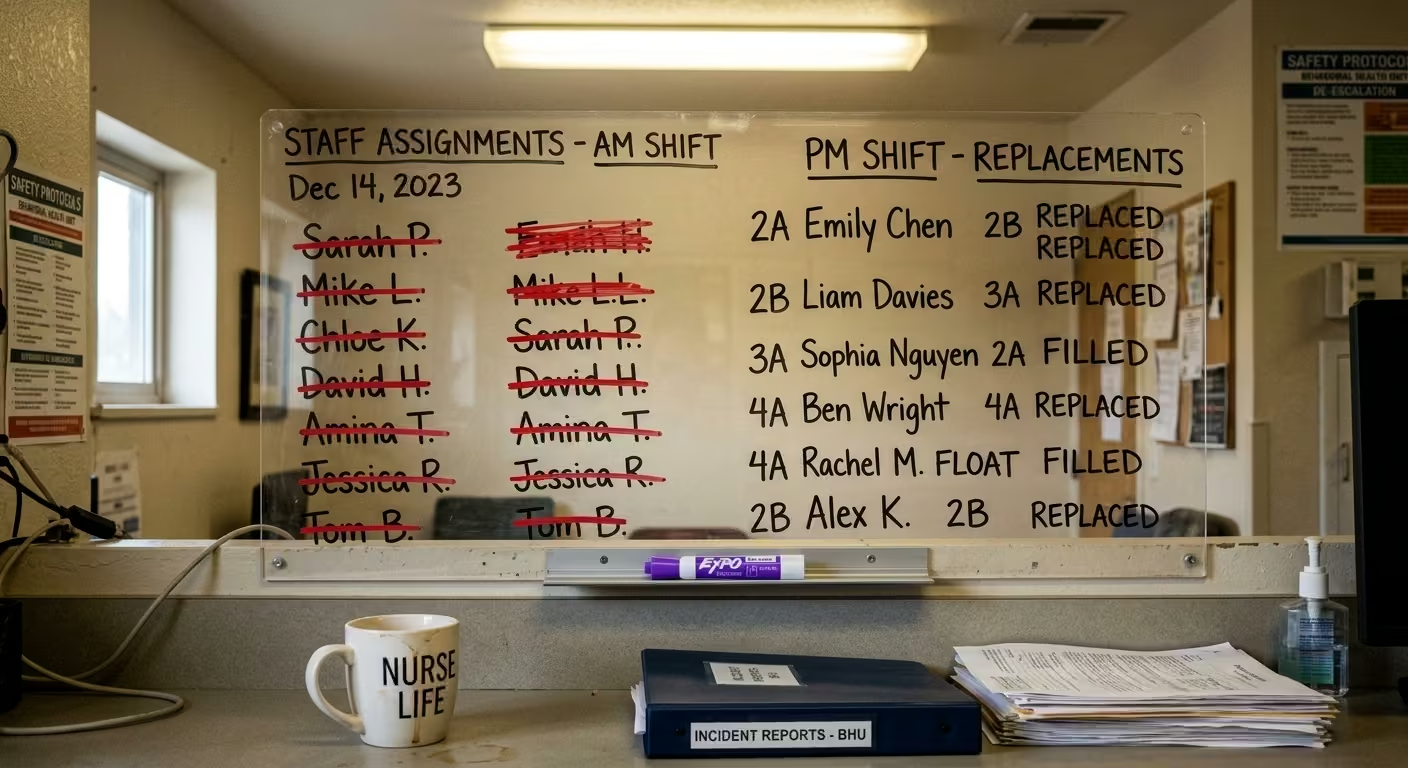
Board presentation folder with crossed-out dates on healthcare desk, staffing board gaps visible behind

Key Takeaways

  • Board conversations about safety spending follow three predictable questions, and preparing concise, evidence-backed answers for each one puts you in control of the room.
  • Every percentage point of nursing turnover your organization avoids translates directly to avoided cost, turning a safety conversation into a workforce economics proposal.
  • A phased pilot with three defined checkpoints converts board anxiety into a testable commitment they can approve in a single meeting.

You’ve had the incident data for quarters. Your CNO made the request. Your CFO keeps flagging agency costs that climb every cycle. What you don’t have is the safety board presentation that gets a governance committee to say yes in one meeting. The gap between your conviction and their approval is a packaging problem, and it closes when you stop framing this as a safety expense and start framing it as a workforce economics proposal with a defined test period.

The Board Meeting You Keep Postponing

Behavioral health facilities face violence rates roughly 14 times higher than most other industries [1]. States keep expanding behavioral health infrastructure, and organizations that lose experienced nurses will lose ground to those that keep them. But knowing the problem never built the presentation. So the safety line item gets bumped behind capital projects with tighter narratives. Safety should be a promise, not just a priority. Your board needs to see it as one.

Three Questions Every Safety Board Presentation Must Answer

Directors evaluate safety spending the same way they evaluate any capital request: financial discipline, peer comparison, accountability. Prepare for three questions, and you control the room.

#QuestionBoard-Ready Answer
1“What’s the financial return?”Each percentage point of nursing turnover your organization avoids saves roughly $289,000 a year [2]. Ask your CFO to pull your current turnover rate before the meeting. The math writes itself.
2“Does this actually work?”At a peer behavioral health organization, the share of staff considering leaving over safety dropped from 22% to 7% within 90 days of deploying a nurse duress system [3]. That gives your board a workforce stability metric they can track against your own baseline.
3“What’s our exposure if we don’t act?”The American Hospital Association identifies behavioral health access as a board-level governance responsibility. When experienced nurses leave because they feel unsafe, the board loses the capacity to fulfill its mission. Nurses facing high violence exposure are 5x more likely to plan to leave [4].

Workforce Data That Survives Scrutiny

Your board will scrutinize sources. They’ll challenge any number that looks like a vendor claim. Give them data points they can verify independently.

Data PointAmountSource
Cost to replace one bedside RN (2024)$61,110NSI National Healthcare Retention Report [2]
Workers’ comp claim reduction at peer organizations24%-50%Peer behavioral health deployment outcomes [3]

Behavioral health nurses require specialized training that extends vacancy periods and raises onboarding costs beyond general acute care roles. Every departure your organization prevents avoids both the replacement cost and the agency premium that fills the gap. Those numbers land differently when your board sees them next to the safety investment that prevents the vacancy in the first place.

See how one behavioral health provider documented these outcomes across their facilities.

Objections Your Board Members Will Raise

“Why can’t we just improve our de-escalation training?” U.S. hospitals already spend $1.4 billion annually on violence prevention training [2]. De-escalation training builds knowledge and confidence, but research hasn’t shown it consistently reduces actual assault rates [5]. Training teaches staff what to do. A duress response system determines how fast help arrives when training isn’t enough. Organizations that added duress response infrastructure saw staff preparedness jump from 38% to 76% [3]. That’s the gap your board should be evaluating.

“What are other organizations our size doing?” Peer behavioral health systems that deployed duress technology are staying with it because the outcomes persist. Staff perception of safety drives retention independently of how often violence actually occurs [4]. No one should face violence while trying to help others heal. Your peer organizations reached that conclusion and acted on it.

Need help tailoring the pilot proposal and financial framing for your board? A behavioral health safety specialist can walk through it with you.

Contact Us

The Safety Board Presentation Ask That Works in Sixty Seconds

Request a 90-day pilot on your highest-acuity unit with three checkpoints the board will review:

  1. Day 30: Staff safety perception survey (baseline already exists in most organizations)
  2. Day 60: Response time data from the pilot unit
  3. Day 90: Intent-to-leave comparison against pre-pilot baseline

Frame this as a testable hypothesis. If the pilot unit shows measurable improvement, the board evaluates expansion. If it doesn’t, the commitment ends. Early signals tend to appear fast, within the pilot window your board will review.

You now have the three answers, the objection responses, and the sixty-second ask. The safety board presentation you’ve been postponing has a script. The next governance meeting is the right one to use it.

BOARD-READY DATA

Ready to Build Your Board Case?

You have the script. A behavioral health safety specialist can help you tailor the pilot proposal, the financial framing, and the checkpoint structure to your board's expectations.

References

  1. Sheps Center, University of North Carolina. Workplace Violence in Healthcare, 2021-2022. https://www.shepscenter.unc.edu/wp-content/uploads/2025/01/Y10.01_Brief-1.pdf
  2. NSI Nursing Solutions. 2024 National Health Care Retention & RN Staffing Report. https://www.nsinursingsolutions.com/documents/library/nsi_national_health_care_retention_report.pdf
  3. ROAR for Good. Internal deployment data, 2024.
  4. Staff safety perception and retention in psychiatric wards. https://pmc.ncbi.nlm.nih.gov/articles/PMC12715384/
  5. Systematic review of de-escalation training outcomes in psychiatric settings. https://pmc.ncbi.nlm.nih.gov/articles/PMC12542813/

Peer CEO Safety Insights: Behavioral Health Adoption

Nurse turnover cost shown through vacant behavioral health workstation with accumulated mail and purple inbox tray

Key Takeaways

  • The behavioral health field has split into three adoption tiers for nurse duress infrastructure, and most CEOs can’t tell their board which tier their organization occupies
  • Early movers are already presenting measurable workforce stability gains to their boards, creating a competitive distance that grows every quarter
  • Three indicators reveal where your organization stands relative to peers: documented response protocols, silent alerting capability, and whether your board has received a formal safety investment briefing

If you polled ten behavioral health CEOs on where their organization stands on nurse duress adoption, most would guess. The field has moved further than it looks from where you sit. Roughly a third of behavioral health organizations have already deployed. Another third is in active evaluation. The rest are still discussing. These peer CEO safety insights matter because the competitive distance between those groups grows every quarter. The financial exposure behind that distance is bigger than most CEOs realize.

The Adoption Curve Most CEOs Can’t See

Psychiatric and substance abuse hospitals report 110.4 violent incidents per 10,000 workers, the highest rate of any healthcare setting [1]. That number explains why the adoption curve has accelerated. Based on available data, behavioral health organizations generally fall into three groups:

TierCharacteristics
Early MoversDeployed duress infrastructure 12+ months ago; reporting workforce outcomes to boards; using safety data in recruitment
Active EvaluatorsIn formal evaluation or pilot phase; triggered by regulatory shifts or board questions; 6-12 months from a deployment decision
Discussion PhaseAware of the issue but no formal evaluation underway; relying on training-only approaches; falling further behind each quarter

Note: These tiers are constructed from deployment data, regulatory timelines, and retention benchmarking. No single published survey tracks adoption rates across the full field.

“If you polled ten behavioral health CEOs on where their organization stands on nurse duress adoption, most would guess.”

That’s part of the problem. Most CEOs lack visibility into where peers actually stand.

What Triggered Peers to Act

Early movers responded to a pattern of converging pressures arriving in the same quarter:

  1. Regulatory momentum. ANA, ENA, and ACEP jointly called on Congress to pass workplace violence prevention legislation, signaling that professional organizations now treat violence as a workforce sustainability crisis [2]. States are following with panic button mandates and compliance deadlines.
  2. Financial exposure from accreditation risk. Joint Commission accreditation loss risks suspension of Medicare and Medicaid funding worth $2 to $5 million annually [3]. That number gets a board’s attention faster than incident reports.
  3. Workforce data. Across 116,345 nurses from 67 hospitals, those experiencing high workplace violence were five times more likely to leave their positions [4]. Peer CEOs recognized that violence was the single largest controllable driver of nursing turnover.

When all three pressures landed in the same quarter, discussion became deployment. The three organizational conditions that predict success are what separated the ones that succeeded from the ones that stalled.

Workforce Outcomes Early Movers Report

The organizations that moved first are now 12 to 18 months into documenting results. At one behavioral health facility that deployed purpose-built duress infrastructure, the share of employees considering leaving due to safety concerns dropped from 22% to 7% within 90 days. Staff assaults fell 40% within six months [5].

Each percentage point of RN turnover costs the average hospital an additional $289,000 per year [6]. A shift of 15 points in intent-to-leave translates into retention savings your CFO can validate against your own staffing data. The executive safety guide walks through how to direct your team to quantify that number.

If your organization hasn’t seen numbers like these yet, that’s common across the field. The difference is timing, not capability. See how one provider achieved these results.

Where Waiting Organizations Lose Ground

The peer organizations that deployed are pulling ahead on three fronts simultaneously. Think of it like compound interest working in reverse: the longer you wait, the more it costs across every line item.

  • Recruitment takes longer. The average time to fill a registered nurse vacancy is 83 days [6]. Every nurse who leaves over safety concerns creates a gap that takes nearly three months to close. When competitors deploy visible safety infrastructure, candidates notice.
  • Agency costs keep climbing. Travel nurses cost roughly 70% more per hour than staff nurses [6]. Peer organizations that acted are shrinking this line item. Organizations that haven’t are still paying the premium.
  • Accreditation readiness weakens. Joint Commission standards now emphasize organizational accountability for violence prevention. Surveyors assess whether you’ve identified violence hazards and put evidence-based strategies in place. Without documented infrastructure, your next survey conversation gets harder.

Early movers gain workforce stability, which reduces agency spend, which strengthens accreditation readiness. Each quarter of delay reverses that sequence. Your CFO will want a plan for translating early deployment signals into board-ready proof before lagging metrics confirm the return.

Talk to us about where your organization sits on the adoption curve and what the next step looks like.

Contact Us

Peer CEO Safety Insights: Locating Your Organization

Three indicators reveal where your organization sits relative to peers. The pattern across leading facilities is that they answered these questions before they deployed.

IndicatorWhat “Yes” MeansWhat “No” Means
Your organization has a documented duress response protocol beyond de-escalation trainingYou have a foundation in place. You’re likely an Active Evaluator or Early Mover.You’re in the Discussion Phase. Peer organizations that deployed started here.
Frontline staff can silently summon help from every area of every facility, including stairwells and units with poor WiFiYou have technology infrastructure deployed. You’re likely an Early Mover.You’re relying on verbal calls or overhead pages, the approach peer organizations are replacing.
Your board received a formal staff safety investment briefing in the past 12 monthsYour board is engaged and expects updates. You’re positioned to move forward.Your board may not know this is a strategic issue. Early movers report that board engagement accelerated everything else.

Organizations like yours are choosing to assess where they stand now, while the adoption curve is still moving. The ones reporting the strongest outcomes started with the same three questions above. They answered honestly, identified their tier, and directed their executive teams to close the distance. A three-question pitch framework structures that board conversation into the format governance committees approve.

You now have the map most behavioral health CEOs don’t. You know where the field has moved, what pushed early movers to act, and what they’re reporting to their boards. Most peer organizations that moved started with one honest conversation at the board level. That’s how it tends to begin.

PEER INSIGHTS

Know Where You Stand Before the Field Moves On

Most organizations that reported the strongest workforce outcomes started with one honest assessment of their current tier. We help leadership teams map where they are and build a path forward that fits their board's timeline.

References

  1. UNC Sheps Center for Health Services Research. Workplace Violence in Healthcare Brief, 2025. https://www.shepscenter.unc.edu/wp-content/uploads/2025/01/Y10.01_Brief-1.pdf
  2. American Nurses Association, Emergency Nurses Association, and American College of Emergency Physicians. ANA, ENA & ACEP Sound the Alarm on Violence Against Nurses, 2024. https://www.nursingworld.org/news/news-releases/2024/ana-ena–acep-sound-the-alarm-on-violence-against-nurses/
  3. Facilio. Healthcare Joint Commission Compliance. https://facilio.ae/blog/healthcare-joint-commission-compliance/
  4. PMC. Workplace Violence and Nurse Turnover Intent, 2024. https://pmc.ncbi.nlm.nih.gov/articles/PMC12811911/
  5. ROAR for Good. Internal Data, 2024.
  6. NSI Nursing Solutions. 2025 National Health Care Retention & RN Staffing Report. https://www.nsinursingsolutions.com/documents/library/nsi_national_health_care_retention_report.pdf

Safety Investment Confidence: 3 Conditions for Success

Behavioral health staffing board showing nurse turnover reversal with names rewritten after safety investment

Key Takeaways

  • Nearly 45% of nurses say their employers ignore reported violence, and that trust gap determines whether a safety investment succeeds or stalls before it starts
  • Behavioral health safety initiatives fail for three predictable organizational reasons, not technical ones, which means you can evaluate your risk before you spend a dollar
  • A national behavioral health provider cut staff assaults 40% in six months because the organizational conditions were right, not because the technology was special

You know the violence numbers. You’ve seen the turnover reports. You’ve heard your CNO ask for a nurse duress system three times this year. Each time, you asked for more data. But here’s what you haven’t said out loud in any board meeting: what if you spend the money, champion the initiative, and six months later staff aren’t wearing the badges?

That fear of visible failure keeps more behavioral health CEOs frozen than any budget constraint. Building real safety investment confidence starts with understanding why that fear, while rational, doesn’t have to be paralyzing.

The Fear Nobody Puts on Slides

You don’t doubt the data. Sixty percent of nurses have changed jobs, left, or considered leaving because of workplace violence [1]. You’ve seen versions of that number in every industry report for the past three years.

You know the problem is real. That was never the question.

The question is whether your organization can actually solve it. You’ve watched technology rollouts underperform before. Quiet disappointments that consumed budget, exhausted goodwill, and made the next initiative harder to approve. Now when someone says “this will work,” you hear “this might not.”

Your CNO advocates. Your CFO asks for proof. You sit between them, carrying a weight neither fully shares: act and fail, the board remembers your judgment. Don’t act and something happens, the board remembers your inaction. Both paths feel dangerous. So you wait. Meanwhile, the financial exposure keeps compounding.

Why Some Safety Investments Stall

Your hesitation is grounded in reality. By some estimates, seven out of ten healthcare technology rollouts fail to meet their goals [2].

But the failures aren’t random. They follow a pattern you can recognize.

“That fear of visible failure keeps more behavioral health CEOs frozen than any budget constraint.”

A duress alarm rollout in a US emergency department stalled completely [3]. The technology worked perfectly. Staff stopped wearing the badges within weeks. Nobody on the frontline had been asked about the design. Training was inadequate. When alarms fired, security response was slow and inconsistent. Staff pressed the button, got unreliable help, and stopped pressing it.

Nearly 45% of nurses say their employers simply ignore workplace violence after it’s reported [1]. When staff already believe leadership won’t respond, handing them a panic button confirms that belief.

Failed initiatives share three gaps:

  • Staff don’t trust that leadership will act
  • No response protocol exists before go-live
  • Frontline workers weren’t involved in the design

Each gap is visible before you spend a dollar. A three-question pitch framework helps you package the case once you’ve closed them.

Three Conditions That Predict Success

If the failure pattern is predictable, so is the success pattern. Three conditions appeared consistently across organizations that made safety technology work.

1. Visible executive sponsorship. Staff need to see you personally back this initiative, beyond a budget line or a memo. Your frontline has been burned before. The signal that this time is different comes from you.

2. Frontline involvement before go-live. The duress alarm failure happened because nobody asked staff what they needed [3]. Charge nurses and direct-care staff shape the rollout, not just attend a training session after decisions are already made. This is where trust rebuilds.

3. A defined response protocol. The single biggest adoption killer is pressing the button and getting nothing. Organizations that define who responds, how fast, and what happens next before the system goes live see rapid adoption. Without that protocol, the first failed response kills trust faster than any technology can rebuild it.

You can evaluate all three against your own organization today. Peer CEOs who’ve already made this evaluation share what triggered them to move from discussion to deployment.

Talk to us about how these conditions apply to your facility.

Contact Us

What Peer CEOs Learned After Acting

A national behavioral health provider made the same calculation you’re making. They had the same fear. They checked the same conditions. Then they acted.

They didn’t wait for certainty. They prepared the organization first, got honest about where the gaps were, and launched with the three conditions in place. Six months later, the quarterly report told a different story than the one they’d feared.

The results came within six months:

What They DidWhat Happened
Met all three conditions40% reduction in assaults against staff [4]
Same conditionsIntent-to-leave dropped from 22% to 7% [4]
Same conditionsStaff preparedness jumped from 38% to 76% [4]

These outcomes aren’t outliers. Across published studies, safety measures in healthcare produce an 18% to 66% reduction in violent incidents when properly implemented [5]. The organizations that land in that range share the three conditions above. The ones that don’t generate the 70% failure statistic.

Those peer CEOs started exactly where you are now. The difference wasn’t courage or budget. It was preparation. The turnover cost framework they used to quantify the cascade started with their leadership team. See how one behavioral health provider achieved a 40% reduction in staff assaults within six months.

No one should face violence while trying to help others heal. The question was never whether your people deserve protection. It was whether you could deliver it without risking your credibility. Now you know what separates success from failure. The only question left is whether your organization is ready today.

A Readiness Check You Own

You don’t need a consultant. You need honest answers to three questions [6].

1. Can your frontline staff name one specific action you’ve taken on safety in the last 90 days?

If not, your sponsorship isn’t visible enough yet.

2. Have you asked charge nurses and direct-care staff what they need from a safety system?

If not, you’re designing for the same adoption failure the research predicts.

3. If someone pressed a panic button right now, does every person in the response chain know what to do?

If not, the first failed response will kill adoption before the system has a chance.

If you can answer yes to all three, your organization is ready. If you can’t, you know exactly what to fix before you invest. Your CNO can tell you what safety confidence looks like on the units where it’s working. Either way, you’ve replaced the fear of an unknowable gamble with something concrete. Safety investment confidence was never about certainty that nothing would go wrong. It was about knowing you’d built the conditions where things go right.

READY FOR ANYTHING

Turn Your Readiness Assessment Into a Plan

If you answered yes to all three questions, your organization has the conditions that predict success. Talk to a safety specialist who can walk through what peer CEOs wish they had known before they started.

References

  1. National Nurses United (NNU) – Workplace Violence Report, 2024. https://www.nationalnursesunited.org/sites/default/files/nnu/documents/0224_Workplace_Violence_Report.pdf
  2. EHR in Practice – EHR Failure Statistics. https://www.ehrinpractice.com/ehr-failure-statistics.html
  3. PubMed – Staff Duress Alarms Study (US), 2023. https://pubmed.ncbi.nlm.nih.gov/37150562/
  4. ROAR for Good – Internal Data, 2024. Internal data
  5. PMC – Trends in Workplace Violence. https://pmc.ncbi.nlm.nih.gov/articles/PMC11630250/
  6. PMC – Consolidated Framework for Implementation Research (CFIR). https://pmc.ncbi.nlm.nih.gov/articles/PMC12357348/

Executive Safety Guide: Turnover Cost Framework

Kitchen table at dawn with scrubs and badge on one side and resignation letter on the other

Key Takeaways

  • Behavioral health RN replacement costs $68,740 per departure, and the cascade effect converts each loss into roughly four departures within 12 months
  • Sixty percent of nurses have changed, left, or considered leaving due to workplace violence, making safety infrastructure the most controllable lever against turnover
  • Healthcare boards approve safety investments when five criteria are met, and peer organizations report a median 5.2 percentage point first-year turnover improvement

Your board chair calls the evening before the quarterly meeting. She’s seen the agency staffing variance and wants to understand why turnover keeps outpacing every projection you build.

You have the number. What you may not have is the framework that connects it to a controllable cause. This executive safety guide walks through how to direct your team to quantify the full exposure, isolate the violence-driven share, and package the business case your board needs. The full financial picture of nurse duress and turnover anchors every number in this framework.

Before you begin: Initial cost analysis takes 2-4 weeks. Full business case development takes 1-2 months. If your board presentation is needed within 30 days, skip to the compressed timeline at the end of Section 2.

Who You NeedWhat They Provide
CFOFinancial analysis and per-percentage-point calculation
CNOOperational context and unit-level incident data
CSOSafety assessment and current response times
CHROTurnover data and exit interview analysis

What Your Team Needs to Quantify

The general healthcare RN replacement average is $61,110 [1]. In behavioral health, the figure is $68,740, driven by extended orientation, specialized training, and a thinner candidate pool [2].

That per-departure cost is the starting point. Not the full picture. One resignation triggers a cascade that averages four departures, turning $68,740 into roughly $275,000 in total cost [3][4]. At a 28.3% facility turnover rate [2], the cascade isn’t a worst-case scenario. It’s the baseline.

Here’s what makes this a CEO problem rather than an HR problem: 44% of behavioral health hospitals now report turning away patients due to staffing limitations [5]. The cascade eventually reaches admissions, revenue, and mission delivery. Your CFO will need a plan for translating early deployment signals into board-ready dollar figures before lagging metrics confirm the return.

Direct your CFO to calculate the per-percentage-point value of turnover at your facility. Each 1% reduction saves approximately $289,000 annually [2]. That single number reframes every safety investment conversation from expense to return. The five-category turnover cost framework gives your CFO the methodology to build that number from your facility’s own data.

The Violence-Driven Share

Most of your turnover budget treats departures as interchangeable. They’re not. The portion driven by violence is different from departures driven by pay, relocation, or career moves. It’s also the portion most within your control.

The violence-departure pattern in behavioral health:

  • 60% of nurses have changed, left, or considered leaving due to workplace violence [6]
  • Among first-year behavioral health RN leavers, 31% cite violence or safety as their primary reason [2]
  • 64% of nurses who leave after a violence incident depart within 90 days [7]
  • 81% of incidents go unreported [8], which means your incident data is mostly blank and your turnover projections will keep missing

No one should face violence while trying to help others heal. The nurses who leave first after a violent incident tend to be mid-career staff with 5-8 years of experience. They’re the ones newer nurses rely on during escalations. When they go, the unit loses the informal safety net that kept other staff feeling protected.

What to direct your team to do:

  • CHRO: Pull exit interviews from the past 24 months. Tag every departure where safety, violence, or “work environment” appeared as a contributing factor.
  • CSO: Document current violence incident rates by unit and compare against the 110.4 per 10,000 benchmark for psychiatric settings [9].
  • Overlay both data sets. That overlay reveals the violence-driven share your board has never seen. Your CHRO has three specific methods for isolating violence-driven turnover that make this overlay defensible.

Compressed timeline: If your board presentation is needed within 30 days, focus on three elements: the per-percentage-point calculation from your CFO, the peer benchmark of 5.2 percentage point median improvement across 47 behavioral health systems [10], and the Joint Commission workplace violence prevention standards effective July 2024 [11]. Full cost analysis can follow board approval.

Talk to us about building your board-ready business case for safety investment.

Contact Us

Packaging the Board Presentation

Healthcare boards approve safety technology investments when five criteria are met [12]. Your business case must address each one.

Board CriterionWhat to PresentWho Owns It
Regulatory compliance riskJoint Commission standards effective July 2024 [11]; state-level violence prevention mandatesCompliance officer
CFO-validated ROIPer-percentage-point calculation using your facility dataCFO
Peer data47 BH systems, 5.2 percentage point median improvement [10]You (synthesized)
Action timeline90-day leading indicators, 6-month stabilization, 12-month full financial impactCNO and CSO
Vendor stabilityCustomer retention rates, documented deployment resultsCFO (due diligence)

Your CFO validates the ROI model. Your CNO provides the operational context. Your compliance officer maps the regulatory exposure. You synthesize and present.

Numbers open the door. Operational specificity closes it. A three-question pitch framework structures those numbers into the format governance committees approve. Your strongest asset in the room will be your CNO describing what’s actually happening on your units right now.

Organizations that addressed the violence-turnover connection have documented the shift. One behavioral health facility recorded intent-to-leave dropping from 22% to 7% and a 39% reduction in violent incidents within the first quarter [13][14]. See how one provider achieved these results.

Before Your Board Meeting

Make sure your team can answer these:

  • Has your CFO calculated the per-percentage-point turnover cost using your actual RN FTE count and departure data?
  • Has your CHRO tagged violence-related departures as a separate category in exit data from the past 24 months?
  • Can your CSO document current response times and incident rates by unit?
  • Has your compliance officer mapped current programs against Joint Commission standards effective July 2024?

Your board chair called because the projections missed again. With your team’s data assembled and the violence-turnover connection quantified, you can walk into the quarterly meeting with a different answer. Not another explanation for why turnover outpaced the model. A business case built on controllable risk, peer-validated outcomes, and a number your CFO already approved. Peer CEOs who’ve already made this move share what triggered them to act.

BOARD READY

Walk Into Your Next Board Meeting With a Different Answer

The framework described here turns uncontrollable turnover into a quantifiable, addressable cost your board can act on. A behavioral health safety specialist can walk you through what peer organizations presented to their boards.

References

  1. Plexsum. The Real Cost of Nurse Turnover, 2025. https://plexsum.com/2025/04/08/the-real-cost-of-nurse-turnover-what-hospitals-need-to-know-in-2025/
  2. NSI Nursing Solutions. 2025 National Health Care Retention & RN Staffing Report. https://www.nsinursingsolutions.com/documents/library/nsi_national_health_care_retention_report.pdf
  3. Journal of Nursing Administration. Workplace Violence and Cascade Turnover in Psychiatric Units, 2025. https://journals.lww.com/jonajournal
  4. NSI / Becker’s Hospital Review. Turnover Cascade Analysis, 2025. https://www.beckershospitalreview.com
  5. National Council for Mental Wellbeing, 2024. https://www.thenationalcouncil.org
  6. National Nurses United. Workplace Violence Report, 2024. https://www.nationalnursesunited.org/sites/default/files/nnu/documents/0224_Workplace_Violence_Report.pdf
  7. Press Ganey. Safety Culture in Behavioral Health, 2025. https://www.pressganey.com/solutions/safety-culture
  8. AHRQ PSNet. Addressing Workplace Violence, 2023. https://psnet.ahrq.gov/perspective/addressing-workplace-violence-and-creating-safer-workplace
  9. Sheps Center, UNC. Workplace Violence in Healthcare Brief. https://www.shepscenter.unc.edu/wp-content/uploads/2025/01/Y10.01_Brief-1.pdf
  10. NSI Nursing Solutions. Benchmarking Analysis (Behavioral Health Partnership), 2025. https://www.nsisolutions.com/healthcare-turnover-benchmarks
  11. Joint Commission. Workplace Violence Prevention Standards, 2024. https://www.jointcommission.org/standards
  12. Advisory Board. Safety Technology Investment Decision Framework, 2024. https://www.advisoryboard.com
  13. ROAR for Good. Internal Data, 2024. Internal data
  14. ISMIE Mutual Holdings. Cost of Violence in the Healthcare Workplace. https://www.ismie.com/news/cost-of-violence-healthcare-workplace/

Staff Duress Solution for Behavioral Health | 2026

Four institutional clocks with one cracked showing measurement gap peers have fixed

Key Takeaways

  • Violence in behavioral health is five times worse than any other care setting, making prevention a board-level strategic priority.
  • Training alone improves staff confidence but does not reduce incidents. Peer facilities pairing prevention with structured response technology report significant assault reductions within the first year.
  • The hospitals seeing the strongest results track four metric categories from day one and use that data to build the board case for enterprise-wide expansion.

Your board chair asks what peer facilities are doing about workplace violence. Your CNO is requesting more resources. Your CFO is flagging a workers’ comp trend that keeps climbing. You need an answer that satisfies all three, and you need it backed by evidence, not assumptions.

Behavioral health settings face the highest workplace violence rates in healthcare. The facilities leading the industry have stopped treating violence as inevitable. They’ve put a structured staff duress solution in place, documented the outcomes, and built the evidence that makes inaction indefensible.

The Violence Crisis in Behavioral Health

Workers at psychiatric and substance abuse hospitals experience about 110.4 violent incidents per 10,000 full-time employees, more than five times the rate at nursing facilities and higher than any other care setting. [1]

The financial cost is just as severe. U.S. hospitals absorbed an estimated $18.27 billion in costs tied to workplace violence in 2023. [2] Costs after an incident run about four times higher than what prevention would have cost. [3] For a CEO building a board presentation, that ratio reframes the conversation: every dollar not spent on prevention generates four dollars in reactive costs.

The workforce consequences compound from there:

  • Nurses experiencing high levels of workplace violence are 5.11 times more likely to report intention to leave [4]
  • 60% of nurses have changed jobs, left their job, or considered leaving because of workplace violence [5]

No one should face violence while trying to help others heal. Yet that is exactly what is happening, shift after shift.

Regulatory pressure has intensified at the same time. The Joint Commission’s workplace violence prevention standards, effective July 1, 2024, require hospitals to establish formal programs, conduct annual worksite risk assessments, and report incidents to governance. [6] The expanded definition now includes verbal, nonverbal, written, and physical aggression.

“Staff don’t typically cite a single incident as the reason they leave. They cite the feeling that leadership isn’t taking the problem seriously.”

The convergence is clear: the highest violence rates in healthcare, billions in annual costs, a workforce crisis driven by safety failures, and rules that now mandate documented action.

Why Training Alone Falls Short

U.S. hospitals spend an estimated $1.4 billion annually on violence prevention training. [3] The outcomes tell a different story than the investment suggests.

De-escalation training on forensic psychiatric wards showed no relevant impact on violent incident rates, despite improving staff perceptions of safety and confidence. [7] A broader review confirmed the pattern: training programs improved confidence in dealing with violence, but evidence for actual incident reduction remains limited. [8]

Staff feel better prepared. Incident rates don’t change.

That gap is especially significant in behavioral health, where many psychiatric inpatients are admitted specifically because of violent behavior. [9] The National Association for Behavioral Healthcare has stated that “despite substantial protections and violence prevention measures, violent events may still occur” and that “not all risk can be eliminated proactively.” [9]

“Training addresses prevention. It does not address response.”

Training addresses prevention. It does not address response. When an incident occurs despite training, the critical question is how quickly help arrives. Without a staff duress solution that captures incidents in real time and routes help immediately, hospitals operate with incomplete data and delayed intervention.

What Peer Behavioral Health Facilities Are Doing Differently

The behavioral health hospitals documenting the strongest outcomes share a common decision. They stopped relying on training alone and put structured response technology in place to ensure rapid help when incidents occur despite prevention efforts.

The peer outcomes are specific and verifiable:

  • A national behavioral health provider reported a 40% reduction in assaults against staff within six months of deployment [10]
  • BeWell mental health center achieved a 24% incident reduction in year one [10]
  • UPHS reported 86% fewer safety events over a four-month period compared to the prior ten months [10]
FacilityOutcomeTimeline
National BH Provider40% assault reduction6 months
BeWell Mental Health Center24% incident reductionYear 1
UPHS86% fewer safety eventsMay–Aug 2025 vs. prior 10 months

These results persist. Hospitals achieving these outcomes renew at a 99% rate across multi-year contracts. [10] They don’t abandon the investment after year one. They expand it.

What distinguishes the highest-performing hospitals is the combination of prevention training, structured response technology, and leadership ownership. See how one behavioral health provider achieved these results.

Peer facilities report 24–40% assault reductions and 99% renewal rates. Talk to us about what a structured response capability looks like in practice.

Contact Us

The Metrics That Build Board Confidence with a Staff Duress Solution

Your CFO will ask what metrics justify the investment. Your CNO will want staff sentiment data. Your CSO will want response time benchmarks. Your board will want ROI. The measurement framework peer hospitals have validated addresses all four.

Metric CategoryWhat It MeasuresPeer Benchmark
Incident MetricsAssault rates, safety events, frequency24–40% reduction in Year 1
Response MetricsTime from alert to arrival93% resolved under 2 minutes
Workforce MetricsStaff satisfaction, safety confidence, retentionSatisfaction from 57% to 73% in 3 months
Financial MetricsWorkers’ comp claims, turnover costs, ROI200% first-year ROI

Staff don’t typically cite a single incident as the reason they leave. They cite the feeling that leadership isn’t taking the problem seriously. Measurement proves you are.

Align your CFO and CNO on which metrics matter most before deployment, so baseline measurement begins on day one. Hospitals that skip baseline capture spend months arguing about whether improvements are real.

The Financial Case for Prevention

Board presentations require financial evidence that translates incident reduction into dollars. Peer hospitals have built that evidence.

Peer behavioral health hospitals report 200% average ROI in the first year of deployment. [10] Workers’ comp reductions provide the most direct proof:

  • BeWell reported a 24% decrease in workers’ comp claims [10]
  • A national behavioral health provider achieved a 50% decrease [10]

Turnover cost avoidance amplifies the return. Each 1% change in registered nurse turnover saves or costs a hospital about $289,000 annually. [11] Even a modest retention improvement from staff feeling safer generates six-figure annual savings.

At about $182 in capital expenditure per staff member, [10] the investment is a fraction of a single workers’ comp claim, a fraction of a single RN replacement, and a fraction of a single OSHA penalty.

Want to understand what this looks like at your facility? Talk to us.

Building Your Violence Prevention Strategy

The hospitals leading on violence prevention followed a structured pathway that peer facilities have validated.

  • Assess and align. Your CNO owns incident data and staff sentiment. Your CFO owns the financial exposure analysis. Your CSO owns response capability. Your CHRO owns turnover data linking safety to departures. Your job as CEO is to make sure these perspectives come together in one business case.
  • Evaluate peer evidence. Request reference conversations with facilities of comparable size and acuity. Ask about deployment burden, time to measurable outcomes, and whether results persisted beyond year one. [10]
  • Put measurement in place from day one. Establish baseline metrics before deployment begins. Peer hospitals report time to value under six months. [10]
  • Report and expand. The first board report after deployment should include baseline-to-current comparisons across all four metric categories. Peer hospitals that document early wins build internal momentum for enterprise-wide expansion.

Pre-deployment readiness check for your leadership team:

  • Can your CSO produce response time data for the last 20 incidents?
  • Does your CHRO have exit interview data that isolates safety as a departure factor?
  • Can your CFO pull workers’ comp claim frequency and severity for the last 24 months, broken out by unit and shift?
  • Has your CNO documented which units and shifts have the highest incident concentration?

The behavioral health hospitals leading on staff safety recognized that a staff duress solution is a strategic investment, one that protects their people, their finances, and their mission. The peer outcomes documented here exist because those hospitals chose to act. When your board chair asks what peer facilities are doing about violence prevention, the evidence is already here.

PEER INSIGHTS

Hear Directly from CEOs Who Have Made This Decision

Organizations evaluating violence prevention readiness often start with peer reference conversations. Talk to leaders at facilities that have documented 24–40% assault reductions, 200% first-year ROI, and measurable workforce improvements.

References

  1. Sheps Center at University of North Carolina. Policy Brief, January 2025. https://www.shepscenter.unc.edu/wp-content/uploads/2025/01/Y10.01_Brief-1.pdf
  2. AHA/Harborview. Workplace Violence Costs Report, 2025. https://www.aha.org/system/files/media/file/2025/01/workplace-violence-costs-hospitals-2025.pdf
  3. AHA. Costs of Violence, 2025. https://www.aha.org/costsofviolence
  4. Peer-reviewed nursing research. https://pubmed.ncbi.nlm.nih.gov/
  5. National Nurses United. Workplace Violence Report, 2024. https://www.nationalnursesunited.org/sites/default/files/nnu/documents/0224_Workplace_Violence_Report.pdf
  6. Joint Commission. Workplace Violence Prevention Standards, 2024. https://www.jointcommission.org/resources/news-and-multimedia/newsletters/newsletters/joint-commission-online/2024/workplace-violence-prevention-standards/
  7. Peer-reviewed study on forensic psychiatric ward training. https://pubmed.ncbi.nlm.nih.gov/
  8. Peer-reviewed systematic review on training effectiveness. https://pubmed.ncbi.nlm.nih.gov/
  9. NABH. Workplace Violence Factsheet. https://www.nabh.org/wp-content/uploads/2022/01/NABH-Workplace-Violence-Factsheet.pdf
  10. ROAR for Good. Internal Data, 2024.
  11. NSI Nursing Solutions. National Health Care Retention Report, 2025. https://www.nsinursingsolutions.com/documents/library/nsi_national_health_care_retention_report.pdf