
Clinical Safety Program Evidence for Joint Commission Surveys
Key Takeaways
- Surveyors verify staff awareness through targeted interviews, and your medical staff's answers determine whether your violence prevention program passes or fails.
- The CMO's role isn't to prepare every team directly but to coordinate across departments so clinical staff, physicians, and APPs can all demonstrate competency on demand.
- Documentation that shows active capability, not just policy existence, is what separates a confident survey from a citation.
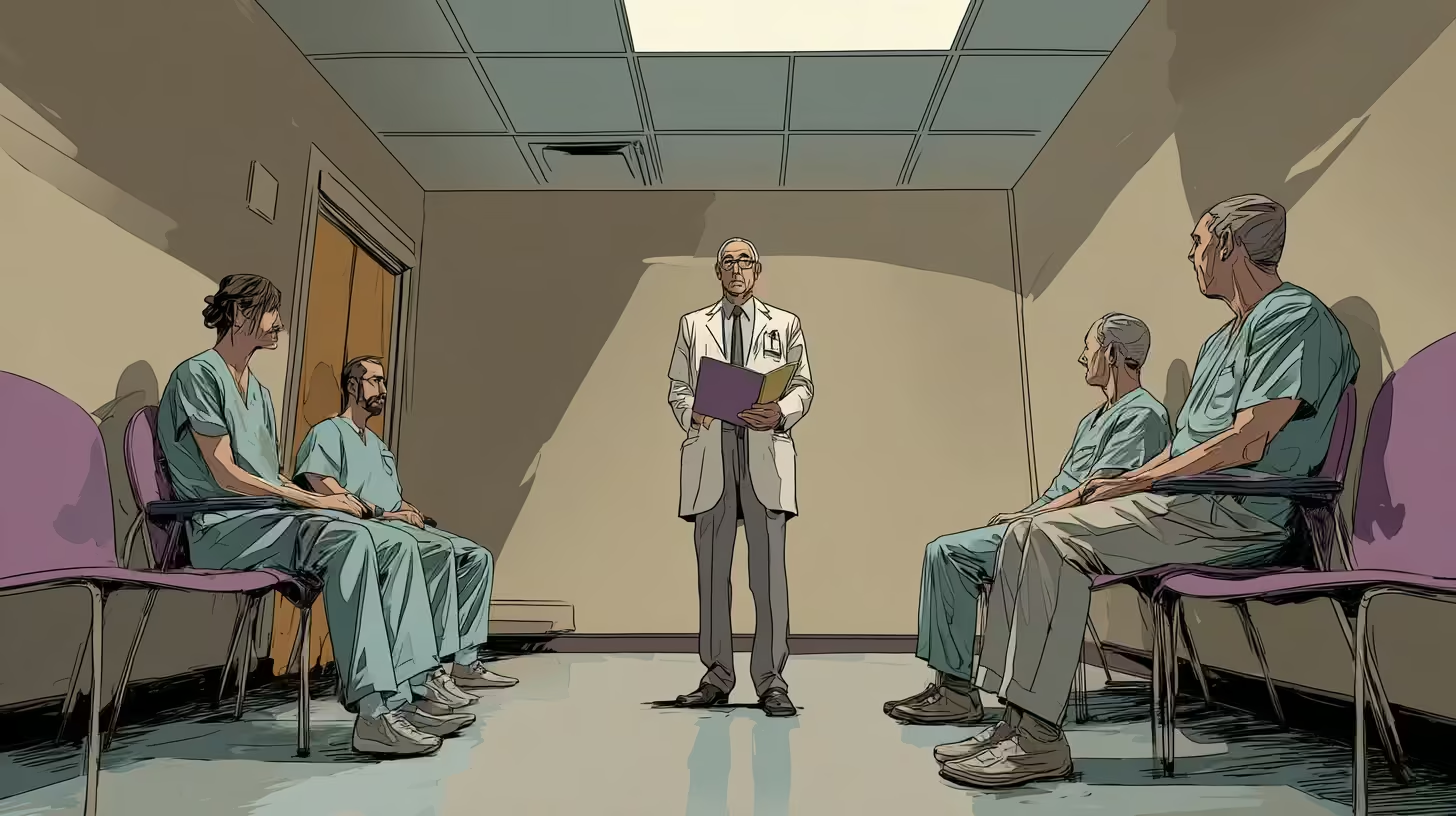
When a surveyor turns to one of your physicians and asks them to describe your facility's violence prevention protocols, what happens next depends on what you've built. Not the policy binder. Not the training sign-in sheet. Whether your medical staff can walk through the protocols in their own words, explain the alert system, and describe de-escalation techniques they've actually practiced. That's the clinical safety program evidence surveyors evaluate, and preparing your clinical teams to deliver it is the CMO's job.
What Surveyors Ask Your Clinical Staff
The 2024 Joint Commission standards require surveyors to verify staff awareness through direct interviews. They ask staff to: [1]
- Describe what counts as workplace violence in their facility
- Explain the alert protocol or emergency response procedure
- Walk through de-escalation techniques they've been trained on
- Explain how to report a violent incident
Your medical staff need to answer these confidently. Distributing policies isn't enough. Staff need to articulate protocols in their own words and show they understand how to apply them.
Here's what typically happens across behavioral health facilities: staff can recite policy language but stumble on specifics. "What do you do if a patient in the day room becomes aggressive toward another patient?" The answer shouldn't require checking a laminated card.
In facilities with documented safety systems, staff who feel "very prepared" to respond to incidents nearly doubled after deployment. [2] Those gains require sustained reinforcement though. Without quarterly refreshers, preparedness scores tend to drift back toward baseline.
The CMO's Coordination Role
Survey readiness isn't something you prepare alone. Your role is making sure every department can demonstrate competency when a surveyor walks in.
| Owner | Deliverable | Timeline |
|---|---|---|
| CNO | Preparation plans for nursing staff on the four surveyor questions | 30 days before survey window |
| CMO (you) | Physician and APP competency verification, including attendings and locum tenens | 30 days before survey window |
| Unit Managers | Rapid competency checks with sample staff from each unit | 14 days before survey window |
| HR/Education | Locum tenens and new attending orientation with documented competency | Ongoing |
Physicians are the gap most CMOs miss. Your attendings may know clinical protocols cold but can't describe the duress alert sequence. APPs rotate across units and may not know facility-specific response procedures. Locum tenens are the highest risk. Surveyors may interview anyone, and a locum who started last week gets the same questions as a 10-year veteran.
If your survey window opens in less than 3 months and you have high physician turnover, prioritize locum tenens and new attendings first. The four questions above are the prep list.
Documentation Surveyors Request
Surveyors want specific evidence your program works, not just that it exists. They request response time data, system reliability records, incident investigation trails, and governance reporting. [3]
| Surveyor Request | What They Want | Your Production Window |
|---|---|---|
| Response time trending | Alert-to-arrival timestamps by unit, shift, and incident type | Within 30 minutes |
| System reliability | Uptime records and coverage verification | Within 30 minutes |
| Incident investigation | Each incident with timeline, investigation notes, and resolution | Within 24 hours |
| Governance reporting | Quality committee minutes showing trending analysis review | Within 24 hours |
Facilities with documented response times show 93% of incidents resolved in under 2 minutes. [2] That's the kind of benchmark your quality committee can report to governance. Think of it like a flight recorder for every incident. You can't argue with timestamps.
Work with your CSO to verify response time tracking exists. Make sure your compliance officer can pull incident investigation records. Your role as CMO is confirming these systems produce the evidence surveyors request within the timeframes above.
Joint Commission has issued over 100 requirements for improvement related to workplace violence since January 2022. [1] Governance reporting receives particularly high scrutiny. Surveyors check whether your quality committee minutes show actual discussion of violence prevention trends, not just slides presented.
If your survey window is approaching and you need help coordinating clinical team readiness, we can walk you through it.
Contact UsGetting Your Program Survey-Ready
Facilities with documented safety technology show 39% reduction in patient-staff incidents in the first 3 months. [2] Worth noting: if your current incident capture is incomplete, numbers may actually increase early on as you capture events that previously went undocumented. That's not failure. That's visibility.
Pre-survey checklist:
- Pull your last 3 quality committee minutes. Do they show documented discussion of violence prevention trends, or just slides?
- Select 5 staff members randomly across units. Can each answer the four surveyor questions without prompting?
- Request response time data for the past 90 days. Can your system produce it within 30 minutes?
- Walk your facility's perimeter areas, stairwells, and outdoor spaces. Does duress coverage extend to every location?
- Review post-incident records for the past quarter. Is follow-up documented for each event?
For enterprise behavioral health organizations, consistency across facilities matters. Corporate sets standards, facilities execute. Surveyors may visit any site, and inconsistency across locations is a common citation area.
See how one behavioral health provider documented these results across their facilities.
Start with one question: can your medical staff articulate your clinical safety program protocols when a surveyor asks? If the answer is "I'm not sure," that's your first gap to close.
SURVEY READINESS
Prepare Your Clinical Teams with Documented Evidence
Facilities with documented safety systems show 93% of incidents resolved in under 2 minutes. See what survey-ready evidence looks like for your clinical program.
References
- The Joint Commission. Joint Commission Online - July 17, 2024. https://www.jointcommission.org/en-us/knowledge-library/newsletters/joint-commission-online/17-jul-24
- ROAR for Good. Internal Data, 2024.
- The Joint Commission. Data Collection. https://www.jointcommission.org/en-us/knowledge-library/workforce-safety-and-well-being-resource-center/workplace-violence-prevention/data-collection