
Peer CHRO Safety Insights: 3 Workforce Dimensions Ranked

CHRO peer turnover benchmarking: healthcare leader at unlit office door looking toward green-lit peer door in corridor

Key Takeaways

  • Leading behavioral health HR teams connect nurse duress data to retention dashboards, workers’ comp reviews, and union talks rather than leaving it in security’s system.
  • Most behavioral health organizations have safety systems producing data that HR never uses for workforce decisions, and the gap between leaders and the field is growing each quarter.
  • The pattern keeping most HR teams behind: treating deployment as a finished purchase rather than the start of ongoing workforce data connection.

Leading behavioral health CHROs have stopped treating nurse duress as a security purchase. They’ve moved safety data onto retention dashboards, into workers’ comp reviews, and onto the table during union talks. The real peer CHRO safety insights question is whether HR owns the data your system produces. This guide maps where peer HR teams actually stand across three workforce dimensions so you can find your spot on the curve.

How Peer CHROs Frame Nurse Duress: Safety Insights for Workforce Strategy

A growing group of CHROs now treats nurse duress as a workforce strategy tool, not a line item in security’s budget. The reason: 60% of nurses have changed jobs, left, or considered leaving because of workplace violence [1].

When the majority of your nursing workforce factors violence into whether they stay, the problem belongs to whoever owns retention. That’s you. The CHROs pulling ahead claimed that data stream and connected it to the workforce decisions they make each quarter.

Three Workforce Dimensions That Matter

Peer CHROs who lead on safety focus on three specific dimensions. Each one connects safety technology to an HR-owned metric.

DimensionWhat Leaders DoWhat It Produces
1. Retention DashboardsConnect safety incident data to turnover dashboards and exit interview themesVisibility into which departures are violence-driven and which units need help
2. Workers’ Comp ManagementCross-reference duress response times with injury claims each quarterA cost-reduction pattern that gives HR leverage in CFO budget talks
3. Labor RelationsReference safety technology outcomes during union talks and contract negotiationsEvidence that shifts grievance discussions toward partnership

On retention, organizations where HR connected safety data saw intent-to-leave over safety concerns drop from 22% to 7% [2]. That’s the kind of shift that shows up in your next engagement survey.

On workers’ comp, peer organizations report 24% to 50% reductions in claims after connection [2]. Each trauma-related workers’ comp claim averages $68,231 [3]. When HR connects response data to claims reviews, the pattern between faster response and fewer claims becomes visible.

Between 2022 and 2024, 43% of newly negotiated RN contracts in behavioral health included workplace violence prevention language [4]. CHROs who bring deployment outcome data to the table shift the conversation from grievance to shared progress.

See how one behavioral health provider documented these results across their facilities.

Where Most HR Teams Actually Stand

Survey data suggests the field breaks into four groups.

Integration LevelWhat It Looks LikeEstimated Share
LeadersSafety data connected to retention dashboards, workers’ comp, and labor relationsA small share of behavioral health organizations
AdvancingConnected on 1-2 dimensions, piloting on othersA growing share
TrackingIncidents tracked centrally, but HR doesn’t use the data for workforce decisionsRoughly half of behavioral health organizations
Not StartedSafety remains entirely a security or facilities functionA significant share of hospital CHROs report this

Most organizations land in “Tracking.” That’s common, and it’s where most of your peers are too. It means the data exists but hasn’t been connected to the workforce systems you already run.

What separates the leaders? Organizations at the top tier report staff satisfaction climbing measurably within a single quarter after connection [2]. Meanwhile, 59% of hospitals have a formal retention strategy, but few connect those strategies to safety data [5]. The retention program and the safety program run on parallel tracks. Leaders merged them.

Want to see how your HR team's integration compares to peer organizations? A behavioral health safety specialist can walk through the dimensions with you.

Contact Us

The Pattern Keeping HR Teams Behind

The sticking point is how organizations categorize the purchase after deployment. When safety technology gets treated as a completed project, the data it produces stays in security’s system. HR sees a summary report at best. The incident details, response times, and resolution metrics that would change workforce decisions never reach your dashboards.

This matters more than most CHROs realize. 81% of workplace violence incidents go unreported [6]. The data security captures is already incomplete. Without HR connection, the picture gets even thinner. You can’t build a retention strategy around data you can’t see.

Three structural barriers keep most HR teams from claiming safety data:

  • Separate budget ownership between security and HR
  • Misaligned metrics between departments
  • Organizational habit of treating safety as someone else’s job

Each barrier is solvable. Solving them requires HR to claim the data directly.

Matching Your Peer CHRO Safety Insights to Action

Peer CHROs who moved to the leader tier followed a consistent sequence. Most started by forming an HR-security joint steering committee. That single step created shared ownership of the data.

From there, the path depends on where you stand today:

  • Not Started: Form an HR-security steering committee to establish shared data access
  • Tracking: Launch a shared dashboard pilot connecting safety data to your biggest gap dimension
  • Advancing: Link safety data to retention forecasting and include it in your next board report

Organizations that completed the full connection pathway report combined improvements: faster emergency response and measurable decreases in workers’ comp claims within the same period [2]. These results come from organizations that completed the full connection pathway; the outcomes reflect what’s possible when HR claims the data, rather than a guarantee for every deployment context.

You can assess your position in a single meeting. Check three things:

  1. Does safety incident data flow into your HR retention dashboards?
  2. Do your workers’ comp reviews include duress response metrics?
  3. Did your most recent union conversation reference your safety technology investment?

Peer CHROs who lead on these dimensions started with the same check. The difference is they claimed the data before someone else defined what it meant. Start with whichever question you answered “no” to first. That’s how most leading organizations began, and it’s where peer CHRO safety insights turn into action. An HR safety brief built for budget approval gives you the format to turn these dimensions into a funded ask.

PEER INSIGHTS

See How Your Integration Compares to Peers

Leading HR teams already connect safety data to retention, workers' comp, and labor relations. A behavioral health safety specialist can show you what the path from tracking to full connection looks like for your organization.

References

  1. National Nurses United. 2024 Workplace Violence Report. https://www.nationalnursesunited.org/sites/default/files/nnu/documents/0224_Workplace_Violence_Report.pdf
  2. ROAR for Good. Internal Deployment Data, 2024.
  3. National Safety Council. Workers’ Compensation Costs. https://injuryfacts.nsc.org/work/costs/workers-compensation-costs/
  4. National Nurses United. 2024 Workplace Violence Report (contract analysis). https://www.nationalnursesunited.org/sites/default/files/nnu/documents/0224_Workplace_Violence_Report.pdf
  5. NSI Nursing Solutions. 2025 National Health Care Retention & RN Staffing Report. https://www.nsinursingsolutions.com/documents/library/nsi_national_health_care_retention_report.pdf
  6. AHRQ PSNet. Addressing Workplace Violence and Creating a Safer Workplace. https://psnet.ahrq.gov/perspective/addressing-workplace-violence-and-creating-safer-workplace


HR Safety Brief: Nurse Duress Budget Approval

Nurse turnover cost analysis one-pager on leather portfolio beside open office door in healthcare admin wing

Key Takeaways

  • Your CFO needs three data points on one page to approve nurse duress funding: the violence-driven turnover share, workers’ comp exposure, and a peer retention result
  • Every percentage point of turnover improvement saves the average hospital $289,000 per year, turning your safety argument into a budget line the CFO can model
  • A phased pilot on your highest-acuity unit lowers the approval threshold and gives the CFO a built-in checkpoint before broader commitment

You’ve had this conversation before. You walk into the CFO’s office with exit interview data showing safety concerns drive departures. The CFO nods. The CEO agrees it matters. Nothing gets funded. This HR safety brief exists because your packaging is the barrier, not your data. Finance evaluates spending in a language HR rarely uses, and closing that gap is the fastest path to approval. The full financial picture of nurse duress and turnover frames why this conversation matters at the board level.

What Your HR Safety Brief Needs to Include

The decision you’re building toward is specific: budget approval for nurse duress on your highest-acuity unit. That decision requires alignment from your CFO, CEO, and nursing leadership.

StakeholderWhat They EvaluateWhat They Need From You
CFOFinancial justificationShort, verifiable metrics tied to numbers they already track
CEOStrategic alignmentConnection to workforce stability and organizational risk
Nursing leadershipOperational feasibilityEvidence that frontline staff will use it and that response protocols are defined

Behavioral health demands its own benchmarks. Psychiatric and substance abuse hospitals reported 110.4 workplace violence incidents per 10,000 workers [1]. That rate demands a different conversation than medical-surgical units face. Your one-pager needs to reflect that severity. This one-pager addresses the violence-driven share of turnover, the piece most within your control. The three methods for isolating that share give you the numbers your CFO can’t dispute.

“Your packaging is the barrier, not your data.”

Three Points That Move Executives

Your one-pager needs exactly three data points. Each one should fit in a single sentence and be independently verifiable.

Data PointWhat It SaysWhy It Works
Violence-driven turnover share38% of behavioral health nurses cite safety concerns in exit interviews, second only to compensationIsolates the share your CFO cannot attribute to pay
Dollar translationEach percentage point of RN turnover costs the average hospital $289,000 per year [2]Converts your retention argument into a number the CFO can model against investment cost
Peer retention resultAt one behavioral health facility, staff considering leaving due to safety dropped from 22% to 7% after investing in duress infrastructure [3]Shows the CFO this works somewhere comparable

Lead with the dollar figure. When you say “turnover improved three points,” the CFO hears “$867,000 in avoided cost.” That sentence opens the conversation. Your CFO’s five-category turnover cost framework is where that number gets validated against facility-specific data.

The workers’ comp line strengthens the case. One behavioral health system documented 24 to 50% reductions in workers’ comp claims after deploying duress infrastructure [3]. That metric your CFO can verify independently through your existing claims data.

Talk to us about building your internal case for nurse duress funding.

Contact Us

Packaging Data for Budget Conversations

The three data points above are the content. Format carries equal weight. Most healthcare CFOs prefer a single-page summary with three financial metrics, followed by a short appendix. Build your one-pager in this sequence:

  1. Lead with the cost your CFO already knows. Replacing one bedside RN costs $61,110 on average [2]. Multiply that by your violence-driven departures. That’s your baseline.
  2. Layer the workers’ comp exposure. This gives the CFO a second financial metric they can verify against your own claims history.
  3. Hold employer brand and staff preparedness metrics for the CEO conversation. Strategic alignment matters more to the CEO than financial proof. Save those for the right audience. Peer CHROs ranking three workforce dimensions confirm that the organizations leading on this metric packaged their data the same way.

No one should face violence while trying to help others heal. Your one-pager makes that conviction financially legible.

Handling the Pushback You Will Hear

Three objections appear most frequently in budget conversations about nurse duress. Knowing them in advance changes the dynamic.

  1. “Staff won’t actually use it.” Staff adopt tools that respond fast. Peer organizations using duress infrastructure report strong adoption among nursing staff within the first six months.
  2. “ROI is unproven in our setting.” One peer organization documented a 40% reduction in assaults against staff within six months [3]. That’s a measurable outcome in a comparable environment.
  3. “This belongs in the security budget, not HR.” Violence-driven turnover is a workforce cost. You own workforce stability. The departures show up in your retention numbers, your agency spend, your engagement scores. The budget line follows the accountability. See how one provider built the case and achieved measurable results.

Making the Ask That Gets Approved

Request a phased pilot on your highest-acuity unit. The majority of behavioral health organizations that succeeded with duress systems used a three-phase approach:

  1. Phase 1: Pilot on one to two highest-acuity units
  2. Phase 2: Department-wide rollout
  3. Phase 3: Enterprise deployment

A phased pilot lowers the approval threshold. It gives your CFO a built-in checkpoint before broader commitment. Organizations that start with this approach rarely stop. The retention gap that compensation can’t close is what makes this investment stick.

Safety is an investment, not an expense. The one-pager is built. The objection responses are ready. The ask is a phased pilot, not a full capital request. You have what you need to start that conversation.

FINANCIAL CASE

Ready to build your internal case for nurse duress?

See the specific retention, workers' comp, and adoption outcomes referenced in this article. A behavioral health safety specialist can walk you through what a phased pilot looks like for your highest-acuity unit.

References

  1. Sheps Center for Health Services Research. Workplace Violence in Healthcare Settings, 2025. https://www.shepscenter.unc.edu/wp-content/uploads/2025/01/Y10.01_Brief-1.pdf
  2. NSI Nursing Solutions, Inc. 2024 National Health Care Retention & RN Staffing Report. https://www.nsinursingsolutions.com/documents/library/nsi_national_health_care_retention_report.pdf
  3. ROAR for Good. Internal deployment data, 2024.

Workforce Safety Confidence: The Retention Gap Pay Can’t Close

CHRO pulling workforce safety binder from row of quarterly review binders in healthcare administration office

Key Takeaways

  • Exit interviews keep naming safety concerns, yet most retention strategies focus on pay and benefits, leaving the biggest driver of nurse departures unaddressed
  • Feeling safe at work predicts job satisfaction regardless of compensation, which means no raise can close the gap your staff keep describing
  • Peer CHROs in behavioral health have already acted on this insight and seen staff satisfaction climb 16 points in a single quarter

You already know what the next exit interview will say. Safety concerns. Again. Three quarters running, maybe longer. Each time, you approve another wage adjustment, expand the wellness program, adjust the shift differential. The numbers barely move. Then another nurse leaves, and the summary reads the same way. The frustration is that you keep solving around the one problem you’ve already identified. And that gap in workforce safety confidence keeps widening.

The Guilt Behind the Dashboard

Six in ten nurses say violence at work has pushed them to change jobs, leave, or seriously consider leaving [1]. That’s the national picture. Your exit interview data is the local version.

What makes this harder: nearly 45% of nurses say their employer simply ignores violence reports after they’re filed [1]. Staff stop raising the issue. They stop believing anyone will act. The mentions you do see are the fraction that made it through.

“No CHRO should carry the weight of knowing the cause while running a playbook that ignores it.”

You’re reviewing this quarter’s summaries. Three of the last seven departing nurses mentioned safety. You know the ones who didn’t mention it probably felt it too. And you know your retention strategy has no answer for what they’re describing.

That’s the weight CHROs in behavioral health carry. You see the signal. You understand what it means. The playbook you’ve been trained to run has no chapter on violence. The financial exposure behind that gap is bigger than most CHROs realize.

Why Compensation Alone Feels Hollow

You approved a 4% wage adjustment last quarter. Expanded the EAP. Added a wellness stipend. Turnover held steady.

You’re in good company. Behavioral health faces 40% annual turnover, and wages keep rising across the industry [2]. Everyone has been raising pay. The number refuses to budge.

The research explains why. When staff feel their compensation fails to reflect the risk they face every shift, a raise registers as a transaction that misses the point [2]. Frontline workers say it plainly:

  • “I don’t think that a wage increase, too much, would affect the turnover… most would rather prefer a better work environment.” [3]
  • “If you’re burning the candle at both ends because you’re always short-staffed… the money’s not worth it.” [3]

You’ve heard versions of this in your own exit interviews. The problem compensation can solve and the problem driving departures are two different problems. An HR safety brief built around the right data points bridges the gap between what you know and what your CFO needs to hear.

What Peer CHROs Discovered First

Workers with higher psychological safety report 95% job satisfaction, compared to 85% for those without it [4]. That gap holds regardless of what people are paid. It’s the piece your compensation strategy will never reach.

Peer CHROs in behavioral health discovered this connection and acted on it. At organizations that invested in safety infrastructure, the results showed up within a single quarter:

MetricBeforeAfter
Staff satisfaction57%73%
Staff considering leaving due to safety22%7%
Staff confident handling safety concernsBaseline~80%

Those are board-reportable numbers in one budget cycle [5].

Filter your own engagement survey by units with the highest incident rates. You’ll likely find safety perception dragging scores well below the organizational average. That gap is invisible in the aggregate data your board sees. It only shows up when you look where the problem actually lives. That filtered view is the insight peer CHROs used to reframe safety as a retention strategy. Peer CHROs rank three workforce dimensions that separate leaders from the field on this exact issue.

Talk to us about what closing the safety-retention gap looks like for your organization.

Contact Us

From Guilt to Authority

The shift that matters most: from recommending safety investment to leading it.

You’ve spent quarters watching exit interview data say the same thing while running a playbook that can’t respond to it. Every budget cycle, you advocate for something you can’t quite name in the language finance wants to hear. You know the cause. You know the retention programs aren’t reaching it. The guilt isn’t about inaction. It’s about action that keeps missing.

Peer CHROs who made the shift from advocate to owner describe the same turning point. They stopped treating safety as someone else’s line item and started treating it as a workforce strategy they controlled. The results came fast enough to validate the decision within a single reporting cycle:

  • Workers’ comp claims fell
  • Staff satisfaction climbed 16 points in a single quarter
  • Recruitment strengthened as organizations earned Best Place to Work recognition and stronger Glassdoor sentiment [5]

Those aren’t long-horizon outcomes. They’re results a CHRO can defend in the next board meeting.

The step-by-step method to isolate violence-driven turnover and structure your CFO conversation exists in Map the Full Cost of Every Nurse Departure. You don’t need to build the case from scratch. See how one behavioral health provider cut staff assaults by 40% and saw intent-to-leave drop from 22% to 7%.

The CHRO who closes the safety-retention gap looked at the same exit interview data everyone else had and decided to own what it was actually saying. No one should face violence while trying to help others heal. And no CHRO should carry the weight of knowing the cause while running a playbook that ignores it. The workforce safety confidence your staff need starts with the confidence you already have: the authority to act on what you’ve known for quarters. Your CNO is seeing the same pattern from the unit level — what they’re finding about safety confidence on the floor confirms what your exit data already says.

KEEP YOUR TEAM

Turn Exit Interview Data Into Retention Results

Your staff keep naming safety as the reason they leave. Peer organizations acted on that signal and saw staff satisfaction climb 16 points in a single quarter. See what that shift looks like for your team.

References

  1. National Nurses United. (2024). Workplace Violence Report. https://www.nationalnursesunited.org/sites/default/files/nnu/documents/0224_Workplace_Violence_Report.pdf
  2. Behavioral Health News. (2024). Do Higher Wages, Benefits, and Career Development Reduce Turnover in Behavioral Health? https://behavioralhealthnews.org/do-higher-wages-benefits-and-career-development-reduce-turnover-in-behavioral-health/
  3. McKnight’s Long-Term Care News. (2024). Staff Support Outweighs Wages as Turnover Solution, Nursing Home Study Finds. https://www.mcknights.com/news/staff-support-outweighs-wages-as-turnover-solution-nursing-home-study-finds/
  4. American Psychological Association. (2024). 2024 Work in America Report. https://www.apa.org/pubs/reports/work-in-america/2024/2024-work-in-america-report.pdf
  5. ROAR for Good. (2024). Internal Data.

Workforce Turnover Safety: Full Cost Calculation

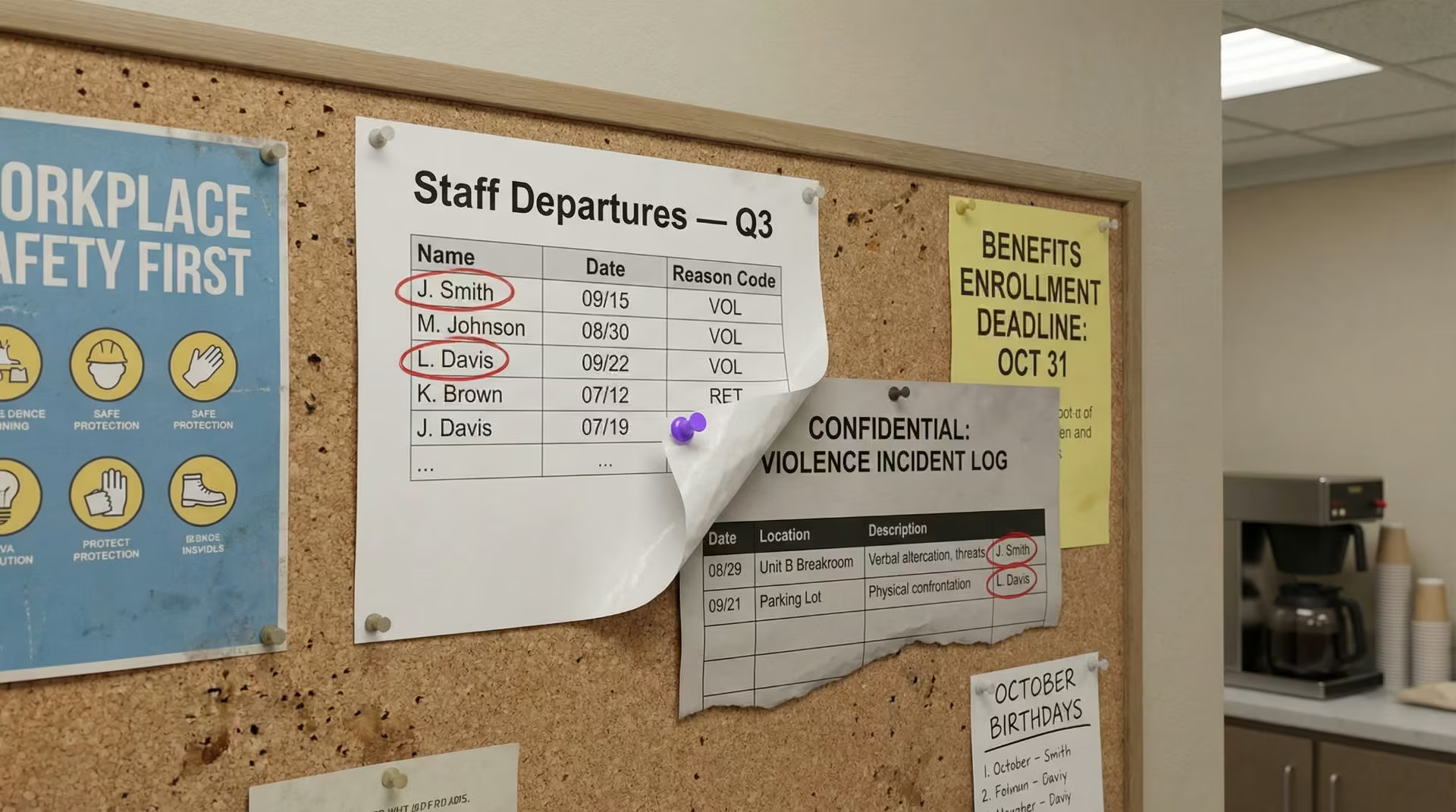
Corkboard departure summary peeled back revealing violence incident log with matching names

Key Takeaways

  • Most turnover calculations miss the violence-driven share entirely because standard exit interviews don’t isolate it, meaning your CFO’s model is built on incomplete data that only HR can fix
  • Three methods using data you already collect (exit interviews, engagement surveys, workers’ comp claims) can identify the violence-driven portion and turn it into a measurable line item
  • Facilities addressing violence-driven turnover have recorded intent-to-leave dropping from 22% to 7%, connecting safety investment directly to the retention metrics CHROs own

When your CFO asks what nurse turnover actually costs your behavioral health facility, what number do you give? If you’re citing the $61,110 industry benchmark, you’re understating the problem [1]. Behavioral health adds extended orientation, longer vacancies, and violence-driven departures that push the real cost significantly higher.

But the bigger issue isn’t the total. It’s what’s hiding inside it. This workforce turnover safety guide walks through how to capture the data your CFO’s model needs but only HR can provide, isolate the violence-driven share, and build a phased retention strategy around the numbers. The full financial picture of nurse duress and turnover frames why this data gap matters at the board level.

What You NeedWho Provides It
Exit interview data (24 months)HR
Engagement survey resultsHR Analytics
Workers’ comp claims history (24 months)Risk Management
Payroll data for BH nursing positionsFinance

Budget 2-4 hours for initial data gathering.

The Data Gap Only HR Can Close

Your CFO can run the turnover cost calculation. The framework exists [1]. What the CFO can’t do is tell you why nurses are leaving or which departures were preventable. That’s your data.

The violence-driven share is hidden because:

  • 60% of nurses have changed, left, or considered leaving due to workplace violence [2]
  • Standard exit interviews bury safety concerns under “work environment” rather than tracking them separately
  • 81% of workplace violence incidents go unreported [3], which means your incident data understates the problem

The violence-driven share is the piece of turnover most within your control. It’s also the piece most invisible in current reporting. The three methods below use data you already collect to make it visible. Once you have the numbers, an HR safety brief built for budget approval gives you the format to present them.

Three Ways to Isolate Violence-Driven Turnover

Each method works independently. Used together, they give you a number your CFO can’t dispute. Your CFO’s five-category turnover cost framework is waiting for exactly this input to complete the calculation.

1. Redesign your exit interviews. Standard templates weren’t built for this. Add four targeted questions:

  • Did you witness or experience violence during your time here?
  • How frequently?
  • Did you report it?
  • How important was safety in your decision to leave?

A departure counts as violence-driven when the employee answers yes to question 1 and rates safety as “important” or “very important” in question 4. Departing staff frequently soften their answers on the way out. Phone interviews conducted two to three weeks after the last day surface more candid responses than day-of paperwork.

2. Cross-reference your engagement surveys. You already run engagement surveys:

  • Pull safety perception scores and intent-to-stay scores for your nursing staff
  • Compare actual turnover rates between low-safety-score staff and high-safety-score staff

The gap between those two groups is the violence-driven component showing up in data you already have.

3. Match workers’ comp claims against departures.

  • Pull all violence-related workers’ comp claims from the past 24 months
  • Cross-reference claimants against staff who departed within 6-12 months of the claim
  • Compare the departure rate for violence-claim staff versus other-claim staff

This method provides objective, third-party documentation. It carries more weight in budget conversations than self-reported exit data.

If exit data is sparse across all three methods, use the 19.2% benchmark as a starting point [2], adjusted for your facility’s violence exposure rate.

Talk to us about isolating the violence-driven share of your turnover data.

Contact Us

Turning the Numbers Into a Retention Strategy

With the violence-driven share isolated, you have the number that connects safety investment to retention outcomes.

Partner with your CFO on the financial validation. Each 1% change in RN turnover costs or saves the average hospital about $289,000 per year [1]. Frame the conversation around workers’ comp reduction first. Not because it’s the largest number, but because it’s the most defensible cost category with objective third-party proof. Peer CHROs ranking three workforce dimensions confirm that workers’ comp integration is the dimension that separates leaders from the field.

Set phased targets your leadership team can track:

TimelineTargetWhat You’re Measuring
90 daysEarly signalSafety sentiment shift, incident response time
12 monthsPreliminary ROITurnover rate trend, intent-to-stay improvement, workers’ comp claims
18-24 monthsFull cycleAnnual turnover comparison, total cost reduction, first-year retention rate

One behavioral health facility recorded intent-to-leave dropping from 22% to 7% after deploying safety infrastructure [4]. Workers’ comp claims dropped 24-50% across separate deployments [4][5]. Your starting baseline will shape what’s realistic in Year 1. Even modest reductions produce six-figure annual savings at the per-percentage-point rate. See how one provider achieved these results.

Before your next budget conversation, make sure you’ve completed these:

  • Pulled actual payroll data for behavioral health RN positions at one facility
  • Requested workers’ comp claims history (24 months) filtered for violence-related incidents
  • Matched violence-related claimants against departures within 6-12 months
  • Added the four violence-specific questions to your exit interview template

The violence-driven share is isolated. The workforce turnover safety strategy you build from these numbers treats safety investment as what your people data has been showing all along: the retention lever hiding inside your largest controllable expense. The emotional weight behind that lever is something every CHRO in behavioral health carries — and the data you just built is how you finally act on it.

YOUR DATA

Turn Your People Data Into a Safety Investment Case

The three methods described here use data you already collect. A behavioral health safety specialist can walk you through what peer CHROs found when they isolated the violence-driven share at their facilities.

References

  1. NSI Nursing Solutions. 2025 National Health Care Retention & RN Staffing Report. https://www.nsinursingsolutions.com/documents/library/nsi_national_health_care_retention_report.pdf
  2. National Nurses United. Workplace Violence Report, 2024. https://www.nationalnursesunited.org/sites/default/files/nnu/documents/0224_Workplace_Violence_Report.pdf
  3. AHRQ PSNet. Addressing Workplace Violence and Creating a Safer Workplace, 2023. https://psnet.ahrq.gov/perspective/addressing-workplace-violence-and-creating-safer-workplace
  4. ROAR for Good. Internal Data, 2024. Internal data
  5. ISMIE Mutual Holdings. Cost of Violence in the Healthcare Workplace. https://www.ismie.com/news/cost-of-violence-healthcare-workplace/

HR Safety Brief: Perception Metrics That Predict Turnover

Key Takeaways

  • This brief gives CHROs the specific perception metrics, financial translation, and talking points needed to present safety as a workforce planning investment
  • The comparison between current measurement approaches and perception-informed approaches shows exactly where the data gap exists
  • A 30-day action checklist turns this from a concept into a pilot your CFO can approve

Your board sees turnover numbers and exit interview themes. What they don’t see is the perception data that predicted those departures months earlier. This HR safety brief gives you the specific metrics and financial framing to change that conversation. For the full research behind these numbers, see the complete guide to staff safety in psychiatric hospitals.

Current State vs. Perception-Informed HR Safety Brief

What You Present NowWhat Perception Data Adds
Turnover rate (lagging, reported after departure)Intent-to-leave scores by unit (leading, captured quarterly)
Exit interview themes (“safety concerns”)Specific perception gap: importance rated high, satisfaction rated low
Incident reports (81% of incidents unreported [1])Staff perception of organizational response, measured directly
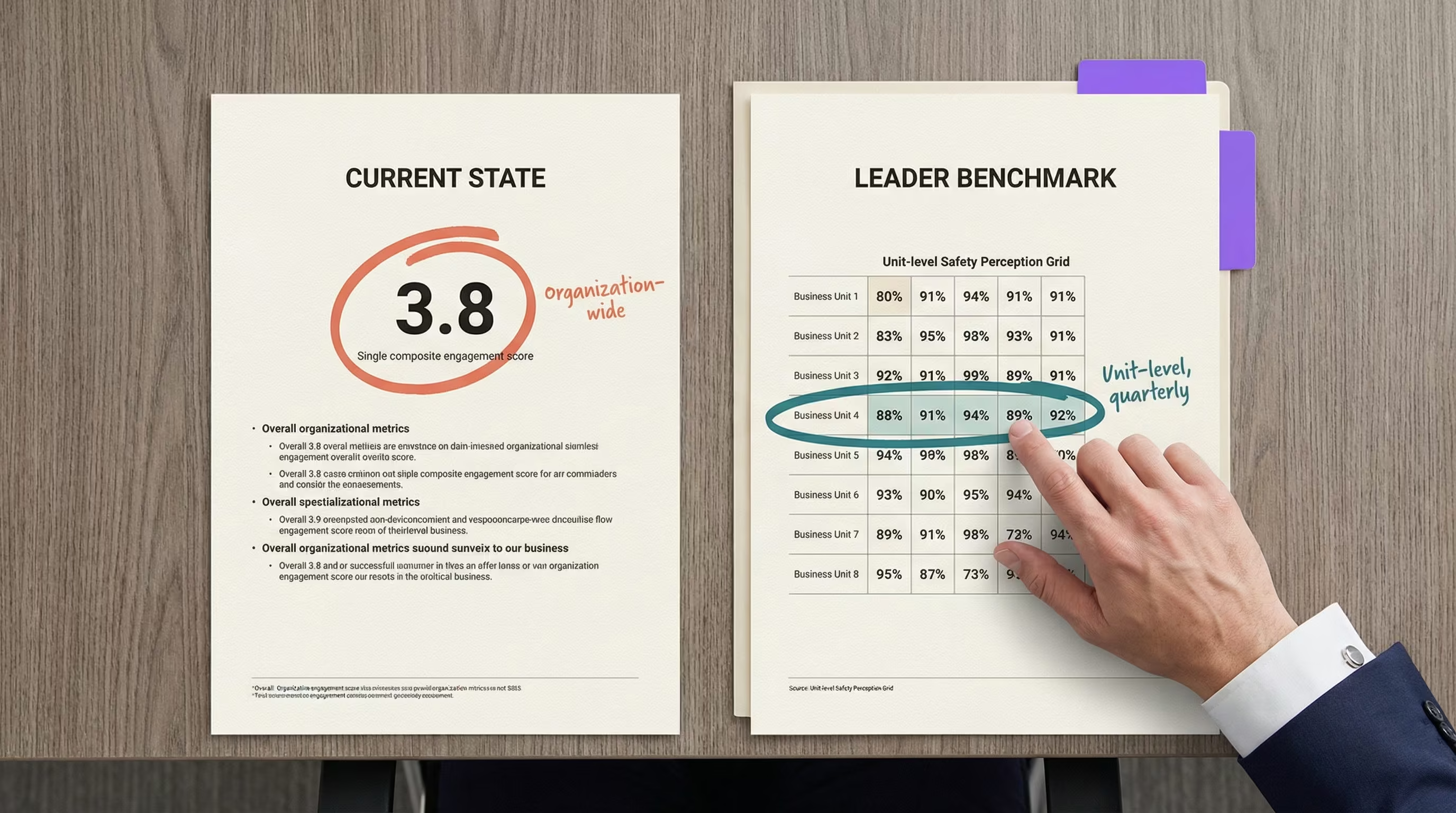
Annual engagement composite scoreUnit-level safety perception scored separately, tracked quarterly
Cost-per-hire and time-to-fillAnnualized retention savings per perception point improvement

The left column describes what most behavioral health HR teams bring to the board today. The right column is what peer CHROs at leading programs are already presenting. The difference is whether your board conversation explains departures after they happen or predicts them before they do.

Key Data Points for Your HR Safety Brief

Bring these to your next CFO or board conversation. Each one connects safety perception to a financial or workforce outcome.

“The difference is whether your board conversation explains departures after they happen or predicts them before they do.”

Retention cost anchor. Each percentage point of nursing turnover costs roughly $289,000 annually [2]. Behavioral health replacement costs typically run higher due to smaller candidate pools. The full financial breakdown shows how these numbers scale across different facility sizes.

Before-and-after proof. Facilities that measured perception and intervened recorded intent-to-leave dropping from 22% to 7%, with safety sentiment lifting up to 38 points [3]. The full evidence set provides the data behind these outcomes.

Engagement connection. Safety perception is one of the strongest drivers of overall engagement [4]. When perception drops, engagement follows. When engagement drops, turnover follows. This means safety investment protects engagement scores your board already tracks.

Reporting gap. 81% of workplace violence incidents go unreported [1]. Your incident data reflects a fraction of what staff actually experience. Perception measurement captures what incident reports miss.

Ready to build the perception metrics into your next board presentation?

Contact Us

Your 30-Day Action Checklist

  • Pull safety-specific items from your existing engagement survey and score them separately by unit. Start with your highest-turnover behavioral health unit.
  • Add two to three intent-to-stay questions tied directly to safety perception on your next pulse survey
  • Work with your CSO to confirm incident reporting workflows include visible follow-up that reporting staff can see
  • Build one slide translating the $289,000-per-point retention anchor into your facility’s specific behavioral health turnover cost
  • Identify one unit for a focused measurement pilot and establish a baseline safety perception score before any changes
  • Brief your CFO with the measurement framework as a workforce planning investment, not a wellness initiative

See how one behavioral health provider documented these results across their facilities.

Safety perception is measurable, movable, and directly tied to retention outcomes. The CHRO who presents this HR safety brief with perception data alongside turnover data changes the board conversation from explaining departures to predicting and preventing them. CNOs tracking this data at the unit level are already seeing the results in their staffing stability.

EXECUTIVE EVIDENCE

Turn Safety Perception Into Board-Ready Retention Data

Behavioral health CHROs using perception measurement are presenting the leading indicator their boards have never seen.

References

  1. AHRQ PSNet. Addressing Workplace Violence and Creating a Safer Workplace. https://psnet.ahrq.gov/perspective/addressing-workplace-violence-and-creating-safer-workplace
  2. NSI Nursing Solutions. 2025 National Health Care Retention & RN Staffing Report. https://www.nsinursingsolutions.com/documents/library/nsi_national_health_care_retention_report.pdf
  3. ROAR for Good. Internal data, 2024. Internal data
  4. Press Ganey. Safety: A Critical Starting Point. https://www.pressganey.com/resources/blog/safety-critical-starting-point/

Workforce Retention Safety: Measure Perception Risk

Institutional building at dusk with most windows dark, showing unreported safety incident gap

Key Takeaways

  • Safety perception measurement gives CHROs a leading indicator that surfaces retention risk before it shows up in vacancy data
  • Validated survey instruments can establish a unit-level baseline in under 30 days, with quarterly tracking that connects directly to intent-to-stay
  • The delegation structure spans corporate HR, facility HR, quality, and clinical leadership, each owning a specific piece of the measurement-to-action workflow

Most facilities track turnover after staff leave. This guide shows you how to measure the safety perception that predicts departures months earlier, so you can intervene before vacancy data confirms what your nurses already decided.

You’ll walk away with a specific instrument selection, delegation structure, implementation timeline, and the connection between perception scores and the workforce retention safety metrics your CFO and board already track. For the research behind why perception predicts retention, see the complete guide to staff safety in psychiatric hospitals.

Before You Start: What You Need in Place

Building a perception measurement framework takes about 90 days to establish a baseline and first quarterly comparison. You need your current engagement survey data, exit interview summaries, incident reports, and turnover data broken out by unit.

Your team includes Quality/Compliance for survey method guidance, your CNO for clinical participation (the unit-level perception guide for nursing leaders covers the CNO’s piece of this), and your CSO for incident data.

If your exit interviews don’t currently include safety-specific questions, add two or three before moving forward: “Did safety concerns influence your decision to leave?” and “How would you rate our response to safety incidents?”

Even adding those two questions changes the data right away. The first round of responses tends to surface units no one flagged as high-risk.

How to Measure Workforce Retention Safety: Instrument Selection

Three validated instruments work for behavioral health settings. Each was developed in acute care and applies across inpatient environments.

InstrumentItemsTimeBest For
SAQ-SF (Safety Attitudes Questionnaire, Short Form)135-10 minutesRapid baseline, compressed timelines [1]
HSOPS 2.0 (AHRQ Hospital Survey on Patient Safety)4015-20 minutesFull annual assessment with national benchmarks [2]
AHRQ Workplace Safety Supplemental ItemsSupplementalAdd-onTargeting staff experience of organizational response [2]

Set a quarterly pulse cadence using the shorter instrument and an annual full assessment using HSOPS 2.0. Quarterly pulses capture directional trends between full assessments. The SAQ-SF works well for speed, but if your primary concern is whether staff trust the organization’s reaction to incidents, the HSOPS supplemental items are worth the extra time.

Here’s what the delegation looks like in practice:

TaskCorporate HRFacility HRQuality/Compliance
Instrument selectionDecidesProvides facility inputAdvises on regulatory alignment
Survey administrationSets cadenceExecutesValidates method
Data analysisAggregates system-wideReports unit-levelConnects to safety culture metrics
Action planningSets enterprise standardsDevelops unit-specific plansDocuments for accreditation

Compressed timeline: If you need a baseline in under 30 days, deploy the SAQ-SF to your single highest-turnover unit. Add two or three intent-to-stay questions. Establish the baseline now and refine instrument selection the following quarter.

One thing to keep in mind: pull your existing safety-related questions from your engagement survey and score them separately first. You may already have a rough baseline hiding in data you already collect. The gap between how important staff rate safety and how satisfied they feel with current systems is the number that predicts your next quarter’s retention.

Connecting Perception Scores to Retention Intent

The link between safety perception and turnover intent is well-established across multiple studies in acute care settings [1][3][4]. The practical question for your team isn’t whether the connection exists. It’s how to surface it in your own data.

Add one question to your safety perception surveys: “I would consider leaving this organization due to safety concerns” (strongly agree to strongly disagree). That single item transforms perception measurement from a culture exercise into a workforce planning tool with documented outcomes.

Then cross-reference. Which units show the largest gap between low perception scores and high stated intent to leave? That’s where your retention risk concentrates. Facilities that have made this connection recorded intent-to-leave dropping from 22% to 7% [5], though the timeline varied across sites. Facilities with pre-existing reporting cultures tended to move faster.

The connection also gives you a second lever. Perception influences job satisfaction, and job satisfaction independently predicts retention [4]. Improving perception directly and improving the conditions perception reflects both reduce turnover intent. Peer CHROs tracking this data describe it as the first time they could see retention risk forming instead of just counting departures after the fact.

Ready to build a perception measurement framework for your facility?

Contact Us

From Measurement to Action

Perception data without intervention is just measurement. What actually moves the needle is visible, repeated proof that safety is an operational priority. Here’s how the work divides across your leadership team:

Intervention ComponentCorporate HRFacility HRCNOCSO
Perception measurementOwns frameworkExecutes surveysSupports participationProvides incident data
Response systemApproves investmentCoordinates trainingOwns clinical workflowOwns response protocol
Visible follow-upSets standardsPuts into practiceEnsures staff see responseDocuments response times

Two questions predict whether your next perception survey will show improvement: When staff activate a call for help, how quickly does help arrive visibly? When staff report an incident, do they see documented follow-up? If the answer to either is “we don’t know,” that’s your starting point. The HR brief on safety perception metrics provides the specific data points to bring into those conversations with your CNO and CSO.

Your First 30 Days

Start with your single highest-turnover behavioral health unit. One unit, measured well, proves the model faster than a system-wide rollout.

  • Pull exit interview data from the past 12 months and flag every mention of safety, violence, or feeling unsupported
  • Identify your three highest-turnover units and cross-reference with whatever safety data exists (incident reports, workers’ comp claims, even anecdotal CNO input)
  • Deploy the SAQ-SF to one unit. Thirteen items, under 10 minutes. Add the intent-to-stay question.
  • Score the importance-satisfaction gap from any existing engagement data. If the gap exceeds 1.0 point, flag that unit for priority intervention planning.
  • Brief your CFO with one number: the annualized cost of turnover in your highest-risk unit. Each percentage point of nursing turnover costs roughly $289,000 annually [6]. For the full financial case and comparison data, the evidence shows what these numbers look like across different organizational models.

See how one behavioral health provider documented these results across their facilities.

Measurement alone doesn’t fix perception, but it gives you the language your CFO needs to approve the next step. With a safety perception baseline established, quarterly tracking in place, and correlation to retention intent on record, workforce retention safety becomes predictive. The next board conversation includes the leading indicator that explains why turnover moved before anyone submitted notice.

WORKFORCE MEASUREMENT

See Retention Risk Before It Hits Your Dashboard

Behavioral health facilities using perception measurement are catching turnover risk months earlier.

References

  1. PMC. Safety Attitudes and Turnover Intention. https://pmc.ncbi.nlm.nih.gov/articles/PMC10809511/
  2. AHRQ. Hospital Survey on Patient Safety Culture. https://www.ahrq.gov/sops/surveys/hospital/index.html
  3. PMC. Safety Culture and Newly Recruited Nurses. https://pmc.ncbi.nlm.nih.gov/articles/PMC9667691/
  4. Sigma Pubs. Safety Climate and Turnover Intention. https://sigmapubs.onlinelibrary.wiley.com/doi/10.1111/wvn.70073
  5. ROAR for Good. Internal data, 2024. Internal data
  6. NSI Nursing Solutions. 2025 NSI National Health Care Retention & RN Staffing Report. https://www.nsinursingsolutions.com/documents/library/nsi_national_health_care_retention_report.pdf

Staff Safety in Psychiatric Hospitals Comparison | 2026

psychiatric hospital safety perception self-assessment — printed five-row checklist with three empty checkboxes and purple pen across unchecked rows

Key Takeaways

  • The comparison matrix across six dimensions reveals where your facility sits between high-safety and low-safety profiles, with measurable gaps on every retention-relevant metric
  • Facilities in the middle of the spectrum tend to assume they’re performing adequately until they run the unit-level correlation between perception scores and turnover
  • A limitations table and evidence assessment checklist give you the framework to evaluate where your measurement infrastructure stands today

Units with the highest turnover are the same units where staff rate safety lowest. Exit interviews confirm it. The connection between safety perception and retention shows up in every workforce dashboard you pull, but most facilities lack a structured way to assess where they stand against peers. This staff safety in psychiatric hospitals comparison provides that framework across six measurable dimensions, along with the limitations of each approach and an assessment checklist for your next leadership review. For the full research behind the perception-retention connection, see the complete guide to staff safety in psychiatric hospitals.

The Comparison Matrix: High vs. Low Safety Perception Organizations

The following framework compares behavioral health settings across six dimensions that correlate with retention outcomes. Each dimension includes an assessment question you can answer with data you already have or can collect within 30 days.

DimensionHigh-Safety ProfileLow-Safety ProfileAssessment Question
Perception measurementUnit-level safety perception scored separately from engagement, tracked quarterlySafety questions buried in annual engagement compositeCan you produce unit-level safety perception scores right now?
Intent-to-stay connectionPerception scores correlated with intent-to-leave by unit; facilities have recorded drops from 22% to 7% [1]Safety perception and turnover tracked as separate metricsDo your perception scores connect to stated retention intent?
Reporting cultureIncidents treated as learning opportunities; visible follow-up on every reportStaff perceive that incidents are ignored after reporting [2]Do reporting staff see documented follow-up?
Response visibilityTimestamped response data verified by unit; staff see the system respond in real timeResponse times estimated or unknown; staff unsure whether calling for help will produce resultsCan you verify response times on your highest-acuity unit with timestamped data?
Preparedness76%+ of staff feel “very prepared” to respond to incidents [1]Fewer than 40% feel preparedWhat percentage of your staff report feeling very prepared?
Financial framingSafety presented as workforce planning investment with per-point ROI ($289,000 per turnover point [3])Safety positioned as a wellness benefit or compliance requirementCan you translate perception improvement into dollar savings for your CFO?

The gap between high and low profiles is substantial. Facilities sitting in the middle of this matrix tend to assume they’re performing adequately. The surprise usually comes when they run the unit-level correlation between perception scores and turnover. The CHRO measurement framework covers how to build that correlation, and peer CHROs already tracking this data describe it as the single most useful addition to their workforce dashboards.

Limitations of Each Approach

No measurement approach is perfect. The following table documents the limitations CHROs should account for when evaluating their position on the comparison matrix.

ApproachWhat It Captures WellWhat It MissesKey Limitation
Annual engagement survey with safety questionsFacility-level trends over timeUnit-level variation; quarterly perception shifts12-month lag means you see problems a year late
Quarterly safety-specific pulse surveysDirectional trends at the unit levelDeep root-cause understanding; nuance behind scoresRequires validated item selection; poorly designed pulses produce noisy data
Before-and-after perception measurementWhether specific interventions moved the needleLong-term sustainability; whether gains hold past 12 monthsA 38-point lift assumes a low starting baseline; mid-range facilities should expect smaller gains [1]
Intent-to-stay correlationLeading indicator of unit-level retention riskDoesn’t capture staff who leave without expressing intentRequires consistent measurement discipline; one-time snapshots aren’t predictive
Incident reportsDocumented events with timestamps81% of incidents that go unreported [4]; the perception that forms between reportsStable incident data often masks declining perception
Workers’ compensation claims dataFinancial impact of safety failuresPrevention value; perception-driven improvements before claims occurReductions of 20-50% are documented [1] but depend on baseline severity mix

Worth noting: the facilities that achieve leader-level outcomes don’t rely on any single approach. They layer quarterly pulses over annual assessments, connect perception to intent-to-stay, and verify response times with timestamped data. Each approach compensates for the blind spots in the others.

The Cost of the Gap

Each percentage point of nursing turnover costs roughly $289,000 annually [3]. For a behavioral health facility running 18% turnover, dropping to 15% represents roughly $867,000 in annual savings. 60% of nurses have changed or left their job due to workplace violence [5], making safety perception one of the most addressable drivers of that cost.

See how one behavioral health provider documented these results across their facilities.

The financial case becomes actionable when you can connect perception scores to intent-to-stay at the unit level. Without that connection, safety investment looks like a cost center. With it, safety investment becomes the workforce planning tool with documented outcomes that changes the CFO conversation.

Assessing Your Facility’s Position

Run through these priority areas before your next leadership review. If three or more reveal gaps, the measurement infrastructure to distinguish between a perception problem and a perception crisis likely isn’t in place.

Priority AreaWhat to EvaluateWhy It Matters
Unit-level measurementWhether safety perception is scored by unit, not just facilityThe facility average masks the units in crisis
Perception-retention correlationWhether perception scores connect to turnover data by unitWithout this, safety investment can’t be justified financially
Before-and-after trackingWhether perception change was measured around your last safety investmentNo before-and-after data means no business case for continued funding
Intent-to-stay trackingWhether intent-to-leave is tracked as a function of safety perceptionSeparates safety-driven attrition from general engagement trends
Reporting visibilityWhether staff who report incidents see documented follow-upUnits with the weakest reporting rates often have the lowest perception scores

The HR brief on safety perception metrics provides the specific data points to bring into each of these evaluation areas, and the full retention data shows what the before-and-after evidence looks like across facility types.

Safety perception is the leading indicator for retention. By the time turnover spikes, the perception problem has been building for months. This staff safety in psychiatric hospitals comparison shows that the gap between current performance and achievable performance is measurable across every dimension in the matrix, and it’s closable.

FACILITY COMPARISON

See Where Your Safety Perception Stands Against Peer Benchmarks

The comparison matrix shows measurable gaps across six retention-relevant dimensions. Find out where your facility falls.

References

  1. ROAR for Good. Internal data, 2024. Internal data
  2. National Nurses United. Workplace Violence Report. https://www.nationalnursesunited.org/sites/default/files/nnu/documents/0224_Workplace_Violence_Report.pdf
  3. NSI Nursing Solutions. 2025 NSI National Health Care Retention & RN Staffing Report. https://www.nsinursingsolutions.com/documents/library/nsi_national_health_care_retention_report.pdf
  4. AHRQ PSNet. Addressing Workplace Violence and Creating a Safer Workplace. https://psnet.ahrq.gov/perspective/addressing-workplace-violence-and-creating-safer-workplace

  5. ROAR for Good. An Analysis of Workplace Violence Statistics in Healthcare. https://www.roarforgood.com/blog/an-analysis-of-workplace-violence-statistics-in-healthcare/

Staff Safety in Psychiatric Hospitals Data: Retention

psychiatric hospital safety perception engagement gap — whiteboard two-bar chart showing 98th vs 3rd percentile cliff between high and low safety perception

Key Takeaways

  • This evidence brief compiles the peer-reviewed and recorded data connecting safety perception to retention, financial outcomes, and workforce stability in behavioral health
  • The evidence summary table consolidates every data point a CFO needs to evaluate safety perception as a retention lever
  • A verification checklist at the end shows whether your facility has the measurement infrastructure to build the business case

Exit interviews keep surfacing safety concerns. Your turnover dashboard keeps climbing. This staff safety in psychiatric hospitals data brief connects those two signals with the specific evidence your CFO needs: peer-reviewed correlation data, recorded before-and-after outcomes, and a financial translation that turns perception improvement into dollar savings. For the full framework behind why perception predicts retention, see the complete guide to staff safety in psychiatric hospitals.

The Perception-Retention Correlation

Safety culture predicts turnover intent with a strong negative correlation. Peer-reviewed research recorded a correlation of -0.883 between safety culture perception and nursing turnover intention [1]. Safety culture accounted for about 6.4% of turnover intent independently [1], which is notable given that it competes with compensation, scheduling, management quality, and commute time for the same outcome.

60% of nurses have changed or left their job due to workplace violence [2]. In behavioral health, where turnover exceeds the national nursing average by more than 6 percentage points [3], each departure costs more than the sector average because the replacement pool is smaller.

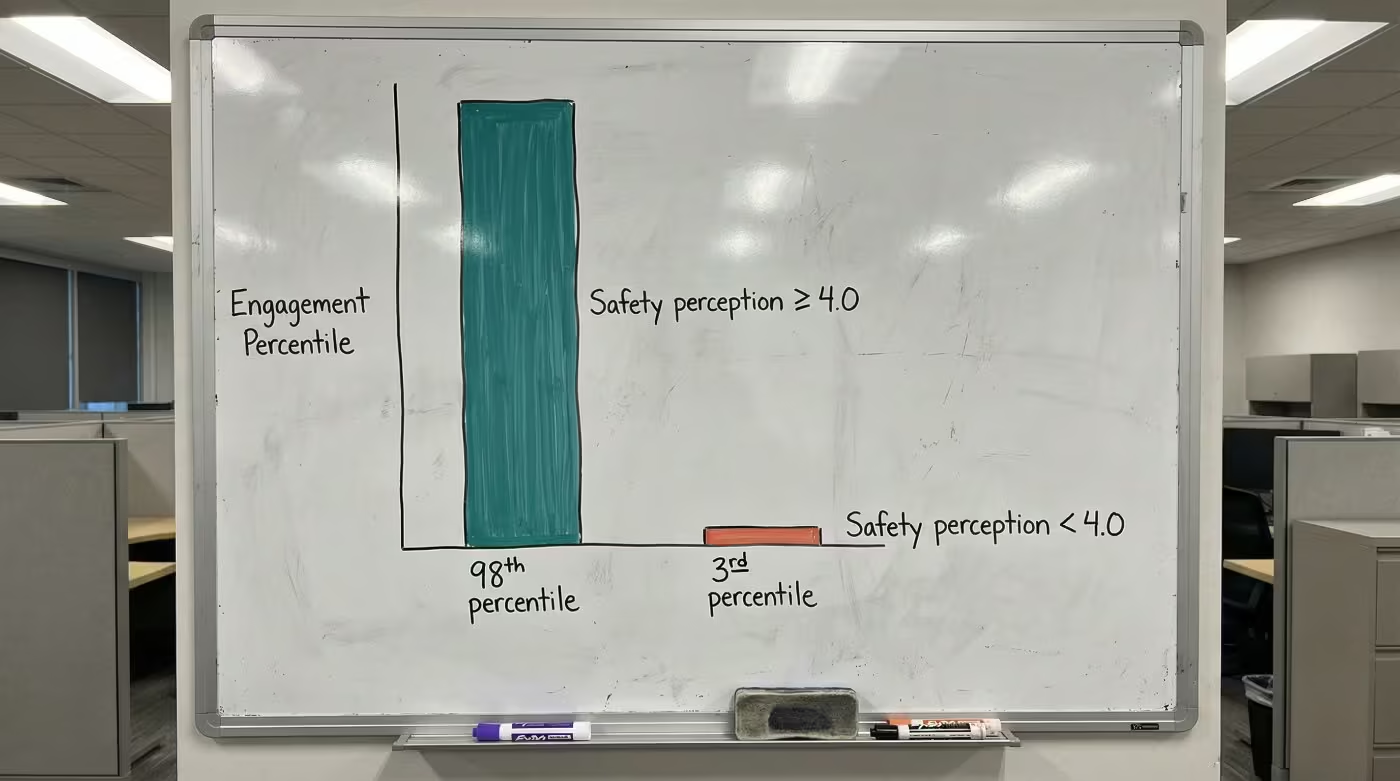
The engagement connection reinforces this. When safety perception scores reach 4.0 or above on a 5-point scale, engagement ranks at the highest levels nationally. When scores drop below that threshold, engagement collapses [4]. Safety perception drives engagement, and engagement drives retention. That chain is now documented at every link. The CHRO measurement framework covers how to surface this connection in your own data.

Recorded Before-and-After Outcomes

Facilities that established baselines, intervened, and re-measured recorded the following shifts [5]:

MetricBeforeAfterChange
Intent-to-leave due to safety concerns22%7%15-point reduction
“I feel safe at work” sentimentBaselineUp to 38-point liftMaximum recorded increase
Staff satisfaction with safety57%73%16-point gain in 3 months
Staff feeling “very prepared” for incidents38%76%38-point increase
Team members reporting increased confidence~80%

The 38-point lift represents the maximum recorded increase. Facilities with higher starting baselines should expect smaller gains over longer timelines. The 57% to 73% satisfaction shift happened within a single quarter, placing it at the fastest end of recorded timelines.

What these numbers share: every one was captured through before-and-after measurement. That measurement discipline is the step most facilities skip, and it’s the step that turns a wellness initiative into a workforce planning tool with documented outcomes.

Ready to build the evidence portfolio for your next budget conversation?

Contact Us

The Financial Case

CategoryMetricValue
Cost of turnoverPer-RN replacement cost$61,110-$88,000 [3]
Cost of turnoverPer-percentage-point turnover cost$289,000/year [3]
Cost of turnoverBH setting (200 nurses, 22% turnover)~$6.4M annually
Value of interventionIntent-to-leave reduction15 percentage points [5]
Value of interventionWorkers’ comp claims reduction24-50% [5]
Value of interventionTimeline to measurable change3-9 months [6]

For a behavioral health facility running 18% turnover, dropping to 15% represents roughly $867,000 in annual savings. The workers’ comp reductions (24-50%) depend on baseline severity; the higher end came from facilities with the most severe incident rates. The full comparison across organizational models shows how these numbers scale by facility size.

See how one behavioral health provider documented these results across their facilities.

The Evidence Summary

The evidence chain below consolidates what a CFO needs to evaluate safety perception as a retention lever.

ClaimEvidenceSource
Safety perception predicts turnoverCorrelation of -0.883 (p = .006)Peer-reviewed [1]
Perception drives engagementDramatic gap between high and low perception scores on engagementPress Ganey / AHRQ [4]
Perception improvement is measurableUp to 38-point sentiment increaseRecorded deployments [5]
Perception change reduces intent-to-leave22% to 7%Recorded deployments [5]
Each turnover point has financial value$289,000/yearNSI 2025 Report [3]
BH is the highest-ROI settingHighest turnover + highest violence rates in healthcareNSI [3], Sheps Center [7]

Behavioral health’s combination of high turnover and high violence rates makes it the setting where safety perception improvement yields the greatest per-dollar retention return. Even a fraction of the documented shifts, in a setting where each turnover point costs $289,000, changes the math. Peer CHROs building this data into their workforce dashboards describe it as the business case that finally moved the budget conversation.

Evidence Portfolio Checklist

Before your next budget conversation, verify whether you can produce answers to these:

Verification QuestionWhy It Matters
Can you produce a dated baseline for “I feel safe at work” scores across behavioral health units?Without a baseline, no improvement is provable
Do exit interviews specifically ask about safety perception (not just “workplace concerns”)?Vague questions produce vague data
Are you tracking incidents filed versus incidents witnessed?Reported data alone understates the problem (81% unreported [4])
Does workers’ comp data connect to specific units and shifts?Facility-level totals hide the highest-risk areas
Can you show a 3-month and 9-month trendline on safety perception scores?Trendlines prove sustained change, not one-time bumps

The HR brief on safety perception metrics provides the specific data points to bring into each of these verification areas.

The staff safety in psychiatric hospitals data is clear: perception predicts turnover intent, perception improvement produces recorded retention shifts, and each turnover point saved returns $289,000 annually. The evidence exists to transform exit interview patterns into a quantified business case.

EVIDENCE PORTFOLIO

Build the Business Case Your CFO Needs

The peer-reviewed and recorded data connecting safety perception to retention exists. See what it looks like for your facility.

References

  1. PMC. Patient Safety Culture, Resilience, and Turnover Intention Among Nurses. https://pmc.ncbi.nlm.nih.gov/articles/PMC12896111/
  2. National Nurses United. Workplace Violence Report. https://www.nationalnursesunited.org/press/nnu-report-shows-increased-rates-of-workplace-violence-experienced-by-nurses
  3. NSI Nursing Solutions. 2025 National Health Care Retention & RN Staffing Report. https://www.nsinursingsolutions.com/documents/library/nsi_national_health_care_retention_report.pdf
  4. AHRQ PSNet. Ensuring Patient and Workforce Safety. https://psnet.ahrq.gov/perspective/ensuring-patient-and-workforce-safety-culture-healthcare
  5. ROAR for Good. Internal data, 2024. Internal data
  6. Dove Press. Workplace Violence Prevention in Healthcare. https://www.dovepress.com/article/download/80739
  7. Sheps Center. Trends in Workplace Violence, 2025. https://www.shepscenter.unc.edu/wp-content/uploads/2025/01/Y10.01_Brief-1.pdf

Peer CHRO Safety Insights: Retention Benchmarks

CHRO safety perception benchmark — two printed summaries showing composite lagging score vs unit-level leader benchmark side by side

Key Takeaways

  • Leading CHROs measure safety perception at the unit level quarterly, while most programs still rely on annual engagement composites that mask the units in crisis
  • The gap between leaders and most programs comes down to whether perception data is connected to intent-to-stay, turning it from a culture metric into a workforce planning tool
  • Peer organizations that acted on perception data saw measurable retention improvements within 90 days of establishing baselines

Every CHRO in behavioral health knows safety concerns drive turnover. The difference between the CHROs who keep losing staff and those who’ve stabilized their hardest units isn’t awareness of the problem. It’s what they measure and when they measure it.

This piece shows what peer CHRO safety insights reveal about how leading behavioral health organizations track safety perception differently, and where most programs fall short. For the full research behind why perception predicts retention, see the complete guide to staff safety in psychiatric hospitals.

What Peer CHRO Safety Insights Reveal About Measurement

The operational gap between leading programs and most behavioral health HR operations shows up across four dimensions. In each case, the difference isn’t budget or technology. It’s measurement precision and speed.

Measurement level: unit vs. composite. Most CHROs review safety perception as part of a facility-wide engagement score. Leaders pull safety-specific items and score them by unit. The difference matters because a facility might report 72% positive safety perception overall while one behavioral health unit sits at 41%. That unit is a retention emergency, invisible in the composite. How to build this measurement framework covers the specific instruments and delegation structure.

Measurement frequency: quarterly vs. annual. Most programs measure safety culture once a year through their engagement survey. Leaders run quarterly pulses on safety perception specifically, capturing directional trends that predict retention shifts 90 days out. Annual measurement can only confirm what already happened. Quarterly measurement surfaces what’s about to happen.

Data connection: standalone vs. correlated. Most programs treat safety perception as a standalone culture metric. Leaders connect perception scores to intent-to-stay data at the unit level, which turns safety perception into a workforce planning tool their CFO can act on. The facilities that made this connection recorded intent-to-leave dropping from 22% to 7% [1].

Onboarding attention: ignored vs. tracked. Most programs wait for the annual survey to capture new hires’ safety perception. Leaders measure perception during the first 90 days of onboarding, because a new nurse’s sense of whether the organization takes safety seriously forms fast and is remarkably durable once set. The CHROs ahead of the curve treat that onboarding window as the highest-leverage moment for perception formation.

Where Leaders and Most Programs Compare

DimensionMost ProgramsLeading Programs
Measurement levelFacility-wide or organization-wide compositeUnit-level, scored separately from engagement
Measurement frequencyAnnual (buried in engagement survey)Quarterly safety-specific pulse + annual full assessment
Retention connectionSafety perception and turnover tracked separatelyPerception scores correlated with intent-to-stay by unit
Onboarding perceptionFirst captured at annual surveyMeasured within first 90 days
Action on dataSurvey results reviewed and filedUnit-level declines trigger CSO coordination and charge nurse coaching
Financial framingSafety positioned as a wellness benefitSafety framed as workforce planning investment with per-point ROI

The financial framing matters for the CFO conversation. Each percentage point of nursing turnover costs roughly $289,000 annually [2]. Leaders don’t present safety perception as a culture initiative. They present it as the leading indicator that explains why their next quarter’s turnover moved, with the full retention data to back it up.

“The CHROs pulling ahead aren’t measuring turnover more carefully. They’re measuring something upstream: the safety perception shift that predicts turnover months before a resignation letter arrives.”

Ready to see where your program stands against peer benchmarks?

Contact Us

Assessing Where Your Program Stands

Run through this self-check against the leader benchmarks above. Be honest about where your program sits today.

  • Can you pull unit-level safety perception scores right now, or would you have to dig through a composite engagement survey?
  • Do your safety perception scores connect to intent-to-stay data, or are they standalone metrics?
  • When was the last time a unit-level perception decline triggered a specific intervention (not a policy review, but a visible action staff could see)?
  • Do new hires on behavioral health units get a safety perception check within their first 90 days, or do they wait for the annual survey?
  • Can you tell your CFO the annualized cost of turnover on your highest-risk unit in a single number?

If more than two answers point to the “most programs” column, that’s the gap. The HR brief on safety perception metrics provides the specific data points to start closing it.

One finding worth flagging: facilities that run safety culture surveys without visibly acting on results see declining response rates and worsening scores [3]. Measurement without visible follow-through is counterproductive. The programs achieving leader-level results pair measurement with action staff can see. Peer CNOs tracking unit-level data describe the same pattern from the clinical side.

Pull your safety-specific items from your engagement survey and score them by unit. That single step, done this week, tells you whether you’re operating as a leader or running the same measurement approach as everyone else. The CHROs who stabilized their behavioral health units started with that one data pull. Within 90 days, they had the peer CHRO safety insights that changed the retention conversation entirely.

PEER BENCHMARKS

See How Your Safety Perception Program Compares

Leading behavioral health CHROs are using perception measurement as a workforce planning tool. Find out where your program stands.

References

  1. ROAR for Good. Internal data, 2024. Internal data
  2. NSI Nursing Solutions. 2025 NSI National Health Care Retention & RN Staffing Report. https://www.nsinursingsolutions.com/documents/library/nsi_national_health_care_retention_report.pdf
  3. AHRQ PSNet. Culture of Safety. https://psnet.ahrq.gov/primer/culture-safety

Staff Safety in Psychiatric Hospitals: Complete Guide

psychiatric hospital staff safety CHRO — conference table contrasting thick lagging workforce reports with single safety perception baseline sheet

Key Takeaways

  • Safety perception is a measurable leading indicator that predicts which staff will leave months before resignation letters arrive
  • The gap between how important staff rate safety and how satisfied they feel with current systems reveals the retention risk most dashboards miss
  • Facilities that track perception shifts and respond visibly can move the needle on turnover before it shows up in quarterly reports

Your vacancy dashboard shows behavioral health nursing turnover at 22.8%, the highest of any specialty in your system [1]. Exit interviews keep surfacing “safety concerns” as a contributing factor. But when you cross-reference incident reports, the numbers look stable.

That gap between what exit interviews say and what incident data shows is a measurement problem, not a staffing mystery. You’re tracking the aftermath of decisions your staff made months ago. The perception that drove those decisions never appeared on any report you reviewed. Understanding staff safety in psychiatric hospitals means measuring what staff actually feel, not just what gets reported.

The Safety Perception Gap: What Staff Feel vs. What Facilities Measure

The workforce metrics on your dashboard (turnover rate, time-to-fill, cost-per-hire, engagement composite score) are all reliable. They’re also all retrospective. By the time a departure appears in your data, the perception shift that caused it happened weeks or months earlier.

The gap starts with what actually gets captured. 81% of workplace violence incidents go unreported by healthcare workers who experienced them [2]. Your incident data isn’t quiet because violence is rare. It’s quiet because staff have stopped reporting.

The reasons are consistent: normalization, perceived futility, fear of retaliation [3]. Nurses on acute psychiatric units often treat physical aggression as part of the job. Nearly half of nurses say incidents are simply ignored after being reported, and fewer than a third say their employer provides a clear way to report them at all [4]. Staff learned that reporting changes nothing, so they stopped. Your incident data looks stable while your turnover accelerates.

None of your standard systems catch this. Incident reports understate reality. Your engagement survey buries safety questions in a 50-item instrument analyzed once a year. Exit interviews capture themes but not timing.

MetricWhat It CapturesWhen You See ItWhat It Misses
Turnover rateDepartures after they happen30-90 days post-decisionThe perception shift that preceded the decision by months
Exit interviewsStated reasons for leavingAt resignationStaff who stay but disengage; incidents never reported
Incident reportsRecorded eventsAfter filing81% of incidents that go unreported
Engagement surveyAnnual composite scoreOnce per yearQuarterly or monthly perception changes on specific units
Safety perception baselineHow staff feel about organizational safety responseIn real timeNothing, if you measure it

The bottom row of that table is where the opportunity lives.

How Staff Safety in Psychiatric Hospitals Predicts Who Stays

60% of nurses have changed or left their job, or considered leaving, due to workplace violence [5]. In behavioral health, where violence exposure rates exceed general healthcare settings, that percentage translates to workforce instability that compounds with every departure.

But here’s what the research keeps confirming: the incident itself doesn’t determine whether someone stays or leaves. Their perception of how the organization responded does [6]. Staff who felt supported and heard after incidents showed far lower intent to leave than staff who felt ignored, even when the incidents were similar in severity [7].

“The incident itself doesn’t determine whether someone stays or leaves. Their perception of how the organization responded does.”

That reframes the retention problem entirely. It shifts from “reduce violence” (difficult, partially outside your control) to “prove organizational commitment to safety” (achievable, directly within your control). A visible, fast response to an incident on the unit can do more for retention than a prevention program staff never see in action.

No one should face violence while trying to help others heal.

The pathway from perception to departure runs through burnout. Staff in organizations where leadership doesn’t prioritize safety are far more likely to burn out [8]. And burnout is the most common precursor to turnover intent [9]. When the workplace itself feels unsafe, dissatisfaction turns into a decision to leave.

Facilities using ongoing perception measurement have recorded retention shifts within 90 days [10]. The signal only becomes useful with repeated data points at the unit level, but it confirms what decades of research now show: safety perception predicts retention intent through well-documented pathways. If you can measure perception, you can see the turnover coming. And if you can see it, you can intervene.

Measuring Perception: The Leading Indicator Your Dashboard Is Missing

Your employee engagement survey likely includes safety-related questions already. The real issue is how that data is structured and used.

When safety questions are blended into a composite score and analyzed once a year, they can’t work as a leading indicator. Leading indicators need frequency, specificity, and actionability. Validated instruments like the Psychosocial Safety Climate Scale and AHRQ’s Surveys on Patient Safety Culture give you the measurement framework. For a detailed implementation guide, see how to measure safety perception as a retention predictor.

“If you can measure perception, you can see the turnover coming. And if you can see it, you can intervene.”

Measurement ApproachFrequencySpecificityActionabilityLeading Indicator Value
Annual engagement survey (composite)Once per yearLow (blended score)Low (no unit-level detail)Minimal
Quarterly safety perception pulseEvery 90 daysModerate (safety-specific)Moderate (trend visible)Moderate
Ongoing perception tracking with unit-level dataOngoingHigh (unit, shift, role)High (targeted intervention)High

The CHRO who treats safety perception as a leading indicator pulls safety-specific questions from the broader engagement instrument, establishes a unit-level baseline, and tracks changes at least quarterly. When perception drops on a specific unit, they investigate before the turnover spike shows up in next quarter’s dashboard.

The benchmark that matters most is your own trajectory: are perception scores improving, stable, or declining? That directional signal predicts your next quarter’s retention. Safety perception is a core driver of engagement, not separate from it [11]. When safety perception drops, engagement follows. When engagement drops, turnover follows.

What Moves Perception and What Doesn’t

Understanding that perception predicts retention creates an obvious question: what actually changes perception? The research identifies three categories, and they compound when combined.

Visible organizational responsiveness. When staff activate a call for help and help arrives fast, that single experience reshapes how they see the organization’s commitment. When they report an incident and see documented follow-up, the perception of futility breaks [12]. What matters is staff seeing the system respond when they need it, not having the right policy on paper. Peer CHROs are already building this kind of tracking into their safety programs.

Multi-component programs over single-session training. Training alone doesn’t shift perception because it addresses individual capability, not organizational response. Multi-component programs that combine training with visible systems and documented follow-through show larger and more sustained improvements [13]. Perception shifts when staff see the system respond, not when they learn a technique in a classroom.

Supervisor communication. Managers who receive coaching on communicating safety as a priority see measurable improvement in how their teams perceive safety culture [14]. This is your highest-leverage mechanism because it’s directly within HR’s control. Whether charge nurses communicate safety commitment at every shift handoff is a coaching decision your CNO can make this week. CNOs tracking unit-level perception data are already using this approach to stabilize staffing.

Facilities putting these approaches into practice have recorded up to a 38-point lift in “I feel safe at work” survey responses within months [10]. For the full evidence set behind these outcomes, the numbers show what happens when perception becomes an operational priority rather than an annual survey question.

Want to understand what measuring safety perception looks like at your facility?

Contact Us

From Perception Shift to Retention Impact

Before implementing perception measurement and intervention at one behavioral health facility, 22% of staff said they’d consider leaving due to safety concerns. After: 7% [10]. That shift was captured before any resignations occurred.

See how one behavioral health provider documented these results across their facilities.

The financial translation is direct. Each 1% reduction in nursing turnover saves roughly $289,000 annually [1]. For a behavioral health system running at 22.8% nursing turnover, even modest perception-driven retention improvements generate substantial returns.

ScenarioTurnover ReductionAnnual Savings (per $289K/point)Nurses Retained (per $61,110 each)
1-point reduction (22.8% to 21.8%)1 percentage point$289,000~5 nurses
3-point reduction (22.8% to 19.8%)3 percentage points$867,000~14 nurses
5-point reduction (22.8% to 17.8%)5 percentage points$1,445,000~24 nurses

Worth noting: $289,000 is a national average across nursing specialties. Behavioral health replacement costs typically run higher due to smaller candidate pools and longer onboarding. Your actual per-nurse cost likely exceeds this benchmark.

The cost savings extend beyond direct replacement. Facilities with documented safety programs also report reductions in workers’ compensation claims and post-incident costs [15]. The full financial breakdown and comparison data shows how perception-driven safety investment compares across organizational models.

Building a Safety Perception Strategy for Your Facility

Leading healthcare systems are integrating safety perception into the same workforce planning frameworks they use for engagement, compensation, and career development [16]. Building this capability takes four elements.

Establish a baseline. Pull safety-specific questions from your existing engagement survey and score them separately by unit. Your overall score may look acceptable while specific units are in crisis. The pattern is remarkably consistent: the organization-wide average masks one or two units where perception has already collapsed and turnover is about to follow.

Track changes with frequency. Annual measurement can’t work as a leading indicator. Quarterly pulse surveys on safety perception give you the trend data that predicts retention shifts. When perception drops on a specific unit between quarters, you have a 90-day window to intervene before turnover shows up. CNOs using perception data for unit staffing decisions describe this as the shift from reactive to proactive workforce management.

Correlate with retention intent. Add intent-to-stay questions to your safety perception surveys. The connection between perception scores and intent-to-leave is what turns safety perception from a “soft” metric into a workforce planning tool with documented outcomes.

Intervene where perception drops. Perception data without intervention is just measurement. When a unit shows declining scores, work with your CSO to evaluate response protocols and your CNO to assess whether staff are experiencing unreported incidents. The HR brief on safety perception metrics provides the specific data points to bring into those conversations.

Here’s a practical starting point for the next 90 days:

  • Pull safety-specific items from your current engagement survey and score them separately by unit. Can you identify which units fall below the organizational average?
  • Add two to three intent-to-stay questions to your next pulse survey, tied directly to safety perception
  • Review your incident reporting workflow. Does your system close the loop visibly enough that the reporting nurse sees what happened after they filed?
  • Ask your CNO whether charge nurses on behavioral health units have explicit language for communicating safety commitment at shift handoff
  • Identify your single highest-turnover behavioral health unit and run a focused safety perception baseline there first. One unit, measured well, proves the model faster than a system-wide rollout.

Your turnover dashboard will still show 22.8% tomorrow morning. The exit interviews will still cite safety concerns. But the CHRO who treats safety perception as a leading indicator, measuring baselines, tracking shifts, intervening before intent-to-leave becomes resignation, gains something lagging metrics can’t provide: the ability to see who’s considering leaving before the resignation letter arrives. The research connecting staff safety in psychiatric hospitals to retention is clear. The measurement tools are validated. The question is whether your team will keep measuring departures after they happen, or start measuring the perceptions that predict them.

WORKFORCE STRATEGY

Turn Safety Perception Into a Retention Lever

See how behavioral health facilities are using perception measurement to predict and prevent turnover.

References

  1. NSI Nursing Solutions. 2025 NSI National Health Care Retention & RN Staffing Report. https://www.nsinursingsolutions.com/documents/library/nsi_national_health_care_retention_report.pdf
  2. AHRQ PSNet. Addressing Workplace Violence and Creating a Safer Workplace. https://psnet.ahrq.gov/perspective/addressing-workplace-violence-and-creating-safer-workplace

  3. American Nurses Association. Unreported Workplace Violence: Why Is This So Common? https://www.nursingworld.org/content-hub/resources/workplace/unreported-workplace-violence—why-is-this-so-common/
  4. National Nurses United. Workplace Violence Report. https://www.nationalnursesunited.org/sites/default/files/nnu/documents/0224_Workplace_Violence_Report.pdf
  5. ROAR for Good. An Analysis of Workplace Violence Statistics in Healthcare. https://www.roarforgood.com/blog/an-analysis-of-workplace-violence-statistics-in-healthcare/
  6. PMC. Workplace Violence and Turnover Intention. https://pmc.ncbi.nlm.nih.gov/articles/PMC12811911/
  7. PMC. Organizational Support and Turnover Intention. https://pmc.ncbi.nlm.nih.gov/articles/PMC7750754/
  8. CDC MMWR. Vital Signs: Health Worker-Perceived Working Conditions and Symptoms of Poor Mental Health. https://www.cdc.gov/mmwr/volumes/72/wr/mm7244e1.htm
  9. PMC. Burnout and Turnover Intention in Healthcare. https://pmc.ncbi.nlm.nih.gov/articles/PMC11496712/
  10. ROAR for Good. Internal data, 2024. Internal data
  11. Press Ganey. Supporting Patient Safety Culture in Healthcare Requires Higher Employee Engagement. https://www.pressganey.com/resources/blog/supporting-patient-safety-culture-in-healthcare-requires-higher-employee-engagement/
  12. PMC. Transparent Reporting Systems and Perception Change. https://pmc.ncbi.nlm.nih.gov/articles/PMC11980070/
  13. PMC. Multi-Component Violence Prevention Programs. https://pmc.ncbi.nlm.nih.gov/articles/PMC12542813/
  14. PMC. Manager Safety Communication and Subordinate Perceptions. https://pmc.ncbi.nlm.nih.gov/articles/PMC9742354/
  15. American Hospital Association. Costs of Violence. https://www.aha.org/costsofviolence
  16. PMC. Safety and Psychological Well-Being in Retention Programs. https://pmc.ncbi.nlm.nih.gov/articles/PMC10341299/

11 Staff Safety Perception and Retention Questions Answered

Staff safety in psychiatric hospitals FAQ — split waiting room with occupied vs abandoned chairs

Psychiatric hospitals face a workforce challenge that standard dashboards miss. Staff who feel unsafe start looking for other jobs months before they resign, and most facilities only measure safety after someone has already left. These frequently asked questions about staff safety in psychiatric hospitals cover what the data shows, how to measure it, and what leaders can do to turn safety perception into a retention strategy.

Why does staff safety perception matter more than incident reports for predicting turnover?

Safety perception captures how staff actually feel on the unit every day. Incident reports miss most of what happens – 81% of workplace violence incidents go unreported. That means facilities relying on incident data alone are building staffing plans on incomplete information. Staff who feel unsafe start job searching quietly, and their resignation arrives months after the perception problem began.

What is the connection between staff safety in psychiatric hospitals and nurse retention?

Feeling safe at work is one of the strongest predictors of whether nurses stay. Peer-reviewed research found a -0.883 correlation between safety culture perception and turnover intention. In practical terms, that means the lower a nurse rates safety, the more likely she is to leave. Behavioral health settings face the steepest risk because they combine high violence rates with turnover that already runs well above the national average.

How much does nursing turnover actually cost in behavioral health settings?

Each percentage point of nursing turnover costs roughly $289,000 per year. That figure includes recruitment, onboarding, agency staffing, and lost productivity. Even a small improvement in retention – say three points – saves nearly $870,000 annually. When the root cause is safety perception, the investment to move the number is far less than the cost of continuing to replace staff.

Why do engagement surveys miss the safety problems driving turnover?

Most engagement surveys measure safety as one item buried in a facility-wide composite score. That composite hides unit-level problems entirely. A behavioral health unit scoring 40% on safety can be averaged into a facility score that looks acceptable. Leading programs break scores out by unit and measure quarterly instead of annually. Annual measurement can only confirm what already happened.

What should CHROs measure instead of standard turnover metrics?

Start with unit-level safety perception scores tied to a single intent-to-stay question. This combination reveals where retention risk is concentrating before resignations arrive. Validated instruments like the SAQ-SF can produce a usable baseline in 30 days on your highest-turnover unit. The gap between how important staff rate safety and how satisfied they feel with current systems is the number that predicts next quarter’s retention.

What can CNOs do at the unit level to improve safety perception quickly?

Charge nurse communication coaching is the fastest lever CNOs control. Leadership quality accounts for about 34% of the variation in whether nurses stay or leave. When charge nurses use specific safety language at shift handoff, after incidents, and during rounding, staff perception shifts within weeks. Pairing that coaching with visible response-time data from the security team reinforces that help arrives when called.

How do leading programs compare to most programs on safety measurement?

Leading programs measure at the unit level quarterly, coach charge nurses on safety communication, and verify response times with timestamped data. Most programs measure annually at the facility level, treat safety as a subset of engagement, and have no structured charge nurse coaching. A five-question self-assessment can show where your program falls against peer benchmarks across these dimensions.

How quickly can safety perception improvements show up in retention data?

Facilities that built unit-level perception measurement saw measurable shifts within a single quarter. One behavioral health program recorded intent-to-leave dropping from 22% to 7% after connecting perception scores to targeted interventions. Staff preparedness ratings doubled in the same period. The key is presenting that movement as measured proof in unit meetings, not just collecting data quietly.

What happens if you measure safety perception but don’t act on the results?

Measurement without visible follow-through makes things worse, not better. Facilities that survey staff without acting on results see declining response rates and worsening scores over time. Staff learn that surveys are performative, and cynicism deepens. The comparison between high-safety and low-safety facility profiles shows that what separates them is organizational response to what the data reveals, not the measurement itself.

Why do CHROs feel anxious presenting workforce data to boards, and what changes that?

The anxiety comes from knowing that every metric on the dashboard is backward-looking. Exit interviews explain why someone left, but they can’t predict who leaves next. CHROs who add unit-level perception data to their board presentations shift from explaining departures to forecasting and preventing them. That shift – from retrospective reporting to predictive measurement – is what replaces uncertainty with confidence.

Where should a facility start if it has never measured safety perception?

Pick your highest-turnover behavioral health unit and run a validated safety perception survey there within 30 days. Add one intent-to-stay question to connect perception scores to retention risk. That single unit, measured well, proves the model faster than a system-wide rollout. Once you can show the board a unit where perception improved and turnover followed, the case for scaling builds itself.

Workforce Safety Confidence: The Retention Gap

workforce safety confidence — CHRO and nurse manager in proactive safety perception conversation before departure decision is made

Key Takeaways

  • The anxiety CHROs carry into board presentations comes from building workforce plans on data that only becomes visible after departure decisions are already made
  • Perception data gives you the leading indicator that replaces uncertainty with a measurable signal you can act on within a single quarter
  • The shift from reactive workforce planning to proactive retention starts with measuring what staff actually feel, not just what they report on the way out

The board member’s question lands in the middle of your quarterly workforce presentation: “If incident reports are stable, why do exit interviews keep citing safety?”

That’s the question that exposes the gap. Your turnover data, your exit interview themes, your engagement composites: they’re all real. They’re also all retrospective. By the time any of those numbers appear on your dashboard, the perception shift that caused them formed weeks or months earlier on a unit whose numbers looked fine. The workforce safety confidence you’re presenting to the board is built on data that can only tell you what already happened. For the full research behind why this gap exists, see the complete guide to staff safety in psychiatric hospitals.

The Anxiety: Your Data Can’t See What’s Coming

Every CHRO in behavioral health knows the feeling. You review your workforce plan, and it looks sound. The metrics are current. The benchmarks are reasonable. Then three experienced nurses on the same unit give notice in the same month, and nothing in your data predicted it.

The nurse who got cornered in a hallway during a patient escalation didn’t file an incident report. She updated her resume. And 81% of violence incidents go unreported [1], which means your incident data reflects a fraction of what staff actually experience. Your dashboard is incomplete in exactly the places where risk is highest.

That incompleteness creates a specific kind of uncertainty that’s hard to shake. You walk into every board meeting knowing the numbers you’re presenting describe last quarter’s reality, not next quarter’s risk. When a board member asks what you’re doing about retention, you can describe programs and investments. What you can’t do is point to a leading indicator that shows whether those investments are actually changing how staff feel about working on your units.

The peer CHROs who’ve moved past this gap describe the same starting point: the realization that every metric on their dashboard was a lagging indicator.

The Gap: Why Lagging Indicators Leave You Exposed

Exit interviews capture themes after decisions are made. Engagement surveys average safety into composites that mask unit-level risk. Turnover rates confirm departures that happened months after the perception shifted. None of them can tell you which units are at risk right now.

The gap between what your data shows and what your staff experiences isn’t subtle. You review incident logs showing two or three events per quarter on a unit. Then you talk to nurses on that unit, and they describe near-daily confrontations. That gap is where your retention risk lives, invisible to every metric you currently track.

What Your Dashboard ShowsWhat Staff Experience
Stable incident reports81% of incidents unreported [1]
Acceptable engagement compositeUnit-level safety perception may be collapsing
Turnover rate (after departure)Perception shift that preceded it by months
Exit interview themes (“safety concerns”)Specific moments where organizational response felt inadequate

Each row represents a measurement gap your current tools can’t close. The CHRO measurement framework covers how to build the leading indicator that sits below the last row.

Ready to close the gap between what your dashboard shows and what your staff experiences?

Contact Us

The Shift: What Changes When You Can See It Coming

The confidence shift happens the first time you can pull unit-level safety perception scores and see the signal your turnover dashboard missed. It happens when you can tell the board not just what happened last quarter, but which units are showing perception decline right now and what you’re doing about it.

“Workforce safety confidence starts the moment you measure what your people actually experience, not just what they report on the way out the door.”

Facilities that built this measurement capability saw perception shifts within a single quarter [2]. That timeline matters. It means safety perception moves within workforce planning cycles, not across multi-year transformation horizons. The full evidence set documents what those shifts look like.

What this doesn’t fix: scheduling gaps, compensation challenges, or physical environment design problems. Perception data reveals those operational gaps, but closing them still requires unit-level action. The measurement is the starting point, not the solution. But it’s the starting point most facilities skip, and it’s the one that turns the CFO conversation from “we hope this helps retention” to “here’s what changed, measured, in 90 days.”

See how one behavioral health provider documented these results across their facilities.

From Uncertainty to Confidence

Each percentage point of nursing turnover costs roughly $289,000 annually [3]. The HR brief on perception metrics translates that into the specific numbers for your next board presentation. The comparison data across facility types shows where your program stands against peers.

You know what the dashboard looks like tomorrow morning. The same turnover numbers. The same exit interview themes. The same gap between what your data says and what your staff feels.

But the CHRO who measures safety perception at the unit level, tracking shifts quarterly and intervening before intent-to-leave becomes resignation, carries something different into the next board meeting: the confidence that comes from seeing the signal before it becomes a vacancy. Workforce safety confidence starts the moment you measure what your people actually experience, not just what they report on the way out the door.

WORKFORCE CONFIDENCE

See the Retention Signal Your Dashboard Misses

Safety perception measurement gives CHROs the leading indicator that turns reactive workforce planning into proactive retention.

References

  1. AHRQ PSNet. Addressing Workplace Violence and Creating a Safer Workplace. https://psnet.ahrq.gov/perspective/addressing-workplace-violence-and-creating-safer-workplace
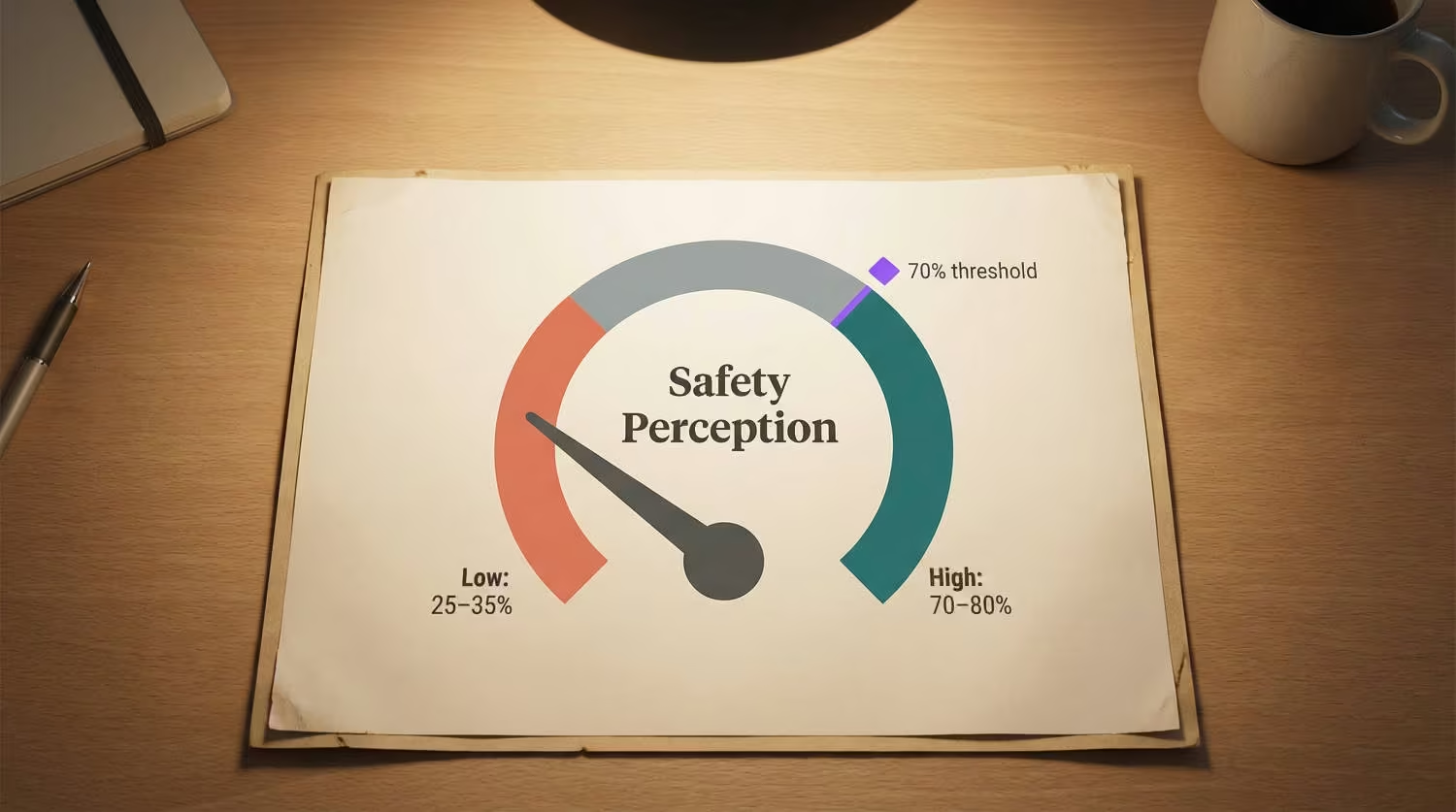
  2. ROAR for Good. Internal data, 2024. Internal data
  3. NSI Nursing Solutions. 2025 National Health Care Retention & RN Staffing Report. https://www.nsinursingsolutions.com/documents/library/nsi_national_health_care_retention_report.pdf