
Key Takeaways
- Safety systems that depend on facility power or Wi-Fi fail precisely when violence risk peaks—during storms, infrastructure failures, and high-census events that strain both staff and systems.
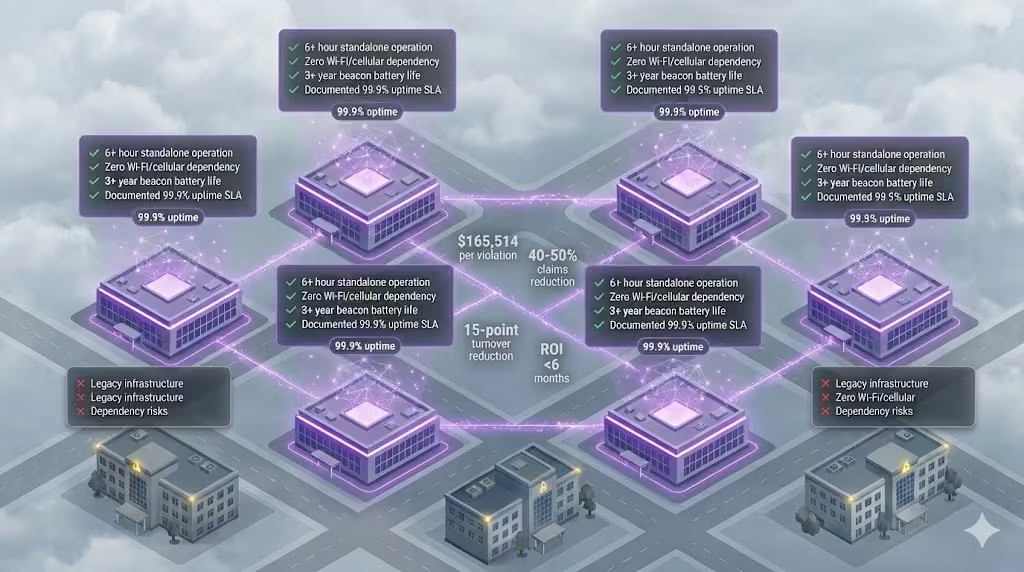
- Four specifications now separate validated solutions from procurement risk: 6+ hour device operation, zero network dependency, 3-year beacon batteries, and documented outage performance with 99.9% uptime.
- CTOs who require these standards position themselves as strategic enablers of operational resilience, defending their organizations against regulatory exposure and accreditation risks that follow system failures.
The Emerging Standard: What Peer Organizations Now Require
Enterprise health systems have begun requiring standalone power resilience as a procurement prerequisite—not a premium feature. In documented RFP cycles across behavioral health and integrated health systems, four specifications now appear as minimum requirements. Organizations still evaluating these capabilities as optional face a widening gap with peer institutions.
Healthcare workers face violence at five times the rate of other industries [1]. In behavioral health settings, 83% of nurses report experiencing violence in the preceding 12 months. Peer CTOs have recognized that the conditions generating incidents—storms, high-census events, infrastructure failures—are the same conditions that compromise Wi-Fi-dependent safety systems. This correlation has driven the shift toward standalone architecture requirements.
PEER STANDARDS
What are other CTOs requiring?
Four specifications now appear as minimum requirements in peer RFPs. See where you stand.
The four specifications appearing in peer RFPs:
1. Device operation without building power: 6+ hours minimum. In one documented deployment at an integrated health system, a four-hour power outage produced zero coverage gaps because devices operated independently on battery. Fully charged devices demonstrated 6–8 hours of continuous operation.
2. Network independence: Zero Wi-Fi or cellular dependency. Staff working in basements, stairwells, and parking garages—areas with poor Wi-Fi coverage—are often the most vulnerable to violence [2]. Standalone BLE mesh architecture eliminates this dependency entirely, providing 100% facility coverage including traditional dead zones.
3. Beacon battery life: 3+ years. Three-year batteries reduce total cost of ownership and eliminate rotating dead zones across multi-site deployments.
4. Documented outage performance: Real customer case studies. Validated solutions demonstrate 99.9% uptime verified by SLA, with 93% of incidents resolved in under two minutes. Customer retention rates of 99–99.5% on multi-year contracts signal sustained operational satisfaction.
The Gap: Where Most Organizations Fall Short
Organizations that have not updated procurement requirements face measurable exposure. The regulatory environment has shifted: $165,514 per willful OSHA violation [3], up to $75,000 per Joint Commission finding [4], and $2–5 million in annual funding at risk from accreditation loss.
The financial case peer organizations have used to close this gap centers on claims reduction data. Deployments demonstrate 40–50% reduction in workers’ compensation claims tied to violence and injury. At one behavioral health facility, claims decreased 24% in year one, contributing to a MOD score improvement of nearly 50%. A national behavioral health provider achieved 50% reduction in compensation claims within six months of deployment.
Concerned about the 44.8% gap? Let’s discuss how to close it
The turnover economics reinforce the business case. Each 1% reduction in RN turnover saves hospitals $263,000 annually in recruitment, training, and labor costs [5]. In one multi-site deployment, staff considering leaving due to safety concerns dropped from 22% to 7%—a 15 percentage point reduction in turnover intent. The cost to replace a single bedside RN reaches $61,110.
The capex efficiency supports straightforward approval. Documented deployments show $182 per staff member for complete solution implementation—a fraction of the $22,300 average cost per lost-time injury claim. Time to value under six months with 200% average first-year ROI provides board-defensible metrics.
Closing the Gap: How to Align with Peer Standards
When presenting to governance bodies, the peer-evidence approach proves effective. Leading health system technology leaders no longer evaluate power resilience as a premium feature—they require it as a procurement prerequisite, and their boards are approving the investment based on quantified returns.
Evidence from peer deployments warrants attention: standalone safety architecture operating during a documented four-hour facility outage with zero coverage gaps. Response times of 25–36 seconds for critical incidents. Customer retention of 99–99.5% across multi-year contracts.
A reasonable starting point: before the next contract renewal, validate current system behavior under simulated outage conditions. Disconnect facility power and Wi-Fi, then verify whether alerts still route to security. Document the results against the four specifications peer organizations now require.
WIDENING GAP
Peer CTOs already require this. Do you?
$165K per OSHA violation. $75K per Joint Commission finding. The standard has shifted.
Procurement Implications
The gap between organizations requiring these standards and those treating them as optional continues to widen. Peer CTOs who have adopted these requirements report stronger board support for safety infrastructure investments—the specifications provide objective criteria that shift the conversation from “should we invest more in safety?” to “does our current system meet the standard?”
Download the Power Resilience Benchmark Summary to share with your leadership team before your next vendor evaluation.
Concerned about the 44.8% gap? Let’s discuss how to close it