
Nursing Safety Confidence: Survey Evidence Your Team Needs

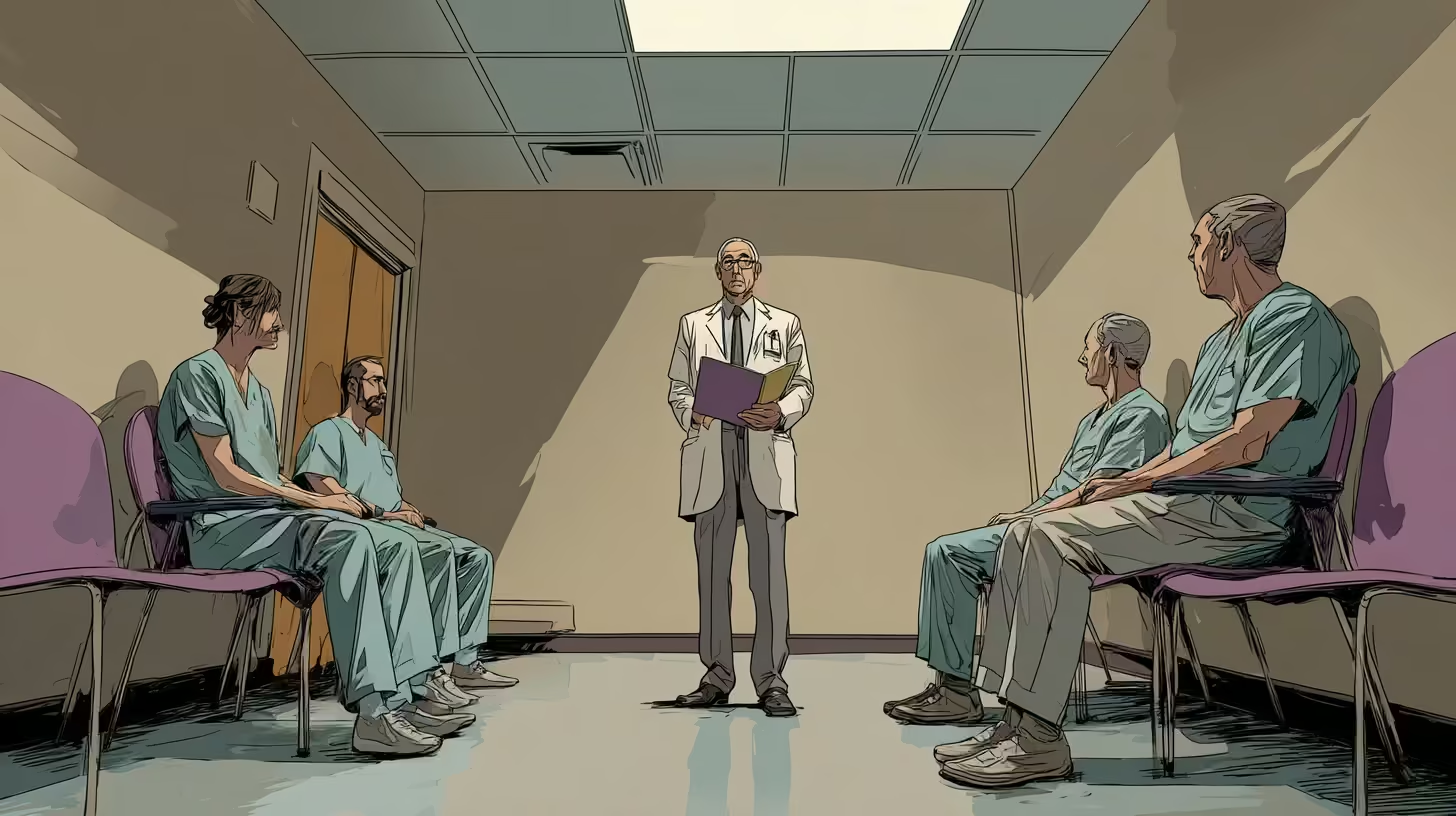
Nursing safety confidence contrast between policy-clutching nurse and confident prepared nurse facing surveyor

Key Takeaways

  • The anxiety CNOs feel before surveys centers on whether their nursing teams can demonstrate capability on the spot, not whether the program itself works.
  • Most underreporting stems from staff who’ve given up on reporting processes that produce no visible results, and surveyors can see the gap in your numbers.
  • Confidence comes when your teams interact with safety systems daily, so describing protocols to a surveyor feels natural rather than rehearsed.

You know your nurses are capable. You’ve watched them de-escalate situations that could have turned violent. You’ve seen charge nurses manage crises with composure. But nursing safety confidence during a survey doesn’t come from what you’ve witnessed. It comes from what your team can show a surveyor who walks onto the unit unannounced and starts asking questions.

The questions that matter before any survey:

  • Can your charge nurse pull up response time data?
  • Can your night shift staff walk through the duress protocol without hesitating?
  • Can anyone on any unit describe what happens after an incident is reported?

That’s where the anxiety lives. Not in whether your program works, but in whether your team can prove it does.

The Gap Your Numbers Reveal

88% of healthcare workers who experienced violence never documented the incident in their facility’s reporting system. [1] Surveyors know this pattern. When they review your incident logs and the numbers look low, they don’t assume your facility is safe. They assume your system isn’t capturing reality.

The underreporting problem goes deeper than CNOs usually realize. Nearly half of nurses say incidents are simply ignored after being reported. [3] Only about a third say their employer gives them a clear way to report incidents at all. [3] Your nurses haven’t stopped documenting because they’re careless. They’ve stopped because the process feels pointless.

That’s the hardest part. You’re responsible for evidence your staff have given up generating.

“Your nurses haven’t stopped documenting because they’re careless. They’ve stopped because the process feels pointless. That’s the hardest part. You’re responsible for evidence your staff have given up generating.”

When a surveyor pulls your incident data, they’re not looking for low numbers. They’re looking for numbers that make sense given your patient population and acuity. If your behavioral health units show 12 documented incidents over 6 months, the surveyor will probe. And the answers your nurses give in confidential interviews will tell a different story than your logs.

What Surveyors See When They Interview Your Staff

Surveyors interview nurses across shifts, roles, and units without advance notice. [4] They ask staff to describe violence prevention procedures in their own words. They’re looking for genuine understanding, not rehearsed answers. [4]

Here’s the pattern across behavioral health units: staff who use safety systems daily can describe them naturally. Staff who last touched the system during orientation stumble. A surveyor asks your charge nurse “how quickly does help arrive when you activate the duress system?” She either has data or she has a guess. That moment shapes the next 30 minutes of your survey.

The gap between day shift and night shift readiness is where most CNOs get caught. Day shift staff see leadership regularly, get reminders, stay current. Night shift and weekend staff operate with less oversight, and surveyors deliberately test that inconsistency. [4]

Try this before your next survey: pull two nurses from different units, one from days, one from nights. Ask them “what happens if de-escalation fails?” If their answers don’t align, if they hesitate, that’s exactly what the surveyor will see.

If the gap between what your team does and what your records show is keeping you up at night, we can help you close it.

Contact Us

What Confidence Actually Looks Like

The shift happens when your staff interact with safety systems often enough that describing them becomes second nature. In facilities with documented safety systems, the share of staff who feel “very prepared” to respond to incidents nearly doubled after deployment. [2]

That confidence shows during surveys. Staff who feel prepared to respond to incidents feel prepared to describe that response to a surveyor. They don’t need the policy binder. They don’t need prompting. They can show it because they do it.

The evidence follows naturally. Facilities with documented response times show 93% of incidents resolved in under 2 minutes, and the data generates automatically without nurses stopping mid-crisis to fill out forms. [2] That matters for CNOs worried about adding burden to units that are already stretched thin.

See how one behavioral health provider documented these results across their facilities.

From Anxiety to Nursing Leadership

60% of nurses have changed or left their job, or considered leaving, due to workplace violence. [5] The stakes go beyond accreditation. Keeping your staff safe and being able to prove it protects both your team and your ability to recruit and retain nurses.

Behavioral health facilities with documented safety technology have passed every Joint Commission and OSHA inspection in tracked deployments. [2] But the real shift isn’t the pass rate. It’s what happens to your team. When your nurses can show capability and your records back them up, survey questions stop being moments to survive. They become opportunities to demonstrate what you’ve built.

Nursing safety confidence isn’t about passing the next survey. It’s about building teams who know they’re protected and can prove it to anyone who asks.

Before your next survey window:

  • Can staff on each shift describe duress activation without referencing written materials?
  • Do you have response time data by unit and shift for the past 90 days?
  • Can you show the investigation trail for your 3 most recent documented incidents?
  • Have charge nurses practiced answering surveyor questions with someone outside their unit?
  • Does your incident count reflect the reality your night shift nurses would describe in a confidential conversation?

NURSING CONFIDENCE

Give Your Team the Evidence They Deserve

Staff who feel very prepared to respond to incidents nearly doubled after deployment. See what nursing safety confidence looks like with documented systems.

References

  1. National Institutes of Health. Workplace Violence in Healthcare. https://pmc.ncbi.nlm.nih.gov/articles/PMC12009039/
  2. ROAR for Good. Internal Data, 2024.
  3. National Nurses United. Workplace Violence Report. https://www.nationalnursesunited.org/sites/default/files/nnu/documents/0224_Workplace_Violence_Report.pdf
  4. Safe Management. Getting Ready for Survey Questions to Ask Staff. https://safemgt.com/2020/10/01/getting-ready-for-survey-questions-to-ask-staff/
  5. ROAR for Good. An Analysis of Workplace Violence Statistics in Healthcare. https://www.roarforgood.com/blog/an-analysis-of-workplace-violence-statistics-in-healthcare/

15 Accreditation Survey Questions About Staff Duress Deployment

Staff duress deployment FAQ - healthcare executive with organized evidence folders ready for surveyor review

Healthcare accreditation surveys test whether your violence prevention program works — not just whether it exists on paper. These FAQs cover what Joint Commission surveyors evaluate, where facilities get cited, how different leaders prepare, and why staff duress deployment changes the evidence equation during accreditation visits.

What do Joint Commission surveyors actually evaluate in a violence prevention program?

Surveyors assess four evidence categories: staff awareness, response capability, incident tracking, and leadership accountability. They walk units, interview frontline staff, and pull random incident records to trace follow-through — they do not sit in a conference room reviewing policy binders. The gap between having a program and proving it works on demand is where most citations start. Surveyors can tell within minutes whether your evidence reflects active operations or last-minute compilation.

Why do strong violence prevention programs still fail accreditation surveys?

Programs fail surveys because of documentation gaps, not missing protocols. A facility can have excellent de-escalation training and fast response times, but if those outcomes are not captured in retrievable records, surveyors treat them as unverified claims. More than 80% of workplace violence incidents go unreported, which means incident logs often understate what actually happens on units. Surveyors compare staff interview answers against documented records, and inconsistencies trigger deeper scrutiny.

What are the most common citation risks during behavioral health surveys?

The two dominant citation categories are inadequate training records and leadership oversight failures — each flagged in more than half of behavioral health surveys with violence prevention findings. Other common risks include investigation trails that stop at the initial report, multi-site inconsistency in protocol execution, and underreporting that makes incident logs look artificially low. Night-shift and weekend staff who cannot articulate protocols are a frequent surveyor exploit point.

How quickly do surveyors expect facilities to produce evidence?

Surveyors expect response time data, system reliability records, and coverage verification within 30 minutes of a request. Investigation records and training documentation typically fall within a 24-hour window. Facilities with automated systems pull dashboards in seconds, while manual programs often spend hours compiling spreadsheets and hoping the gaps are not obvious. That speed difference shapes the entire tone of the survey conversation.

What specific questions do surveyors ask frontline staff?

Surveyors ask staff to describe what they would do during a violent incident, how they would call for help, what happened after the last incident they witnessed, and whether they feel the organization responds to reports. These questions test whether protocols live in daily practice or only in training binders. A charge nurse on night shift gets the same questions as a day-shift manager, and a locum who started last week gets the same questions as a ten-year veteran. Staff answers must be consistent across roles, shifts, and sites.

Who owns what during accreditation survey preparation?

The CEO owns delegation and governance proof, not protocol details. The CMO coordinates across clinical leadership to verify physician and staff competency documentation. The CNO ensures unit-level evidence is producible across all shifts, and the CSO owns response capability and system reliability records. Survey readiness breaks down when everyone assumes someone else owns a deliverable. A named delegation table with specific owners, deliverables, and timelines prevents that failure.

How does staff duress deployment technology change survey outcomes?

Automated systems generate timestamped response data, continuous monitoring proof, and coverage verification as a byproduct of daily operations. Facilities with documented safety technology show 93% of incidents resolved in under two minutes — a number that ends surveyor follow-up questions immediately. These facilities produce evidence that already exists rather than compiling it under pressure. The result is that survey readiness becomes continuous instead of episodic.

How should leaders handle the anxiety of an upcoming survey?

Survey anxiety usually comes from knowing your program works but not being sure your records can prove it. That gap between operational confidence and documentation confidence is real, and it affects CNOs, CSOs, and CEOs differently. The fix is building systems where evidence generates automatically through daily use so preparation sprints become unnecessary. When any record is producible in under 30 minutes, the survey window stops feeling like a threat.

What financial consequences follow accreditation loss?

Accreditation loss can suspend Medicare and Medicaid billing immediately, putting millions in annual revenue at risk for behavioral health systems. OSHA penalties for willful workplace violence violations now exceed $165,000 per violation. Beyond direct financial exposure, boards need to see accreditation protection framed as risk mitigation alongside program effectiveness and workforce stability data.

How do peer-leading organizations prepare differently for surveys?

Peer-leading programs generate evidence continuously rather than compiling it before a survey window opens. Their security directors open dashboards instead of flipping through binders. Their CNOs can pull five random incidents and show complete investigation trails on demand. The clearest benchmark is evidence speed — how long it takes to produce incident trending data when a surveyor asks. Organizations that pass surveys with confidence are not better at preparing; they are better at making preparation unnecessary.

What is the single best test to check survey readiness right now?

Pull your incident trending data for the past 90 days. If that takes more than 30 minutes, your evidence infrastructure has a gap surveyors will find. Then ask a night-shift charge nurse to walk through your violence response protocol without checking any reference materials. Those two tests — evidence speed and staff demonstration capability — reveal more about your readiness than any policy review.

Does higher incident reporting hurt or help during a survey?

Higher documented incident counts actually strengthen your position with surveyors. Facilities that report more incidents demonstrate an active reporting culture, which surveyors value far more than artificially low numbers. When 81% of incidents go unreported industry-wide, low counts signal underreporting rather than safety. Surveyors look for trending data that reflects actual acuity levels paired with complete investigation follow-through on every reported event.

How should multi-site systems handle consistency across facilities?

Multi-site inconsistency is one of the most common citation risks in behavioral health surveys. Surveyors expect the same protocols, documentation standards, and staff competency levels at every location. Corporate offices typically own policy standards, but each facility must demonstrate local execution with its own evidence. Automated systems help because they enforce the same data capture process everywhere, eliminating site-by-site variation in how records are generated.

What should a CEO present to the board about survey readiness?

Present documented outcomes across three lenses: risk mitigation, program effectiveness, and workforce stability. Show response time data, incident trending over six months, staff confidence metrics, and investigation completion rates — not policy summaries. Each data point should connect to a financial consequence the board already tracks, like OSHA penalty exposure or RN turnover costs. If you cannot pull any of those numbers today, that gap is what needs to be fixed before the next board meeting.

How far in advance should survey preparation start?

Survey preparation should not start at all — it should already be happening. The most effective programs treat evidence generation as a daily operational function, not a pre-survey sprint. For organizations closing gaps, a 90-day action sequence covers the highest-priority items: export testing, investigation trail audits, night-shift readiness checks, and governance reporting verification. Mock surveys conducted during that window can reduce official findings by 20–30%.

Staff Duress Deployment Data: Survey Evidence Guide

Staff duress deployment data underreporting: one nurse files report while four colleagues ignore blank forms

Key Takeaways

  • More than half of behavioral health surveys with violence prevention findings cite training gaps, and over half cite leadership oversight failures, making these the two highest-risk areas for accreditation.
  • Documented outcome data from facilities with safety technology shows measurable response times, incident reduction, and pass rates that satisfy what surveyors evaluate.
  • A CMO evidence portfolio covering response capability, incident trending, training competency, and governance reporting provides the survey-ready documentation that policy binders alone can’t deliver.

About 56% of behavioral health surveys with violence prevention findings cite inadequate training records. Another 55% cite leadership oversight gaps [1]. These aren’t edge cases. They’re the two most common reasons behavioral health facilities run into trouble during accreditation visits. This staff duress deployment data brief compiles the outcome evidence that demonstrates program effectiveness when surveyors come looking for proof.

The Citation Pattern

The data tells a consistent story. The most common citation category involves training records that prove attendance but not competency [1]. Sign-in sheets show who was in the room. Surveyors want evidence that staff retained what they learned and can demonstrate it on the spot.

Leadership oversight gaps follow close behind. Surveyors look for board reporting, leadership rounding observations, and executive participation in program development [1]. When those records are missing or inconsistent, the citation targets leadership accountability rather than frontline performance.

Underneath both patterns sits an underreporting problem that makes the numbers worse. 81% of workplace violence incidents go unreported by healthcare workers who experienced them [2]. Only about a third of nurses say their employer gives them a clear way to report [3]. Behavioral health settings face the highest violence rates in healthcare, with psychiatric facilities seeing roughly 11 times the incident rate of the general workforce [4]. When surveyors interview staff who’ve experienced violence but see no corresponding records, the gap reflects directly on program credibility.

The combination is what creates accreditation risk: high incident environments with low documentation rates and training records that don’t prove competency.

Outcome Evidence That Satisfies Surveyors

Facilities with documented safety technology produce measurable outcomes that map directly to what surveyors evaluate. The data shows consistent patterns across tracked deployments:

Evidence CategoryDocumented OutcomeWhy It Matters
Inspection results100% Joint Commission and OSHA pass rate [5]Direct accreditation evidence from facilities with systematic tracking
Response capability93% of incidents resolved in under 2 minutes [5]Quantified response data replaces anecdotal estimates
Incident reduction39% reduction in patient-staff incidents within 3 months [5]Measurable program effectiveness over time
Staff preparednessStaff feeling “very prepared” increased from 38% to 76% after deployment [5]Training effectiveness with before-and-after data

The practical difference matters. When a surveyor asks how quickly help arrives, pulling a report showing documented response times with historical trending ends the conversation. An estimate invites follow-up questions that get harder with each one.

See how one behavioral health provider documented these results across their facilities.

Behavioral health facilities show 40% reduction in assaults against staff within six months of deployment [5]. That trajectory matters for CMOs building internal business cases: the same data that satisfies surveyors demonstrates ROI to the board.

The Financial Stakes

Accreditation loss can suspend Medicare and Medicaid billing, putting millions in annual revenue at risk for behavioral health systems [6]. OSHA penalties for willful workplace violence violations exceed $165,000 per violation [7]. Beyond penalties, the regulatory exposure includes CMS reviewing compliance with its own standards when Joint Commission accreditation lapses [8].

But the financial case extends past risk avoidance. Each percentage point change in RN turnover costs roughly $289,000 annually [9]. Facilities with documented safety systems report measurable improvement in staff feeling safe at work [5], and that connection between documented safety and retention is the number that resonates with CFOs and boards.

Want to see what documented outcome evidence looks like for your facilities?

Request a Demo

Building Your Evidence Portfolio

CMOs preparing for accreditation should verify they can produce staff duress deployment data across these categories:

  • Response capability: documented response times with trending by unit and shift. Can you pull this for any quarter a surveyor selects?
  • Incident trending: data showing volume, location, shift, and time-of-day patterns formatted for board reporting with quarter-over-quarter comparisons.
  • Training competency: pre-training and post-training assessment scores for all staff, including travelers and agency nurses. Attendance records without competency proof are the single most cited gap [1].
  • Investigation follow-through: complete trails from incident report through root cause analysis, corrective action, and resolution for every documented event. Surveyors pull 5-10 random incidents and review each trail [10].
  • Governance reporting: quarterly safety data presented to leadership with evidence of discussion and follow-up action.

Behind the 81% underreporting rate are staff who’ve experienced violence and concluded that documenting it changes nothing. Systematic documentation changes that calculation by making every incident visible and every response measurable. For CMOs, the staff duress deployment data compiled here provides the evidence that surveyors evaluate and that policy binders alone can’t deliver.

SURVEY EVIDENCE

Build Your Evidence Portfolio Before Surveyors Arrive

Facilities with documented safety systems produce the outcome evidence surveyors evaluate. See what that looks like for your organization.

References

  1. National Library of Medicine. “Behavioral Health Survey Findings.” https://pmc.ncbi.nlm.nih.gov/articles/PMC8816837/
  2. Agency for Healthcare Research and Quality (AHRQ) PSNet. “Addressing Workplace Violence and Creating a Safer Workplace.” 2023. https://psnet.ahrq.gov/perspective/addressing-workplace-violence-and-creating-safer-workplace
  3. National Nurses United. “High and Rising Rates of Workplace Violence.” February 2024. https://www.nationalnursesunited.org/sites/default/files/nnu/documents/0224_Workplace_Violence_Report.pdf
  4. Sheps Center at University of North Carolina. “Trends in Workplace Violence for Health Care Occupations.” January 2025. https://www.shepscenter.unc.edu/wp-content/uploads/2025/01/Y10.01_Brief-1.pdf
  5. ROAR for Good. Internal Data, 2024.
  6. Facilio. “Healthcare CMMS for Joint Commission Compliance in 2025.” https://facilio.ae/blog/healthcare-joint-commission-compliance/
  7. Safety + Health Magazine. “OSHA and MSHA Civil Penalty Amounts Going Up.” January 2025. https://www.safetyandhealthmagazine.com/articles/26317-osha-and-msha-civil-penalty-amounts-going-up
  8. CMS. “Workplace Violence in Hospitals Memorandum.” https://www.cms.gov/files/document/qso-23-04-hospitals.pdf
  9. NSI Nursing Solutions, Inc. “2025 National Health Care Retention & RN Staffing Report.” March 2025. https://www.nsinursingsolutions.com/documents/library/nsi_national_health_care_retention_report.pdf
  10. The Joint Commission. “Workplace Violence Prevention Program.” https://www.jointcommission.org/en-us/knowledge-library/workforce-safety-and-well-being-resource-center/workplace-violence-prevention/workplace-violence-prevention-program

Staff Duress Deployment Comparison: Evidence Types

Staff duress deployment comparison - incident form fading to show 81% unreported violence

Key Takeaways

  • Documentation-only approaches have structural limitations that create gaps surveyors are trained to identify, regardless of how thorough the policies are.
  • Technology-generated evidence addresses those gaps by producing timestamped, continuous records that match what surveyors specifically request.
  • A comparison matrix mapping documentation vs. technology evidence across six surveyor criteria helps CMOs assess where their current approach falls short.

Every behavioral health CMO faces the same question before an accreditation visit: does your evidence show that your violence prevention program works, or does it show that the program exists? The distinction matters because surveyors evaluate implementation through documented outcomes, not policy binders. This staff duress deployment comparison examines what each evidence type actually provides and where the gaps live.

Documentation Evidence: What It Shows and Where It Falls Short

Documentation-based approaches establish that a program exists. Policies are written, training is scheduled, incident forms are available. For surveyors, that’s the starting point, not the finish line.

The core limitation is structural: manual records depend on staff to document incidents during or after crisis moments. 81% of workplace violence incidents go unreported by healthcare workers who experienced them [1]. Only about a third of nurses say their employer gives them a clear way to report [2]. When staff focused on de-escalation don’t stop to log timestamps, records capture what people remember afterward, not what actually happened.

That gap compounds across every evidence area surveyors assess:

Evidence AreaWhat Documentation ProvidesWhere It Falls Short
Response capabilityAnecdotal estimates reconstructed after incidentsNo timestamped data showing how fast help actually arrived
Incident trackingReports filed by staff who chose to documentMisses the majority of incidents that go unreported
Staff readinessSign-in sheets proving training attendanceNo evidence that staff retained or can demonstrate what they learned
Investigation follow-throughInitial reports with varying levels of detailFollow-up trails that go cold after the first filing
Continuous monitoringPeriodic audits and spot checksNo proof the system was operational between checks

The limitations aren’t about effort. Security directors and CNOs working with manual systems aren’t doing it wrong. The system itself can’t capture what it depends on humans to record during the moments they’re least able to do so.

Technology Evidence: What Automated Systems Produce

Technology-generated evidence addresses the structural gap by capturing data as incidents happen rather than relying on post-incident documentation. The practical difference shows up in three areas surveyors specifically evaluate:

Timestamped response data. When a surveyor asks how quickly help arrives, facilities with automated systems pull documented response times with historical trending. Facilities with documented safety systems show 93% of incidents resolved in under 2 minutes [3]. That’s a different conversation than “we respond quickly.”

Continuous monitoring proof. Surveyors request 90-day trending data as a minimum for analysis [4]. Automated systems generate this continuously, analyzed by unit and shift. Manual compilation of the same data after a survey is announced creates gaps in detail and consistency that surveyors notice.

Coverage verification. Surveyors walk facilities including stairwells, parking structures, and utility areas [4]. They check whether staff can summon help from every location. Automated systems document coverage across the full facility including outdoor areas. Manual approaches rely on assumed coverage that hasn’t been verified since the last walkthrough.

Facilities with documented safety technology have passed every Joint Commission and OSHA inspection in tracked deployments [3]. The evidence surveyors request already exists in the system. There’s no compilation step.

Technology doesn’t solve everything. When surveyors interview your night shift and hear that staff don’t activate the system because they believe nothing will change, your documented response times don’t matter. The technology produces records. The culture determines whether those records reflect reality.

The Comparison

This matrix maps documentation and technology evidence against the specific criteria surveyors use during accreditation visits.

Surveyor CriterionDocumentation EvidenceTechnology EvidenceThe Question to Ask
Response time capabilityEstimated from incident reports, reconstructed after the factTimestamped from alert initiation through responder arrivalCan you produce response timestamps within 30 minutes of a surveyor request?
Coverage verificationSelf-reported coverage maps from periodic walkthroughsDocumented coverage across all areas including stairwells and outdoor spacesAre there areas where staff can’t summon help?
How many incidents your system capturesManual reporting dependent on staff willingness and awarenessAutomated capture with location, timestamp, and response dataWhat percentage of incidents actually reach your system?
Continuous monitoring proofPeriodic audits and spot checks with no continuous verificationSystem availability records showing consistent operation over 90+ daysCan you prove your safety system was operational every day for the past quarter?
Trending data availabilityCompiled after survey announcement, may lack unit-level detailRolling 90-day data analyzed by unit, shift, and time periodDo you have 90 days of trending data ready to produce today?
Staff readiness evidenceTraining attendance records with annual sign-offsStaff preparedness metrics showing measurable improvement over time [3]Can your staff demonstrate competency, or just prove they attended?

The pattern across facilities: documentation evidence establishes that a program exists. Technology evidence proves it works. Surveyors can tell the difference within minutes of reviewing your records.

See how one behavioral health provider documented these results across their facilities.

Your Evidence Assessment

Before your next survey window, assess where your current evidence falls on the comparison matrix:

  • Response time test. Request your own 90-day response data. Can your team produce it in under 30 minutes? If it requires manual compilation from multiple systems, you’re in the documentation column.
  • Coverage walkthrough. Walk your stairwells, parking structures, and outdoor areas. Can staff activate duress from every location, or are there dead zones you’ve been assuming don’t exist?
  • Incident capture reality check. Compare your incident logs to what your night-shift nurses would describe in a confidential surveyor interview. If those numbers don’t align, your records aren’t capturing reality.
  • Trending data readiness. Do you have 90 days of incident data analyzed by unit, shift, and time period ready to produce today? Not after a week of compilation. Today.
  • Staff competency verification. Pull three staff from different shifts this week. Ask them to describe the response protocol in their own words. Note who hesitates.

The staff duress deployment comparison between documentation and technology evidence comes down to one question: can you show a surveyor that your program produces outcomes, or only that it exists? For CMOs preparing for accreditation, the evidence portfolio you build determines which answer your organization gives.

EVIDENCE COMPARISON

See What Technology Evidence Looks Like at Your Facility

Behavioral health facilities with documented safety systems produce the evidence surveyors request on demand. See how documentation and technology evidence compare for your organization.

References

  1. Agency for Healthcare Research and Quality (AHRQ) PSNet. “Addressing Workplace Violence and Creating a Safer Workplace.” 2023. https://psnet.ahrq.gov/perspective/addressing-workplace-violence-and-creating-safer-workplace
  2. National Nurses United. “High and Rising Rates of Workplace Violence.” February 2024. https://www.nationalnursesunited.org/sites/default/files/nnu/documents/0224_Workplace_Violence_Report.pdf
  3. ROAR for Good. Internal Data, 2024.
  4. The Joint Commission. “Workplace Violence Prevention Program.” https://www.jointcommission.org/en-us/knowledge-library/workforce-safety-and-well-being-resource-center/workplace-violence-prevention/workplace-violence-prevention-program

Clinical Safety Program Evidence for Joint Commission Surveys

Clinical safety program surveyor interview - three prepared staff, one empty chair with folder

Key Takeaways

  • Surveyors verify staff awareness through targeted interviews, and your medical staff’s answers determine whether your violence prevention program passes or fails.
  • The CMO’s role isn’t to prepare every team directly but to coordinate across departments so clinical staff, physicians, and APPs can all demonstrate competency on demand.
  • Documentation that shows active capability, not just policy existence, is what separates a confident survey from a citation.

When a surveyor turns to one of your physicians and asks them to describe your facility’s violence prevention protocols, what happens next depends on what you’ve built. Not the policy binder. Not the training sign-in sheet. Whether your medical staff can walk through the protocols in their own words, explain the alert system, and describe de-escalation techniques they’ve actually practiced. That’s the clinical safety program evidence surveyors evaluate, and preparing your clinical teams to deliver it is the CMO’s job.

What Surveyors Ask Your Clinical Staff

The 2024 Joint Commission standards require surveyors to verify staff awareness through direct interviews. They ask staff to: [1]

  • Describe what counts as workplace violence in their facility
  • Explain the alert protocol or emergency response procedure
  • Walk through de-escalation techniques they’ve been trained on
  • Explain how to report a violent incident

Your medical staff need to answer these confidently. Distributing policies isn’t enough. Staff need to articulate protocols in their own words and show they understand how to apply them.

Here’s what typically happens across behavioral health facilities: staff can recite policy language but stumble on specifics. “What do you do if a patient in the day room becomes aggressive toward another patient?” The answer shouldn’t require checking a laminated card.

In facilities with documented safety systems, staff who feel “very prepared” to respond to incidents nearly doubled after deployment. [2] Those gains require sustained reinforcement though. Without quarterly refreshers, preparedness scores tend to drift back toward baseline.

The CMO’s Coordination Role

Survey readiness isn’t something you prepare alone. Your role is making sure every department can demonstrate competency when a surveyor walks in.

OwnerDeliverableTimeline
CNOPreparation plans for nursing staff on the four surveyor questions30 days before survey window
CMO (you)Physician and APP competency verification, including attendings and locum tenens30 days before survey window
Unit ManagersRapid competency checks with sample staff from each unit14 days before survey window
HR/EducationLocum tenens and new attending orientation with documented competencyOngoing

Physicians are the gap most CMOs miss. Your attendings may know clinical protocols cold but can’t describe the duress alert sequence. APPs rotate across units and may not know facility-specific response procedures. Locum tenens are the highest risk. Surveyors may interview anyone, and a locum who started last week gets the same questions as a 10-year veteran.

If your survey window opens in less than 3 months and you have high physician turnover, prioritize locum tenens and new attendings first. The four questions above are the prep list.

Documentation Surveyors Request

Surveyors want specific evidence your program works, not just that it exists. They request response time data, system reliability records, incident investigation trails, and governance reporting. [3]

Surveyor RequestWhat They WantYour Production Window
Response time trendingAlert-to-arrival timestamps by unit, shift, and incident typeWithin 30 minutes
System reliabilityUptime records and coverage verificationWithin 30 minutes
Incident investigationEach incident with timeline, investigation notes, and resolutionWithin 24 hours
Governance reportingQuality committee minutes showing trending analysis reviewWithin 24 hours

Facilities with documented response times show 93% of incidents resolved in under 2 minutes. [2] That’s the kind of benchmark your quality committee can report to governance. Think of it like a flight recorder for every incident. You can’t argue with timestamps.

Work with your CSO to verify response time tracking exists. Make sure your compliance officer can pull incident investigation records. Your role as CMO is confirming these systems produce the evidence surveyors request within the timeframes above.

Joint Commission has issued over 100 requirements for improvement related to workplace violence since January 2022. [1] Governance reporting receives particularly high scrutiny. Surveyors check whether your quality committee minutes show actual discussion of violence prevention trends, not just slides presented.

If your survey window is approaching and you need help coordinating clinical team readiness, we can walk you through it.

Contact Us

Getting Your Program Survey-Ready

Facilities with documented safety technology show 39% reduction in patient-staff incidents in the first 3 months. [2] Worth noting: if your current incident capture is incomplete, numbers may actually increase early on as you capture events that previously went undocumented. That’s not failure. That’s visibility.

Pre-survey checklist:

  • Pull your last 3 quality committee minutes. Do they show documented discussion of violence prevention trends, or just slides?
  • Select 5 staff members randomly across units. Can each answer the four surveyor questions without prompting?
  • Request response time data for the past 90 days. Can your system produce it within 30 minutes?
  • Walk your facility’s perimeter areas, stairwells, and outdoor spaces. Does duress coverage extend to every location?
  • Review post-incident records for the past quarter. Is follow-up documented for each event?

For enterprise behavioral health organizations, consistency across facilities matters. Corporate sets standards, facilities execute. Surveyors may visit any site, and inconsistency across locations is a common citation area.

See how one behavioral health provider documented these results across their facilities.

Start with one question: can your medical staff articulate your clinical safety program protocols when a surveyor asks? If the answer is “I’m not sure,” that’s your first gap to close.

SURVEY READINESS

Prepare Your Clinical Teams with Documented Evidence

Facilities with documented safety systems show 93% of incidents resolved in under 2 minutes. See what survey-ready evidence looks like for your clinical program.

References

  1. The Joint Commission. Joint Commission Online – July 17, 2024. https://www.jointcommission.org/en-us/knowledge-library/newsletters/joint-commission-online/17-jul-24
  2. ROAR for Good. Internal Data, 2024.
  3. The Joint Commission. Data Collection. https://www.jointcommission.org/en-us/knowledge-library/workforce-safety-and-well-being-resource-center/workplace-violence-prevention/data-collection

Nursing Unit Safety: What Surveyors Check at Unit Level

Nursing unit safety incident board showing few posted cards while nurse shadow reveals many unreported held back

Key Takeaways

  • Surveyors evaluate violence prevention at the unit level through direct observation, staff interviews, and record review, not by reading policy binders in a conference room.
  • The biggest documentation gap is between what your units actually do and what they can prove on demand when a surveyor asks for records.
  • Preparing charge nurses and night shift staff to answer surveyor questions confidently matters as much as the documentation itself.

Surveyors don’t evaluate your violence prevention program from a conference room. They walk your units, interview your charge nurses, and ask staff to demonstrate protocols on the spot. The gap between having a strong nursing unit safety program and being able to prove it at the unit level is where most citations originate. This guide covers what surveyors actually check when they’re standing on your floor, where the documentation gaps hide, and how to close them before your next survey.

What Surveyors Check on Your Units

Joint Commission surveyors check violence prevention by watching it happen. They pick high-risk areas, pull actual incident records, and interview staff across different shifts. [1]

Here’s what most CNOs underestimate: surveyors deliberately test consistency across shifts and roles. They pay particular attention to night and weekend staff because that’s when things tend to slip. [2] Day shift might know the protocols cold. Night shift might know the policy exists but struggle to walk through the steps when asked directly.

Joint Commission has tightened the screws since 2022, issuing over 100 new requirements tied to workplace violence. [3] Behavioral health facilities face the highest scrutiny, and the stakes are real. Accreditation loss can put millions in annual Medicare and Medicaid funding at risk. [4]

Quick checks for your units:

  • Can your charge nurses on every unit demonstrate the duress response protocol on demand?
  • Do you have response time data for the past quarter that you can pull within 30 minutes?
  • Are your night shift and weekend staff as prepared as your day shift?

The Documentation Gap Most Units Miss

Your program may be effective. The question is whether your units can prove it when a surveyor asks.

81% of workplace violence incidents go unreported by healthcare workers who experienced them. [5] Nearly half of nurses say incidents are simply ignored by their employers after being reported. [6] When two-thirds of your nursing staff may not know how to document an incident in a way that creates the record surveyors expect, the gap isn’t about willingness. Staff have given up on a process that produces no visible results.

Automated systems close part of this gap by creating records automatically as events happen, removing the documentation burden that causes underreporting. But the system handles records, not culture. When incidents get ignored after reporting, that requires leadership follow-through. Surveyors check for that too.

Quick checks:

  • What percentage of incidents on your units are actually documented?
  • Can you produce investigation follow-up records for incidents from 6 months ago?
  • Do your training records show that staff actually learned something, or just that they showed up?

If your survey window is approaching and your units need documentation support, we can help you assess readiness.

Contact Us

Building Unit-Level Evidence

Surveyors want proof in four areas at the unit level, and most units can’t produce it. (For the full organizational breakdown, see the Joint Commission survey readiness guide.)

What Surveyors RequestWhat Most Units HaveWhat Survey-Ready Units Produce
Training records with competency scores [7]Sign-in sheets showing attendancePre/post assessments with passing scores
Timestamped response data [1]Anecdotal estimates (“usually pretty fast”)Continuous response time logs
Investigation findings and corrective actions [1]Incomplete incident reportsFull investigation trails with follow-through
Evidence of coverage across all areasAssumed coverageDocumented coverage with no dead zones

Here’s how surveyors test this: they pick a random incident from the past 6 to 12 months and ask to see the response records. They want timestamped proof of what happened and how fast. [1] Facilities with documented response times show 93% of incidents resolved in under 2 minutes. [8] That’s the kind of data surveyors can check immediately, and the kind most units can’t pull from manual logs.

Preparing Staff for Surveyor Questions

Surveyors ask your frontline nurses specific questions. Your staff either answer confidently or they don’t.

Common surveyor questions include: “What constitutes workplace violence in this facility?” “How do you report a workplace violence incident?” “Describe what you do if a patient becomes aggressive.” “How quickly can you get help if you need it?” [2]

Preparation ElementNurse ManagerCharge NurseYour Role as CNO
Question preparationTrain staff on expected questionsConduct unit-level drillsVerify consistency across units
Protocol demonstrationEnsure staff can show protocolLead practice sessionsObserve readiness during rounding
Shift coveragePrepare all shifts equallyBrief incoming shift staffAudit night and weekend preparedness

In facilities with documented safety systems, the share of staff who feel “very prepared” to respond to incidents nearly doubled after deployment. [8] That shift typically takes 45 to 90 days to settle across a facility, longer if turnover is high.

Don’t forget float staff and agency nurses. Surveyors may interview anyone on your unit. Agency staff know their clinical protocols but often don’t know your specific duress response sequence.

Getting Survey-Ready

If your survey window opens in less than 3 months, focus on these priorities:

  • Response time data first. If you can’t show response times for the past quarter, that’s your biggest gap.
  • Staff preparation on surveyor questions. Run through the six questions above with every shift on every unit.
  • Unit-by-unit assessment. Use the quick checks throughout this guide. The gaps you find will tell you exactly where to focus.
  • Night and weekend shift gaps. Address these immediately. Surveyors test consistency across shifts deliberately.

See how one behavioral health provider documented these results across their facilities.

Start with one unit. Run through the checks. The gaps you find will tell you exactly where to focus your nursing unit safety preparation before surveyors arrive.

SURVEY READINESS

Get Your Units Survey-Ready

Facilities with documented safety systems show 93% of incidents resolved in under 2 minutes. See what automated evidence looks like at the unit level.

References

  1. Joint Commission. Survey Activity Guides. https://www.jointcommission.org/en-us/knowledge-library/support-center/survey-or-review-preparation/survey-activity-guides
  2. Barrins & Associates. Preparing for Behavioral Health Outcomes. https://barrins-assoc.com/tjc-cms-blog/behavioral-health/preparing-for-behavioral-health-outcomes/
  3. Joint Commission. Preventing Workplace Violence. https://www.jointcommission.org/en-us/standards/national-performance-goals/preventing-workplace-violence
  4. Facilio. Healthcare Joint Commission Compliance. https://facilio.ae/blog/healthcare-joint-commission-compliance/
  5. AHRQ PSNet. Addressing Workplace Violence and Creating Safer Workplace. https://psnet.ahrq.gov/perspective/addressing-workplace-violence-and-creating-safer-workplace
  6. National Nurses United. Workplace Violence Report. https://www.nationalnursesunited.org/sites/default/files/nnu/documents/0224_Workplace_Violence_Report.pdf
  7. Joint Commission. Workplace Violence Prevention Program. https://www.jointcommission.org/en-us/knowledge-library/workforce-safety-and-well-being-resource-center/workplace-violence-prevention/workplace-violence-prevention-program
  8. ROAR for Good. Internal Data, 2024.

Safety Board Presentation: Accreditation Evidence Guide

Safety board presentation evidence gap - surveyor hand reaching for purple metrics folder bypassing thick policy binder

Key Takeaways

  • A board-ready safety presentation covers four areas: response capability, incident trending, staff readiness, and governance reporting.
  • Framing safety technology as risk mitigation and workforce retention resonates with boards more than compliance language.
  • A five-item pre-presentation checklist helps CEOs verify they can back up every slide with documented evidence.

Accreditation survey windows create board questions. When your board asks whether the organization is ready, a safety board presentation built on documented evidence gives you a fundamentally different conversation than one built on policy summaries. This brief gives you the structure, the metrics, and the checklist to walk in prepared.

Why Your Board Needs to See This

Accreditation loss suspends Medicare and Medicaid billing. For behavioral health systems, that puts millions in annual revenue at risk [1]. Joint Commission surveyors now verify that violence prevention programs produce documented outcomes, and they expect leadership to show personal engagement with those outcomes [2].

Your board evaluates you partly on your ability to prepare the organization for successful surveys [3]. This presentation gives them the evidence that you have.

The Evidence Your Board Should See

Your safety board presentation should cover four evidence areas. These are the same categories surveyors evaluate during accreditation visits, translated into board-level metrics.

Evidence AreaWhat to PresentWhy It Matters to the Board
Response capabilityAverage response time data by unit and shiftShows the program works with measurable speed, not just policies
Incident trendingQuarter-over-quarter data showing incident volume and resolution patternsDemonstrates whether the program is improving outcomes over time
Staff readinessTraining completion rates with competency verificationProves staff can demonstrate capability when surveyors interview them
Governance reportingQuarterly review records showing leadership engagement with safety dataSatisfies the Joint Commission requirement that incidents reach governance [2]

Facilities with documented safety systems can produce this evidence in minutes [4]. If your team needs days to compile the same data, that gap is worth addressing before your next survey window.

See how one behavioral health provider documented these results across their facilities.

How to Frame It for Your Board

Boards respond to three lenses. Structure your safety board presentation around them:

  • Risk mitigation. Accreditation protection is insurance language boards understand. OSHA penalties for willful workplace violence violations now exceed $165,000 per violation [5]. Position documented safety systems as protection against regulatory and financial exposure.
  • Program effectiveness. Facilities with documented safety technology show measurable incident reduction in the first year [4]. Present before-and-after data that demonstrates your program produces outcomes, not just compliance artifacts.
  • Workforce stability. Staff who feel protected stay longer. Each percentage point change in RN turnover costs roughly $289,000 annually [6]. Documented safety systems show measurable improvement in staff confidence [4], and that connection between safety investment and retention resonates with boards watching staffing costs.

When a board member asks the follow-up question about what happens if you pass accreditation but still have an incident, the answer is straightforward: documented evidence shows you had a functioning system when it occurred.

“When a board member asks what happens if you pass accreditation but still have an incident, the answer is straightforward: documented evidence shows you had a functioning system when it occurred.”

Want to see what board-ready accreditation evidence looks like for your facility?

Request a Demo

Your Pre-Presentation Checklist

Before you present to your board, verify you can back up every claim:

  • Pull response time data for the most recent quarter. Can you produce it in under 5 minutes, broken out by unit?
  • Check your incident trending data. Does it show quarter-over-quarter patterns, or just a snapshot?
  • Confirm training completion rates include competency verification, not just attendance records.
  • Review your governance reporting trail. Can you show the board has received quarterly safety updates with documented discussion?
  • Test the 6-month lookback: pick a random incident from 6 months ago and reconstruct the full timeline. How long does it take?

If any of those checks stall, you’ve found the gap to close before your next safety board presentation. Start with the response time pull. That single test tells you whether your evidence infrastructure is ready or whether you’re presenting promises instead of proof.

ACCREDITATION READINESS

Present Documented Evidence at Your Next Board Meeting

Behavioral health facilities with documented safety systems pass Joint Commission surveys with confidence. See what board-ready evidence looks like.

References

  1. Facilio. “Healthcare CMMS for Joint Commission Compliance in 2025.” https://facilio.ae/blog/healthcare-joint-commission-compliance/
  2. The Joint Commission. “R3 Report 42: Workplace Violence Prevention in Behavioral Health Care and Human Services.” https://www.jointcommission.org/en-us/standards/r3-report/r3-report-42/
  3. American Hospital Association. “Effective CEO Performance Evaluation and Board Governance.” https://trustees.aha.org/effective-ceo-performance-evaluation
  4. ROAR for Good. Internal Data, 2024.
  5. Safety + Health Magazine. “OSHA and MSHA Civil Penalty Amounts Going Up.” January 2025. https://www.safetyandhealthmagazine.com/articles/26317-osha-and-msha-civil-penalty-amounts-going-up
  6. NSI Nursing Solutions, Inc. “2025 National Health Care Retention & RN Staffing Report.” March 2025. https://www.nsinursingsolutions.com/documents/library/nsi_national_health_care_retention_report.pdf

Security Safety Brief Checklist for Survey Evidence

Ghostlike security officer rushing past surveyor who sees no evidence

Key Takeaways

  • Surveyors evaluate security directors on documented evidence of response capability, incident tracking, system reliability, and coverage verification.
  • A comparison of manual versus automated approaches shows where documentation gaps create citation risk.
  • A pre-survey checklist helps security directors verify they can produce every record a surveyor might request.

When a surveyor asks for your response time trending data from the past quarter, how long does it take you to produce it? Security directors with automated systems pull up a dashboard. Security directors with manual logs start digging through spreadsheets, hoping the gaps aren’t obvious. This security safety brief gives you the checklist to know which side of that line you’re on before the surveyor arrives.

Manual vs. Automated Evidence

The core problem is straightforward: surveyors verify action through documented evidence, and manual records have structural gaps that automated systems don’t. 81% of workplace violence incidents go unreported by healthcare workers who experienced them [1]. When logging depends on staff memory after a crisis, records capture what people remember to write down, often hours later, often incomplete.

The comparison matters for every evidence area surveyors assess:

Evidence AreaManual ApproachAutomated Approach
Response timesAnecdotal estimates, no timestampsDocumented response data with historical trending
Incident trackingHandwritten logs with gaps and delaysTimestamped records with location data
System reliabilityUnknown or estimated uptimeDocumented reliability records exportable on demand
Coverage verificationAssumed coverage across the facilityDocumented coverage maps including outdoor areas
Investigation follow-throughInitial report filed, trail goes coldFull trail from report through corrective action

Facilities with documented safety systems show 93% of incidents resolved in under 2 minutes [2]. That number matters because surveyors compare your data against what they’ve seen at peer facilities. When your data shows longer times or doesn’t exist, the conversation shifts.

“The test for each item: can you produce it within 30 minutes of a surveyor request? If any category requires hours of manual compilation, that’s the gap to close first.”

See how one behavioral health provider documented these results across their facilities.

Your Survey Evidence Checklist

Security directors should be able to produce evidence across four categories when surveyors arrive. This is what they’ll ask for:

Response capability:

  • Response time data with trending by unit and shift for the past 90 days
  • System reliability records showing consistent availability
  • Coverage verification confirming no dead zones in patient care areas, stairwells, parking structures, and outdoor spaces

Incident tracking:

  • Timestamped incident records with location data
  • Trending analysis showing patterns by unit, shift, and time of day
  • Investigation documentation showing root cause, corrective action, and resolution for each incident

Staff awareness:

  • Training completion records with competency verification, not just sign-in sheets
  • Staff preparedness data showing your team can describe protocols when asked
  • Evidence that training covers all shifts equally, including nights and weekends

Leadership accountability:

  • Governance reporting records showing incidents reach leadership
  • Quarterly safety review documentation with evidence of discussion and follow-up
  • Audit trails showing continuous monitoring, not just periodic checks

The test for each item: can you produce it within 30 minutes of a surveyor request? If any category requires hours of manual compilation, that’s the gap to close first.

Want to see what automated survey evidence looks like for your security team?

Request a Demo

Pre-Survey Verification

Before your next survey window, run through these five checks:

  • Export your response time data for the past 90 days. Does it take minutes or does it take a phone call to get started?
  • Walk your facility’s parking structures, stairwells, and outdoor areas. Can staff activate duress from every location?
  • Pull 5 random incidents from the past year. Does each one have documented investigation follow-up with findings and corrective actions?
  • Ask 3 night-shift staff to describe the response protocol. Do their answers match what day shift would say?
  • Check whether your governance reporting shows quarterly safety reviews with documented leadership engagement.

Start with the 90-day export. That single test tells you whether your security safety brief is built on documented evidence or on estimates you’ll have to defend when a surveyor is standing in front of you.

SURVEY READINESS

Build Your Survey Evidence Package Before Surveyors Arrive

Security directors at behavioral health facilities with documented safety systems produce evidence surveyors request in minutes. See what that looks like.

References

  1. Agency for Healthcare Research and Quality (AHRQ) PSNet. “Addressing Workplace Violence and Creating a Safer Workplace.” 2023. https://psnet.ahrq.gov/perspective/addressing-workplace-violence-and-creating-safer-workplace
  2. ROAR for Good. Internal Data, 2024.

Peer CSO Safety Insights: Survey-Ready Documentation

Surveyor interviewing nurse in hospital hallway during accreditation evaluation

Key Takeaways

  • Peer security directors who pass surveys confidently share one trait: they can produce evidence on demand rather than compiling it under pressure.
  • The gap between leaders and everyone else comes down to whether evidence generates continuously or gets assembled manually before the surveyor arrives.
  • Knowing where you stand relative to peer benchmarks is the first step toward closing that gap.

When a surveyor asks for your response time trending data, how long does it take you to produce it? Peer security directors at leading behavioral health facilities answer in seconds. They pull up a dashboard, show incidents by unit and shift, and move on. Others spend 45 minutes compiling data from multiple systems while the surveyor waits. That gap in evidence speed is the clearest peer CSO safety insights benchmark, and it predicts survey outcomes more reliably than policy completeness.

How Peer CSOs Prepare Differently

The security directors who pass surveys confidently haven’t built better policies. They’ve built better systems for generating and keeping records. The difference shows up in four areas:

“The security directors who pass surveys confidently haven’t built better policies. They’ve built better systems for generating and keeping records.”

Evidence availability. Leaders produce any record a surveyor requests within minutes. Their systems generate response time logs, incident trending, and coverage verification as a byproduct of daily operations. They’re not preparing for the survey. They’re exporting what already exists.

Investigation completeness. When surveyors pull a random incident and trace the follow-up, leaders can show the full trail: initial report, investigation notes, corrective actions, resolution. Nearly half of nurses say incidents are simply ignored after being reported. [3] Leaders have closed that gap. Average programs haven’t.

Coverage verification. Surveyors test duress activation in unexpected locations: stairwells, parking structures, loading docks. Leaders can show documented coverage across the full facility including outdoor areas. [4] Most security directors feel confident about their main units. The parking structure at shift change is where the hesitation starts.

Staff readiness across shifts. Surveyors interview staff on nights and weekends deliberately. [2] Leaders prepare all shifts equally. Average programs focus on day shift and hope for the best.

The Peer Benchmark

Where do you stand against peer security directors preparing for the same surveys?

Evidence AreaLeading ProgramsMost Programs
Response time dataAvailable in seconds, historical trending on dashboard45+ minutes to compile, or unavailable
Incident investigationFull trail for every logged incidentInitial reports without follow-up
Coverage verificationDocumented across full facility including outdoor areasAssumed coverage, gaps unknown
System reliabilityDocumented uptime records“It seems to work”
Governance reportingExportable audit logs, monthly review documentedInconsistent committee minutes

Facilities with documented safety systems show 93% of incidents resolved in under 2 minutes. [4] That’s the benchmark surveyors compare your program against. They’ve seen it at other facilities in your region. When your data shows longer times or doesn’t exist at all, the conversation shifts.

81% of workplace violence incidents go unreported. [1] Leaders address this by making reporting automatic. Average programs acknowledge the problem and leave the manual process in place.

If you want to see where your evidence capability stands against peer benchmarks, we can walk you through it.

Contact Us

What Separates Confident Surveys from Anxious Ones

Peer CSOs who describe their survey experience as confident rather than stressful share a common thread: the evidence was already there. They didn’t prepare for the survey. They showed what their systems had been generating all along.

Facilities with documented safety technology have passed every Joint Commission and OSHA inspection in tracked deployments. [4] Staff who interact with these systems regularly report feeling significantly more prepared to respond to incidents. [4] That confidence carries into surveyor interviews. Staff who’ve seen the system work can describe it naturally. Staff who’ve never tested it stumble.

The body language alone tells the story. A security director who opens a dashboard is having a different conversation than one who’s flipping through binders.

See how one behavioral health provider documented these results across their facilities.

Your Readiness Self-Check

Before your next survey window, test yourself against peer benchmarks:

  • Evidence speed test. Can you produce 12-month incident trending by unit in under 5 minutes? If it takes a phone call to your technology team, that’s your answer.
  • Investigation completeness. Pull 5 random incidents from the past year. Does each have documented investigation follow-up with findings and corrective actions?
  • Coverage walkthrough. Walk your facility’s outdoor areas, parking structures, and stairwells. Can staff activate duress from every location?
  • Night shift readiness. Ask 3 night shift staff to describe the response protocol. Do their answers match what day shift would say?
  • Governance proof. Can you show exportable records proving leadership reviewed trends monthly? Not slides. Actual minutes with documented discussion.

You don’t need to match every peer benchmark by next month. Start by knowing where you stand. Pull your response time data for the past 90 days. That number tells you what to work on first. The peer CSO safety insights that matter most are the ones that show you where your gaps are before a surveyor finds them.

PEER BENCHMARKS

See How Your Evidence Capability Compares

Leading security directors produce survey evidence in seconds. See what peer-level readiness looks like with documented safety systems.

References

  1. Agency for Healthcare Research and Quality (AHRQ) PSNet. Addressing Workplace Violence and Creating a Safer Workplace. 2023. https://psnet.ahrq.gov/perspective/addressing-workplace-violence-and-creating-safer-workplace
  2. Joint Commission. Workplace Violence Prevention Program. https://www.jointcommission.org/en-us/knowledge-library/workforce-safety-and-well-being-resource-center/workplace-violence-prevention/workplace-violence-prevention-program
  3. National Nurses United. High and Rising Rates of Workplace Violence. February 2024. https://www.nationalnursesunited.org/sites/default/files/nnu/documents/0224_Workplace_Violence_Report.pdf
  4. ROAR for Good. Internal Data, 2024.

Security Program Confidence: Survey-Ready Evidence

Key Takeaways

  • The anxiety security directors feel before surveys comes from the gap between knowing their program works and being able to prove it on demand.
  • Most violence prevention programs perform well operationally but fail to generate the documented evidence surveyors require, and that records gap is where citations live.
  • Confidence replaces anxiety when evidence generates continuously, so survey readiness becomes a byproduct of daily operations rather than a preparation sprint.

The hardest part of survey readiness for security directors isn’t the program itself. It’s the uncertainty. You know your team responds well. You’ve seen them handle situations. But when a surveyor asks for documented proof of what happened three months ago, your security program confidence depends on whether your records captured it or whether you’re reconstructing it from memory, shift reports, and text messages between charge nurses.

That gap between what your program accomplishes and what your records can prove is where the anxiety lives.

Where the Uncertainty Comes From

Survey prep sits differently on security directors than on anyone else in the organization. Accreditation loss can suspend Medicare and Medicaid funding worth millions annually. [1] OSHA penalties for willful violations reach over $165,000 per violation. [2] These aren’t abstract compliance concerns. They’re career-defining moments where your records either hold or they don’t.

The weight gets heavier when you realize what the data says about your records. 81% of workplace violence incidents go unreported by the workers who experienced them. [4] Only about a third of nurses say their employer gives them a clear way to report incidents. [5] Your incident logs probably represent a fraction of what actually happens on your units.

You know this. Your CNO knows this. And when a surveyor pulls up your incident data and starts asking questions, that gap becomes visible.

The anxiety comes from one place: the gap between what your program does and whether the evidence exists to prove it. You’ve built something that works. The question is whether your records show it.

“The anxiety comes from one place: the gap between what your program does and whether the evidence exists to prove it. You’ve built something that works. The question is whether your records show it.”

Why Good Programs Fail Surveys

Manual records fail because they depend on human action during crisis moments. Staff focused on de-escalation don’t stop to log timestamps. Charge nurses managing chaos don’t record response sequences. The incidents that test your program most are the ones least likely to be documented.

Think about the last serious incident on your units. Your team responded. The situation was resolved. But did anyone capture the response time? Did the follow-up get documented in the same system as the initial report? Can you pull up that incident right now and show a surveyor the complete trail?

If you paused on any of those questions, you’ve found the gap.

Surveyors evaluate four evidence categories: staff awareness, response capability, incident tracking, and leadership accountability. [3] They don’t accept “we respond quickly.” They want documented evidence showing how quickly, how consistently, and whether performance is improving. When you can’t produce that data, the surveyor doesn’t see your program’s effectiveness. They see a records gap.

The paradox is real: the better your program works operationally, the more frustrating it is when your records can’t prove it.

If the gap between what your program does and what your records show is keeping you up at night, we can help you close it.

Contact Us

What Closing the Gap Actually Feels Like

The shift from anxiety to confidence happens when evidence generation becomes automatic. Instead of reconstructing incidents from six different sources, your system captures them as they happen. Timestamps, location data, response sequences, all recorded without anyone stopping mid-crisis to fill out a form.

Facilities with documented safety systems show 93% of incidents resolved in under 2 minutes. [3] That number matters to surveyors, but what matters more to you as a security director is being able to pull it up in 30 seconds when someone asks. The data is already there. You’re not building a case. You’re showing what your system already knows.

That changes the survey conversation completely. A surveyor asks for response time trending from last quarter. You open a dashboard. Incidents by unit, by shift, by time of day. The data is current because it updates continuously. The surveyor notes the information and moves on.

No scramble. No three hours reconstructing a timeline. No wondering if you missed something.

See how one behavioral health provider documented these results across their facilities.

From Anxiety to Confidence

Behavioral health facilities with documented safety technology have passed every Joint Commission and OSHA inspection in tracked deployments. [3] Beyond compliance, they show roughly 40% reduction in violent incidents within the first year. [3] The same records that satisfy surveyors drive actual improvement in safety outcomes.

But technology alone doesn’t eliminate the anxiety. Someone still has to review the data, spot patterns, and follow up on outliers. The difference is that the foundation, the documented evidence surveyors request, exists automatically. The work shifts from creating records to using them.

Your next survey window opens. For the first time, you’re not dreading it. When the surveyor asks for any record from the past quarter, you produce it in under 30 minutes. Not because you prepared, but because the system captured it.

Security program confidence isn’t about working harder before surveys. It’s about having systems that record what your program accomplishes every day, so when someone asks for proof, you already have it.

SURVEY CONFIDENCE

Replace Survey Anxiety with Documented Evidence

Facilities with documented safety systems have passed every Joint Commission and OSHA inspection in tracked deployments. See what confidence looks like.

References

  1. Facilio. “Healthcare CMMS for Joint Commission Compliance in 2025.” https://facilio.ae/blog/healthcare-joint-commission-compliance/
  2. Safety + Health Magazine. “OSHA and MSHA Civil Penalty Amounts Going Up.” January 2025. https://www.safetyandhealthmagazine.com/articles/26317-osha-and-msha-civil-penalty-amounts-going-up
  3. ROAR for Good. Internal Data, 2024.
  4. Agency for Healthcare Research and Quality (AHRQ) PSNet. “Addressing Workplace Violence and Creating a Safer Workplace.” 2023. https://psnet.ahrq.gov/perspective/addressing-workplace-violence-and-creating-safer-workplace
  5. National Nurses United. “High and Rising Rates of Workplace Violence.” February 2024. https://www.nationalnursesunited.org/sites/default/files/nnu/documents/0224_Workplace_Violence_Report.pdf

Security Safety System Evidence for Surveys | Checklist

Incident report forms fading to invisible representing 81 percent unreported workplace violence

Key Takeaways

  • Surveyors request specific security evidence: response time data, system reliability records, incident investigation trails, and coverage verification. Having these ready on demand is the difference between passing and scrambling.
  • The records gap security directors face comes from proving policies work through documented operational data, not from missing policies themselves.
  • Preparing your evidence package means knowing exactly what surveyors will ask for and being able to produce it within 30 minutes.

When a surveyor asks “what’s your average response time this quarter,” you either pull up a dashboard or you start guessing. That moment defines your survey. Your security safety system either generates the evidence surveyors want continuously, or you’re assembling it manually while the surveyor makes notes. This guide covers the specific records surveyors request from security directors, where the gaps usually hide, and how to organize your evidence package so you can produce it on demand.

The Records Surveyors Request from You

Each of the four evidence categories surveyors assess requires specific records. As security director, you own or co-own most of them. The challenge isn’t knowing what’s required. It’s having the records actually exist when someone asks.

Response Capability

This is your primary evidence area. Surveyors want three timestamps for any incident they pull: when the alert was activated, when it was acknowledged, and when someone arrived. Whether you track this through badge swipes, radio logs, or duress system exports, they expect all three. [2]

For trending, prepare a report showing response times by unit, shift, and time period. Weekend overnight shifts typically show longer times, and surveyors know this. They’ll check those windows specifically.

Facilities with documented response times show 93% of incidents resolved in under 2 minutes. [3] That’s the benchmark surveyors compare you against.

System Reliability

Surveyors check whether your security safety system works when staff need it. They want uptime records and coverage maps showing protection across the full facility, including parking lots and stairwells. [3]

Think of coverage maps like a roof inspection. They’re only as good as your last walkthrough. Systems drift. New construction creates gaps. A map from 18 months ago doesn’t prove current coverage.

Incident Investigation

Surveyors pull random incidents and trace the investigation: what happened, what was found, what changed. [4] They also want annual worksite analysis showing identified risks and documented mitigation actions. [5]

81% of workplace violence incidents go unreported. [7] Surveyors know your logs probably undercount reality. They’re checking whether your system captures what actually happens, not whether your numbers are low.

Training Records

This area is co-owned with your CNO, but surveyors may ask you about it. Training records need competency verification (pre/post assessments with passing scores), not just sign-in sheets. [1] Contract workers, volunteers, and consulting providers must be included.

Evidence AreaWhat Surveyors WantYour Production Window
Response time trendingTimestamps by unit, shift, and incident typeWithin 30 minutes
System reliabilityUptime records and current coverage mapsWithin 30 minutes
Incident investigationEach incident with findings and corrective actionsWithin 24 hours
Worksite analysisIdentified risks with mitigation actions and completion datesWithin 24 hours
Training competencyPre/post assessments for all staff including contractorsWithin 24 hours

Where Security Directors Get Cited

These aren’t theoretical risks. They’re the specific gaps that show up in survey findings.

Underreporting. If your incident logs show significantly fewer events than peer facilities, surveyors will probe for reporting barriers. You need to show you’re aware of the gap and actively addressing it. [8]

Missing investigation follow-up. Nearly half of nurses say incidents are simply ignored after being reported. [8] Surveyors pull random incidents and check for investigation notes. Excellent capture with zero follow-up is worse than moderate capture with complete investigations.

Unaddressed risks. Identifying a dead zone in the parking garage and leaving it unaddressed for 8 months is worse than never identifying it. [6] Worksite analysis without documented mitigation actions fails surveyor review.

Inconsistency across sites. If your organization has multiple facilities, surveyors may visit any one. A records gap at one site is an organizational gap. Accreditation loss risks suspension of Medicare and Medicaid funding. [9]

If your survey window is approaching and you need help building your evidence package, we can walk you through it.

Contact Us

How Automated Records Change This

Facilities with documented safety technology have passed every Joint Commission and OSHA inspection in tracked deployments. [3] The reason is straightforward: automated systems generate the evidence surveyors request as a byproduct of daily operations.

Evidence AreaManual ApproachAutomated Approach
Response timesEstimates from memoryTimestamped logs with historical trending
Incident trackingPaper forms, inconsistent completionAutomatic records with location data
Coverage verificationVerbal assuranceDocumented maps with dead zone elimination
Audit trailsCompiled before surveyExportable reports on demand

Technology doesn’t guarantee compliance. But it eliminates the scramble that makes compliance feel impossible.

See how one behavioral health provider documented these results across their facilities.

Your Pre-Survey Checklist

If your survey window is less than 90 days out, focus on the three highest-citation areas first: response time records, training competency verification, and incident investigation follow-up. Everything else matters, but these are where surveys fail.

  • Export test. Can you produce response time trending within 30 minutes? Time yourself.
  • Investigation completeness. Pull 5 random incidents from the past 12 months. Does each have investigation notes, findings, and corrective actions?
  • Coverage walkthrough. Walk your facility’s perimeter, stairwells, and low-traffic areas. Does your security safety system cover every location?
  • Night shift readiness. Ask 3 night shift staff: “What do you do if a patient becomes aggressive?” If they hesitate, that’s what the surveyor will see too.
  • Worksite analysis review. Are identified risks paired with mitigation actions and completion dates?

Mock interviews across shifts reveal whether staff understanding is consistent or concentrated among day shift leadership. Surveyors test this deliberately. [6]

Facilities that generate records continuously don’t prepare for surveys the traditional way. They export the evidence that already exists. When surveyors arrive, the records are ready.

SURVEY READINESS

Build Your Evidence Package with Automated Records

Facilities with documented safety systems have passed every Joint Commission and OSHA inspection in tracked deployments. See what survey-ready evidence looks like.

References

  1. American Society for Clinical Pathology. CMS Orders State Surveyors to Focus on Hospitals’ Workplace Violence Prevention Programs. https://www.ascp.org/news/news-details/2023/01/19/cms-orders-state-surveyors-to-focus-on-hospitals-workplace-violence-prevention-programs
  2. Joint Commission. Preventing Workplace Violence. https://www.jointcommission.org/en-us/standards/national-performance-goals/preventing-workplace-violence
  3. ROAR for Good. Internal Data, 2024.
  4. Joint Commission. Data Collection for Workplace Violence Prevention. https://www.jointcommission.org/en-us/knowledge-library/workforce-safety-and-well-being-resource-center/workplace-violence-prevention/data-collection
  5. Joint Commission. Worksite Analysis for Workplace Violence Prevention. https://www.jointcommission.org/en-us/knowledge-library/workforce-safety-and-well-being-resource-center/workplace-violence-prevention/worksite-analysis
  6. Joint Commission. Workplace Violence Expectations Presentation. https://swflcoalition.org/wp-content/uploads/2024/01/thursday_-_1330_-_the_joint_commission_workplace_violence_expectations_-_robert_neil.pdf
  7. AHRQ PSNet. Addressing Workplace Violence and Creating a Safer Workplace. https://psnet.ahrq.gov/perspective/addressing-workplace-violence-and-creating-safer-workplace
  8. National Nurses United. Workplace Violence Report 2024. https://www.nationalnursesunited.org/sites/default/files/nnu/documents/0224_Workplace_Violence_Report.pdf
  9. Facilio. Healthcare Joint Commission Compliance. https://facilio.ae/blog/healthcare-joint-commission-compliance/

Peer CEO Safety Insights: Survey Preparation Benchmarks

Peer CEO survey readiness benchmark showing prepared executives versus empty seat

Key Takeaways

  • Peer behavioral health CEOs who pass accreditation surveys consistently can produce documented evidence of their violence prevention program on demand, not just policy binders.
  • The gap between organizations that pass with confidence and those that scramble comes down to whether evidence generates continuously or gets compiled under pressure.
  • A five-item readiness self-check helps CEOs benchmark their preparation against peers before their next survey window.

Your board chair calls four months before the Joint Commission survey window opens. The question is simple: can you prove your violence prevention program works? Peer CEO safety insights from behavioral health organizations that consistently pass point to the same thing: it comes down to what evidence you can produce when someone asks.

The CEO Accountability Shift

Behavioral health CEOs used to delegate survey preparation to compliance teams and check the box before the visit. That approach worked when surveyors mainly reviewed policy binders in conference rooms.

The stakes have changed. Accreditation loss can suspend Medicare and Medicaid billing immediately, and for behavioral health systems that depend on those revenue streams, that threatens the organization’s survival [1]. OSHA penalties for willful workplace violence violations now exceed $165,000 per violation [2]. Peer CEOs who’ve absorbed these realities treat survey readiness as a board-level priority, not something that lives in an operations report.

The shift is straightforward: boards now ask CEOs to demonstrate that safety investments produce measurable outcomes. Peer CEOs who can pull response time data, incident trends, and audit logs on demand have a fundamentally different board conversation than those who point to policies and training sign-in sheets.

How Peer CEOs Prepare Differently

Evidence availability. Leading programs have safety systems that create the documentation surveyors need, automatically. When a surveyor requests incident trending data, peer CEOs produce it within minutes. Most programs start compiling manually, a process that can take days when surveyors are already on-site [3].

Governance reporting. Peer CEOs present safety data to their boards quarterly, treating violence prevention metrics the same way they treat financial performance or patient satisfaction. Most programs report safety metrics reactively, usually only when an incident forces the conversation.

Delegation clarity. Peer CEOs maintain named accountability for every survey deliverable: who owns what, by when, with specific timelines. Most programs assume someone owns each piece without confirming it. Survey readiness breaks down the moment everyone assumes someone else has a deliverable covered.

Implementation approach. Leading programs deploy safety technology that requires no hospital network dependency and minimal operational disruption. Peer behavioral health systems with 8-15 facilities achieve enterprise deployment within 4-6 months while maintaining normal operations [4]. Most programs approach technology implementation as a multi-year capital project.

The Peer Benchmark

The clearest difference between peer-leading programs and average ones shows up in how fast evidence reaches a surveyor’s hands.

Evidence AreaPeer-Leading ProgramsMost Programs
Incident trend analysisAutomated dashboard exportable in minutesManual compilation requiring days
Response time documentation93% resolved under 2 minutes, system-documented [4]Anecdotal estimates with no supporting data
Continuous monitoring proofExportable audit logs covering 90+ daysSnapshots from the last audit prep
Staff awareness recordsVerified training completion above 95%Incomplete training records with gaps
Investigation follow-throughDocumented root cause, corrective action, and outcome for each incidentInitial report filed, follow-up trail goes cold

See how one behavioral health provider documented these results across their facilities.

“The organizations that pass surveys with confidence aren’t better at preparing. They’re better at generating evidence continuously so preparation becomes unnecessary.”

Peer CEO safety insights point to one consistent pattern: the organizations that pass surveys with confidence aren’t better at preparing. They’re better at generating evidence continuously so preparation becomes unnecessary.

Board-Ready Preparation

Peer CEOs who present safety investment with confidence at the board level frame it through three lenses:

  • Risk mitigation. Accreditation protection is the language boards understand. A single serious incident that triggers regulatory citations, litigation, and potential accreditation loss threatens revenue streams worth millions annually [1]. Safety technology is insurance against that cascade.
  • Regulatory alignment. Documented safety systems check the boxes surveyors care about: continuous monitoring, incident tracking, and leadership accountability [5]. Peer CEOs present technology as something that reduces citation risk, not as equipment.
  • Workforce stability. Staff who feel protected stay longer. Each percentage point change in RN turnover costs the average hospital roughly $289,000 annually [6]. Organizations with documented safety systems report measurable improvement in “I feel safe at work” sentiment [4], and that connection between safety investment and retention resonates with boards watching staffing costs climb.

When a board member asks whether the organization is ready for the next survey, peer CEOs answer with documented outcomes. That conversation is fundamentally different from reassuring the board that policies are in place.

Want to see how your organization compares to peer benchmarks for survey readiness?

Request a Demo

Your Readiness Self-Check

Before your next survey window, test yourself against peer benchmarks:

  • Pull your incident trending data for the past 90 days. Does it take minutes or days to produce?
  • Ask your CNO whether night-shift staff can articulate violence prevention protocols without checking a reference card.
  • Review the last 5 incident investigations. Does each one show documented root cause analysis, corrective action, and outcome, or does the trail stop at the initial report?
  • Check whether your board has received quarterly safety metrics in the past 12 months, with trend data showing program impact.
  • Verify that your delegation framework names specific owners for every survey deliverable, with timelines attached.

If more than one of those gave you pause, you’ve identified the gaps a surveyor would find.

Start with the 90-day data pull. That single number, how long it takes to produce incident trending data on demand, tells you more about your survey readiness than any policy review. Peer CEO safety insights from leaders who’ve been through this come down to one thing: fix the evidence speed first, and the rest follows.

SURVEY READINESS

Benchmark Your Survey Preparation Against Peer CEOs

Organizations with documented safety systems pass Joint Commission surveys with confidence. See what peer-level evidence looks like at your facility.

References

  1. Facilio. “Healthcare CMMS for Joint Commission Compliance in 2025.” August 5, 2025. https://facilio.ae/blog/healthcare-joint-commission-compliance/
  2. Safety + Health Magazine. “OSHA and MSHA Civil Penalty Amounts Going Up.” January 9, 2025. https://www.safetyandhealthmagazine.com/articles/26317-osha-and-msha-civil-penalty-amounts-going-up
  3. Barrins & Associates. “Evidence Production Timelines in Healthcare Accreditation.” https://www.barrinsandassociates.com/
  4. ROAR for Good. “Internal Data.” 2024.
  5. The Joint Commission. “R3 Report 42: Workplace Violence Prevention in Behavioral Health Care and Human Services.” https://www.jointcommission.org/en-us/standards/r3-report/r3-report-42/
  6. NSI Nursing Solutions, Inc. “2025 National Health Care Retention & RN Staffing Report.” March 2025. https://www.nsinursingsolutions.com/documents/library/nsi_national_health_care_retention_report.pdf