Clinical Safety Outcomes: CMO Peer Evaluation Guide

Clinical outcomes peer data evidence grading centrifuge on healthcare executive credenza

Key Takeaways

  • Your quality committee needs peer clinical safety outcomes filtered through evidence criteria, with limitations documented, before they can act on any safety initiative recommendation
  • The evidence filtering step belongs to you personally as CMO because grading methodology, identifying bias, and assigning confidence levels requires clinical judgment that can’t be handed off
  • A completed peer outcome summary serves every future quality committee meeting, medical staff discussion, and survey preparation cycle when you update it quarterly

Your quality committee needs a peer clinical safety outcomes summary they can evaluate with the same rigor they apply to any clinical intervention. Here’s why that’s urgent: behavioral health facilities face 110.4 violent incidents per 10,000 workers, the highest rate in healthcare [1]. That rate is exactly why quality committees demand structured evidence rather than undocumented peer impressions.

This guide walks you through producing that deliverable: peer facilities matched to your clinical profile, outcomes filtered through evidence criteria, and limitations documented alongside every result.

What Clinical Outcome Collection Accomplishes

This process produces one deliverable: a reusable summary your quality committee can review with the same rigor they apply to any clinical intervention.

Quality committees expect evidence across three categories. The NIH framework defines them as [2]:

  • Structural measures (staffing, equipment, training)
  • Process measures (documentation, protocols, response capability)
  • Outcome measures (incident reduction, readmission rates)

Quality committees require specificity across all three categories that only documented peer data can provide.

What does structured peer data look like in practice? Facilities with documented safety technology report 93% of incidents resolved in under two minutes [3]. That’s a process metric with a defined measurement method (system-generated alert logs) and a clear threshold. Your quality committee can evaluate it. An informal peer report about “faster response times” lacks the measurement method and threshold your quality committee needs to evaluate it.

Think of it like the difference between a lab result and a hallway opinion. One has a methodology your committee can assess. The other doesn’t.

Verification question: Can you name the three evidence categories your quality committee reviews when evaluating a new intervention?

Prerequisites for Credible Peer Evaluation

Before collecting a single peer outcome, confirm three things are in place.

1. Your own baseline metrics. You need your facility’s current numbers for restraint rates, staff injury rates, incident frequency, and staff safety sentiment scores. Without these, peer outcomes have no comparison point. Staff retention concerns related to safety are widespread across behavioral health. If you haven’t measured sentiment at your own facility, you can’t evaluate whether a peer’s improvement is meaningful for your environment.

2. Facility matching criteria. Match peers on at least three of these five variables:

Matching VariableWhy It Matters
Acuity levelHigher-acuity facilities have fundamentally different incident profiles
Bed countScale affects staffing ratios and response logistics
Patient populationForensic, adolescent, and adult units produce different baselines
Clinical staffing modelNurse-to-patient ratios shape both incident rates and reporting rates
Reporting systemsFacilities with clear reporting systems capture more incidents, inflating baseline numbers

3. Evidence standards you’ll apply. Decide before you start: What methodology qualifies? What timeframe is credible? How will you grade confidence? Having these criteria defined prevents the committee from questioning your standards after the fact.

Verification question: Can you state your facility’s current restraint rate and staff injury rate for the past 12 months?

For multi-site systems: a 200-bed acute psychiatric hospital and a 40-bed residential treatment center need different peer comparisons. Build a facility-level matching table showing which peers correspond to which internal sites.

Four Steps to Evaluate Peer Clinical Safety Outcomes

Step 1: Identify matched peers

Use your three-to-five matching criteria to select two to four peer facilities. ROAR’s network provides a documented peer outcome set across 350+ behavioral health facilities [3]. Your CNO and CSO may already have peer contacts. Coordinate to avoid duplicating outreach.

Step 2: Collect specific metrics

For each peer, gather:

  • Incident reduction rate with timeframe
  • Response time data with measurement method
  • Staff safety sentiment with survey methodology
  • Workers’ comp trends with comparison period

Step 3: Apply evidence filters

This step requires clinical judgment that belongs to you personally.

Walk through each peer outcome and ask: What was the measurement methodology? What was the timeframe? What’s the sample context?

Here’s how that works. One national behavioral health provider documented a 40% reduction in staff assaults within six months [3]. That’s a pre/post comparison with a defined window. Grade it as customer-reported pre/post data, credible as a reference point, pending independent verification. A second facility reported 39% reduction in three months. Two facilities showing similar magnitude across different timeframes strengthens confidence, but both carry the same limitation: vendor-reported customer outcomes.

ColumnWhat to Include
Facility TypeAcuity level, bed count, population served
Outcome MetricSpecific measure (e.g., staff assault rate)
Result + TimeframeQuantified change with measurement window
MethodologyPre/post, system-generated, self-reported
Confidence GradeHigh, medium, or preliminary
LimitationsUnderreporting risk, sample context, matching gaps

Verification question: For each peer outcome in your summary, can you identify the measurement methodology, timeframe, and confidence grade?

When Peer Data Falls Short

Three limitations show up in nearly every peer outcome summary. Document each one alongside your results. Transparency strengthens the summary. Omitting caveats undermines it.

Underreporting bias. Roughly 81% of workplace violence incidents go unreported [4]. Every peer outcome you evaluate sits on incomplete data. Note this: “Peer outcomes reflect reported incidents only. Actual incident volumes may be higher at both peer and comparison facilities.”

Reporting systems variation. Only 31.7% of nurses say their employer provides a clear way to report incidents [5].

Facilities with better reporting systems capture more incidents, which can make their baseline numbers look worse. When one facility reports a 50% workers’ comp reduction and another reports 24% [3], the gap may reflect timeline, facility size, or baseline severity rather than intervention quality.

Missing outcome data. The vast majority of behavioral health outcomes carry high risk of bias from missing data [6]. Missing outcome data is a documented challenge across behavioral health research, peer-reported and published alike. Name it so the committee sees you’ve accounted for it.

Verification question: Have you noted underreporting risk and reporting systems variation alongside every peer outcome?

A behavioral health safety specialist can help you identify matched peer facilities for your evidence collection.

Contact Us

Confirming Your Summary Holds Up

Three checks before you present.

Cross-check against your own data. Does the summary include your facility’s baseline metrics alongside peer outcomes? The quality committee needs to see the comparison alongside the peer numbers.

Verify regulatory alignment. Joint Commission standards require organizations to define and collect data on performance measures relevant to patient safety [7]. Accreditation loss risks suspension of Medicare and Medicaid funding [7]. Your summary must meet this documentation floor. Work with your compliance team to confirm it does.

Confirm evidence thresholds. Every peer outcome should have a methodology note, timeframe, confidence grade, and documented limitations.

TaskWho Owns It
Compile baseline metricsDelegate to Quality Officer and site medical directors
Identify peer facilitiesYou approve matching criteria; delegate outreach
Apply evidence filtersYou personally. This requires your clinical judgment.
Draft limitation notesDelegate drafting to Quality Officer; you review for clinical accuracy
Verify regulatory alignmentDelegate to Corporate Compliance; you sign off

Compressed timeline: If your quality committee meets in under two weeks, match two peers on acuity and bed count only. Use published deployment data (40% assault reduction at six months, 39% at three months) as reference points. Flag clearly: “Preliminary summary. Full five-criteria matching to follow in Q[next]. Vendor-reported outcomes included pending independent verification.” Deliverable in five to seven business days.

Your summary is ready. It meets the same evidence standards you apply to any clinical intervention. You don’t need to perfect it before presenting. Start with what you have, then update quarterly as new peer data becomes available.

The process is yours to repeat for every clinical safety outcomes discussion ahead. One summary at a time.

PEER EVIDENCE

Ready to Build Your Peer Evidence Summary?

See the documented clinical outcomes from behavioral health organizations comparable to yours.

References

  1. Sheps Center, UNC. Workplace Violence in Healthcare, 2021-2022. https://www.shepscenter.unc.edu/wp-content/uploads/2025/01/Y10.01_Brief-1.pdf
  2. National Institute of Mental Health. Developing Tools for Measuring Mental Health Outcomes. https://www.nimh.nih.gov/news/science-updates/developing-tools-for-measuring-mental-health-outcomes
  3. ROAR for Good. Internal Data, 2024. Internal data
  4. AHRQ Patient Safety Network. Addressing Workplace Violence and Creating a Safer Workplace. https://psnet.ahrq.gov/perspective/addressing-workplace-violence-and-creating-safer-workplace
  5. National Nurses United. Workplace Violence Report, 2024. https://www.nationalnursesunited.org/sites/default/files/nnu/documents/0224_Workplace_Violence_Report.pdf
  6. PMC. Missing Outcome Data in Behavioral Health Trials. https://pmc.ncbi.nlm.nih.gov/articles/PMC11566980/
  7. Joint Commission / Facilio. Healthcare Joint Commission Compliance. https://facilio.ae/blog/healthcare-joint-commission-compliance/


Security Safety Outcomes: Peer Reference Guide for CSOs

Security director walks toward executive suite carrying peer findings document past five-day deadline calendar

Key Takeaways

  • Informal peer conversations produce impressions that die in budget meetings. A structured process with specific questions surfaces the operational metrics your COO needs to approve spending.
  • Matching peer facilities on security profile — facility type, acuity, campus layout — determines whether the evidence you collect is credible enough to justify investment at your organization.
  • A one-page findings summary that connects response times and coverage data to organizational costs gives executive leadership something they can act on immediately.

To build a budget case your COO will approve, you need peer security data from comparable behavioral health facilities. Impressions from a conference hallway won’t survive the scrutiny. This guide gives you a repeatable process for collecting security safety outcomes from peer directors, interpreting what you hear, and packaging findings that connect to organizational costs.

What Structured Peer Outreach Produces

Structured outreach changes what you collect. Instead of impressions, you get specific numbers: response times, coverage percentages, false alarm rates, adoption data. ROAR deployments across 350+ behavioral health facilities show what those numbers look like when measured. In those facilities, 93% of incidents resolve in under two minutes [1].

Structured calls surface that kind of metric. Hallway conversations produce impressions.

Think of it like the difference between checking your bank balance and guessing what’s in your account. One survives a budget meeting. The other doesn’t.

Before you start, confirm these prerequisites:

  • Your own facility’s incident rates, response times, and current coverage gaps (you need a baseline for comparison)
  • A list of 5-8 peer contacts from your IAHSS network or vendor reference lists
  • Calendar access for scheduling 3-5 calls over 2-4 weeks
  • A security supervisor available to assist with site visit observations

Can you name your own facility’s average response time right now? If you can’t, pull that number before your first peer call. You can’t evaluate someone else’s metrics without knowing your own.

Matching Facilities by Security Profile

A peer at a 20-bed psychiatric unit inside a 400-bed general hospital operates in a fundamentally different security environment than you do at a standalone facility. Regulatory requirements differ between standalone psychiatric hospitals and psychiatric units within general hospitals [2]. Matching on bed count alone produces misleading comparisons.

Psychiatric settings face 110.4 incidents per 10,000 workers, far above any other healthcare environment [3]. That severity makes precise matching essential.

Match on at least three of these five criteria:

  1. Facility type: Standalone psychiatric hospital vs. psychiatric unit within a general hospital
  2. Acuity and patient mix: Ratio of involuntary to voluntary admissions
  3. Campus layout: Single building vs. multi-building, including outdoor transition areas and parking structures
  4. Security staffing model: In-house vs. contracted, 24/7 vs. limited hours, armed vs. unarmed
  5. Current technology: What duress or alerting systems are already in place, and whether coverage reaches every area of the facility

Verbal and physical abuse from patients accounts for 30.6% of top risks in behavioral health security [1]. Your peer facility should share that risk profile. If it doesn’t, weight the evidence lower.

Can you name at least three criteria that make your selected peer comparable, and at least one way it differs? That distinction matters when you present findings.

Seven Questions for Peer Security Directors

On a 30-minute reference call, these seven questions surface metrics instead of impressions. Ask them in this order if time is short. The first three produce the most executive-relevant data.

#QuestionWhat It SurfacesWhat a Strong Answer Sounds Like
1What’s your average time from alert to responder arrival?Response time“Under two minutes, verified by alert logs”
2Are there any areas where staff can’t activate an alert?Coverage gaps“Full facility coverage, including stairwells and parking”
3What percentage of alerts turn out to be accidental or false?False alarm rateA specific percentage, not “very few”
4Has the system gone down during an actual incident?Reliability“99.9% uptime, SLA-verified”
5What percentage of staff carry or wear the device on a typical shift?Adoption rateA number above 85%, with context on privacy concerns
6Did incident reporting rates change after deployment?Reporting cultureSpecific before/after numbers
7What was the biggest unexpected result, positive or negative?Implementation realitiesCandid answer with specifics

Currently, 81% of workplace violence incidents in healthcare go unreported [4]. Question 6 matters because it reveals whether the system changed that pattern or left it intact.

See how one behavioral health provider documented these results across their facilities.

After each call, check: did you get a specific number for response time, coverage, false alarm rate, and adoption? Or just a general impression? If you got impressions, schedule a follow-up or find a better-matched peer.

When Peer Answers Raise Concerns

Two peers will sometimes give you opposite feedback. One reports fast response times and high adoption. The other describes staff resistance and unreliable coverage. The difference usually falls into one of three categories:

CategorySignals to Listen ForWhat to Do
Vendor problemSystem failures during emergencies, coverage gaps the vendor promised to fix, unresponsive supportAsk a third peer. If the pattern repeats, it’s the vendor.
Implementation problemLow adoption despite good technology, inconsistent use across shifts, staff complaints about training or privacyAsk about the rollout process and leadership support. Privacy concerns are the most common barrier to wearable safety technology adoption [5].
Environment mismatchThe peer facility doesn’t match yours on three or more criteria from Section 2Weight this feedback lower. Seek a better-matched peer.

One diagnostic signal stands out. 44.8% of nurses report that their employers ignore violence incidents after they’re reported [6]. If a peer’s staff say the same thing post-deployment, the system hasn’t changed the culture.

When staff still feel ignored after deployment, the implementation failed. The technology worked as designed. Power outage resilience is another signal worth asking about. If a peer reports the system stayed live during an outage, that’s a reliability indicator worth documenting separately.

Can you distinguish whether negative feedback reflects a vendor problem, an implementation problem, or an environment mismatch? If you can’t yet, ask more questions before recording the finding.

A behavioral health safety specialist can help you identify matched peer facilities for your reference calls.

Contact Us

Presenting Security Safety Outcomes to Executive Leadership

Your COO and CFO don’t need your raw call notes. They need a one-page summary that connects what you found to costs they already track.

MetricYour Facility BaselinePeer Facility ResultCost Connection
Response time[Your current average]Under 2 minutesEach minute of delay increases injury severity and workers’ comp claims
Coverage[% of facility covered]100% facility coverageDead zones create liability exposure in areas staff avoid
Incident reduction[Current trend]40% reduction in staff assaults [1]Fewer assaults reduce injury costs and overtime backfill
Staff retention impact[Your turnover rate]Measurable improvement: ask for before/after numbersHealthcare workers frequently cite safety concerns as a reason for considering leaving their roles [6]

Fill in your baseline from your own data. Fill in peer results from your calls. The cost connection column translates operational metrics into language your CFO already uses.

Your job is to present the operational evidence with cost connections. Your CFO builds the financial model. You provide the inputs.

TaskWho Owns ItCSO’s Role
Peer facility selectionCorporate security sets criteriaApprove final list based on comparability
Reference callsCorporate security conductsPersonally conduct 2-3 calls to assess credibility
Site visit observationsSecurity supervisor documentsPersonally observe response drills and staff interactions
Findings compilationCorporate security compilesReview, validate, and sign off
Executive presentationCSO presents to COO/CFOOwn the presentation and answer operational questions

Compressed timeline (1 week): If your COO needs evidence before next month’s budget meeting, match on acuity and bed count only. Conduct two phone calls using questions 1, 2, and 5. Ask for ranges if peers can’t provide exact metrics. Flag assumptions clearly: “Based on 2 peer calls matched on acuity and bed count. Full matching to follow in Q[X].” Complete in five business days: Day 1 identify and schedule, Days 2-3 conduct calls, Day 4 compile, Day 5 finalize.

You don’t need to fix everything by next quarter. Start with one well-matched peer call and one clean findings page.

You now have a process that turns peer conversations into documented evidence. Your next reference call has seven questions calibrated to your security priorities. Your next site visit has a checklist. And your next budget request has a one-page summary connecting security safety outcomes to costs your COO and CFO already track.

PEER EVIDENCE

Ready to Start Your Peer Reference Calls?

Get matched with behavioral health facilities comparable to yours and start collecting the security safety outcomes your COO needs.

References

  1. ROAR for Good. Internal Data, 2024.
  2. CMS. Psychiatric Hospitals Certification and Compliance. https://www.cms.gov/medicare/health-safety-standards/certification-compliance/psychiatric-hospitals
  3. Sheps Center, UNC. Workplace Violence in Healthcare Settings, 2021-2022. https://www.shepscenter.unc.edu/wp-content/uploads/2025/01/Y10.01_Brief-1.pdf
  4. AHRQ Patient Safety Network. Addressing Workplace Violence and Creating Safer Workplace. https://psnet.ahrq.gov/perspective/addressing-workplace-violence-and-creating-safer-workplace
  5. PMC. Barriers to Adoption of Wearable Sensors in Workplace Safety. https://pmc.ncbi.nlm.nih.gov/articles/PMC9307130/
  6. National Nurses United. Workplace Violence Report, 2024. https://www.nationalnursesunited.org/sites/default/files/nnu/documents/0224_Workplace_Violence_Report.pdf

Nursing Safety Outcomes: Peer Data Collection Guide

CNO on phone call extracting peer safety data with notepad showing crossed-out impressions and one circled metric

Key Takeaways

  • Most behavioral health CNOs rely on hallway impressions when asked about peer nursing safety outcomes. A step-by-step collection process turns those impressions into evidence that holds up in budget meetings and on the unit floor.
  • Matching peer facilities on patient severity level, unit type, and staffing model determines whether their outcomes apply to yours. Matching on at least three criteria makes two peer calls more useful than five random ones.
  • The same peer data serves two audiences when you package it right: a metrics summary your CEO can act on and a nurse-centered narrative your charge nurses will trust.

To build a safety case your CEO will fund and your nurses will believe, you need peer nursing safety outcomes from similar behavioral health facilities. A step-by-step collection process, built from peer nursing leaders with verified metrics, is what holds up in a budget meeting and on the unit floor. Facilities using documented safety technology have cut violent incidents within three months [1]. That’s the kind of peer evidence this guide helps you capture and package.

What Peer Nursing Data Actually Delivers

Your Director of Nursing mentions a peer facility “saw great results.” She can’t name the facility, the metric, or the timeline. That impression won’t survive your next executive meeting.

The gap is collection. Among mental health nurses, 83% reported violence in the past year [2]. The problem is real and shared. Facilities using safety programs are documenting results. ROAR’s deployment across 350+ behavioral health facilities means a large pool of similar organizations are tracking nursing safety outcomes right now.

Joint Commission standards require violence prevention programs that include trend analysis and governance reporting [3]. Peer outcome comparison supports that requirement. Think of it like keeping a maintenance log for a building: you do it because the inspector expects it, and because it tells you where the cracks are forming.

This process produces a peer evidence file that serves two audiences:

  • Executives who need metrics tied to timelines
  • Nurses who need proof someone listened

The sections below walk through how to build it.

Identifying the Right Peer Facilities

A vendor offers you three references. One is a 200-bed acute care hospital with a small psych unit. Another is a 40-bed residential center. Your facility is a 60-bed acute stabilization unit. None match without criteria.

Psychiatric and substance abuse hospitals report 110.4 violent incidents per 10,000 workers [4]. That rate varies sharply by facility type. Acute stabilization units with short stays will always show higher rates than residential programs with 30-day averages.

Match peer facilities on at least three of these five variables:

VariableWhy It Affects Comparability
Patient severity level (acuity)Acute stabilization, residential, and crisis units produce different incident patterns
Unit typeInpatient psych, adolescent, geriatric, and PICU units face different risks
Staffing modelRN-to-patient ratio and CNA mix change how incidents unfold and get reported
Patient demographicsAge, gender distribution, and types of diagnoses your patients carry shape violence frequency
Building layout and designFacility design influences how quickly staff can respond and how incidents escalate

Verification: Can you confirm your selected peers match on at least three of five criteria? If not, request different references.

For multi-site organizations: Collect peer data separately by facility type. A residential peer outcome doesn’t apply to your acute unit. Corporate CNOs aggregate across types for the enterprise summary. Site DONs use facility-specific peers for local communication.

Six Questions That Surface Nursing Safety Outcomes

You’re on the phone with a peer CNO. You have 20 minutes. “How’s it going with your safety system?” gets you a vague answer. These six questions get you numbers.

  1. Adoption rate: “What percentage of nurses use the system daily, and how long did it take to reach that level?”
  2. Staff perception shift: “What changed in your safety surveys after deployment?” One peer facility saw nurses considering leaving drop from 22% to 7% [1].
  3. Incident trend direction: “What happened to violent incident numbers in the first 90 days?” A similar behavioral health facility documented a 39% reduction within three months [1].
  4. Reporting behavior change: “Did incident reporting go up or down, and what does that mean?” Only 31.7% of nurses say their employer provides a clear way to report [7]. Reporting going up after deployment often signals better capture infrastructure.
  5. Staff resistance points: “What did nurses push back on, and how did you address it?”
  6. Hindsight question: “If you started over, what would you change about the rollout?”

See how one behavioral health provider documented these results across their facilities.

Verification: Did each conversation produce at least one quantified outcome with a timeline? Impressions without numbers don’t belong in your evidence file.

When Peer Data Tells Conflicting Stories

You’ve completed three calls. One peer reports significant incident reductions. Another reports a smaller reduction. A third says they’re not sure it helped.

Your instinct is to average or discard the outlier. The discrepancies are actually your most useful data. They’re like getting three different quotes for a kitchen renovation: the differences tell you more than the similarities.

Three variables explain most conflicts:

  1. Implementation maturity. A facility six months in shows different results than one at 18 months. One facility documented a workers’ comp reduction at six months; another showed a larger reduction at 18 months [1]. Same technology, different timelines.
  2. Leadership support. Lack of leadership support is a primary barrier to safety technology adoption in mental health settings [5]. Facilities where the CNO championed the rollout show higher adoption than those where operations managed it alone.
  3. Reporting infrastructure. Better reporting captures more incidents. Post-deployment numbers can look worse on paper even when actual violence is declining.

Verification: Can you explain each discrepancy using a specific implementation variable? If you can, the conflicting data becomes guidance for your own rollout. If you can’t, ask the peer facility one more question.

A behavioral health safety specialist can help you identify matched peer facilities for your reference calls.

Contact Us

Packaging Nursing Safety Outcomes for Two Audiences

You have your peer evidence file. Now you present the same data to your CEO on Tuesday and your charge nurses at the next unit meeting. Each audience needs a different format.

Executive summary format:

ColumnWhat to Include
Peer facility typePatient severity level, bed count, unit type
Outcome metricIncident reduction, satisfaction change, retention shift
Result with timelinee.g., staff satisfaction grew from 57% to 73% in three months [1]
Matching methodologyWhich variables matched, which didn’t

Include a note on how facilities were selected and what questions were asked. Your CFO will ask about methodology. Have the answer ready.

Nurse-facing format:

Nearly 45% of nurses say incidents get ignored after reporting [7]. That’s the trust gap your communication must bridge. Nurses are most likely to believe peer safety data when their CNO delivers it in person, in a conversation that invites questions [6].

Lead with similarity: “This facility has the same patient severity level, similar staffing, and the same kinds of patients we see.” Then share what their nurses reported. Close with what changed on the unit: the number of times a nurse called for help and got it in under two minutes. Deliver it at a unit meeting, with space for questions.

TaskWho Owns It
Set matching criteriaCNO
Conduct peer callsDON or Nurse Manager (CNO conducts at least one)
Interpret conflicting dataCNO
Package executive summaryCNO reviews and presents
Package nurse-facing summaryCNO delivers to leadership; charge nurses deliver to units

Compressed timeline (1 week): If a budget meeting is imminent, contact your safety technology vendor and request documented outcomes from two similar facilities. Specify patient severity level, unit type, and staffing model. Email one peer CNO the six questions above. Supplement with published case studies matching your profile. Present with a clear note: “This is preliminary peer data. Full collection follows within 30 days.” Flag that you haven’t independently verified facility comparability.

Organizations building their peer evidence file can see how ROAR’s deployment across 350+ behavioral health facilities creates the reference network this process depends on.

You don’t need to do all of this by Friday. Start with two peer facilities that match your profile and schedule the conversations. The peer evidence file you build becomes a living document, updated quarterly as new data surfaces. Your own facility’s nursing safety outcomes will eventually join the comparison.

PEER EVIDENCE

Ready to Build Your Peer Evidence File?

Get matched with behavioral health organizations similar to yours and start collecting the nursing safety outcomes your CEO and nurses need.

References

  1. ROAR for Good – Internal Data, 2024. Internal data
  2. Edward, K., et al. Violence in mental health settings: prevalence study. Geographic scope may include non-US populations. https://www.cleverly.com
  3. Joint Commission. Workplace Violence Prevention Program Standards. https://www.jointcommission.org/en-us/knowledge-library/workforce-safety-and-well-being-resource-center/workplace-violence-prevention/workplace-violence-prevention-program
  4. Sheps Center, UNC. Workplace violence in healthcare: incident rates by facility type, 2021-2022. https://www.shepscenter.unc.edu/wp-content/uploads/2025/01/Y10.01_Brief-1.pdf
  5. PMC. Implementation barriers for safety technology in mental health settings. https://pmc.ncbi.nlm.nih.gov/articles/PMC10898174/
  6. Nursing information preferences research. https://hmacademy.com/insights/nursing-catalyst/workforce/nurse-driven-insights-understanding-frontline-nurses-information-preferences
  7. National Nurses United. Workplace Violence Report, 2024. https://www.nationalnursesunited.org/sites/default/files/nnu/documents/0224_Workplace_Violence_Report.pdf

Executive Safety Guide: Structured Peer References for Safety Investment

Two mismatched healthcare facility floor plans on drafting table with measuring tape falling short between them

Key Takeaways

  • A structured peer reference process turns conversations into board-ready data your CFO can translate into dollars, replacing the impressions that informal calls produce
  • Matching reference organizations by acuity, bed count, and staffing model matters more than volume. Two calls with the right peers beat five calls with the wrong ones.
  • The CEO who hands the board a one-page comparison matrix with quantified peer outcomes moves safety technology from discussion to decision.

Your board won’t approve a safety technology investment based on “peers liked it.” They need matched organizations, specific outcomes, and documented findings. This executive safety guide gives you a repeatable reference process you can delegate. Every peer conversation produces comparable data instead of reassuring anecdotes.

What Structured References Deliver

Structured references produce specific numbers tied to organizations that match yours. Incident reduction percentages. Response times. Staff retention changes. Implementation timelines compared to vendor promises.

Think of it like checking a contractor’s work on a house similar to yours. A glowing review from someone who renovated a studio apartment tells you little about your four-bedroom project. Behavioral health facilities face a violence profile that makes matched references essential.

Matched references give you:

  • Quantified outcomes you can compare across organizations
  • Implementation realities (timeline accuracy, staff burden, surprises)
  • Accreditation results tied to the technology
  • Honest assessments of what the vendor promised vs. what happened

Preparing Before the Reference Call

Before scheduling a single call, get three things in place.

  1. Matching criteria. Healthcare procurement guidance suggests peer references are most useful when organizations match on bed count, acuity level, and staffing model [1]. For behavioral health, acuity and bed count are the strongest predictors. A 40-bed residential treatment center and a 200-bed psychiatric hospital will have different outcomes with the same technology.
  2. Stakeholder questions. Direct your CFO to submit two or three financial questions (cost accuracy, hidden fees, budget surprises). Ask your CNO for clinical workflow questions (training time, staff adoption). Have your CTO provide technology integration questions (system reliability, deployment workload). Collect these before the first call.
  3. Reference source diversity. ROAR’s customer base spans 350+ behavioral health facilities, which makes finding a matched reference practical. But also source at least one reference through your own peer network.

Roughly four in five workplace violence incidents go unreported [2]. Reference organizations that share actual incident data have better measurement systems. That’s a matching signal worth noting.

Quick verification:

  • Do your reference organizations match on at least three criteria?
  • Have your CFO, CNO, and CTO each submitted specific questions?
  • Do you have at least one reference sourced outside the vendor?

Five Questions That Surface Real Outcomes

Each question targets a different dimension. Together, they produce the data points your board summary needs.

  1. “What specific changes did you see in incident rates, response times, or staff retention after deployment?” This forces numbers. One behavioral health facility reported a 39% drop in violent incidents within three months [3]. That’s the kind of answer a structured question produces.
  2. “How long did deployment take, and what was the actual burden on your clinical and technology teams?” A manager at a reference organization reported no disruption to patient care or additional workload during deployment [3]. If your reference can’t speak to operational burden, that’s a gap worth noting.
  3. “What percentage of your staff actively use the system, and how did you get there?” Nearly two in five healthcare workers have considered leaving over safety concerns [4]. Adoption rates determine whether the investment changes that number.
  4. “Have you been through a Joint Commission or OSHA survey since deployment, and what was the result?” Facilities with automated duress systems have passed 100% of Joint Commission and OSHA inspections with zero citations [3]. Ask for the specific survey outcome.
  5. “If you were starting over, what would you change about the evaluation or implementation process?” This bypasses coached talking points. The answer reveals implementation realities vendors won’t volunteer.

See how one behavioral health provider documented these results across their facilities.

Verification check: Can each question produce a specific, comparable data point rather than a yes-or-no answer?

When References Reveal Red Flags

Three patterns warrant attention.

Red FlagWhat It SignalsYour Response
Vague answersThe organization may not be measuring results, or the technology hasn’t delivered measurable onesRequest an additional reference
Repeated issues across referencesThree references reporting the same timeline overruns or adoption struggles may signal a vendor patternTrack patterns across calls and raise directly with the vendor
Restricted reference accessVendors who resist providing complete client lists may be filtering out problem deployments. ROAR maintains 99% customer retention [3], meaning nearly every customer is available as a referenceAsk for the full client list

Unsolicited advice during reference calls (“get everything in writing,” “budget more time than they estimate”) signals real implementation challenges. Each one warrants a follow-up question.

A behavioral health safety specialist can walk you through what peer organizations are documenting from their reference processes.

Contact Us

Documenting Findings: Your Executive Safety Guide to Board Review

Your board needs a one-page summary they can read in five minutes.

FieldWhat to IncludeExample Entry
Organization ProfileBed count, acuity, payer mix, staffing model60-bed psychiatric hospital, 70% Medicaid, unionized
Implementation TimelineVendor estimate vs. actualPromised 2 weeks, completed in 10 days
Key OutcomesIncident rates, response times, retention93% of incidents resolved in under 2 minutes
ChallengesHonest implementation difficultiesStaff training took one extra day beyond plan
Vendor Support QualityResponsiveness, problem resolutionSame-day response to technical issues

Delegation table: who owns what

TaskOwner
Define matching criteriaCEO reviews and approves
Collect stakeholder questionsCOO or Chief of Staff coordinates
Conduct reference callsCOO or Chief of Staff executes; CEO joins 1-2 peer CEO calls
Interpret red flagsCEO makes judgment calls
Populate board summaryChief of Staff drafts from call notes
Present to boardCEO owns presentation and Q&A

The average cost to replace a bedside RN is $61,110 [5]. When a reference organization reports retention improvements, that number translates peer data into the financial language your board speaks.

Compressed timeline: If your board meeting is less than two weeks away, prioritize matching criteria and the five questions. Conduct a minimum of two calls with organizations matched on acuity and bed count. Two matched references with documented outcomes give your board a defensible interim finding. Present with this framing: “We have preliminary peer data from two matched behavioral health organizations. Full documentation will be complete by [date].”

Archive your reference notes for at least 12 months. They become institutional memory for your next technology evaluation.

Hand this process to your COO or Chief of Staff. Schedule the first reference call this week. Your matching criteria are set, your five questions are ready, and your documentation template is built. Present peer evidence alongside your CFO’s financial analysis. That’s the board meeting where this executive safety guide becomes a decision.

REFERENCE PROCESS

Ready to Start Your Peer Reference Calls?

Get matched with behavioral health organizations similar to yours and hear their documented safety outcomes.

References

  1. School Health Centers. Vendor Reference Checks & Site Visits: Tips for Success. https://www.schoolhealthcenters.org/wp-content/uploads/2011/06/3-Vendor-Reference-Checks-Site-Visits-Tips-for-Success.pdf
  2. AHRQ Patient Safety Network. Addressing Workplace Violence and Creating a Safer Workplace. https://psnet.ahrq.gov/perspective/addressing-workplace-violence-and-creating-safer-workplace
  3. ROAR for Good. Internal Data, 2024.
  4. Verkada. Healthcare Safety Research. https://www.verkada.com/blog/healthcare-safety-research/
  5. Plexsum. The Real Cost of Nurse Turnover: What Hospitals Need to Know in 2025. https://plexsum.com/2025/04/08/the-real-cost-of-nurse-turnover-what-hospitals-need-to-know-in-2025/

Workforce Turnover Safety: Full Cost Calculation

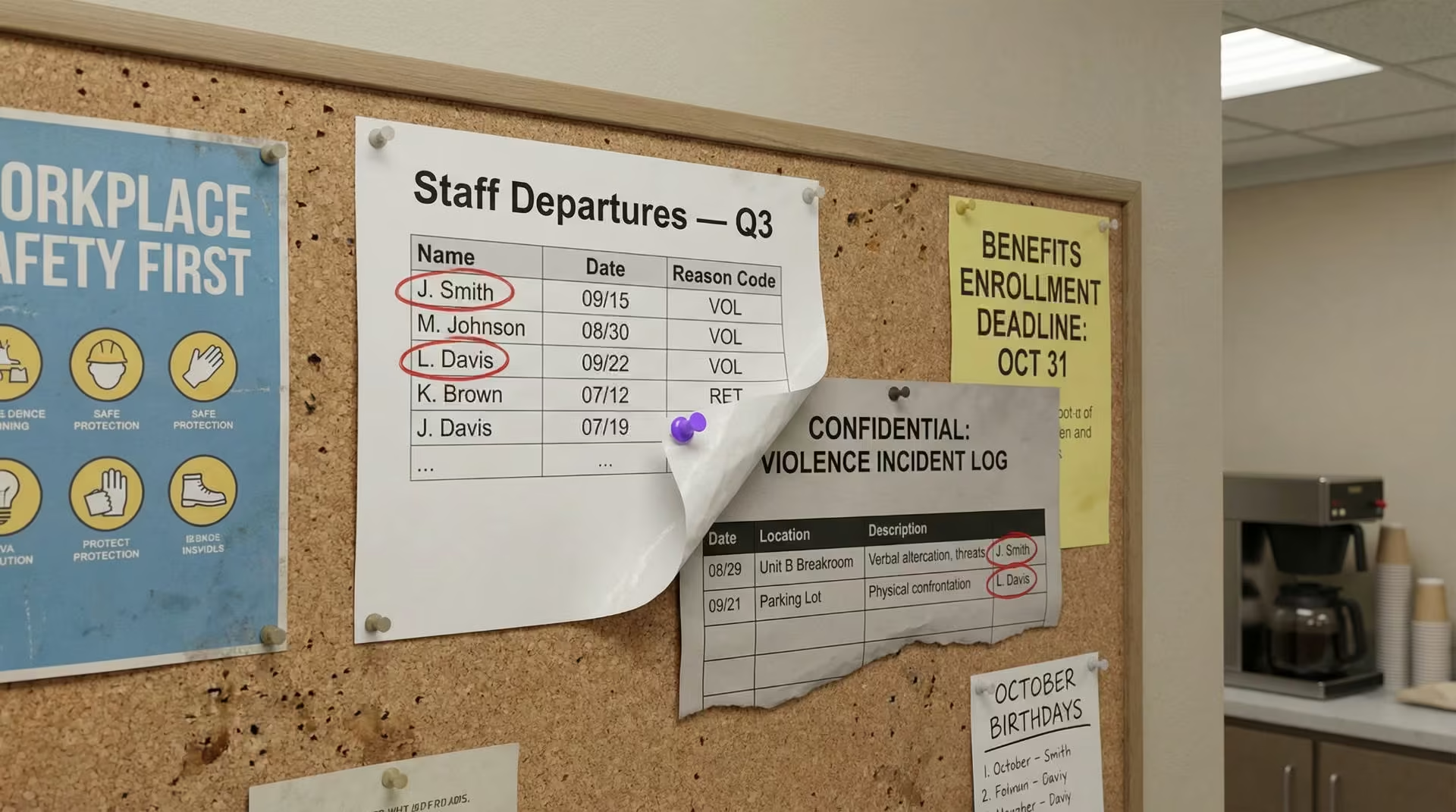
Corkboard departure summary peeled back revealing violence incident log with matching names

Key Takeaways

  • Most turnover calculations miss the violence-driven share entirely because standard exit interviews don’t isolate it, meaning your CFO’s model is built on incomplete data that only HR can fix
  • Three methods using data you already collect (exit interviews, engagement surveys, workers’ comp claims) can identify the violence-driven portion and turn it into a measurable line item
  • Facilities addressing violence-driven turnover have recorded intent-to-leave dropping from 22% to 7%, connecting safety investment directly to the retention metrics CHROs own

When your CFO asks what nurse turnover actually costs your behavioral health facility, what number do you give? If you’re citing the $61,110 industry benchmark, you’re understating the problem [1]. Behavioral health adds extended orientation, longer vacancies, and violence-driven departures that push the real cost significantly higher.

But the bigger issue isn’t the total. It’s what’s hiding inside it. This workforce turnover safety guide walks through how to capture the data your CFO’s model needs but only HR can provide, isolate the violence-driven share, and build a phased retention strategy around the numbers. The full financial picture of nurse duress and turnover frames why this data gap matters at the board level.

What You NeedWho Provides It
Exit interview data (24 months)HR
Engagement survey resultsHR Analytics
Workers’ comp claims history (24 months)Risk Management
Payroll data for BH nursing positionsFinance

Budget 2-4 hours for initial data gathering.

The Data Gap Only HR Can Close

Your CFO can run the turnover cost calculation. The framework exists [1]. What the CFO can’t do is tell you why nurses are leaving or which departures were preventable. That’s your data.

The violence-driven share is hidden because:

  • 60% of nurses have changed, left, or considered leaving due to workplace violence [2]
  • Standard exit interviews bury safety concerns under “work environment” rather than tracking them separately
  • 81% of workplace violence incidents go unreported [3], which means your incident data understates the problem

The violence-driven share is the piece of turnover most within your control. It’s also the piece most invisible in current reporting. The three methods below use data you already collect to make it visible. Once you have the numbers, an HR safety brief built for budget approval gives you the format to present them.

Three Ways to Isolate Violence-Driven Turnover

Each method works independently. Used together, they give you a number your CFO can’t dispute. Your CFO’s five-category turnover cost framework is waiting for exactly this input to complete the calculation.

1. Redesign your exit interviews. Standard templates weren’t built for this. Add four targeted questions:

  • Did you witness or experience violence during your time here?
  • How frequently?
  • Did you report it?
  • How important was safety in your decision to leave?

A departure counts as violence-driven when the employee answers yes to question 1 and rates safety as “important” or “very important” in question 4. Departing staff frequently soften their answers on the way out. Phone interviews conducted two to three weeks after the last day surface more candid responses than day-of paperwork.

2. Cross-reference your engagement surveys. You already run engagement surveys:

  • Pull safety perception scores and intent-to-stay scores for your nursing staff
  • Compare actual turnover rates between low-safety-score staff and high-safety-score staff

The gap between those two groups is the violence-driven component showing up in data you already have.

3. Match workers’ comp claims against departures.

  • Pull all violence-related workers’ comp claims from the past 24 months
  • Cross-reference claimants against staff who departed within 6-12 months of the claim
  • Compare the departure rate for violence-claim staff versus other-claim staff

This method provides objective, third-party documentation. It carries more weight in budget conversations than self-reported exit data.

If exit data is sparse across all three methods, use the 19.2% benchmark as a starting point [2], adjusted for your facility’s violence exposure rate.

Talk to us about isolating the violence-driven share of your turnover data.

Contact Us

Turning the Numbers Into a Retention Strategy

With the violence-driven share isolated, you have the number that connects safety investment to retention outcomes.

Partner with your CFO on the financial validation. Each 1% change in RN turnover costs or saves the average hospital about $289,000 per year [1]. Frame the conversation around workers’ comp reduction first. Not because it’s the largest number, but because it’s the most defensible cost category with objective third-party proof. Peer CHROs ranking three workforce dimensions confirm that workers’ comp integration is the dimension that separates leaders from the field.

Set phased targets your leadership team can track:

TimelineTargetWhat You’re Measuring
90 daysEarly signalSafety sentiment shift, incident response time
12 monthsPreliminary ROITurnover rate trend, intent-to-stay improvement, workers’ comp claims
18-24 monthsFull cycleAnnual turnover comparison, total cost reduction, first-year retention rate

One behavioral health facility recorded intent-to-leave dropping from 22% to 7% after deploying safety infrastructure [4]. Workers’ comp claims dropped 24-50% across separate deployments [4][5]. Your starting baseline will shape what’s realistic in Year 1. Even modest reductions produce six-figure annual savings at the per-percentage-point rate. See how one provider achieved these results.

Before your next budget conversation, make sure you’ve completed these:

  • Pulled actual payroll data for behavioral health RN positions at one facility
  • Requested workers’ comp claims history (24 months) filtered for violence-related incidents
  • Matched violence-related claimants against departures within 6-12 months
  • Added the four violence-specific questions to your exit interview template

The violence-driven share is isolated. The workforce turnover safety strategy you build from these numbers treats safety investment as what your people data has been showing all along: the retention lever hiding inside your largest controllable expense. The emotional weight behind that lever is something every CHRO in behavioral health carries — and the data you just built is how you finally act on it.

YOUR DATA

Turn Your People Data Into a Safety Investment Case

The three methods described here use data you already collect. A behavioral health safety specialist can walk you through what peer CHROs found when they isolated the violence-driven share at their facilities.

References

  1. NSI Nursing Solutions. 2025 National Health Care Retention & RN Staffing Report. https://www.nsinursingsolutions.com/documents/library/nsi_national_health_care_retention_report.pdf
  2. National Nurses United. Workplace Violence Report, 2024. https://www.nationalnursesunited.org/sites/default/files/nnu/documents/0224_Workplace_Violence_Report.pdf
  3. AHRQ PSNet. Addressing Workplace Violence and Creating a Safer Workplace, 2023. https://psnet.ahrq.gov/perspective/addressing-workplace-violence-and-creating-safer-workplace
  4. ROAR for Good. Internal Data, 2024. Internal data
  5. ISMIE Mutual Holdings. Cost of Violence in the Healthcare Workplace. https://www.ismie.com/news/cost-of-violence-healthcare-workplace/

Executive Safety Guide: Turnover Cost Framework

Kitchen table at dawn with scrubs and badge on one side and resignation letter on the other

Key Takeaways

  • Behavioral health RN replacement costs $68,740 per departure, and the cascade effect converts each loss into roughly four departures within 12 months
  • Sixty percent of nurses have changed, left, or considered leaving due to workplace violence, making safety infrastructure the most controllable lever against turnover
  • Healthcare boards approve safety investments when five criteria are met, and peer organizations report a median 5.2 percentage point first-year turnover improvement

Your board chair calls the evening before the quarterly meeting. She’s seen the agency staffing variance and wants to understand why turnover keeps outpacing every projection you build.

You have the number. What you may not have is the framework that connects it to a controllable cause. This executive safety guide walks through how to direct your team to quantify the full exposure, isolate the violence-driven share, and package the business case your board needs. The full financial picture of nurse duress and turnover anchors every number in this framework.

Before you begin: Initial cost analysis takes 2-4 weeks. Full business case development takes 1-2 months. If your board presentation is needed within 30 days, skip to the compressed timeline at the end of Section 2.

Who You NeedWhat They Provide
CFOFinancial analysis and per-percentage-point calculation
CNOOperational context and unit-level incident data
CSOSafety assessment and current response times
CHROTurnover data and exit interview analysis

What Your Team Needs to Quantify

The general healthcare RN replacement average is $61,110 [1]. In behavioral health, the figure is $68,740, driven by extended orientation, specialized training, and a thinner candidate pool [2].

That per-departure cost is the starting point. Not the full picture. One resignation triggers a cascade that averages four departures, turning $68,740 into roughly $275,000 in total cost [3][4]. At a 28.3% facility turnover rate [2], the cascade isn’t a worst-case scenario. It’s the baseline.

Here’s what makes this a CEO problem rather than an HR problem: 44% of behavioral health hospitals now report turning away patients due to staffing limitations [5]. The cascade eventually reaches admissions, revenue, and mission delivery. Your CFO will need a plan for translating early deployment signals into board-ready dollar figures before lagging metrics confirm the return.

Direct your CFO to calculate the per-percentage-point value of turnover at your facility. Each 1% reduction saves approximately $289,000 annually [2]. That single number reframes every safety investment conversation from expense to return. The five-category turnover cost framework gives your CFO the methodology to build that number from your facility’s own data.

The Violence-Driven Share

Most of your turnover budget treats departures as interchangeable. They’re not. The portion driven by violence is different from departures driven by pay, relocation, or career moves. It’s also the portion most within your control.

The violence-departure pattern in behavioral health:

  • 60% of nurses have changed, left, or considered leaving due to workplace violence [6]
  • Among first-year behavioral health RN leavers, 31% cite violence or safety as their primary reason [2]
  • 64% of nurses who leave after a violence incident depart within 90 days [7]
  • 81% of incidents go unreported [8], which means your incident data is mostly blank and your turnover projections will keep missing

No one should face violence while trying to help others heal. The nurses who leave first after a violent incident tend to be mid-career staff with 5-8 years of experience. They’re the ones newer nurses rely on during escalations. When they go, the unit loses the informal safety net that kept other staff feeling protected.

What to direct your team to do:

  • CHRO: Pull exit interviews from the past 24 months. Tag every departure where safety, violence, or “work environment” appeared as a contributing factor.
  • CSO: Document current violence incident rates by unit and compare against the 110.4 per 10,000 benchmark for psychiatric settings [9].
  • Overlay both data sets. That overlay reveals the violence-driven share your board has never seen. Your CHRO has three specific methods for isolating violence-driven turnover that make this overlay defensible.

Compressed timeline: If your board presentation is needed within 30 days, focus on three elements: the per-percentage-point calculation from your CFO, the peer benchmark of 5.2 percentage point median improvement across 47 behavioral health systems [10], and the Joint Commission workplace violence prevention standards effective July 2024 [11]. Full cost analysis can follow board approval.

Talk to us about building your board-ready business case for safety investment.

Contact Us

Packaging the Board Presentation

Healthcare boards approve safety technology investments when five criteria are met [12]. Your business case must address each one.

Board CriterionWhat to PresentWho Owns It
Regulatory compliance riskJoint Commission standards effective July 2024 [11]; state-level violence prevention mandatesCompliance officer
CFO-validated ROIPer-percentage-point calculation using your facility dataCFO
Peer data47 BH systems, 5.2 percentage point median improvement [10]You (synthesized)
Action timeline90-day leading indicators, 6-month stabilization, 12-month full financial impactCNO and CSO
Vendor stabilityCustomer retention rates, documented deployment resultsCFO (due diligence)

Your CFO validates the ROI model. Your CNO provides the operational context. Your compliance officer maps the regulatory exposure. You synthesize and present.

Numbers open the door. Operational specificity closes it. A three-question pitch framework structures those numbers into the format governance committees approve. Your strongest asset in the room will be your CNO describing what’s actually happening on your units right now.

Organizations that addressed the violence-turnover connection have documented the shift. One behavioral health facility recorded intent-to-leave dropping from 22% to 7% and a 39% reduction in violent incidents within the first quarter [13][14]. See how one provider achieved these results.

Before Your Board Meeting

Make sure your team can answer these:

  • Has your CFO calculated the per-percentage-point turnover cost using your actual RN FTE count and departure data?
  • Has your CHRO tagged violence-related departures as a separate category in exit data from the past 24 months?
  • Can your CSO document current response times and incident rates by unit?
  • Has your compliance officer mapped current programs against Joint Commission standards effective July 2024?

Your board chair called because the projections missed again. With your team’s data assembled and the violence-turnover connection quantified, you can walk into the quarterly meeting with a different answer. Not another explanation for why turnover outpaced the model. A business case built on controllable risk, peer-validated outcomes, and a number your CFO already approved. Peer CEOs who’ve already made this move share what triggered them to act.

BOARD READY

Walk Into Your Next Board Meeting With a Different Answer

The framework described here turns uncontrollable turnover into a quantifiable, addressable cost your board can act on. A behavioral health safety specialist can walk you through what peer organizations presented to their boards.

References

  1. Plexsum. The Real Cost of Nurse Turnover, 2025. https://plexsum.com/2025/04/08/the-real-cost-of-nurse-turnover-what-hospitals-need-to-know-in-2025/
  2. NSI Nursing Solutions. 2025 National Health Care Retention & RN Staffing Report. https://www.nsinursingsolutions.com/documents/library/nsi_national_health_care_retention_report.pdf
  3. Journal of Nursing Administration. Workplace Violence and Cascade Turnover in Psychiatric Units, 2025. https://journals.lww.com/jonajournal
  4. NSI / Becker’s Hospital Review. Turnover Cascade Analysis, 2025. https://www.beckershospitalreview.com
  5. National Council for Mental Wellbeing, 2024. https://www.thenationalcouncil.org
  6. National Nurses United. Workplace Violence Report, 2024. https://www.nationalnursesunited.org/sites/default/files/nnu/documents/0224_Workplace_Violence_Report.pdf
  7. Press Ganey. Safety Culture in Behavioral Health, 2025. https://www.pressganey.com/solutions/safety-culture
  8. AHRQ PSNet. Addressing Workplace Violence, 2023. https://psnet.ahrq.gov/perspective/addressing-workplace-violence-and-creating-safer-workplace
  9. Sheps Center, UNC. Workplace Violence in Healthcare Brief. https://www.shepscenter.unc.edu/wp-content/uploads/2025/01/Y10.01_Brief-1.pdf
  10. NSI Nursing Solutions. Benchmarking Analysis (Behavioral Health Partnership), 2025. https://www.nsisolutions.com/healthcare-turnover-benchmarks
  11. Joint Commission. Workplace Violence Prevention Standards, 2024. https://www.jointcommission.org/standards
  12. Advisory Board. Safety Technology Investment Decision Framework, 2024. https://www.advisoryboard.com
  13. ROAR for Good. Internal Data, 2024. Internal data
  14. ISMIE Mutual Holdings. Cost of Violence in the Healthcare Workplace. https://www.ismie.com/news/cost-of-violence-healthcare-workplace/

Safety Cost Analysis: Nurse Turnover Framework

Five shipping crates on loading dock, smallest sealed, larger ones overflowing

Key Takeaways

  • The $61,110 replacement cost benchmark misses vacancy coverage, productivity ramp-up, and violence-driven departures, which means most behavioral health facilities are undercounting turnover by tens of thousands per nurse
  • A five-category calculation gives your board a number they can act on, not an industry average they can dismiss
  • Isolating the violence-driven share of turnover turns an uncontrollable labor expense into an addressable line item with a clear investment case

You already know turnover is expensive. What you probably don’t have is a number your board will trust. Not an industry average. Your number, built from your data, covering costs most calculations miss entirely. The full financial picture of nurse duress and turnover frames why this calculation matters at the board level.

This safety cost analysis walks through a five-category framework. By the end, you’ll have a per-departure figure, an annual total, and the violence-driven component isolated as a separate line item.

Before You Start

This calculation takes 2-4 hours of data gathering and about an hour to run the numbers. Here’s what you need and who provides it.

What You NeedWho Has It
Total nursing FTEs and annual turnover rateHR
Annual separations (FTEs multiplied by rate)Calculated
Average time-to-fill for RN positions (days)HR or Recruiting
Agency hourly rate and staff hourly rateFinance
Total recruitment spend (last 12 months)Finance
Total agency spend (last 12 months)Finance
Exit interviews citing safety concerns (%)HR
Workers’ comp claims related to violenceRisk Management

If you can’t get all of this right away, start with Categories 1, 2, and 4 below. Those use the most accessible data and still produce a useful number.

The Five Cost Categories

Most turnover calculations capture recruitment and miss everything else. Think of it like pricing a kitchen renovation by looking at countertops alone. Plumbing, electrical, permits, the weeks you’re eating takeout: skip any of those and your budget is fiction.

  1. Direct recruitment. Job postings, recruiter time, background checks, signing bonuses, agency placement fees. The national benchmark is $61,110 per bedside RN [1]. Divide last year’s total recruitment spend by total separations to get your facility-specific figure.
  2. Onboarding and training. Orientation hours, preceptor time, competency assessments, and specialized training. In behavioral health, structured orientation runs 8-12 weeks compared to 4-6 weeks in general settings [2]. That extra training time is real money.
  3. Productivity ramp-up. Even after orientation ends, new hires don’t produce at full capacity immediately. This category doesn’t show up on an invoice. It shows up in heavier loads for the nurses around them.
  4. Vacancy coverage. Often the biggest number. Agency nurses cost $93.81 per hour versus $55.79 for employed staff [1]. 77% of psychiatric nursing positions have vacancies lasting more than 60 days [3]. Two months of agency coverage at nearly double the hourly rate adds up fast.
  5. Violence-driven departures. The category that changes the conversation. Most exit interviews categorize safety concerns under “work environment.” They don’t isolate violence as a separate cost driver. The next section shows you how to calculate it.

Does your per-departure figure exceed $61,110? For behavioral health, it should. If it doesn’t, you’re missing categories. Your CNO can run the same calculation at the unit level to surface where the hospital-wide average hides the worst gaps.

Running the Calculation

  1. Sum your actual costs across all five categories for a single departure. Use the benchmarks above where your own data isn’t available, but flag those as estimates.
  2. Multiply by annual separations for the total annual turnover expense.
  3. Apply behavioral health adjustments. The two biggest: extend your vacancy duration estimate and add the extra orientation weeks. Both push the per-departure number up.
  4. Isolate the violence-driven component (next section).
InputFormulaExample (200 RN FTEs)
Annual separationsFTEs x turnover rate200 x 18% = 36 departures
Per-departure costSum of 5 categories$95,000 (hypothetical)
Annual turnover costSeparations x per-departure36 x $95,000 = $3,420,000
Violence-driven shareAnnual cost x violence departure %$3,420,000 x 19.2% = $656,640

That last line is the number most boards have never seen. The board-ready evidence table gives you the format to present it alongside sourced peer data.

Compressed timeline: If you need a number before next budget cycle, use the $61,110 benchmark, add a conservative adjustment for longer behavioral health vacancies and extended orientation, and multiply by your annual separations. Note your assumptions clearly. A rough number is better than no number.

Isolating the Violence-Driven Component

This is where the calculation turns from a cost report into a business case.

Research shows that 19.2% of nurses who experience workplace violence leave their positions [4]. In behavioral health, where violence rates run 5 to 20 times higher than general healthcare [5], that percentage likely understates the problem.

Three methods to find your number:

  1. If your exit interviews capture safety concerns: Pull the percentage of departing nurses who cited safety, violence, or workplace environment concerns. Apply that percentage to your annual turnover cost. That’s your violence-driven share.
  2. If your exit interviews don’t capture it clearly: Use the 19.2% research proxy [4]. Apply it to your annual turnover cost. This is conservative because exit interviews consistently undercount violence as a factor.
  3. Cross-reference with incident data. Pull incident reports by unit. Overlay turnover data by unit. If the units with the highest incident rates also have the highest turnover, you’ve got your signal. That correlation is the evidence your board needs to see. Your CHRO has three specific methods for isolating this share using exit interviews, engagement surveys, and workers’ comp claims.

One important note: the 19.2% figure is from aggregate research across healthcare settings. Your facility’s percentage depends on patient acuity, staffing ratios, and whether staff trust the exit process enough to be candid.

Talk to us about building your facility-specific turnover cost calculation.

Contact Us

From Calculation to Capital Request

Each 1% change in RN turnover costs or saves the average hospital $289,000 per year [1]. That’s the lever you model against any retention investment.

Organizations that addressed the violence-turnover connection have documented results: intent-to-leave dropped from 22% to 7% at one behavioral health facility [6], and workers’ comp claims dropped 24-50% across separate deployments [6][7]. See how one provider achieved these results.

Model ComponentYour DataCalculation
Violence-driven annual turnover costFrom previous section$ _______
Conservative reduction estimate (20%)$ _______ x 0.20 = $ _______
Per-percentage-point value$289,000 [1]Context for scale
Investment costGet vendor quotes$ _______
First-year returnSavings minus investment$ _______

You don’t need to model perfection. You need to show your board that violence-driven turnover is a quantifiable cost, and that addressing it produces a return they can track. A one-pager that aligns your C-suite packages these numbers into the format that gets approved.

Start with the five categories. Pull the data you can get today. The safety cost analysis you build will be more defensible than any industry average, because it’s yours. Benchmarking your results against peer CFOs shows where you stand on the three indicators that separate top-quartile performers.

YOUR NUMBERS

Build Your Facility-Specific Turnover Cost

The five-category calculation described here is more defensible than any industry average. A behavioral health safety specialist can walk you through the data inputs and help you model the violence-driven share for your board.

References

  1. NSI Nursing Solutions, Inc. 2025 National Health Care Retention & RN Staffing Report. https://www.nsinursingsolutions.com/documents/library/nsi_national_health_care_retention_report.pdf
  2. PMC. New Graduate Nurse Retention in Psychiatric Settings. https://www.ncbi.nlm.nih.gov/pmc/articles/PMC12034567/
  3. Texas Center for Nursing Workforce Studies. Psychiatric Nursing Vacancy Data. https://www.dshs.texas.gov/chs/cnws/
  4. National Nurses United. Workplace Violence Report, 2024. https://www.nationalnursesunited.org/sites/default/files/nnu/documents/0224_Workplace_Violence_Report.pdf
  5. Sheps Center, UNC. Workplace Violence in Healthcare Settings. https://www.shepscenter.unc.edu/wp-content/uploads/2025/01/Y10.01_Brief-1.pdf
  6. ROAR for Good. Internal Data, 2024. Internal data
  7. ISMIE Mutual Holdings. Cost of Violence in the Healthcare Workplace. https://www.ismie.com/news/cost-of-violence-healthcare-workplace/

Nursing Unit Safety Turnover Costs: 5 Categories

Building cross-section showing cascading water damage through five rooms below missing roof shingles

Key Takeaways

  • Hospital-wide replacement averages hide the real cost on behavioral health units, where longer orientations, extended vacancies, and violence-driven departures push per-nurse costs well above the $61,110 benchmark
  • A unit-level calculation built from your actual data gives you a number your CFO can verify, not an industry average they can dismiss
  • Overlaying your incident data with your turnover data by unit reveals the violence-driven share that most finance teams never see

Your acute psychiatric unit lost four nurses last quarter. Finance applied the hospital-wide replacement average of $61,110 per departure, projected $244,440, and moved on.

But you know that number is wrong. Your unit’s eight-week orientation, the months before new hires can handle a full patient load independently, and travel nurses covering vacancies at nearly double the hourly rate make the real cost far higher. This nursing unit safety guide walks you through calculating the actual number, unit by unit, so you have a figure your CFO can act on. The full financial picture of nurse duress and turnover frames why unit-level precision matters.

What you’ll need: 2-4 hours for data gathering, about an hour for the calculation. You’ll need your unit’s turnover data from HR, agency and recruitment spend from Finance, incident reports from Risk Management, and your own assessment of the productivity ramp on your unit.

Why Hospital Averages Don’t Work for Your Unit

Hospital-wide turnover numbers treat every departure the same. They don’t distinguish between a med-surg nurse who onboards in four weeks and a behavioral health nurse who needs eight weeks of specialized orientation in de-escalation, restraint protocols, and milieu management.

Behavioral health nurses had the highest specialty turnover rate at 22.8% in 2024, compared to the national RN average of 16.4% [1]. On your unit, that means roughly one in four nurses turns over each year. The departures often cluster. One nurse leaves after an assault. Within six weeks, two more follow. The emotional toll of that pattern on CNOs compounds with every incident report.

The Five Cost Categories, Applied to Your Unit

The structure is the same as the facility-wide framework. What changes is the inputs. Here’s where behavioral health units diverge from hospital norms.

  1. Direct recruitment. Same as hospital-wide: job postings, recruiter time, background checks, signing bonuses. The $61,110 benchmark is your starting point [1]. Divide your unit’s recruitment spend by your unit’s departures for a more accurate figure.
  2. Onboarding and training. General med-surg orientation takes 4-6 weeks. Behavioral health runs 8-12 weeks [2]. Every extra week is preceptor time, reduced patient assignments, and supervisory oversight that doesn’t appear in the hospital-wide average.
  3. Productivity ramp-up. After orientation ends, new psychiatric nurses still need several months before they can handle a full patient load independently. They’re relying on senior staff to read the unit’s mood during escalations. That gap between “oriented” and “fully productive” is real labor cost without full labor output.
  4. Vacancy coverage. Travel nurses cost $93.81 per hour versus $55.79 for staff nurses [1]. 77% of psychiatric nursing positions have vacancies lasting more than 60 days [3]. Your unit is likely filling gaps at nearly double the hourly rate for two months or longer per departure.
  5. Violence-driven departures. The category that changes the conversation. The next section shows you how to isolate this share using data you already have.

The RETAIN framework, validated across 1,501 nurses at seven hospitals, found a per-nurse turnover cost of $85,498 when contract replacement is included [4]. That’s roughly 40% above the hospital-wide average. Your unit’s number may be higher or lower, but $61,110 is almost certainly too low.

Does your unit-level per-departure cost exceed $61,110? For behavioral health, it should. If it doesn’t, you’re missing categories. The facility-wide five-category framework shows your CFO the same calculation at the enterprise level.

Finding the Violence-Driven Share

This is the piece that turns your calculation from a cost report into an investment case.

Psychiatric and substance abuse hospitals experience 110 violent incidents per 10,000 workers, compared to 8 per 10,000 in general settings [5]. And 19.2% of nurses who experience workplace violence leave their positions [6].

Three methods to find what that means for your unit:

  1. Use your exit data. Pull exit interviews for your unit over the past 12 months. Look for departures citing safety concerns, violence, or workplace environment. Apply that percentage to your annual unit turnover cost.
  2. Use the research proxy. If your exit interviews don’t isolate safety concerns, apply the 19.2% figure [6] to your annual unit turnover cost. This is conservative. Nurses who’ve normalized violence rarely name it on the way out.
  3. Overlay incident and turnover data. Pull incident reports by unit. Overlay turnover data by unit. If the units with the highest incident rates also have the highest turnover, you’ve found the signal your CFO needs to see. Your CHRO has three complementary methods for isolating violence-driven turnover using exit interviews, engagement surveys, and workers’ comp claims.

Short on time? Apply the 19.2% proxy to your total unit turnover cost and note it as a conservative placeholder. A rough estimate of the violence-driven share is better than leaving it out entirely.

Talk to us about building your unit-level turnover cost calculation.

Contact Us

Presenting Your Number to the CFO

Each 1% change in RN turnover costs or saves the average hospital about $289,000 per year [1]. Your unit-level calculation translates that hospital-wide figure into something specific and verifiable.

Present it in three parts:

ComponentWhat to ShowWhere It Comes From
Per-departure costYour five-category totalHR, Finance, your unit assessment
Annual unit impactDepartures x per-departure costHR turnover data for your unit
Violence-driven shareExit data % or 19.2% proxy applied to annual costExit interviews, incident reports, or research proxy [6]
Gap from hospital averageYour unit figure minus $61,110Calculated

For enterprise settings, calculate for one high-acuity unit first. That’s your proof of concept. Then scale the method across sites. Start with the unit where the CFO already suspects the numbers are bad. A nursing safety brief built for CFO approval gives you the one-page format that gets funded.

Before your budget conversation, make sure you can answer these:

  1. Can you show your per-departure cost broken out by all five categories, with sources for each input?
  2. Do you have your unit’s 12-month departure count separated from hospital-wide totals?
  3. Have you isolated the violence-driven departures as a distinct line item?
  4. Can you show the gap between your unit-level figure and the $61,110 hospital average?

The four nurses your unit lost last quarter didn’t cost $244,440. Your number is higher, your method is documented, and the investment that would reduce those departures now has a financial case your CFO can verify. Peer CNOs tracking adoption across behavioral health show where your organization stands relative to those already acting. See how one provider achieved measurable results.

YOUR UNIT'S NUMBERS

Build the Case Your CFO Can't Dismiss

The unit-level calculation described here produces a number your finance team can verify. A behavioral health safety specialist can walk you through the data inputs and help you isolate the violence-driven share for your highest-acuity unit.

References

  1. NSI Nursing Solutions, Inc. 2025 National Health Care Retention & RN Staffing Report. https://www.nsinursingsolutions.com/documents/library/nsi_national_health_care_retention_report.pdf
  2. PMC. New Graduate Nurse Retention in Psychiatric Settings. https://www.ncbi.nlm.nih.gov/pmc/articles/PMC12034567/
  3. Texas Center for Nursing Workforce Studies. Psychiatric Nursing Vacancy Data. https://www.dshs.texas.gov/chs/cnws/
  4. Academic Medical Center Researchers. RETAIN Framework Turnover Cost Methodology. https://pubmed.ncbi.nlm.nih.gov/
  5. Sheps Center, UNC. Workplace Violence in Healthcare Brief. https://www.shepscenter.unc.edu/wp-content/uploads/2025/01/Y10.01_Brief-1.pdf
  6. National Nurses United. Workplace Violence Report, 2024. https://www.nationalnursesunited.org/sites/default/files/nnu/documents/0224_Workplace_Violence_Report.pdf

Workforce Retention Safety: Measure Perception Risk

Institutional building at dusk with most windows dark, showing unreported safety incident gap

Key Takeaways

  • Safety perception measurement gives CHROs a leading indicator that surfaces retention risk before it shows up in vacancy data
  • Validated survey instruments can establish a unit-level baseline in under 30 days, with quarterly tracking that connects directly to intent-to-stay
  • The delegation structure spans corporate HR, facility HR, quality, and clinical leadership, each owning a specific piece of the measurement-to-action workflow

Most facilities track turnover after staff leave. This guide shows you how to measure the safety perception that predicts departures months earlier, so you can intervene before vacancy data confirms what your nurses already decided.

You’ll walk away with a specific instrument selection, delegation structure, implementation timeline, and the connection between perception scores and the workforce retention safety metrics your CFO and board already track. For the research behind why perception predicts retention, see the complete guide to staff safety in psychiatric hospitals.

Before You Start: What You Need in Place

Building a perception measurement framework takes about 90 days to establish a baseline and first quarterly comparison. You need your current engagement survey data, exit interview summaries, incident reports, and turnover data broken out by unit.

Your team includes Quality/Compliance for survey method guidance, your CNO for clinical participation (the unit-level perception guide for nursing leaders covers the CNO’s piece of this), and your CSO for incident data.

If your exit interviews don’t currently include safety-specific questions, add two or three before moving forward: “Did safety concerns influence your decision to leave?” and “How would you rate our response to safety incidents?”

Even adding those two questions changes the data right away. The first round of responses tends to surface units no one flagged as high-risk.

How to Measure Workforce Retention Safety: Instrument Selection

Three validated instruments work for behavioral health settings. Each was developed in acute care and applies across inpatient environments.

InstrumentItemsTimeBest For
SAQ-SF (Safety Attitudes Questionnaire, Short Form)135-10 minutesRapid baseline, compressed timelines [1]
HSOPS 2.0 (AHRQ Hospital Survey on Patient Safety)4015-20 minutesFull annual assessment with national benchmarks [2]
AHRQ Workplace Safety Supplemental ItemsSupplementalAdd-onTargeting staff experience of organizational response [2]

Set a quarterly pulse cadence using the shorter instrument and an annual full assessment using HSOPS 2.0. Quarterly pulses capture directional trends between full assessments. The SAQ-SF works well for speed, but if your primary concern is whether staff trust the organization’s reaction to incidents, the HSOPS supplemental items are worth the extra time.

Here’s what the delegation looks like in practice:

TaskCorporate HRFacility HRQuality/Compliance
Instrument selectionDecidesProvides facility inputAdvises on regulatory alignment
Survey administrationSets cadenceExecutesValidates method
Data analysisAggregates system-wideReports unit-levelConnects to safety culture metrics
Action planningSets enterprise standardsDevelops unit-specific plansDocuments for accreditation

Compressed timeline: If you need a baseline in under 30 days, deploy the SAQ-SF to your single highest-turnover unit. Add two or three intent-to-stay questions. Establish the baseline now and refine instrument selection the following quarter.

One thing to keep in mind: pull your existing safety-related questions from your engagement survey and score them separately first. You may already have a rough baseline hiding in data you already collect. The gap between how important staff rate safety and how satisfied they feel with current systems is the number that predicts your next quarter’s retention.

Connecting Perception Scores to Retention Intent

The link between safety perception and turnover intent is well-established across multiple studies in acute care settings [1][3][4]. The practical question for your team isn’t whether the connection exists. It’s how to surface it in your own data.

Add one question to your safety perception surveys: “I would consider leaving this organization due to safety concerns” (strongly agree to strongly disagree). That single item transforms perception measurement from a culture exercise into a workforce planning tool with documented outcomes.

Then cross-reference. Which units show the largest gap between low perception scores and high stated intent to leave? That’s where your retention risk concentrates. Facilities that have made this connection recorded intent-to-leave dropping from 22% to 7% [5], though the timeline varied across sites. Facilities with pre-existing reporting cultures tended to move faster.

The connection also gives you a second lever. Perception influences job satisfaction, and job satisfaction independently predicts retention [4]. Improving perception directly and improving the conditions perception reflects both reduce turnover intent. Peer CHROs tracking this data describe it as the first time they could see retention risk forming instead of just counting departures after the fact.

Ready to build a perception measurement framework for your facility?

Contact Us

From Measurement to Action

Perception data without intervention is just measurement. What actually moves the needle is visible, repeated proof that safety is an operational priority. Here’s how the work divides across your leadership team:

Intervention ComponentCorporate HRFacility HRCNOCSO
Perception measurementOwns frameworkExecutes surveysSupports participationProvides incident data
Response systemApproves investmentCoordinates trainingOwns clinical workflowOwns response protocol
Visible follow-upSets standardsPuts into practiceEnsures staff see responseDocuments response times

Two questions predict whether your next perception survey will show improvement: When staff activate a call for help, how quickly does help arrive visibly? When staff report an incident, do they see documented follow-up? If the answer to either is “we don’t know,” that’s your starting point. The HR brief on safety perception metrics provides the specific data points to bring into those conversations with your CNO and CSO.

Your First 30 Days

Start with your single highest-turnover behavioral health unit. One unit, measured well, proves the model faster than a system-wide rollout.

  • Pull exit interview data from the past 12 months and flag every mention of safety, violence, or feeling unsupported
  • Identify your three highest-turnover units and cross-reference with whatever safety data exists (incident reports, workers’ comp claims, even anecdotal CNO input)
  • Deploy the SAQ-SF to one unit. Thirteen items, under 10 minutes. Add the intent-to-stay question.
  • Score the importance-satisfaction gap from any existing engagement data. If the gap exceeds 1.0 point, flag that unit for priority intervention planning.
  • Brief your CFO with one number: the annualized cost of turnover in your highest-risk unit. Each percentage point of nursing turnover costs roughly $289,000 annually [6]. For the full financial case and comparison data, the evidence shows what these numbers look like across different organizational models.

See how one behavioral health provider documented these results across their facilities.

Measurement alone doesn’t fix perception, but it gives you the language your CFO needs to approve the next step. With a safety perception baseline established, quarterly tracking in place, and correlation to retention intent on record, workforce retention safety becomes predictive. The next board conversation includes the leading indicator that explains why turnover moved before anyone submitted notice.

WORKFORCE MEASUREMENT

See Retention Risk Before It Hits Your Dashboard

Behavioral health facilities using perception measurement are catching turnover risk months earlier.

References

  1. PMC. Safety Attitudes and Turnover Intention. https://pmc.ncbi.nlm.nih.gov/articles/PMC10809511/
  2. AHRQ. Hospital Survey on Patient Safety Culture. https://www.ahrq.gov/sops/surveys/hospital/index.html
  3. PMC. Safety Culture and Newly Recruited Nurses. https://pmc.ncbi.nlm.nih.gov/articles/PMC9667691/
  4. Sigma Pubs. Safety Climate and Turnover Intention. https://sigmapubs.onlinelibrary.wiley.com/doi/10.1111/wvn.70073
  5. ROAR for Good. Internal data, 2024. Internal data
  6. NSI Nursing Solutions. 2025 NSI National Health Care Retention & RN Staffing Report. https://www.nsinursingsolutions.com/documents/library/nsi_national_health_care_retention_report.pdf

Nursing Safety Program: Unit-Level Perception Guide

nursing safety program CNO — hands annotating unit-level safety perception breakdown, circling low-scoring units on printed report

Key Takeaways

  • Unit-level perception data surfaces retention risk that facility-wide engagement scores and incident reports miss entirely
  • Charge nurse communication coaching is the highest-leverage intervention a CNO controls directly, with the shortest distance between action and perception shift
  • A focused 90-day measurement cycle on one high-turnover unit proves the model faster than a system-wide rollout

Your incident reports show nothing alarming. Your engagement survey scores look acceptable. Yet the resignations keep coming from your behavioral health units, and exit interviews keep circling back to safety.

The disconnect is a measurement problem. A nursing safety program built on incident counts and annual engagement composites can’t surface what’s actually driving departures: how safe your nurses believe they are, and whether they trust the organization to respond when something happens. This guide walks through how to measure safety perception at the unit level, coach the charge nurses who shape it daily, and coordinate the response systems that prove commitment. For the research behind why perception predicts retention, see the complete guide to staff safety in psychiatric hospitals.

What You Need Before You Start

Building a unit-level perception baseline takes about 90 days to establish and get a first quarterly comparison. You need your current engagement survey data (with safety-specific items identified), exit interview summaries, incident reports, and turnover data broken out by unit.

Your team: your CHRO or HR lead for survey infrastructure (the CHRO measurement framework covers the corporate side of this), your CSO for incident and response time data, and your directors of nursing for unit-level context.

If your exit interviews don’t currently include safety-specific questions, add two or three before moving forward: “Did safety concerns influence your decision to leave?” and “How would you rate our response to safety incidents?” The first round of responses tends to surface units no one flagged as high-risk.

Measuring Your Nursing Safety Program at the Unit Level

The critical shift here is moving from facility-wide scores to unit-level data. Your organization-wide average may look acceptable while specific units are in crisis. CNOs who have pulled safety-specific items from engagement surveys and scored them by unit often discover that their highest-turnover units share one trait: not the most incidents, but the lowest confidence that leadership will act on what gets reported.

Start with what you already have. Pull safety-related questions from your existing engagement survey and score them separately by unit. If your engagement instrument doesn’t include safety-specific items, add three to five targeted questions to your next pulse survey focused on organizational response, not just incident frequency.

Measurement StepOwnerDeliverableTimeline
Pull safety-specific items from engagement survey by unitClinical EducatorUnit-level scoresWeek 1-2
Add intent-to-stay questions to pulse surveyDirector of NursingQuarterly correlation dataWeek 2-4
Identify single highest-turnover behavioral health unitCNO (personal)Target unit for focused baselineWeek 1
Establish measurement frequency (quarterly minimum)CNO (personal)Measurement calendarWeek 2

Then add the question that connects perception to retention: “I would consider leaving this organization due to safety concerns.” That single item turns perception measurement into a workforce planning tool with documented outcomes. Cross-reference the results. Which units show the largest gap between low perception scores and high intent to leave? That’s where your retention risk concentrates.

If survey infrastructure doesn’t exist yet: Focus on your single highest-turnover unit first. Three to five safety-specific questions on a pulse survey takes under 10 minutes per nurse. One unit measured well proves the model faster than a facility-wide rollout.

Coaching Charge Nurses to Move Perception

Perception doesn’t shift because of policy memos or annual training refreshers. It shifts when staff experience visible, rapid organizational response to their safety concerns. And the person who shapes that daily experience on each unit is the charge nurse.

Leadership quality accounts for about 34% of the variation in whether nurses stay or leave [1]. One-third of your retention outcome depends on something you directly control: how your charge nurses communicate commitment to safety on every shift.

This means explicit coaching, not general encouragement. Your charge nurses need specific language for three moments:

  • Shift handoff: A sentence acknowledging current safety status and any open concerns from the prior shift. Not a policy reading. A direct statement: “We had an escalation on this unit yesterday, the response took under two minutes, and here’s what we’re doing differently today.”
  • After an incident: Visible follow-up that the reporting nurse can see. When a nurse reports an incident and nothing visibly happens, the lesson they learn is that reporting is pointless. Directors of nursing describe a pattern where a single failed response undoes months of goodwill.
  • During routine rounding: Asking one safety-specific question per round. Not “do you feel safe?” (too broad). Something like “is there anything about safety response on this unit you’d change?”

In behavioral health settings where this kind of visible communication was paired with documented safety systems, staff reporting they felt “very prepared” to respond to incidents went from 38% to 76% [2]. Peer CNOs using unit-level perception data describe charge nurse coaching as the intervention with the shortest distance between action and measurable perception shift.

Want to see what unit-level perception measurement looks like in practice?

Contact Us

Coordinating Response Systems With Your CSO

The other half of the perception equation is what happens when staff actually call for help. Charge nurses describe a telling detail: what registers with staff isn’t the difference between 30 seconds and three minutes on a stopwatch. It’s whether the person who called for help can still see the situation escalating when backup walks through the door. That visual, help arriving while the moment is still live, is what staff remember when asked whether the organization takes safety seriously.

Work with your CSO to verify actual response times on your target unit. Is there timestamped data, or are you relying on estimates? The nursing safety brief on unit-level perception data provides the specific talking points to bring into that conversation.

Coordination AreaCNO ResponsibilityCSO Responsibility
Response time verificationDefines acceptable threshold for clinical unitsProvides timestamped response data
Protocol reviewIdentifies unit-specific escalation patternsAdjusts protocols to match clinical workflow
Follow-up visibilityEnsures reporting nurses see documented outcomesDocuments and shares response records

Your 90-Day Unit-Level Action Plan

Start with your single highest-turnover behavioral health unit. Each percentage point of nursing turnover costs roughly $289,000 annually [3], so even one unit’s improvement builds the financial case for scaling.

  • Pull safety-specific engagement items and score them by unit this week. Can you identify your three lowest-scoring units without requesting new data?
  • Add two intent-to-stay questions to your next pulse survey cycle, distinguishing between “planning to leave the organization” and “planning to leave this unit”
  • Script three sentences of safety commitment language for charge nurses to use at shift handoff, and test the language with a charge nurse before rolling it out
  • Verify actual response times on your target unit with your CSO using timestamped data
  • Schedule a 90-day re-measure on your target unit with a comparison point, not just a single snapshot

See how one behavioral health provider documented these results across their facilities.

Your charge nurse on that high-acuity unit doesn’t need another policy update. She needs to see that when her team calls for help, help arrives fast, and that the organization measures whether she feels protected, not just whether an incident was filed. A nursing safety program that tracks perception at the unit level gives you the lead time to intervene before the next resignation letter lands on your desk. Start with one unit. Measure it well. The retention data will make the case for every unit after.

UNIT-LEVEL SAFETY

See Retention Risk at the Unit Level Before It Becomes a Vacancy

Behavioral health CNOs using perception measurement are catching turnover risk months before resignation letters arrive.

References

  1. PMC. Leadership Quality and Nurse Retention. https://pmc.ncbi.nlm.nih.gov/articles/PMC10806563/
  2. ROAR for Good. Internal data, 2024. Internal data
  3. NSI Nursing Solutions. 2025 NSI National Health Care Retention & RN Staffing Report. https://www.nsinursingsolutions.com/documents/library/nsi_national_health_care_retention_report.pdf

Dead Zone Coverage: Bluetooth Panic Button Safety Guide

Nurse fading transparent near stairwell door showing bluetooth panic button safety coverage gap

Key Takeaways

  • The locations where workplace violence happens most often in behavioral health facilities are the same locations where WiFi-dependent safety systems lose signal, and you can find that overlap with data you already have.
  • A structured walkthrough process using incident reports and coverage maps shows you where bluetooth panic button safety gaps are and builds the evidence case for closing them.
  • Deploying coverage in highest-risk zones first, then expanding facility-wide, gives security leaders a defensible, documented safety program that holds up under survey scrutiny.

Your monthly incident reports keep telling the same story. The stairwell between units. The parking lot after second shift. The outdoor courtyard during patient transport. These locations show up month after month because they are where your WiFi-dependent bluetooth panic button safety system goes silent.

Reinforced concrete and metal fire doors block WiFi signals. The same construction materials that keep patients contained are the ones that create dead zones for staff. The coverage map and the incident map overlap in exactly the wrong places.

This guide walks through how to find those gaps, document them, and close them with technology that works where WiFi can’t.

Start With What You Already Have: Incident Data and Coverage Maps

Before evaluating any new technology, build the case with data that already sits in your systems.

Pull your last 12 months of incident location data. Your violence prevention committee, your CNO, or your risk management team should have this. Then get current WiFi coverage maps from your technology staff. Overlay the two datasets. Across behavioral health facilities, the pattern is consistent: the areas where incidents cluster are the areas where coverage drops.

What you are looking for:

  • Which incident locations fall inside documented WiFi dead zones
  • Whether the same locations appear repeatedly across months
  • Which high-traffic staff areas (parking lots, stairwells, outdoor walkways) have no coverage at all
  • Whether your coverage maps were tested with doors in their normal locked position or standing open

That last point matters more than most people realize. WiFi signal tests run with doors propped open produce coverage maps that look nothing like what your facility actually looks like day to day. Reinforced doors in locked position block enough signal to turn a covered corridor into a dead zone.

For multi-site teams, this assessment must happen at each facility separately. Construction materials and layouts vary building to building, and a coverage map from one location tells you nothing about another.

The Locations That Matter Most

Focus your coverage checks on the locations you worry about most, not the locations easiest to cover.

LocationWhy It MattersWhat to Test
Parking lots and structuresWhere a large share of healthcare violence happens [1]Test at facility perimeter and every level of parking structures
StairwellsAmong the highest-risk areas for staff injury [2]Test with fire doors in closed and locked position
Outdoor transition areasNothing covers the open space between buildingsTest at maximum distance between buildings
Elevator cabsMetal enclosure blocks most wireless signals [2]Test at each floor with doors closed
Older building wingsThick walls and old construction block signals even moreTest in corridors and patient rooms, not just common areas

Walk these locations yourself with a test device. Press the panic button in the parking garage on level three. Press it in the stairwell with the fire door shut. Press it in the outdoor walkway between buildings at the farthest point from either entrance.

If the alert doesn’t go through, your staff already know. They figured out which zones are dead long before any formal audit confirmed it.

See how one behavioral health provider documented coverage results across their facilities.

What Closes the Gap

The dead zone problem is structural. WiFi can’t reach these areas because the building materials physically block the signal. Extending WiFi or running wires into a parking garage or a concrete stairwell is expensive, disruptive, and often still unreliable.

Standalone wireless safety systems operate on their own network, independent of facility WiFi [3]. Battery-powered beacons require no wiring, run for years on standard batteries, and go in areas that wired systems could never reach. If one beacon goes down, the network routes around it automatically.

What that means for your walkthrough: the parking structure, the stairwell, and the outdoor courtyard all become covered zones. During a four-hour power outage at one facility, the safety system kept running on battery power with six to eight hours of backup while WiFi went dark [4].

For the full technical breakdown of how this architecture works, the CTO evaluation guide covers it in detail.

If your walkthrough confirmed dead zones in high-risk areas, we can help you map a deployment plan.

Contact Us

Bluetooth Panic Button Safety: Who Owns What

Bluetooth panic button safety deployment works when responsibilities are clear from the start.

TaskCorporate SecurityFacility Security DirectorCSO Role
Coverage standardsEstablish enterprise-wide requirementsExecute within corporate standardsDefine what “complete coverage” means for each site
Gap assessmentProvide assessment frameworkConduct site-specific walkthroughReview results against incident data
Deployment oversightMonitor enterprise rolloutExecute facility deploymentVerify coverage in previously uncovered zones
Compliance recordsEstablish documentation standardsMaintain site-specific evidenceEnsure evidence package is survey-ready

Joint Commission workplace violence prevention standards took effect in July 2024 for behavioral health settings [5], and surveyors have started asking for coverage proof in parking structures and outdoor areas. Loss of accreditation puts Medicare and Medicaid funding at risk [6]. The technology alone doesn’t protect you in a survey. The evidence package does.

Get your current incident numbers on record before deployment. You need a documented before-and-after comparison. Without it, proving program effectiveness to leadership and surveyors becomes a credibility problem.

Your Assessment Checklist for This Week

You don’t need to wait for budget approval or a vendor selection to start. The assessment itself is free and builds the case for everything that follows.

  • Pull 12 months of incident location data and overlay it against current WiFi coverage maps. Where do the clusters land relative to your dead zones?
  • Walk your parking structures, stairwells, and outdoor transition areas with a test device. Can you trigger and receive an alert from every location where staff actually work?
  • Confirm with facilities management whether WiFi access points sit on backup generator circuits. If they don’t, document the gap.
  • Verify you can pull up audit logs within 30 minutes of a surveyor request. Surveyors don’t schedule these asks in advance.
  • Ask your violence prevention committee: can staff name the zones where they don’t trust the system? That list is your real coverage audit.

Start with the parking lot that showed up on last month’s incident report. With the assessment complete and gaps documented, bluetooth panic button safety coverage can extend to every location where incidents actually happen. One zone at a time is how coverage gaps close for good.

STAFF SAFETY

Close the Dead Zones in Your Facility

Bluetooth panic button safety coverage that reaches every parking lot, stairwell, and outdoor area where your staff work.

References

  1. ASPR TRACIE / American Hospital Association. https://files.asprtracie.hhs.gov/documents/on-campus-hospital-armed-assailant-planning-considerations.pdf
  2. Office of Justice Programs. https://www.ojp.gov/pdffiles/cptedpkg.pdf
  3. NCBI. https://pmc.ncbi.nlm.nih.gov/articles/PMC11435828/
  4. ROAR for Good – Internal Data, 2024.
  5. Joint Commission. https://www.jointcommission.org/en-us/knowledge-library/workforce-safety-and-well-being-resource-center/workplace-violence-prevention/workplace-violence-prevention-program
  6. Facilio. https://facilio.ae/blog/healthcare-joint-commission-compliance/
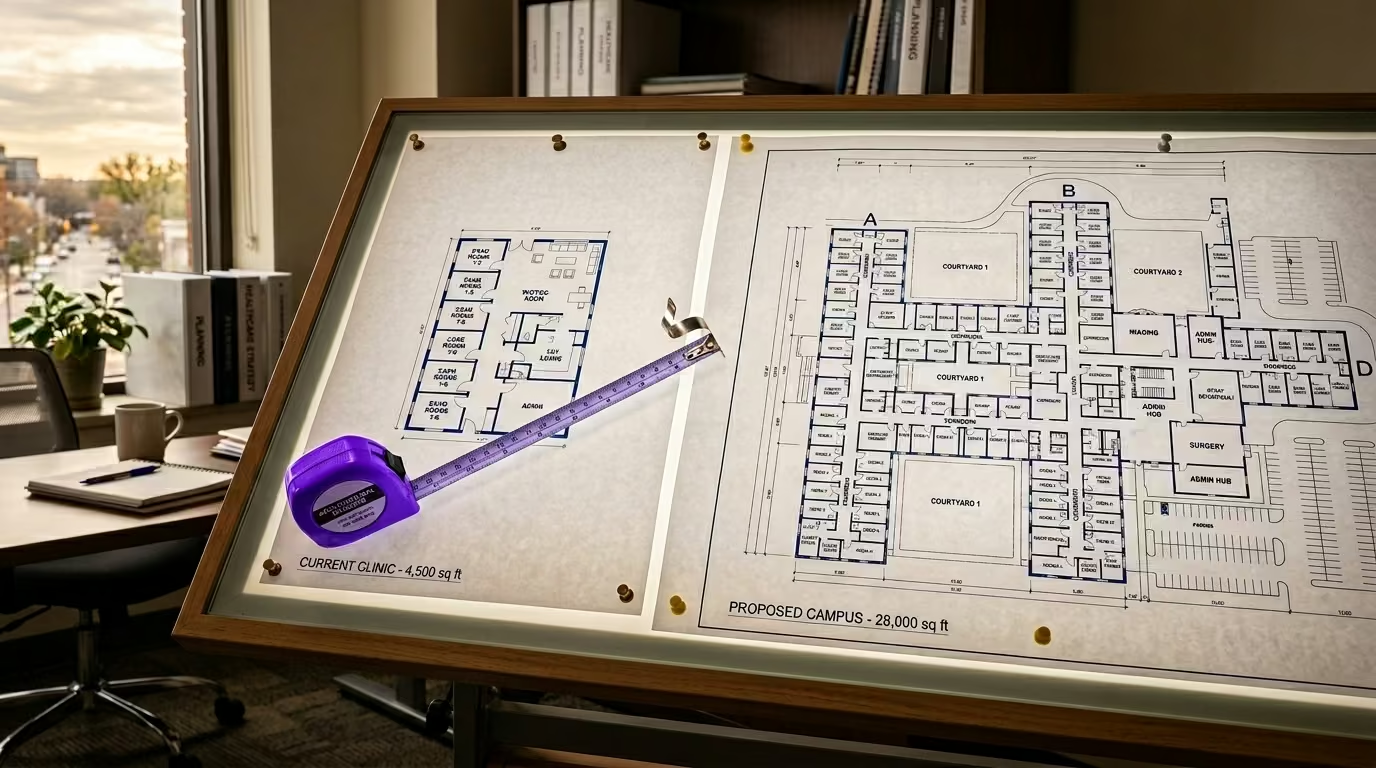
CTO Checklist: How to Evaluate Bluetooth Panic Button Systems

Bluetooth panic button evaluation — nurse in stairwell with dead phone signal and active BLE beacons

Key Takeaways

  • The strongest bluetooth panic button evaluation starts with your own facility data, not a vendor brochure. Overlay your incident locations onto your RF coverage map before the first call.
  • Assign evaluation ownership across CTO, IT Director, CISO, and CSO before engaging vendors so each stakeholder knows what they are validating.
  • Phase deployment by risk priority, starting with the dead zones where incidents already cluster, and set decision gates that require documented evidence rather than projected targets.

Your next bluetooth panic button evaluation will come down to one question: will the system actually work where WiFi does not?

You already know the answer for most of your building. The nurse stations are fine. The admin corridors are fine. But the stairwell behind the locked unit? The outdoor smoking area? The parking garage? Those are the spots where incidents happen. And those are the spots where WiFi drops.

This guide walks through how to run your evaluation as an internal project, from facility assessment through vendor selection to deployment.

Start With Your Facility, Not the Vendor Brochure

Psychiatric and substance abuse hospitals recorded 110.4 violence incidents per 10,000 workers [1]. Emergency departments account for 30% of active shooter incidents in hospitals, followed by patient rooms at 21% and parking lots at 15% [2].

Incidents cluster in stairwells, smoking areas, and the spaces between buildings that never got access points.

Many psychiatric hospitals were built in the 1950s through 1980s using dense materials for durability and security [3]. These buildings were never designed for WiFi. Behavioral health facilities compound the challenge with older IT infrastructure and limited technology staff [3][4].

Any panic button system that depends on facility WiFi inherits every weakness of that network. The locations where coverage fails are precisely where incidents concentrate.

Before evaluating any vendor, check your baseline:

  • Can you produce a current RF heat map showing dead zones overlaid with incident location data from the past 12 months?
  • What percentage of your facility square footage has reliable WiFi coverage in locked-door and outdoor areas?

If you cannot answer both, that is your first action item.

Build Your Coverage Requirements Document

Your evaluation needs a written requirements document before the first vendor conversation. Your IT Director, CISO, and CSO will reference it throughout.

Facility profile (document per building on campus):

  • Construction era and primary materials (concrete block, steel framing, masonry)
  • Number of floors, locked units, and ligature-resistant areas
  • Known dead zones from most recent RF survey
  • Outdoor areas requiring coverage (parking structures, courtyards, walkways between buildings)

Infrastructure constraints:

  • Current WiFi coverage percentage in locked-door and outdoor areas
  • Network capacity for an isolated VLAN, or whether full network independence is required
  • Technology staff capacity for new system deployment and maintenance
  • Electrical infrastructure age and power outage frequency

Performance requirements:

  • Minimum uptime standard (healthcare life-safety threshold is 99.9%) [5]
  • Coverage verification method (site survey with doors closed and locked, not just open)
  • Power independence requirement (how many hours of battery backup given your outage history)
  • Integration needs (EHR, nurse call, dispatch, incident management)

This document becomes the scorecard every vendor is measured against. Without it, evaluations turn into feature comparisons that tell you nothing about whether the system fits your buildings.

Run the Dead Zone / Incident Overlap Analysis

This is the single most valuable pre-evaluation step. It takes one afternoon and changes the entire conversation.

  • Pull 12 months of incident location data from your security director
  • Overlay incident locations onto your current RF heat map
  • Identify your three highest-risk dead zones by comparing where incidents happen most with where signal is weakest
  • Walk those three locations with a signal tester under realistic conditions (doors locked, equipment running)
  • Document findings as a one-page brief with the overlay visualization

The pattern is consistent: the dead zones and the high-incident zones overlap. That overlap is your business case and the first thing you show any vendor.

For multi-site organizations, this analysis must be site-specific. A coverage map from one facility tells you nothing about another.

See how one behavioral health provider used this approach to eliminate coverage gaps across their facilities.

Your dead zone map already tells you where coverage fails. See what closing those gaps looks like with infrastructure-independent architecture.

Contact Us

Structure the Vendor Evaluation

With your requirements document and dead zone analysis complete, you can evaluate vendors against your facility, not their marketing.

BLE mesh architecture operates independently of facility WiFi, using battery-powered beacons that form a self-healing private network. For a detailed comparison of all three architectures, see the bluetooth panic button comparison.

Assign evaluation ownership before your first vendor call:

  • CTO: Define architecture standards, lead vendor assessment, own the final recommendation
  • IT Director: Validate technical specifications against local infrastructure constraints
  • CISO: Review network isolation, encryption standards, and security certifications (require current HITRUST r2 and SOC 2 Type II)
  • CSO: Provide incident location data, validate that coverage maps align with actual risk areas

For the full evaluation checklist covering infrastructure independence, security architecture, integration, reliability, and coverage proof, use the CTO evaluation framework in the bluetooth panic button guide.

The deployment comparison matters for your timeline planning:

FactorBLE Mesh (Battery-Powered)WiFi-Dependent
Installation timeline2-3 days for a 100-room facility [6]Weeks to months including network planning [4]
Wiring requiredNoneAccess point additions, cabling
Clinical network impactZero, operates on isolated network [7]Requires network capacity planning
Ongoing maintenanceRemote firmware updates, multi-year battery life [8]Network monitoring, access point management
Capital expenditure$182 per badge [7]Varies by scope

CNOs report that the biggest deployment friction is scheduling installation around patient census and unit lockdown schedules.

Set the Timeline and Decision Gate

Your bluetooth panic button evaluation should follow a structured timeline with clear decision gates.

Weeks 1-2: Assessment

  • Complete the dead zone / incident overlap analysis
  • Finalize your coverage requirements document
  • Identify your three highest-risk areas for Phase 1 deployment

Weeks 3-4: Vendor engagement

  • Share your requirements document with vendors. Their response to your specific facility constraints, not their standard pitch deck, is the evaluation.
  • Require documented performance data from comparable behavioral health deployments, not projected targets
  • Request a site survey proposal that specifies testing under locked-door conditions

Weeks 5-6: Decision gate

  • Score vendors against your requirements document
  • Confirm that the recommended vendor meets the 99.9% uptime life-safety threshold with documented, not projected, evidence [5]
  • Present recommendation with your dead zone overlay, requirements scorecard, and vendor comparison

Phase 1 deployment: Start with your three highest-risk dead zones. Battery-powered beacons with no wiring enable deployment without clinical disruption [7]. Expand coverage facility-wide in Phase 2 based on Phase 1 results.

You do not need to fix everything before your first vendor call. Start with that RF heat map overlaid with incident data. That single document will tell you more about your bluetooth panic button evaluation priorities than any vendor slide deck.

EVALUATION SUPPORT

Ready to Start Your Bluetooth Panic Button Evaluation?

ROAR's behavioral health technology specialists can walk through your facility constraints and help you build the requirements document before your first vendor call.

References

  1. Sheps Center at UNC. Workplace Violence in Healthcare Brief. https://www.shepscenter.unc.edu/wp-content/uploads/2025/01/Y10.01_Brief-1.pdf
  2. AHA / Harborview. Costs of Violence. https://www.aha.org/costsofviolence
  3. MedCity News. Mind the Gaps: Closing the Digital Divide to Improve Behavioral Healthcare. https://medcitynews.com/2025/12/mind-the-gaps-closing-the-digital-divide-to-improve-behavioral-healthcare/
  4. Silex Technology. Reliable Hospital Wi-Fi. https://www.silextechnology.com/unwired/reliable-hospital-wi-fi-how-purpose-built-connectivity-keeps-patients-safe-and-networks-always-on
  5. Web Alert. Uptime SLA Explained. https://web-alert.io/blog/uptime-sla-explained-99-9-vs-99-99-availability
  6. GAO RFID. Operation, Maintenance and Support of a BLE Beacon. https://gaorfid.com/operation-maintenance-and-support-of-a-ble-beacon/
  7. ROAR for Good. Internal Data, 2024.
  8. Acal BFi. Comprehensive Guide to BLE Applications. https://www.acalbfi.com/news-and-insights/comprehensive-guide-to-ble-applications/