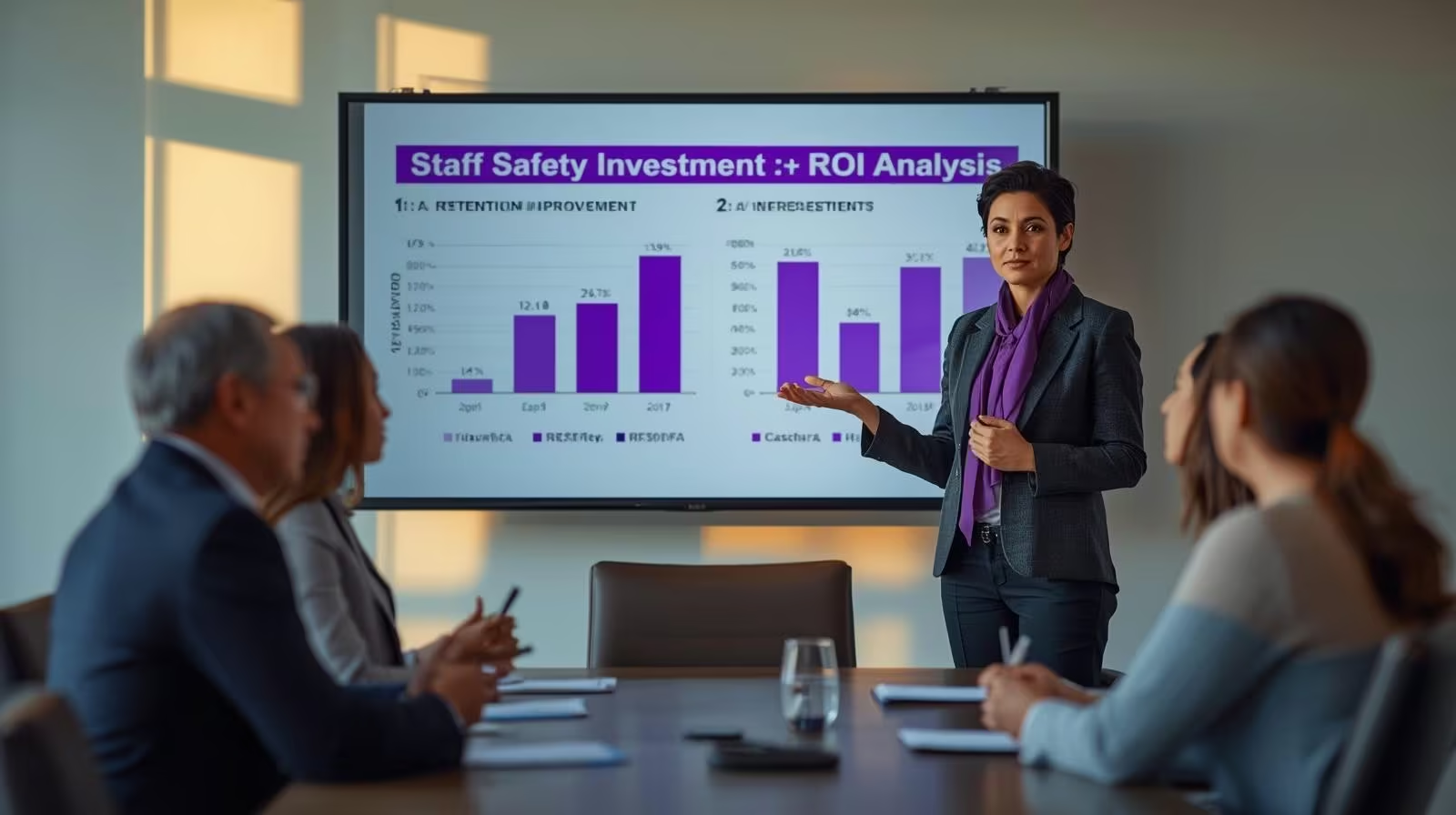
Your role during a survey isn’t to know every protocol detail but to show personal engagement with violence prevention outcomes, demonstrate leadership accountability, and present evidence to governance.
Survey readiness requires clear delegation with specific owners, timelines, and verification questions. The CEO who tries to own everything ends up proving nothing.
The gap between having a program and proving it works is where accreditation risk lives, and closing it means building systems that generate evidence continuously.
A surveyor asks for incident trending data from last quarter. The quality director looks at the CNO. The CNO looks at the technology team. Forty-five minutes later, someone’s pulling records from three different systems while the surveyor makes notes. That gap between “we have a program” and “we can prove it works” is where citations live, and it’s the CEO’s job to make sure the executive safety guide for your organization starts with clear ownership so no one is scrambling when the surveyor shows up.
What Your Role Actually Is
Surveyors don’t expect you to know every protocol detail. They expect you to show personal engagement with violence prevention outcomes. Specifically, they want to see that you can present incident trending data, articulate your investment rationale, describe how leadership rounding informs program improvements, and show that governance receives regular updates on program effectiveness. [2]
That’s leadership accountability, one of the four evidence categories surveyors assess. Your CMO, CNO, and CSO own the other three (staff awareness, response capability, incident tracking). Your job is making sure they can deliver, and that the board sees the results.
The stakes are real. Accreditation loss can suspend Medicare and Medicaid funding worth millions annually for behavioral health systems. [3] Surveyors know behavioral health facilities face the highest workplace violence rates in healthcare, [4] and they arrive expecting programs that match that reality.
The Delegation Framework
Survey readiness breaks down the moment everyone assumes someone else owns a deliverable. The fix is a delegation table with names, not departments.
Deliverable
Owner
Timeline
Gap analysis against current standards
Chief Quality Officer
Months 1–2
Staff training audit with competency verification
CNO
Months 2–3
Mock survey coordination and corrective action plan
Chief Quality Officer
Months 3–4
Response capability testing and coverage verification
CSO / COO
Months 3–4
Audit log export demonstration and uptime records
CTO
Months 3–4
Board communication on survey readiness
You
Month 6
Preparation takes 6 to 12 months ideally, though compressed timelines work with focused prioritization. [6] The key is starting with the gap analysis. Everything else builds from what it finds.
For multi-site systems, corporate leadership owns system-wide policy standards and technology platform decisions. Facility leaders own local execution, site-specific training completion, and staff interview readiness. Surveyors may visit any facility in your system, and inconsistency across sites is a common citation area.
Where CEOs Get Cited
Two deficiency patterns show up most often in behavioral health surveys: 56% cite inadequate training records and 55% cite leadership oversight gaps. [8] The training gap is your CNO’s problem to fix. The leadership gap is yours.
Gap
What Surveyors Find
What to Do
Leadership accountability
No evidence of board updates, no documented rounding
CNO implements pre/post assessments with passing thresholds
Leadership accountability gaps are the ones surveyors hold you personally responsible for. If your board hasn’t received a violence prevention update in the past quarter, that’s your citation.
If your survey window is approaching and you need help building a delegation framework, we can walk you through it.
Facilities with documented safety technology produce the evidence surveyors request within 30 minutes. [5] Manual systems take 6+ hours to compile the same records. That efficiency gap matters when a surveyor is standing in your facility making notes.
Facilities with documented response times show 93% of incidents resolved in under 2 minutes. [1] They’ve passed every Joint Commission and OSHA inspection in tracked deployments. [1] Beyond compliance, facilities show 39% reduction in patient-staff incidents in the first 3 months. [1]
But technology alone won’t fix a culture that discourages reporting or leadership that treats safety as a compliance checkbox. The technology produces the records. You have to make sure the organization actually acts on what those records show.
Complete these 30 days before your survey window opens:
Records production test. Ask your team to generate any requested evidence within 30 minutes. Time it. If they can’t, that’s your biggest gap.
Board minutes review. When did the board last receive a violence prevention update? Pull the minutes and verify documented discussion, not just slides.
Staff readiness spot-check. Walk to any unit and ask 3 staff members: “What happens if de-escalation fails?” Their answers tell you everything.
Mock survey results. Hospitals conducting mock surveys report 20–30% reduction in official survey findings. [7] If you haven’t done one, schedule it now.
Survey readiness shouldn’t require a sprint. When evidence generates continuously, any unannounced visit finds your team ready. Your executive safety guide is the delegation framework above, the verification checks in this section, and the confidence that comes from knowing your organization can prove what its program delivers.
ACCREDITATION READINESS
Lead Your Next Survey with Evidence
Facilities with documented safety systems have passed every Joint Commission and OSHA inspection in tracked deployments. See what survey-ready evidence looks like for your organization.
Surveyors evaluate violence prevention by looking for proof of action, not policy binders, across four categories: staff awareness, response capability, incident tracking, and leadership accountability.
Organizations that generate continuous records pass surveys confidently because they can hand over the exact evidence surveyors request on demand.
The gap between having a program and proving it works is where most accreditation failures start, and closing that gap means building systems that document what happens automatically.
Accreditation surveys expose a gap most behavioral health leaders don’t see coming. Your violence prevention program may be thorough. Your staff may be well-trained. Your protocols may work. But if you can’t hand a surveyor documented proof of all three, none of it counts. Staff duress deployment that generates continuous evidence is what separates a confident walkthrough from a scramble, and surveyors can tell the difference in minutes.
What Joint Commission Surveyors Actually Evaluate
The 2024 Joint Commission standards for behavioral health changed what surveyors look for. Three new requirements and one revised standard now demand proof that programs are working, not just that they exist. Surveyors check whether each requirement is met, partially met, or not met based on what you can show them. [1]
Behavioral health settings face the highest workplace violence rates in healthcare. Psychiatric and substance abuse hospitals see roughly 11 times the rate of incidents compared to the general workforce. [2] Surveyors know this. They arrive expecting programs that match the reality staff face every shift.
What they want to see: that violence prevention policies exist and are practiced, that incident reporting and trend analysis actually function, that follow-up support for affected staff is documented, and that incidents reach leadership. [3]
The key phrase is “put into practice.” Surveyors don’t just read your policies. They watch, they interview staff, and they review records. They’ll pull a random incident from months ago and trace every step of the response. If the records stop at the initial report, they notice. [4]
“Surveyors don’t just read your policies. They watch, they interview staff, and they review records. They’ll pull a random incident from months ago and trace every step of the response.”
That’s the challenge. Your program might be effective. But if you can’t produce the documentation, surveyors can’t verify it.
Want to understand what this looks like at your facility? Talk to us.
The Four Evidence Categories Surveyors Require
Surveyors look at violence prevention across four categories. Knowing what they request in each one shows why passing is harder than it looks.
Staff Awareness
Healthcare settings must train staff at hire, annually, and whenever changes happen. Surveyors check whether training covers what counts as workplace violence, who does what during a response, de-escalation skills, emergency procedures, and how to report incidents. [5]
Here’s where teams get stuck. Sign-in sheets prove attendance. Surveyors want proof of competency. They want to know that training covered de-escalation specific to your patient population and that staff actually retained it. Facilities with documented preparedness data can show measurable improvement in how confident staff feel responding to incidents. [6] Without that, training compliance is just a claim.
Response Capability
Surveyors want to know your team can respond when something happens. They check whether response systems actually work, stay reliable, and leave a paper trail.
When a surveyor asks “how quickly does help arrive when staff press the button,” they expect real data. Facilities with documented response times can answer precisely: in tracked deployments, more than 9 in 10 incidents resolve in under two minutes. [6] “We think it’s usually pretty fast” doesn’t cut it.
System reliability matters too. Surveyors check whether your safety systems stay available consistently. They also test coverage. They’ll walk to the loading dock, the basement, the stairwell between floors and ask staff to show duress activation. Systems with facility-wide coverage eliminate the dead zones that make those moments uncomfortable. [6]
Incident Tracking
Psychiatric units need continuous monitoring, internal reporting, and investigation processes for safety incidents. Surveyors want data that identifies the highest-risk locations, the times and types of incidents, and the conditions that contributed. They check whether your team uses that data to shape prevention. [4]
Fewer than 1 in 3 nurses say their employer gives them a clear way to report incidents. [7] Surveyors know this pattern. They know manual logs undercount what actually happens. When they review your data, they’re judging not just what you documented but whether your system captures reality.
The follow-through matters as much as the initial report. Surveyors pull sample incidents and trace the investigation: root cause analysis, corrective actions, follow-up interviews. When the trail goes cold after the first report, that’s a failed element. Joint Commission data shows leadership failure in follow-through as a factor in nearly 2 in 3 violent incident events. [8] The committee exists. The policy says investigate. But the documented follow-up stops at the initial report.
Leadership Accountability
Surveyors check whether violence prevention has designated leadership and multidisciplinary oversight. They want proof that incidents reach governance and that leadership is actively engaged with outcomes. Deficiencies here come from inadequate oversight of action, not from missing programs. [8]
Evidence Category
What Surveyors Request
Common Gap
Staff Awareness
Training completion with competency proof
Sign-in sheets without content verification
Response Capability
Response time data and system reliability
Anecdotal estimates without measurement
Incident Tracking
Trending analysis and investigation records
Initial reports without follow-up
Leadership Accountability
Governance reporting and active oversight
Committee existence without documented activity
Where Facilities Actually Fail
Facilities don’t fail surveys because they lack policies. They fail because they can’t show action.
The Underreporting Problem
More than 8 in 10 workplace violence incidents go unreported by the workers who experienced them. [9] Surveyors know this. When they look at your incident logs, they’re asking whether your numbers reflect what actually happens or just a fraction of it.
Nearly 9 in 10 workers don’t formally document incidents in their facility’s central database. [10] The reasons are consistent: staff believe reporting won’t change anything, they see violence as “part of the job,” and the reporting process itself is too cumbersome. Surveyors treat underreporting as a sign that the safety culture isn’t working.
That creates a paradox. Hospitals with more documented incidents may actually show stronger compliance than hospitals with fewer. Surveyors aren’t looking for low numbers. They’re looking for evidence your system captures what really happens.
“Hospitals with more documented incidents may actually show stronger compliance than hospitals with fewer. Surveyors aren’t looking for low numbers. They’re looking for evidence your system captures what really happens.”
The Investigation Problem
Reporting alone isn’t enough. Surveyors check that reported incidents get real follow-up. Your team has to show they “report and investigate.” [4]
OSHA and Joint Commission enforcement cases show a consistent pattern of deficiencies: records limited to incidents that needed first aid rather than all incidents, weak review processes, outdated policies no one communicated, and no organized follow-up on staff safety suggestions. [11]
Nearly half of nurses say workplace violence incidents are simply ignored after being reported. [7] Surveyors test this by reviewing actual records and asking staff directly how investigations work. Paper processes without documented execution don’t hold up.
What Failure Costs
When facilities show serious noncompliance, Joint Commission can issue Preliminary Denial of Accreditation. That triggers follow-up reviews and can suspend the designation that lets you bill Medicare and Medicaid. [12]
The financial exposure is real: losing accreditation can put millions in annual funding at risk. [13] Beyond money, it threatens clinical programs, physician recruitment, and the care environment you’ve spent years building.
Deficiency Pattern
Root Cause
How Surveyors Find It
Incomplete incident records
Manual reporting barriers
Reviewing logs for gaps
Missing investigation follow-up
No systematic process
Tracing sample incidents
Unverified training competency
Sign-in sheets only
Interviewing staff about content
Undocumented response capability
No measurement system
Direct observation and timing
If your team is preparing for an upcoming survey, we can walk you through what documentation surveyors typically request.
Behavioral health facilities with documented safety technology show a clear advantage during surveys. Automated systems create continuous records of incident reporting, training completion, and response data. That’s exactly what Joint Commission requires when it asks for ongoing monitoring and trending. [4]
What Automated Records Actually Produce
Staff duress deployment with automated records generates the specific evidence surveyors ask for:
Staff Awareness: Training completion with competency proof. Preparedness data showing measurable improvement over time.
Response Capability: Response time tracking with historical trends. Reliability records. Coverage verification with no dead zones.
Incident Tracking: Timestamped records with location data. Automated trending by unit, shift, and acuity level. Investigation workflow documentation.
Leadership Accountability: Exportable audit logs for governance reporting. Dashboard visibility into program metrics. Continuous monitoring evidence.
Behavioral health facilities using documented staff duress deployment have passed every Joint Commission and OSHA inspection in tracked deployments. [6] When surveyors ask for evidence, these facilities hand it over immediately.
The advantage comes from generating evidence continuously rather than scrambling before audits. Manual systems have gaps, inconsistent reporting, and trouble identifying trends. Automated systems create the verifiable audit trails surveyors specifically look for. [4]
Surveyor Request
Manual Response
Automated Response
“Show me response time trending”
Estimates or no data
Dashboard with historical records
“How do you track incidents by location?”
Spreadsheet requiring manual work
Real-time visualization by unit
“What’s your system uptime?”
Unknown or estimated
Documented reliability records
“Can staff show the duress protocol?”
Depends on training
Consistent with documented competency
Beyond passing surveys, facilities show roughly 40% reduction in violent incidents within the first year. [6] The same records that satisfy surveyors drive real quality improvement.
Preparing for Survey Success
Joint Commission expects continuous readiness, not last-minute preparation. Best practice means conducting mock surveys at least six months before your triennial date and running internal compliance checks quarterly. [14]
Mock Survey Priorities
Mock surveys should cover the same ground real surveyors cover:
Staff interviews about duress response protocols and training content
Direct observation of system activation and response timing
Review of incident records for investigation follow-up
Assessment of trending data availability
Verification of governance reporting processes
The Quick Readiness Check
Four questions that cut through the noise:
Can you export 90 days of incidents by unit in one click? If it takes 20 minutes and a spreadsheet, that’s a problem.
Can you find proof leadership reviewed trends monthly? Not slides. Minutes with actual discussion.
Grab two random staff from different units and ask: “What happens if de-escalation fails?” If they hesitate, your training records don’t matter.
Does response time data exist, or are you guessing?
Continuous Over Episodic
The strongest facilities maintain safety culture year-round. Quality improvement research shows meaningful reduction in violence incidents when continuous approaches run for 15 months or longer. [15] The goal isn’t to pass the next survey. It’s to build systems that make survey prep unnecessary because the evidence generates itself.
No one should face violence while trying to help others heal. Your staff duress deployment should deliver on that standard, and your records should prove it.
ACCREDITATION READINESS
Build Survey Confidence with Documented Evidence
Facilities using staff duress deployment with automated records have passed every Joint Commission and OSHA inspection in tracked deployments. See what continuous compliance looks like.
The hardest question a CEO faces before a survey is whether their organization can prove its violence prevention program works, and most can’t answer it with confidence.
Accreditation loss doesn’t just trigger regulatory consequences. It threatens the funding, the clinical programs, and the staff retention you’ve spent years building.
Confidence comes when evidence generates continuously, so the board chair’s question stops being a source of dread and becomes a conversation you welcome.
Your board chair calls before the quarterly meeting. “The Joint Commission survey window opens in four months. Are we ready?” You pause. You have policies. You have training records. But can you show that your violence prevention program actually works? That pause is where safety investment confidence lives or dies, and closing it requires more than a binder update.
Why Your Numbers Won’t Hold Up
You review incident logs before your quality committee meeting. Twelve incidents over 6 months in your highest-acuity unit. The number feels low because it is.
81% of workplace violence incidents go unreported by healthcare workers who experienced them. [4] Only about a third of nurses say their employer gives them a clear way to report incidents. [5] The reasons are consistent: staff believe nothing will change, so they stop documenting.
That means the data you’re presenting to your board represents a fraction of reality. Surveyors know this pattern. When they review your incident logs and the numbers don’t match your facility’s acuity level, they probe. And the answers staff give in confidential interviews will tell a different story than your logs.
You have policies. What you’re missing is documented proof that those policies produce results. And that’s the gap your board will ask about if accreditation is lost.
“You have policies. What you’re missing is documented proof that those policies produce results. And that’s the gap your board will ask about if accreditation is lost.”
What You Think You’re Showing
What Surveyors Actually See
Low incident numbers = safe facility
Low numbers = underreporting problem
Policy binder = program compliance
Binder without evidence = paper program
Training sign-in sheets = prepared staff
Sign-in sheets without competency proof = attendance records
“We respond quickly” = response capability
No timestamps = unverifiable claim
What Surveyors Ask You Personally
Surveyors don’t just evaluate your team. They evaluate you. They expect the CEO to show personal engagement with violence prevention outcomes: present incident trending data, articulate the investment rationale, describe how leadership rounding informs improvements, and demonstrate that governance receives regular updates. [1]
This is the accountability moment other leaders don’t face the same way. Your CNO answers for nursing readiness. Your CSO answers for security evidence. But when the surveyor asks about leadership oversight and governance reporting, they’re looking at you.
The stakes are personal. When Joint Commission removes accreditation, the designation that lets you bill Medicare and Medicaid terminates immediately. Your facility can’t bill during the gap until CMS completes separate certification. [2] For behavioral health systems, that’s millions in suspended revenue, followed by patient census decline and the staff exodus that accompanies institutional crisis. [3]
Your board will ask one question: “How did we not see this coming?”
If your board is asking about survey readiness and you need help building the evidence, we can walk you through it.
The shift happens when you can answer the board chair’s question with evidence instead of assurance. Facilities with documented safety technology have passed every Joint Commission and OSHA inspection in tracked deployments. [6] The reason is straightforward: when surveyors ask for evidence, these facilities produce it in minutes.
That changes your board conversation completely. Instead of presenting compliance status, you’re presenting outcomes:
Response capability: documented response times showing consistent performance across units and shifts
Incident trending: data showing whether violence rates are declining, stable, or rising, with context for each
Staff readiness: preparedness metrics showing your team can demonstrate capability when asked
Leadership engagement: governance records showing the board receives regular updates with actual discussion, not just slides
Beyond survey outcomes, facilities show roughly 40% reduction in violent incidents within the first year. [6] That’s the kind of outcome that translates directly into the governance language your board understands: risk reduction with measurable proof.
If your survey window opens in 4 months, four checks tell you whether you’re ready:
Pull 90 days of incident data by unit. Can you do it in under 5 minutes? If it takes longer, or if any unit shows zeros, you have a problem.
Find proof leadership reviewed trends monthly. Not slides. Committee minutes showing actual discussion where someone asked a hard question.
Ask 2 random staff from any unit: “What happens if de-escalation fails?” Listen for hesitation.
Check your response time data. Does it exist, or are you guessing?
The gaps you find now are the gaps surveyors will find in 4 months. The difference is whether you discover them with time to act.
Safety investment confidence means knowing your program generates the evidence that makes survey preparation unnecessary, because the proof exists continuously. When the board chair asks “are we ready,” the answer is built on documented outcomes, not reassurance.
BOARD CONFIDENCE
Answer the Board Chair's Question with Evidence
Facilities with documented safety systems have passed every Joint Commission and OSHA inspection in tracked deployments. See what board-ready survey evidence looks like.
Behavioral health workplace violence is the fastest-growing driver of union organizing in healthcare. These FAQs answer the most common questions leaders ask about the connection between safety investment, union concerns, and workforce stability. Whether you are a CHRO preparing for bargaining, a CNO advocating for staff, or a CEO presenting to your board, these answers draw from published evidence and peer benchmarks to help you act before pressure arrives.
Why are unions organizing around workplace violence instead of wages?
Safety unites every staff role in a way wages cannot. A pay dispute divides nurses from techs from support staff, but violence exposure is shared across all classifications. That makes safety the strongest coalition-building tool unions have. Nearly half of nurses say their employers ignore reported violence, giving organizers a credible grievance that resonates with every worker on the unit. When safety concerns go unaddressed, they escalate through predictable stages from informal complaints to formal organizing triggers.
How does behavioral health workplace violence affect turnover and costs?
Violence drives nurses out faster than almost any other factor. Each RN departure costs roughly $61,000 in recruiting, onboarding, and lost productivity. Those costs compound because remaining staff absorb more risk, burn out faster, and leave sooner. The cycle feeds itself: higher turnover means more agency staff who don’t know the patients, which increases incident rates further.
What is the gap between what dashboards show and what staff actually experience?
Most organizations track incident counts that staff have already stopped trusting. Nearly half of nurses report that their employers ignore incidents after they are reported, and the majority of incidents go unreported entirely. Unions collect lived experience from members while management relies on official figures. That perception gap is where bargaining tension lives, because union representatives arrive with stories that contradict the data leadership presents.
What separates organizations with stable labor dynamics from those facing escalating grievances?
Early-moving organizations invest in safety before union demands arrive. They measure staff perception of safety, not just incident counts. They document visible responses to concerns and share outcomes transparently with staff and union representatives. Organizations still waiting show the opposite pattern: rising intent-to-leave, declining safety sentiment, and a widening gap that compounds each quarter.
Why does the timing of safety investment matter so much for union negotiations?
Investment that comes before a grievance reads as leadership. Investment that comes after reads as a concession. Unions and staff both evaluate safety commitment based on whether the organization acted before it was forced to. At one multi-site behavioral health provider, staff who said they would consider leaving over safety dropped from 22% to 7% after proactive investment. That kind of documented outcome shifts bargaining conversations from “you haven’t done enough” to “how do we keep this going.”
How should CHROs present safety investment to their CFO and CEO?
The data stays the same, but the framing changes for each audience. For the CFO, frame safety as cost avoidance using turnover costs and workers’ comp trends. For the CEO, frame it as strategic risk by connecting safety gaps to board exposure and union escalation timelines. For union representatives, lead with shared values and visible commitment before presenting solutions. Four data sources CHROs already collect, including exit interviews, engagement surveys, workers’ comp claims, and grievance filings, provide everything needed to build all three versions.
What does a successful 90-day safety pilot look like?
A bounded pilot on one or two high-incident units with three defined success metrics is the ask most likely to get executive approval. Track intent-to-leave, workers’ comp claim trajectory, and staff safety sentiment scores. Peer organizations that ran this approach documented measurable improvements within the first quarter. If those three signals move in the right direction, the case for expansion builds itself from the data.
How do CHROs know if their organization is falling behind on safety investment?
Three signals in data you already collect reveal your position. First, check whether safety appears in more than 10% of exit interviews. Second, look at whether grievance volume is trending up quarter over quarter. Third, compare your engagement survey scores on safety questions against prior years. If all three signals are moving in the wrong direction, the cost of waiting already exceeds the cost of acting.
What should leaders do when unions say “you haven’t done enough” about workplace violence?
The strongest response is documented evidence of what changed, when it changed, and how it was measured. Hope says “we think this is helping.” Confidence comes from specific outcomes you can point to. Workers’ comp claims dropping 24% to 50% after investment gives you something concrete to discuss. The goal is to arrive at the table with evidence that shifts the conversation toward sustaining progress rather than defending inaction.
The internal barrier to safety investment isn’t disagreement about whether it matters. It’s that safety and labor relations are budgeted as separate line items.
Executives move when safety investment is framed against turnover cost and workers’ comp data they already track, not against incident rates they delegate to security.
The strongest objection, “the union will just ask for more,” is answered by peer evidence that proactive investment reduces total grievance volume.
CHROs who already see the link between behavioral health workplace violence and union grievance activity face a specific internal challenge: getting the CEO and CFO past the habit of treating safety and labor relations as separate budget conversations. This brief gives you the arguments, data framing, and objection responses to walk into that meeting and come out with approval.
The Decision You’re Driving
The organizational change this advocacy supports is simple: reclassify safety investment from an operational expense managed by security into a labor relations strategy owned by HR. That shift determines the budget category, the approval pathway, and whether the investment connects to the workforce metrics you already own.
If safety stays in operations, the CHRO doesn’t control the narrative. If it moves to workforce stabilization, it connects to turnover, workers’ comp, and engagement, which are the numbers the CFO and CEO already watch.
“If safety stays in operations, the CHRO doesn’t control the narrative. If it moves to workforce stabilization, it connects to the numbers the CFO and CEO already watch.”
Three Points That Move Executives
Point one: the retention math. Each RN departure costs roughly $61,000 in recruiting, onboarding, and lost productivity [1]. When more than one in five staff members say they’d consider leaving over safety concerns, the exposure adds up fast. Peer organizations that invested in safety saw that number drop from 22% to 7% [2]. That’s the kind of shift the CFO can model against headcount.
Point two: the workers’ comp trajectory. Violence-related claims are among the most expensive in healthcare. Peer organizations have documented 24% to 50% reductions in claims after investing [2]. Those reductions lower the experience modification rate, which means lower premiums the following year. This is financial data the CFO already tracks. You’re connecting it to a cause they may not have linked yet.
Point three: the grievance cost of waiting. Nearly 45% of nurses say reported violence gets ignored [3]. That perception is showing up in grievance filings. Every quarter that safety concerns go unaddressed, the union’s case gets stronger. Proactive investment demonstrates good faith before the grievance formalizes. Reactive investment, after the grievance, carries the implicit message that the organization only acted because it was forced to.
Data Packaged for the Budget Conversation
Present one table. Executives scan, they don’t read paragraphs in budget meetings.
Leading indicator of retention that engagement surveys confirm
Don’t present all five at once. Lead with the one that matches your CFO’s biggest concern this quarter. If it’s turnover cost, lead with the 22% to 7% drop. If it’s insurance premiums, lead with the claims reduction.
Objections You’ll Hear
“We already have safety training.” Training addresses skills. It doesn’t address the 45% of staff who say nothing changes after they report an incident [3]. The investment you’re proposing closes the gap between training and visible organizational response.
“The union will just demand more.” Peer data shows the opposite. Organizations that invested proactively saw grievance volume decrease, not increase [2]. When the union’s core demand is met with measurable evidence, the conversation shifts from escalation to collaboration.
“Show me the ROI before I commit.” Point to the retention math and workers’ comp data. Peer organizations documented measurable returns within the first six months [2]. A bounded pilot on one high-risk unit gives the CFO a way to verify the numbers before committing to enterprise scale.
If you're building the internal case and want to see what peer organizations presented, that conversation is worth having.
Propose a bounded pilot: one high-acuity unit, 90 days, with three success metrics tied to the data you just presented.
Intent-to-leave on the pilot unit before and after
Workers’ comp claim trajectory on the pilot unit
Staff safety sentiment scores before and after
If the pilot produces the outcomes peer organizations have documented, the case for expansion writes itself. If it doesn’t, the investment was bounded and the data is clear.
Walk in with the table, the three points, and the pilot proposal. That’s enough to get a yes.
INTERNAL ADVOCACY
Get the Budget Approved Before the Grievance Forces It
See how peer CHROs secured executive buy-in for safety investment positioned as labor relations strategy.
Peer CHROs in behavioral health are treating safety investment as a labor relations strategy, and the gap between early movers and those still waiting is showing up in measurable workforce outcomes.
The organizations with stable labor relations share a pattern: they invested in safety before the grievance forced it, and they can prove what changed.
Most organizations stall because they’re waiting for union pressure to justify the spend, which guarantees they negotiate from a reactive position.
The question behavioral health CHROs keep asking each other is simple: what are other organizations actually doing about workplace violence and union safety pressure? Not what they’re planning. Not what they’re evaluating. What they’ve done, and what happened after.
The answer is splitting the field. Some peer organizations have already invested and are documenting results. Others are still waiting, and the gap between the two groups is getting harder to close.
Where Peer CHROs Are Moving
Across behavioral health, CHROs are starting to treat safety investment as a workforce stability tool tied directly to labor relations, not as a security line item managed by operations.
The shift is driven by what unions are bringing to the table. Nearly half of nurses say their employers ignore reported violence [1]. Psychiatric and substance abuse hospitals see the highest violence rates in healthcare [2]. These aren’t new numbers, but they’re now showing up in grievance filings and bargaining proposals with increasing frequency.
Peer CHROs who’ve moved on this describe a common realization: waiting for the grievance to justify the investment means you’re always one step behind the conversation. The organizations documenting the strongest labor relations outcomes are the ones that invested before the demand arrived.
What Top-Performing Organizations Do Differently
Four patterns separate the organizations with stable labor dynamics from those still managing escalating safety grievances.
They invested before the ask. The strongest peer outcomes come from organizations where safety investment preceded formal union demands. In one multi-site deployment, staff who said they’d consider leaving over safety dropped from 22% to 7% [3]. That shift happened because the investment was visible before the grievance was filed, not after.
They measure what staff feel, not just what happens. Leading organizations track safety perception alongside incident counts. Staff sentiment scores went up by as much as 38 points after investment [3]. Unions care about what their members experience, not what the dashboard says. Organizations that track perception have evidence unions accept.
They share the data openly. Peer CHROs who gave union representatives access to adoption rates, sentiment trends, and outcome metrics turned potential adversaries into advocates. Transparency converted resistance into partnership at multiple documented sites.
They frame safety as retention, not security. Organizations that positioned safety investment under workforce stabilization got CFO and CEO support faster than those who kept it in the operations budget. Workers’ comp claims dropping 24% to 50% [3] speaks the CFO’s language without translation.
The Gap Between Leaders and Laggards
The performance difference between organizations that invested proactively and those still evaluating is measurable.
Dimension
Early Movers
Still Waiting
Staff intent-to-leave over safety
Dropped to single digits
Remains above 20%
Safety sentiment trajectory
Measurable improvement documented
No baseline to compare against
Union conversation tone
Collaborative, focused on expanding what works
Adversarial, centered on what hasn’t been done
Workers’ comp trend
Declining claims, improving mod rates
Flat or rising
Board visibility
Safety metrics in workforce reporting
Safety buried in operations reports
The gap isn’t just about outcomes. It’s about positioning. Organizations with documented investment enter every labor conversation with evidence. Organizations without it enter with explanations.
“Organizations with documented investment enter every labor conversation with evidence. Organizations without it enter with explanations.”
Where Most Organizations Get Stuck
The most common stalling point isn’t disagreement about whether safety matters. Every behavioral health CHRO knows it does. The stall happens in the space between knowing and acting.
Waiting for the “right” trigger. Many CHROs wait for a serious incident or a formal grievance to justify the budget request. But by the time the trigger arrives, the investment reads as reactive. The organizations with the strongest outcomes invested before external pressure forced it.
Treating it as a security decision. When safety investment stays in the security budget, the CHRO doesn’t own it. And if the CHRO doesn’t own it, the workforce data that makes the case never gets attached. The organizations that moved fastest put it in the HR budget from the start.
Underestimating how fast peers are moving. CHROs who assume they have time to evaluate are often surprised by how far ahead peer organizations already are. The gap compounds: early movers document results, which strengthens their position, which widens the distance from organizations still in evaluation mode.
If your organization is still in the evaluation column, a conversation about what peers are seeing might help clarify the path.
If you’re reading this and recognizing your organization in the “still waiting” column, here’s what peer CHROs recommend as the first step.
Check your own data against three signals:
Exit interview themes. Are departing staff citing safety? If safety shows up in more than 10% of exits, the retention case is already there.
Grievance trajectory. Are safety-related complaints increasing, even slightly? A rising trend means union representatives are building a record.
Engagement survey gaps. Do your safety perception scores lag behind other categories? That gap is exactly what organizers use to frame leadership as disconnected.
If any of those signals are present, the peer data says the same thing: the cost of waiting is higher than the cost of acting. And the organizations that acted first are the ones sitting across the bargaining table with evidence instead of explanations.
PEER BENCHMARKS
See Where Your Organization Stands
Peer CHROs are documenting workforce outcomes from proactive safety investment. Find out how your organization compares.
Positioning safety investment in labor relations requires a structured narrative built for three audiences: the CFO, the CEO, and union representatives.
The same workforce data must be framed differently depending on whether you’re requesting budget approval or presenting at the bargaining table.
CHROs can verify the narrative worked within 90 days by tracking budget approval, grievance trajectory, and whether bargaining language shifted.
Most CHROs in behavioral health know safety investment matters for labor relations. The problem isn’t conviction. It’s that there’s no repeatable process for turning that conviction into a narrative that gets the CFO to approve the budget and gets the union to see it as a collaborative commitment rather than a reactive concession.
This article delivers that process. By the end, you’ll have a structured workflow for building the safety-as-labor-strategy narrative, packaging the data for each audience, and confirming it landed.
What This Process Produces
The output is a documented safety investment narrative the CHRO can use in three settings:
CFO budget conversations where the ask competes against recruitment bonuses, compensation adjustments, and benefits expansion
CEO strategic discussions where safety needs to connect to workforce stability and regulatory exposure
Union discussions where the investment needs to read as proactive commitment, not a response to pressure
The narrative connects the same underlying workforce data to what each audience cares about. The data doesn’t change. The framing does.
The Workforce Data You Need First
Before building the narrative, gather four data points you already have access to.
Data Source
What You’re Looking For
Where to Find It
Exit interviews (last 12 months)
Frequency of safety as a cited reason for leaving
HR records, exit interview summaries
Engagement surveys
Safety perception scores vs. other categories
Most recent annual or pulse survey
Workers’ comp claims
Violence-related claim count and cost trend
Risk management or insurance broker
Grievance filings
Safety-related complaints, formal and informal
Employee relations records
If safety shows up in more than 10% of exit interviews, your retention case is already strong [1]. If 45% of nurses say reported incidents get ignored [2], the grievance case is building whether you see it in formal filings yet or not. If workers’ comp claims for violence-related injuries are flat or rising, the CFO case writes itself.
You don’t need new research. You need to pull what you already track into one place.
Building the Labor Relations Narrative
The narrative has three versions, one per audience. Each uses the same data but frames it around what that audience tracks.
For the CFO: cost avoidance. Lead with workers’ comp trends and turnover cost. Each RN departure costs roughly $61,000 in recruiting, onboarding, and lost productivity [3]. If your intent-to-leave data shows 20%+ of staff citing safety, multiply that by your headcount and your replacement cost. Then show that peer organizations saw intent-to-leave drop from 22% to 7% after investing [4]. The CFO doesn’t need to care about safety to care about that number.
For the CEO: strategic risk. Lead with the grievance trajectory and regulatory exposure. If safety-related complaints are rising, even informally, that’s a leading indicator of formal organizing activity. Frame the investment as getting ahead of a labor relations risk before it reaches the board. CEOs respond to “this will be a board conversation in six months if we don’t act” faster than they respond to incident data.
For union representatives: visible commitment. Lead with what you’re prepared to invest, not what you’ve already done. Unions respond to forward-looking action more than backward-looking defense. Frame it as: “We agree staff deserve to feel safe. Here’s what we’re committing to, and here’s how we’ll measure whether it’s working.” Peer organizations that opened with shared values before presenting solutions saw representatives become advocates for adoption [4].
When the Standard Approach Won’t Work
Three situations require a modified process.
Active organizing campaign underway. If union organizing has already started, the narrative framing shifts. Anything you present will be read through the lens of “they’re only doing this because we forced them.” In this case, lead with the data you gathered before the campaign, show that the evaluation was already underway, and document the timeline. If you can’t show prior evaluation, acknowledge the timing honestly and focus on joint oversight of the implementation.
Multi-site system with uneven risk. Some facilities face acute safety pressure while others don’t. The narrative needs to address why you’re investing system-wide (because the workforce is mobile and the brand is shared) or why you’re piloting at high-risk sites first (because the data supports starting where the need is greatest). Don’t let the low-risk sites become an argument against investment at the high-risk ones.
No union presence, retention is the primary frame. If your facility isn’t unionized, the labor relations angle drops out and retention becomes the lead frame. The process is the same, but the CEO and CFO conversations center on exit interview data and replacement cost rather than grievance risk. The urgency argument shifts from “this will become a bargaining issue” to “this is already costing us staff we can’t replace.”
If you've got the data but need help packaging it for the budget conversation, we can walk through what peers have used.
Track three signals within 90 days of presenting the narrative.
Budget approval. Did the CFO approve the investment? If not, what specific objection blocked it? The most common blocker is “show me peer data,” which means the narrative needs more external benchmarks. The second most common is “not this quarter,” which means the urgency framing didn’t land.
Grievance trajectory. Are safety-related complaints holding steady, declining, or still rising? If they’re declining after the investment was announced (even before deployment), the narrative is shifting how staff perceive organizational commitment.
Bargaining language. In your next union conversation, did the tone shift? Are representatives asking about implementation details rather than demanding action? If the conversation moved from “you haven’t done enough” to “how do we make this work,” the narrative landed.
If none of these signals show movement within 90 days, revisit the data packaging. The most common failure isn’t the wrong argument. It’s the right argument presented in the wrong audience’s language.
LABOR RELATIONS STRATEGY
Build the Narrative Before the Grievance Builds It for You
See how peer CHROs positioned safety investment to secure budget approval and shift union dynamics.
The real fear behind union safety negotiations isn’t the data representatives bring to the table, it’s the feeling that nothing you’ve done will be enough to answer it.
Unions don’t judge safety commitment by what’s in the policy manual. They judge it by what staff say they experience on the floor.
CHROs who can show measurable changes in how staff feel about safety walk into bargaining with confidence that reactive responses can’t replicate.
Every CHRO in behavioral health knows the moment. Union representatives sit down across the table with a stack of incident data, staff surveys, and grievance filings. The numbers are accurate. The stories are real. And the question hanging over the room is one you’ve been asking yourself for months: have we done enough?
That question is the hardest part of healthcare union safety negotiations. Not the data. Not the demands. The doubt.
The Fear That Follows CHROs Into Bargaining
The anxiety isn’t about whether workplace violence is a problem. Every CHRO in behavioral health knows it is. Psychiatric and substance abuse hospitals see the highest violence rates among all healthcare facility types [1]. Nearly half of nurses say their employers ignore incidents after they’re reported [2]. Representatives don’t have to exaggerate. The numbers speak for themselves.
The fear is more specific than that. It’s the worry that despite the training programs, the incident reporting systems, and the policy updates, none of it will hold up when someone asks: what did you actually change?
That fear keeps CHROs in a defensive posture before the conversation even starts. And unions can tell.
Why Good Intentions Don’t Satisfy Unions
CHROs often walk into bargaining with a list of things the organization has done: updated policies, new training modules, revised incident reporting forms. These are real efforts. They take time and resources.
But unions aren’t asking what you’ve written down. They’re asking what staff experience on the floor. And the gap between those two things is where the tension lives.
When 45% of nurses say reported violence gets ignored [2], the problem isn’t a missing policy. It’s that staff don’t see their reports leading to anything they can point to. The training happened, but the hallway where the last assault took place still has the same coverage gaps. The policy was updated, but the nurse who filed the report never heard what changed because of it.
Unions frame this gap as evidence that leadership treats safety as a paperwork exercise. That framing sticks because staff feel it matches their experience. Until the CHRO can show something that changed how safety actually feels on the unit, policy documents don’t close the gap.
What Changes When Staff Can See the Investment
The shift happens when safety investment becomes something staff can point to. Not a memo. Not a training slide. Something visible on the unit that changes how they experience their workday.
In one multi-site behavioral health deployment, staff who said they’d consider leaving over safety dropped from 22% to 7% [3]. Safety sentiment scores went up by as much as 38 points [3]. Staff who said they felt “very prepared” to handle an incident went from 38% to 76% [3].
Those numbers didn’t move because of a new policy. They moved because staff could see and feel that something had changed.
That visibility is what unions are actually asking for when they say they want “commitment.” They want something their members can point to. When that evidence exists, the bargaining conversation shifts. Representatives aren’t building a case against you. They’re looking at what’s working and asking how to build on it.
If the gap between what you've done and what you can prove is keeping you up at night, that's a conversation worth having.
The CHRO’s doubt doesn’t go away because someone says “you’ve done enough.” It goes away when the numbers show it.
When your engagement surveys show a measurable jump in safety confidence, that’s evidence you can bring to the table. When workers’ comp claims drop 24% to 50% after deployment [3], that’s evidence the CFO tracks independently. When staff preparedness scores nearly double, that’s evidence union representatives can take back to their membership.
This is what separates confidence from hope. Hope says “we think this is helping.” Confidence says “here’s what changed, here’s when it changed, and here’s how we measured it.”
CHROs who have this evidence describe bargaining differently. The conversation moves from “you haven’t done enough” to “how do we keep this going.” That shift doesn’t require a new negotiating strategy. It requires having answers to the questions you’ve been dreading, backed by numbers that hold up.
From Dread to a Defensible Position
The fear that follows CHROs into union safety negotiations is real. The data representatives bring is accurate. The concerns staff raise are legitimate. None of that changes.
What changes is whether you walk in with documented evidence that your organization acted before the grievance forced it. Whether you can show that staff perception of safety moved in a direction both sides can verify. Whether the investment preceded the demand.
“The doubt doesn’t disappear because the problem goes away. It disappears because you can prove what you did about it.”
That sequencing is what earns confidence. CHROs who invested proactively don’t walk into bargaining hoping their efforts were enough. They walk in knowing what changed, by how much, and when.
The doubt doesn’t disappear because the problem goes away. It disappears because you can prove what you did about it.
NEGOTIATE WITH CONFIDENCE
Walk Into Bargaining With Evidence, Not Hope
See how CHROs are entering union discussions with documented safety outcomes that change the conversation.
Safety grievances have replaced wages as the primary organizing tool in behavioral health, giving unions a story that unites every staff classification under one demand.
When nearly half of nurses say their employers ignore reported violence, the gap between what staff experience and what dashboards show becomes the strongest argument organizers have.
Organizations that invest in safety before unions force the issue gain a seat at the table they can’t get back once the grievance has already been filed.
Union organizing campaigns in behavioral health don’t lead with wages anymore. They lead with safety. When nearly half of nurses say their employers ignore workplace violence incidents after they’re reported [1], organizers have something better than a pay grievance. They have a story that unites every worker in the building, from housekeeping to psychiatry, around a single demand: protect us.
For CHROs, behavioral health workplace violence now touches everything at once: staffing, union activity, compliance, and retention. The only question is whether you deal with it on your own terms or on the union’s.
Why Safety Organizes Better Than Wages
Safety grievances give unions three advantages that wage disputes can’t match.
Everyone’s in. A demand for higher wages splits the workforce along pay grades. RNs earn more than CNAs, experienced staff earn more than new hires. A demand for safety investment unites them. Every role shares exposure to violence, so organizers can build a coalition management can’t break apart.
The public pays attention. Media coverage of staff getting assaulted gets immediate sympathy. Complicated arguments about pension multipliers or shift differentials don’t. When healthcare systems face strike authorization votes, the story the public hears is about safety, not economics. That puts pressure on hospital boards that’s hard to push back against.
Regulators get involved. Unions can file OSHA complaints for unsafe working conditions while bargaining stalls at the table. That puts pressure coming from two directions at once: the bargaining table and the inspection report.
Behavioral health is especially exposed. Psychiatric and substance abuse hospitals see the highest behavioral health workplace violence rates among all healthcare facility types [2]. In settings where violence has been treated as “part of the job” for years, staff aren’t asking for better pay. They’re asking for the basic assurance of going home safe.
How Safety Grievances Escalate to Formal Action
The path from frustration to formal organizing follows a pattern. CHROs can spot it early if they know what to look for.
It starts with the reporting process itself. When nearly a third of nurses say their employer doesn’t give them a clear way to report incidents [1], the paperwork becomes the barrier. Staff weigh whether 20 minutes of documentation is worth the effort. Many decide it isn’t.
Then comes the futility problem. A nurse documents an assault and nothing visibly changes. No protocol update, no staffing adjustment, no patient flag. The report goes into a queue somewhere. The nurse never hears back. Over time, that silence sends a message: reporting doesn’t lead anywhere.
Stage
What Staff Experience
What Management Sees
Reporting friction
Complex portals, unclear process
Low incident volume on dashboards
Futility cycle
No visible response after filing
Stable or declining trend data
Perception gap
“They ignore what we report”
“Our numbers look fine”
Grievance formation
Stories shared informally, trust erodes
Surprise when formal complaints surface
Organizing trigger
Union frames the narrative around safety
Reactive scramble to respond
By the time formal organizing starts, the union has already built its case with stories, anonymous surveys, and specific grievances. Management shows up to the bargaining table with official figures that staff have already stopped trusting. That mismatch between the two versions of reality is exactly what organizers point to.
The Reporting Gap CHROs Don’t See
The dashboards look fine. Incident reports show manageable numbers. But nearly 45% of nurses say incidents are ignored, and another 17% say their employers actively discourage reporting [1]. What CHROs are looking at reflects only the fraction of incidents that actually make it through the reporting process.
That gap between what gets reported and what actually happens on the floor is where grievance pressure builds.
What the dashboard shows: A dozen incidents this quarter, consistent with last year.
What staff experience: Dozens of verbal threats, near-misses, and physical encounters that never get documented because the process is too heavy or the outcome feels like a foregone conclusion.
What the union collects: Anonymous surveys, hallway conversations, and specific stories that add up to a very different picture than the one on your dashboard.
When those two versions of reality show up at the same bargaining table, management looks out of touch. The union has lived experience. Management has numbers staff don’t believe in.
“The real signal is the gap between your reported numbers and your staff’s perception of safety.”
The real signal is the gap between your reported numbers and your staff’s perception of safety. If your engagement surveys flag safety concerns but your incident reports don’t match, that gap is already open. And organizers are likely already working with it.
If your engagement surveys flag safety concerns your incident reports don't match, that gap is worth a conversation.
What Happens When Behavioral Health Workplace Violence Goes Unaddressed
When safety concerns go unanswered, they don’t stay the same size. Three cost drivers start feeding each other, and each one makes the next one worse.
Turnover picks up first. When more than one in five staff members say they’d think about leaving over safety concerns, every departure costs tens of thousands in recruiting, onboarding, and ramp-up time [3]. The staff who stay pick up extra shifts, which puts them in front of more incidents, which pushes the next round of departures.
Workers’ comp costs climb alongside it. Violence-related injuries are among the most expensive claims in healthcare. Each one raises the organization’s experience modification rate, which means higher premiums the following year. If the root cause stays the same, premiums keep going up while the problem keeps getting worse.
Union leverage builds with every cycle. Every grievance that goes unanswered becomes evidence in the next bargaining session. Every nurse who leaves and cites safety in the exit interview adds to the organizing story. Every workers’ comp claim puts on paper what management chose not to address. The longer this runs, the weaker the CHRO’s position at the table.
Cost Driver
How It Compounds
What It Feeds
Turnover
Remaining staff absorb workload, face more incidents
More departures, higher recruitment costs
Workers’ comp
Claims raise experience mod rates year over year
Budget pressure that delays safety investment
Union leverage
Each unanswered grievance strengthens the organizing case
More restrictive contract language, less flexibility
The longer you wait, the worse it gets, and faster than most organizations expect. Each quarter of inaction makes the eventual response more expensive and more constrained.
Documented Outcomes From Proactive Investment
Organizations that invested in safety before union pressure forced the decision have seen real changes in their workforce numbers.
In one multi-site behavioral health deployment, staff who said they’d consider leaving over safety concerns dropped from 22% to 7% [4]. Safety sentiment scores went up by as much as 38 points on annual surveys [4]. Staff who said they felt “very prepared” to respond to an incident went from 38% to 76% [4].
These are observed outcomes from facilities that made safety investment visible before it became a bargaining demand.
The day-to-day numbers tell a similar story. Facilities documented 39% fewer patient-staff incidents within the first three months [4]. Workers’ comp claims dropped 24% to 50% across deployments [4]. When staff can point to real investment and faster response times, the “they don’t care about us” argument doesn’t hold up the way it used to.
They justify the spend to the board. Turnover reduction, lower workers’ comp costs, and fewer incidents translate directly into the financial outcomes the CFO already tracks.
They answer the union’s core claim. When staff are saying they feel safer, when the sentiment numbers have moved, and when the infrastructure is visible on every unit, the argument that management ignores safety falls apart.
The organizations that got ahead of this didn’t just improve their numbers. They changed how the labor conversation works. Instead of fighting about whether management cares, both sides could focus on making things better. That’s a much harder shift to pull off after the grievance has already been filed.
The Proactive CHRO’s Position
Behavioral health workplace violence has become the defining labor relations issue in this sector. The 45% of incidents that staff say go ignored represent accumulated risk. That risk will show up eventually, whether as a grievance, a citation, or a strike authorization.
CHROs who get ahead of it gain something that’s very hard to recover once it’s lost: the ability to shape how the organization and its workforce work together on safety. That means being a partner in protection rather than a target for organizing. It means having evidence that holds up at the bargaining table. And it means giving the board numbers that show where the money went and what it did.
“Every quarter of waiting makes it harder to get to the table as a partner instead of a target.”
The alternative is waiting. And every quarter of waiting makes it harder to get to the table as a partner instead of a target.
Want to understand what this looks like at your facility? Talk to us.
WORKFORCE SAFETY
Turn Safety Investment Into Labor Relations Strategy
See how proactive safety infrastructure changes the terms of the union conversation, with documented retention and sentiment outcomes.