
Safety Investment Confidence: Why It Comes After You Commit

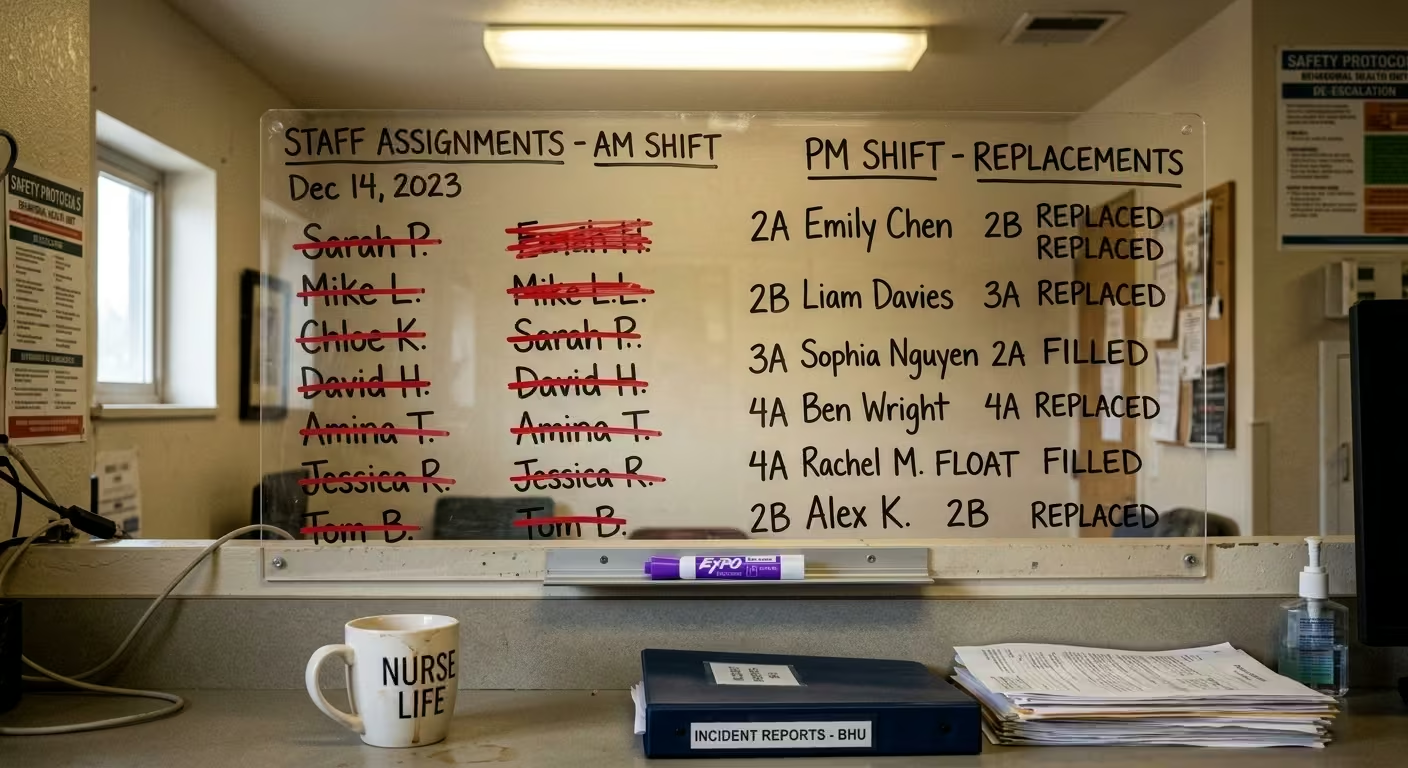
CEO desk with worn outline around unsigned safety investment document and purple pen at night

Key Takeaways

  • The hesitation most behavioral health CEOs feel before approving a safety investment comes from professional identity risk, and peer leaders describe the same private doubt before every commitment
  • Peer CEOs consistently report that safety investment confidence arrived after they committed, sparked by visible staff behavior shifts they could observe within months
  • You can transform the decision from an uncontrollable leap into a structured test by defining your own markers of success before you sign

You’ve read the outcome reports. You’ve heard peer references. You’ve reviewed the projections. And you still haven’t committed. The evidence supporting your safety investment confidence is solid. The real barrier is a question you haven’t asked out loud: what happens to your reputation, your board standing, and your career if the outcomes disappoint?

The Decision That Keeps You Up

That question lives in a place no spreadsheet reaches. It surfaces at 11pm when you open the proposal one more time, scan the same numbers, and close the laptop without signing. The data is strong. You know that. The hesitation is personal.

You’re calculating something no vendor deck addresses: the professional cost if this becomes the investment the board remembers you championing and the outcomes fall short.

You’re not alone in this pattern. Organizations routinely delay safety technology deployment despite available evidence, with hesitation driven by executive decision anxiety rather than data gaps [1]. The evidence exists. The confidence lags behind.

And while you weigh the decision, nearly two in five healthcare workers are considering leaving their positions over safety concerns [2]. Your workforce is making its own timeline.

No one should face violence while trying to help others heal. Yet every week you delay, that’s exactly what your staff absorbs.

Why More Data Fails to Settle It

The instinct is to request one more reference call. One more financial model. One more site visit. Each confirms what you already know. None resolves what you actually feel.

U.S. hospitals already spend $1.4 billion annually on workplace violence prevention training [3]. The industry has the information. It lacks the confidence. One study of healthcare executives found something counterintuitive: access to more case studies extended evaluation periods rather than shortening them [4]. Every new data point opens a new question rather than closing the last one.

The gap between knowing and committing is emotional. Behavioral health leaders themselves say the barriers to technology adoption center on peer recommendations from trusted leaders and reduced personal risk [5].

More analysis won’t bridge this gap. The strategy of “one more data point” is the very thing keeping you stuck.

What Peer CEOs Noticed After Committing

Peer CEOs describe something over dinner they skip in conference presentations: they felt exactly what you feel now when they signed.

Their confidence arrived later. It arrived when charge nurses started wearing the panic buttons without reminders. When staff stopped asking whether the system worked and started describing how it changed their shift. In one study, staff who were skeptical before deployment began recognizing value during it [6].

Peer CEOs describe a consistent sequence after committing:

  • Voluntary adoption appeared within weeks, before any formal outcome data
  • Staff language shifted from skepticism to ownership during the first quarter
  • The CEO’s own anxiety dropped as observable signals replaced abstract projections

ROAR customers report the same trajectory. Roughly eight in ten team members reported increased confidence in handling safety concerns after deployment [7]. That shift took months.

Staff engagement and safety culture scores track closely together [8]. Voluntary adoption is a meaningful signal the investment is working.

The peer CEOs who sound confident today committed before the confidence arrived and watched it build through signals they could see from their chair.

See how one behavioral health provider documented these results across their facilities.

When Your Organization Tells You It Worked

The signals come in three layers, and you’ll notice them from your chair without digging into operational dashboards.

Signal TypeWhat You’ll Notice From Your Chair
Staff behaviorAt one ROAR deployment, employees considering leaving due to safety concerns dropped from 22% to 7% [7]. That movement shows up in quarterly retention data and exit interview themes that change.
Board toneAnnual staff surveys at facilities with safety technology show up to a 38-point lift in “I feel safe at work” [7]. That’s the kind of number a board member cites without being prompted.
CultureStaff who feel organizationally valued show lower turnover intention even under high work demands [9]. When you invest in their physical safety, they interpret it as evidence that leadership values them. The retention benefit compounds beyond the direct safety improvement.

Management commitment scores lowest among safety culture dimensions in psychiatric settings [10]. Your visible endorsement directly addresses the area your organization is weakest. Safety should be a promise, not just a priority.

A behavioral health safety specialist can show you what these signals look like at organizations similar to yours.

Contact Us

Building Your Safety Investment Confidence Before You Decide

The CEOs who describe the most confidence today share one practice: they defined what “working” would look like before they committed. They built certainty before it arrived.

One behavioral health leadership publication describes leaders who navigate uncertainty well as staying anchored in mission rather than perfect metrics [11]. You don’t need to predict exact results. You need to name what “on track” looks like so you can evaluate with clarity rather than dread.

You’re sitting with the proposal open again tonight. Before you close the laptop, define what you’ll watch for:

  • Staff signal, first 90 days. Will your charge nurses use the system voluntarily? Will incident reporting trends shift in your quarterly safety data?
  • Board signal, first two quarters. Will a director mention the investment unprompted? Will the safety line item shift from a question to a citation of leadership strength?
  • Personal signal. The moment you stop checking the data anxiously and start citing it confidently.

Those peer organizations started exactly where you are now. The CEOs who feel most certain today chose to build their safety investment confidence one observable signal at a time, starting before they signed.

PEER EVIDENCE

Ready to Define Your Confidence Markers?

See what peer behavioral health organizations documented after committing to safety technology.

References

  1. ASIS International. (2024). Companies Slow to Deploy Safety Technology. https://www.asisonline.org/security-management-magazine/latest-news/today-in-security/2024/july/companies-slow-to-deploy-safety-technology/
  2. Verkada. Healthcare Safety Research. https://www.verkada.com/blog/healthcare-safety-research/
  3. American Hospital Association. Costs of Violence. https://www.aha.org/costsofviolence
  4. Censinet. Leading Through Uncertainty: Executive Decision-Making in Healthcare. https://censinet.com/perspectives/leading-through-uncertainty-executive-decision-making-healthcare-ai
  5. PMC. Barriers to Technology Adoption in Behavioral Health. https://pmc.ncbi.nlm.nih.gov/articles/PMC4362852/
  6. PubMed. WardSonar Implementation in Acute Mental Health Settings. https://pubmed.ncbi.nlm.nih.gov/38279658/
  7. ROAR for Good – Internal Data, 2024. Internal data
  8. PMC. Staff Engagement and Safety Culture Correlation. https://pmc.ncbi.nlm.nih.gov/articles/PMC10209723/
  9. PMC. Organizational Value and Turnover Intention. https://pmc.ncbi.nlm.nih.gov/articles/PMC10756926/
  10. PMC. Safety Culture in Psychiatric Clinics. https://pmc.ncbi.nlm.nih.gov/articles/PMC12523074/
  11. Healthcare Executive. Tough Decisions in Tough Times. https://www.healthcareexecutive.org/archives/july-august-2025/tough-decisions-in-tough-times


Workforce Safety Confidence: The Retention Gap Pay Can’t Close

CHRO pulling workforce safety binder from row of quarterly review binders in healthcare administration office

Key Takeaways

  • Exit interviews keep naming safety concerns, yet most retention strategies focus on pay and benefits, leaving the biggest driver of nurse departures unaddressed
  • Feeling safe at work predicts job satisfaction regardless of compensation, which means no raise can close the gap your staff keep describing
  • Peer CHROs in behavioral health have already acted on this insight and seen staff satisfaction climb 16 points in a single quarter

You already know what the next exit interview will say. Safety concerns. Again. Three quarters running, maybe longer. Each time, you approve another wage adjustment, expand the wellness program, adjust the shift differential. The numbers barely move. Then another nurse leaves, and the summary reads the same way. The frustration is that you keep solving around the one problem you’ve already identified. And that gap in workforce safety confidence keeps widening.

The Guilt Behind the Dashboard

Six in ten nurses say violence at work has pushed them to change jobs, leave, or seriously consider leaving [1]. That’s the national picture. Your exit interview data is the local version.

What makes this harder: nearly 45% of nurses say their employer simply ignores violence reports after they’re filed [1]. Staff stop raising the issue. They stop believing anyone will act. The mentions you do see are the fraction that made it through.

“No CHRO should carry the weight of knowing the cause while running a playbook that ignores it.”

You’re reviewing this quarter’s summaries. Three of the last seven departing nurses mentioned safety. You know the ones who didn’t mention it probably felt it too. And you know your retention strategy has no answer for what they’re describing.

That’s the weight CHROs in behavioral health carry. You see the signal. You understand what it means. The playbook you’ve been trained to run has no chapter on violence. The financial exposure behind that gap is bigger than most CHROs realize.

Why Compensation Alone Feels Hollow

You approved a 4% wage adjustment last quarter. Expanded the EAP. Added a wellness stipend. Turnover held steady.

You’re in good company. Behavioral health faces 40% annual turnover, and wages keep rising across the industry [2]. Everyone has been raising pay. The number refuses to budge.

The research explains why. When staff feel their compensation fails to reflect the risk they face every shift, a raise registers as a transaction that misses the point [2]. Frontline workers say it plainly:

  • “I don’t think that a wage increase, too much, would affect the turnover… most would rather prefer a better work environment.” [3]
  • “If you’re burning the candle at both ends because you’re always short-staffed… the money’s not worth it.” [3]

You’ve heard versions of this in your own exit interviews. The problem compensation can solve and the problem driving departures are two different problems. An HR safety brief built around the right data points bridges the gap between what you know and what your CFO needs to hear.

What Peer CHROs Discovered First

Workers with higher psychological safety report 95% job satisfaction, compared to 85% for those without it [4]. That gap holds regardless of what people are paid. It’s the piece your compensation strategy will never reach.

Peer CHROs in behavioral health discovered this connection and acted on it. At organizations that invested in safety infrastructure, the results showed up within a single quarter:

MetricBeforeAfter
Staff satisfaction57%73%
Staff considering leaving due to safety22%7%
Staff confident handling safety concernsBaseline~80%

Those are board-reportable numbers in one budget cycle [5].

Filter your own engagement survey by units with the highest incident rates. You’ll likely find safety perception dragging scores well below the organizational average. That gap is invisible in the aggregate data your board sees. It only shows up when you look where the problem actually lives. That filtered view is the insight peer CHROs used to reframe safety as a retention strategy. Peer CHROs rank three workforce dimensions that separate leaders from the field on this exact issue.

Talk to us about what closing the safety-retention gap looks like for your organization.

Contact Us

From Guilt to Authority

The shift that matters most: from recommending safety investment to leading it.

You’ve spent quarters watching exit interview data say the same thing while running a playbook that can’t respond to it. Every budget cycle, you advocate for something you can’t quite name in the language finance wants to hear. You know the cause. You know the retention programs aren’t reaching it. The guilt isn’t about inaction. It’s about action that keeps missing.

Peer CHROs who made the shift from advocate to owner describe the same turning point. They stopped treating safety as someone else’s line item and started treating it as a workforce strategy they controlled. The results came fast enough to validate the decision within a single reporting cycle:

  • Workers’ comp claims fell
  • Staff satisfaction climbed 16 points in a single quarter
  • Recruitment strengthened as organizations earned Best Place to Work recognition and stronger Glassdoor sentiment [5]

Those aren’t long-horizon outcomes. They’re results a CHRO can defend in the next board meeting.

The step-by-step method to isolate violence-driven turnover and structure your CFO conversation exists in Map the Full Cost of Every Nurse Departure. You don’t need to build the case from scratch. See how one behavioral health provider cut staff assaults by 40% and saw intent-to-leave drop from 22% to 7%.

The CHRO who closes the safety-retention gap looked at the same exit interview data everyone else had and decided to own what it was actually saying. No one should face violence while trying to help others heal. And no CHRO should carry the weight of knowing the cause while running a playbook that ignores it. The workforce safety confidence your staff need starts with the confidence you already have: the authority to act on what you’ve known for quarters. Your CNO is seeing the same pattern from the unit level — what they’re finding about safety confidence on the floor confirms what your exit data already says.

KEEP YOUR TEAM

Turn Exit Interview Data Into Retention Results

Your staff keep naming safety as the reason they leave. Peer organizations acted on that signal and saw staff satisfaction climb 16 points in a single quarter. See what that shift looks like for your team.

References

  1. National Nurses United. (2024). Workplace Violence Report. https://www.nationalnursesunited.org/sites/default/files/nnu/documents/0224_Workplace_Violence_Report.pdf
  2. Behavioral Health News. (2024). Do Higher Wages, Benefits, and Career Development Reduce Turnover in Behavioral Health? https://behavioralhealthnews.org/do-higher-wages-benefits-and-career-development-reduce-turnover-in-behavioral-health/
  3. McKnight’s Long-Term Care News. (2024). Staff Support Outweighs Wages as Turnover Solution, Nursing Home Study Finds. https://www.mcknights.com/news/staff-support-outweighs-wages-as-turnover-solution-nursing-home-study-finds/
  4. American Psychological Association. (2024). 2024 Work in America Report. https://www.apa.org/pubs/reports/work-in-america/2024/2024-work-in-america-report.pdf
  5. ROAR for Good. (2024). Internal Data.

Safety ROI Confidence: 90-Day Proof for CFOs

Healthcare CFO board deck with blank ROI column and purple highlighter on conference table

Key Takeaways

  • The financial metrics that prove a safety investment worked (MOD scores, turnover rates, insurance premiums) are built to lag by quarters or years, leaving CFOs exposed between approval and proof
  • Three leading indicators move within days to weeks and reliably predict the lagging financial outcomes boards wait for
  • A 30/60/90-day checkpoint sequence lets you translate early signals into projected dollar figures, so you’re never more than one month from a defensible board update

You’re staring at next Thursday’s board deck. The safety line item is there. The results column is empty. Your CNO says staff are using the system, but the turnover data won’t shift for months. The insurance renewal is eleven months away. And the finance committee chair always asks about new spend before you’re ready to answer.

This is where safety ROI confidence lives or dies: the silence between commitment and proof.

The Approval You Carry

The financial exposure was real: documented violence rates, 30% annual turnover, $289,000 per percentage point [1][2]. You approved the spend because the math justified it.

The deployment went smoothly. Staff adopted the technology. And now you sit with a variance report showing the same agency spend, the same turnover trajectory, the same workers’ comp numbers. The investment line item is visible. The return line item is blank.

“Safety should be a promise you can prove, not just a line item you defend.”

Every week without movement in those numbers feels like evidence against a decision you already made.

Why Standard Metrics Arrive Too Late

Your anxiety about that blank column is rational. The financial proof system moves slowly by design.

Insurance experience modification factors use three years of historical claims data, calculated once per year. A safety system deployed in early 2026 won’t appear in any insurance rating until the 2027 renewal cycle. Measurable premium reductions won’t show until 2028 [3].

The most costly lost-time workers’ comp claims average $68,231 for trauma cases [4]. Those claims take months to close and longer to flow into your MOD calculation.

The financial system that will eventually validate your decision is built to lag. You need a different set of signals entirely. The board-ready evidence across three cost categories will matter when those lagging metrics do arrive, but right now you need leading indicators.

Early Signals That Predict Safety ROI Confidence

Behavior-based safety indicators shift within days to weeks. Perception-based indicators shift within weeks to months [5]. Both reliably predict the lagging financial outcomes you’re waiting for.

Three signals give you that early read:

SignalWhen AvailableWhat It Predicts
Response time dataDay 1 onwardInfrastructure functioning; incident containment speed
Incident reporting volumeWeeks 2 through 6Staff trust in the system; fewer serious incidents downstream
Staff perception shiftsDays 30 through 60Turnover trajectory two quarters out

Your first response time report arrives immediately. ROAR deployments show 93% of incidents resolved in under two minutes [6]. If your facility hits that threshold in Week 1, the infrastructure is working.

By Week 3, reporting volume starts climbing. That increase means staff believe someone will respond. Organizations where near-miss reporting rises see fewer serious incidents downstream [7].

At Day 45, you run a perception survey. At one organization, intent-to-leave dropped from 22% to 7% after deployment [6]. That shift was visible at the 60-day mark, months before the actual turnover rate confirmed it.

Together, these three signals draw a trajectory you can defend. Peer CFOs tracking these same indicators are finding that the gap between top-quartile and bottom-half performers starts here.

Talk to us about what the first 90 days of monitoring look like for your facility.

Contact Us

What Peer CFOs Tracked First

The financial proof does arrive. At comparable behavioral health organizations:

  • MOD scores improved nearly 50%, with time to value under six months [6]
  • Workers’ comp claims dropped between 24% and 50% [6]
  • Staff satisfaction climbed measurably within three months

The CFOs who tracked those outcomes with confidence watched the leading indicators first. When reporting volume increased in the first month, they read it as system trust. When perception scores shifted by Day 60, they knew the workers’ comp trajectory was bending before a single claim closed.

You’re sitting where they sat. The board deck looked the same. The anxiety felt the same. The difference between presenting early signals with confidence and apologizing for missing annual data comes down to knowing which numbers matter at which point. When you’re ready to present, a one-pager that aligns your C-suite turns those signals into a funded next step. See how one behavioral health provider achieved a 40% reduction in staff assaults and response times under 2 minutes for 87% of alerts.

Your 90-Day Confidence Check

Your controller asks what success metrics to build into the quarterly review. You’ve been defaulting to “we’ll look at turnover and claims at year-end.” Now you have a better answer.

  1. Day 30: Ask your security team for response time data and reporting volume trends. If both are trending positive, the system is working and staff are using it.
  2. Day 60: Ask your CNO to run a brief perception survey measuring intent-to-leave and safety confidence [8]. If intent-to-leave is declining, the leading indicator that predicts turnover reduction is moving.
  3. Day 90: Combine all three signals. The methodology in Five Cost Categories That Turn Nurse Turnover Into a Board-Ready Number gives you the cost-per-departure inputs to translate those shifts into projected dollar figures for a board slide.

You open the board deck again. The results column still reads blank today. But you know what to watch at Day 30, what to measure at Day 60, and what to project at Day 90. The silence between approval and proof fills with data you can hear. And benchmarking your cost gaps against peer facilities gives you the context to interpret what that data means.

No one should carry the weight of a decision they can’t yet prove. You won’t have to carry it long.

MEASURABLE ROI

Turn Early Signals Into Board-Ready Proof

The leading indicators are available in your first 30 days. We can walk you through the monitoring path that helps you translate response time data, reporting trends, and staff perception shifts into projected dollar figures your board can act on.

References

  1. PMC. Behavioral health workforce turnover and financial exposure. https://pmc.ncbi.nlm.nih.gov/articles/PMC10756926/
  2. NSI Nursing Solutions. 2025 National Health Care Retention & RN Staffing Report. https://www.nsinursingsolutions.com/documents/library/nsi_national_health_care_retention_report.pdf
  3. NCCI. ABCs of Experience Rating. https://www.ncci.com/articles/documents/uw_abc_exp_rating.pdf
  4. National Safety Council. Workers’ Compensation Costs, 2025. https://injuryfacts.nsc.org/work/costs/workers-compensation-costs/
  5. PubMed. Leading indicators in occupational safety: scoping review, 2025. https://pubmed.ncbi.nlm.nih.gov/41338808/
  6. ROAR for Good. Internal data, 2024.
  7. PMC. Near-miss reporting and subsequent occupational accidents. https://pmc.ncbi.nlm.nih.gov/articles/PMC11457368/
  8. PMC. Perception surveys as early-stage proxies for behavioral change. https://pmc.ncbi.nlm.nih.gov/articles/PMC9730368/

Safety Investment Confidence: 3 Conditions for Success

Behavioral health staffing board showing nurse turnover reversal with names rewritten after safety investment

Key Takeaways

  • Nearly 45% of nurses say their employers ignore reported violence, and that trust gap determines whether a safety investment succeeds or stalls before it starts
  • Behavioral health safety initiatives fail for three predictable organizational reasons, not technical ones, which means you can evaluate your risk before you spend a dollar
  • A national behavioral health provider cut staff assaults 40% in six months because the organizational conditions were right, not because the technology was special

You know the violence numbers. You’ve seen the turnover reports. You’ve heard your CNO ask for a nurse duress system three times this year. Each time, you asked for more data. But here’s what you haven’t said out loud in any board meeting: what if you spend the money, champion the initiative, and six months later staff aren’t wearing the badges?

That fear of visible failure keeps more behavioral health CEOs frozen than any budget constraint. Building real safety investment confidence starts with understanding why that fear, while rational, doesn’t have to be paralyzing.

The Fear Nobody Puts on Slides

You don’t doubt the data. Sixty percent of nurses have changed jobs, left, or considered leaving because of workplace violence [1]. You’ve seen versions of that number in every industry report for the past three years.

You know the problem is real. That was never the question.

The question is whether your organization can actually solve it. You’ve watched technology rollouts underperform before. Quiet disappointments that consumed budget, exhausted goodwill, and made the next initiative harder to approve. Now when someone says “this will work,” you hear “this might not.”

Your CNO advocates. Your CFO asks for proof. You sit between them, carrying a weight neither fully shares: act and fail, the board remembers your judgment. Don’t act and something happens, the board remembers your inaction. Both paths feel dangerous. So you wait. Meanwhile, the financial exposure keeps compounding.

Why Some Safety Investments Stall

Your hesitation is grounded in reality. By some estimates, seven out of ten healthcare technology rollouts fail to meet their goals [2].

But the failures aren’t random. They follow a pattern you can recognize.

“That fear of visible failure keeps more behavioral health CEOs frozen than any budget constraint.”

A duress alarm rollout in a US emergency department stalled completely [3]. The technology worked perfectly. Staff stopped wearing the badges within weeks. Nobody on the frontline had been asked about the design. Training was inadequate. When alarms fired, security response was slow and inconsistent. Staff pressed the button, got unreliable help, and stopped pressing it.

Nearly 45% of nurses say their employers simply ignore workplace violence after it’s reported [1]. When staff already believe leadership won’t respond, handing them a panic button confirms that belief.

Failed initiatives share three gaps:

  • Staff don’t trust that leadership will act
  • No response protocol exists before go-live
  • Frontline workers weren’t involved in the design

Each gap is visible before you spend a dollar. A three-question pitch framework helps you package the case once you’ve closed them.

Three Conditions That Predict Success

If the failure pattern is predictable, so is the success pattern. Three conditions appeared consistently across organizations that made safety technology work.

1. Visible executive sponsorship. Staff need to see you personally back this initiative, beyond a budget line or a memo. Your frontline has been burned before. The signal that this time is different comes from you.

2. Frontline involvement before go-live. The duress alarm failure happened because nobody asked staff what they needed [3]. Charge nurses and direct-care staff shape the rollout, not just attend a training session after decisions are already made. This is where trust rebuilds.

3. A defined response protocol. The single biggest adoption killer is pressing the button and getting nothing. Organizations that define who responds, how fast, and what happens next before the system goes live see rapid adoption. Without that protocol, the first failed response kills trust faster than any technology can rebuild it.

You can evaluate all three against your own organization today. Peer CEOs who’ve already made this evaluation share what triggered them to move from discussion to deployment.

Talk to us about how these conditions apply to your facility.

Contact Us

What Peer CEOs Learned After Acting

A national behavioral health provider made the same calculation you’re making. They had the same fear. They checked the same conditions. Then they acted.

They didn’t wait for certainty. They prepared the organization first, got honest about where the gaps were, and launched with the three conditions in place. Six months later, the quarterly report told a different story than the one they’d feared.

The results came within six months:

What They DidWhat Happened
Met all three conditions40% reduction in assaults against staff [4]
Same conditionsIntent-to-leave dropped from 22% to 7% [4]
Same conditionsStaff preparedness jumped from 38% to 76% [4]

These outcomes aren’t outliers. Across published studies, safety measures in healthcare produce an 18% to 66% reduction in violent incidents when properly implemented [5]. The organizations that land in that range share the three conditions above. The ones that don’t generate the 70% failure statistic.

Those peer CEOs started exactly where you are now. The difference wasn’t courage or budget. It was preparation. The turnover cost framework they used to quantify the cascade started with their leadership team. See how one behavioral health provider achieved a 40% reduction in staff assaults within six months.

No one should face violence while trying to help others heal. The question was never whether your people deserve protection. It was whether you could deliver it without risking your credibility. Now you know what separates success from failure. The only question left is whether your organization is ready today.

A Readiness Check You Own

You don’t need a consultant. You need honest answers to three questions [6].

1. Can your frontline staff name one specific action you’ve taken on safety in the last 90 days?

If not, your sponsorship isn’t visible enough yet.

2. Have you asked charge nurses and direct-care staff what they need from a safety system?

If not, you’re designing for the same adoption failure the research predicts.

3. If someone pressed a panic button right now, does every person in the response chain know what to do?

If not, the first failed response will kill adoption before the system has a chance.

If you can answer yes to all three, your organization is ready. If you can’t, you know exactly what to fix before you invest. Your CNO can tell you what safety confidence looks like on the units where it’s working. Either way, you’ve replaced the fear of an unknowable gamble with something concrete. Safety investment confidence was never about certainty that nothing would go wrong. It was about knowing you’d built the conditions where things go right.

READY FOR ANYTHING

Turn Your Readiness Assessment Into a Plan

If you answered yes to all three questions, your organization has the conditions that predict success. Talk to a safety specialist who can walk through what peer CEOs wish they had known before they started.

References

  1. National Nurses United (NNU) – Workplace Violence Report, 2024. https://www.nationalnursesunited.org/sites/default/files/nnu/documents/0224_Workplace_Violence_Report.pdf
  2. EHR in Practice – EHR Failure Statistics. https://www.ehrinpractice.com/ehr-failure-statistics.html
  3. PubMed – Staff Duress Alarms Study (US), 2023. https://pubmed.ncbi.nlm.nih.gov/37150562/
  4. ROAR for Good – Internal Data, 2024. Internal data
  5. PMC – Trends in Workplace Violence. https://pmc.ncbi.nlm.nih.gov/articles/PMC11630250/
  6. PMC – Consolidated Framework for Implementation Research (CFIR). https://pmc.ncbi.nlm.nih.gov/articles/PMC12357348/

Nursing Safety Confidence: What CNOs Miss on Units

Charge nurse confidently entering behavioral health unit night shift showing nursing safety confidence transformation

Key Takeaways

  • Behavioral health CNOs carry a specific guilt: you’ve invested in training and staffing, and nurses still get hurt. Research confirms this weight is a proven pattern, not a personal failing.
  • Staff nursing safety confidence shifts when response becomes visible and fast, not when violence drops to zero. That changes the standard you should hold yourself to.
  • Three indicators on your highest-acuity unit can tell you whether nurses feel protected or whether they’ve quietly stopped believing help will come.

The guilt you feel every morning when you open that incident report has a clinical name. It lives in the gap between what you owe your nurses and what your current tools let you deliver. Another incident on the acute unit. Another nurse who waited too long for help. You’ve invested in training, adjusted staffing, rewritten protocols. And every morning, the same weight: this still falls short. Building nursing safety confidence starts with naming that burden honestly.

The Weight Only CNOs Carry

Psychiatric and substance abuse hospitals see 110.4 incidents per 10,000 workers, the highest rate of any healthcare setting [1]. You see it in the incident reports, in the charge nurse’s tired eyes during morning huddle, in the name of the experienced nurse who transferred out last month.

Research suggests that 47% of psychiatric nursing leaders report symptoms consistent with moral injury tied to moments where they could not prevent staff injuries they felt responsible for [2]. That means the weight you carry is the gap between what you believe you owe your nurses and what you can actually deliver with the tools you have.

“Staff who had been quietly planning to leave stopped planning. The CNO could feel it on the units before any dashboard confirmed it.”

No one should face violence while trying to help others heal. That truth sits with you at every morning huddle. The financial weight behind it compounds with every departure.

Why Training Alone Leaves Doubt

De-escalation training is valuable. You invested in it because it works. But it works on a specific slice of the problem. Research indicates that 78% of remaining violent incidents happen after de-escalation has already been tried [3].

That’s the gap your charge nurses feel but struggle to name. They know the techniques. They trust the techniques. What they lack is confidence in what happens when the techniques fail and they’re waiting for someone to show up.

Nearly 45% of nurses say their employers simply ignore reported violence after it’s been documented [4]. Nurses report. Nothing visible changes. Your promise of protection starts to feel hollow, even to you.

The distinction matters:

  • Skill confidence is whether nurses trust their training. De-escalation builds this.
  • Safety confidence is whether nurses believe help will come when training isn’t enough. Training alone cannot build this. Peer CNOs tracking adoption across behavioral health are finding that the organizations pulling ahead addressed this gap first.

What Changes When Response Becomes Visible

Here’s what peer CNOs discovered that changed the equation. Safety perception scores jump 34 to 41 points when response time drops below 90 seconds, independent of whether violence rates change [5]. The shift happens because nurses stop wondering whether help will come. They know it will.

Peer deployments show sub-2-minute average response times [6]. That speed sits well below the 90-second threshold where perception shifts. Nurses who have never pressed the button still report feeling safer. The knowledge that the system works, confirmed by watching a colleague get help in seconds, changes how they experience every shift. The three organizational conditions that make this kind of response infrastructure work are visible before you spend a dollar.

If this resonates with what you're carrying, talk to us about what peer CNOs did to close the gap between promise and protection.

Contact Us

Peer CNOs Who Stopped Carrying the Weight Alone

The earliest proof a peer CNO pointed to: staff who said they’d consider leaving due to safety concerns dropped from 22% to 7% [6].

That shift happened within weeks. Before the CFO’s quarterly numbers moved. Before assault rates showed a trend line. Staff who had been quietly planning to leave stopped planning. The CNO could feel it on the units before any dashboard confirmed it.

A charge nurse at one of these facilities told her CNO three weeks after deployment: “I don’t dread the night shift anymore.” That sentence carries more weight than any metric. It means the promise of protection became something nurses could feel. Translating that feeling into numbers means building your unit’s true turnover cost so the CFO sees what you see.

Three Indicators That Reveal Nursing Safety Confidence

The guilt you carry every morning can become something different: clarity about exactly where your nurses need you. Three indicators on your highest-acuity unit reveal whether your nurses feel protected.

IndicatorWhat It RevealsWhat Peer Facilities See
Silent alerting awarenessWhether nurses know how to call for help without escalating the situationUnits with high staff awareness of duress systems report 52% higher confidence [5]
Response speedWhether help arrives fast enough to change perceptionPeer facilities document 93% of incidents resolved in under two minutes [6]
Leadership follow-throughWhether nurses believe you act on what they reportUnits where CNOs conduct safety debriefs within 24 hours see 71% staff agreement that leadership responds, compared to 31% without [5]

Where those indicators fall short on your unit, you now know what to change. A nursing safety brief built for CFO approval gives you the format to turn these indicators into a funded ask. See how one provider closed this gap.

Safety should be a promise, not just a priority. The guilt that follows you home from every incident report can become the nursing safety confidence that comes from knowing, finally, that you can deliver on what you owe your nurses.

PEACE OF MIND

Turn the Weight You Carry Into a Measurable Promise

CNOs at peer organizations moved from absorbing guilt alone to showing nurses exactly how fast help arrives. A short conversation can show you what that looks like for your team.

References

  1. Sheps Center, UNC. Workplace Violence in Healthcare Brief. https://www.shepscenter.unc.edu/wp-content/uploads/2025/01/Y10.01_Brief-1.pdf
  2. Journal of Healthcare Risk Management. Moral Injury in Psychiatric Nursing Leaders. https://www.jhrmjournal.org/
  3. American Journal of Psychiatry. De-escalation Training Outcomes in Psychiatric Settings. https://ajp.psychiatryonline.org/
  4. National Nurses United. 2024 Workplace Violence Report. https://www.nationalnursesunited.org/sites/default/files/nnu/documents/0224_Workplace_Violence_Report.pdf
  5. Safety Science. Safety Perception and Response Time in Healthcare Settings. https://www.sciencedirect.com/journal/safety-science
  6. ROAR for Good. Internal Data, 2024.

Nursing Safety Confidence: The Leading Indicator

Hospital staffing whiteboard with nurse names filled in and purple marker in tray

Key Takeaways

  • The anxiety CNOs carry into every staffing huddle comes from knowing that the metrics they rely on only confirm departures after the decision to leave was already made
  • Safety perception data gives you a leading indicator that arrives months before the resignation letter, turning reactive staffing into proactive retention
  • The shift from uncertainty to confidence starts with measuring what your nurses actually feel on each unit, not just what gets filed in incident reports

Two experienced nurses gave notice last week. Both exit interviews cited safety concerns. When you pulled the incident data, the numbers looked stable.

That’s the gap that keeps CNOs reacting instead of anticipating. Your incident reports, your engagement composites, your turnover dashboards: they all describe what already happened. None of them can tell you which unit is about to lose its next experienced nurse. Nursing safety confidence erodes in that space between what your data shows and what your nurses actually feel. For the full research behind why perception predicts retention, see the complete guide to staff safety in psychiatric hospitals.

The Anxiety: Always Reacting, Never Anticipating

Every CNO in behavioral health knows this version of the morning. You’re scanning which units are short, figuring out where float nurses need to go, and wondering whether the unit that just lost two staff will lose a third before you can backfill the first.

The pattern repeats because the data chain is broken. 81% of violence incidents go unreported [1]. Your charge nurses know things that never make it into a report. During rounding, a nurse mentions an incident from last night that she didn’t bother filing because nothing changed the last time she did. She’s telling you the measurement system can’t see what’s actually happening on her unit.

That creates a specific kind of uncertainty. You walk into every staffing huddle knowing that the numbers you’re working with describe last month’s reality. The perception shift that will drive next month’s vacancy happened on a shift you never heard about.

The peer CNOs who’ve moved past this gap describe the same starting point: the realization that every metric on their dashboard was a lagging indicator.

The Gap: What Your Dashboard Can’t Show You

Your turnover rate confirms departures. Your exit interviews explain them after the fact. Your incident reports capture a fraction of what happens. None of them measure the perception that drove the decision to leave.

The gap between what your data shows and what your staff experiences shows up during rounding. You review incident logs showing two or three events per quarter on a unit. Then you talk to nurses on that unit, and they describe near-daily confrontations. The nurse who says she “doesn’t feel safe anymore” isn’t describing a specific event. She’s describing a perception that formed over weeks of feeling unsupported.

What Your Staffing Data ShowsWhat Your Nurses Experience
Stable incident reportsMost incidents never filed
Acceptable engagement compositeUnit-level perception may be collapsing
Turnover rate (after departure)Perception shift that preceded it by months
Exit interview themes (“safety”)Specific moments where response felt inadequate

No one should face violence while trying to help others heal. And no staffing plan should be built on data that can’t see the departures forming.

Ready to see the signal your staffing dashboard has been missing?

Contact Us

The Shift: What Changes When You Can See It Coming

The confidence shift happens the first time you can pull unit-level perception scores and see which units are at risk before the resignation letter arrives. It happens when your charge nurses have specific talking points backed by measured data instead of general reassurance.

“Nursing safety confidence starts the moment you can see the signal your turnover dashboard has been missing.”

Facilities that built this measurement capability saw perception shifts within a single quarter [2]. That timeline matters for a CNO. It means you don’t need a multi-year transformation to start seeing results. You need one unit, one baseline, one 90-day measurement cycle. The unit-level perception guide covers exactly how to build that.

What this doesn’t fix: census spikes, acuity shifts, regional labor shortages. Perception data reveals the operational gaps driving departures, but closing them still requires unit-level action. The measurement is the starting point. But it’s the starting point that turns the conversation with your CHRO from “we need more staff” to “here’s why we’re losing the staff we have, and here’s where to intervene.” The CHRO measurement framework covers the corporate infrastructure needed to support what you build at the unit level.

One critical caution: measurement without visible follow-through backfires. When staff complete surveys and see no response, cynicism deepens rather than lifts [3]. The facilities that achieved results paired every measurement cycle with action staff could see.

See how one behavioral health provider documented these results across their facilities.

From Uncertainty to Confidence

Each percentage point of nursing turnover costs roughly $289,000 annually [4]. The full retention data shows what perception-driven improvements look like across facility types.

You know what tomorrow morning’s staffing huddle looks like. The same units short. The same scramble to cover. The same gap between what your data says and what your nurses feel.

But the CNO who measures safety perception at the unit level, tracking shifts quarterly and intervening before intent-to-leave becomes resignation, carries something different into that huddle: the confidence that comes from knowing which units need attention before the next name disappears from the schedule. Nursing safety confidence starts the moment you can see the signal your turnover dashboard has been missing.

NURSING CONFIDENCE

See Which Units Need Attention Before the Next Name Disappears

Safety perception measurement gives CNOs the leading indicator that turns reactive staffing into proactive retention.

References

  1. AHRQ PSNet. Addressing Workplace Violence and Creating a Safer Workplace. https://psnet.ahrq.gov/perspective/addressing-workplace-violence-and-creating-safer-workplace
  2. ROAR for Good. Internal data, 2024. Internal data
  3. PMC. Organizational Factors and Turnover Intention. https://pmc.ncbi.nlm.nih.gov/articles/PMC12258548/
  4. NSI Nursing Solutions. 2025 National Health Care Retention & RN Staffing Report. https://www.nsinursingsolutions.com/documents/library/nsi_national_health_care_retention_report.pdf

Workforce Safety Confidence: The Retention Gap

workforce safety confidence — CHRO and nurse manager in proactive safety perception conversation before departure decision is made

Key Takeaways

  • The anxiety CHROs carry into board presentations comes from building workforce plans on data that only becomes visible after departure decisions are already made
  • Perception data gives you the leading indicator that replaces uncertainty with a measurable signal you can act on within a single quarter
  • The shift from reactive workforce planning to proactive retention starts with measuring what staff actually feel, not just what they report on the way out

The board member’s question lands in the middle of your quarterly workforce presentation: “If incident reports are stable, why do exit interviews keep citing safety?”

That’s the question that exposes the gap. Your turnover data, your exit interview themes, your engagement composites: they’re all real. They’re also all retrospective. By the time any of those numbers appear on your dashboard, the perception shift that caused them formed weeks or months earlier on a unit whose numbers looked fine. The workforce safety confidence you’re presenting to the board is built on data that can only tell you what already happened. For the full research behind why this gap exists, see the complete guide to staff safety in psychiatric hospitals.

The Anxiety: Your Data Can’t See What’s Coming

Every CHRO in behavioral health knows the feeling. You review your workforce plan, and it looks sound. The metrics are current. The benchmarks are reasonable. Then three experienced nurses on the same unit give notice in the same month, and nothing in your data predicted it.

The nurse who got cornered in a hallway during a patient escalation didn’t file an incident report. She updated her resume. And 81% of violence incidents go unreported [1], which means your incident data reflects a fraction of what staff actually experience. Your dashboard is incomplete in exactly the places where risk is highest.

That incompleteness creates a specific kind of uncertainty that’s hard to shake. You walk into every board meeting knowing the numbers you’re presenting describe last quarter’s reality, not next quarter’s risk. When a board member asks what you’re doing about retention, you can describe programs and investments. What you can’t do is point to a leading indicator that shows whether those investments are actually changing how staff feel about working on your units.

The peer CHROs who’ve moved past this gap describe the same starting point: the realization that every metric on their dashboard was a lagging indicator.

The Gap: Why Lagging Indicators Leave You Exposed

Exit interviews capture themes after decisions are made. Engagement surveys average safety into composites that mask unit-level risk. Turnover rates confirm departures that happened months after the perception shifted. None of them can tell you which units are at risk right now.

The gap between what your data shows and what your staff experiences isn’t subtle. You review incident logs showing two or three events per quarter on a unit. Then you talk to nurses on that unit, and they describe near-daily confrontations. That gap is where your retention risk lives, invisible to every metric you currently track.

What Your Dashboard ShowsWhat Staff Experience
Stable incident reports81% of incidents unreported [1]
Acceptable engagement compositeUnit-level safety perception may be collapsing
Turnover rate (after departure)Perception shift that preceded it by months
Exit interview themes (“safety concerns”)Specific moments where organizational response felt inadequate

Each row represents a measurement gap your current tools can’t close. The CHRO measurement framework covers how to build the leading indicator that sits below the last row.

Ready to close the gap between what your dashboard shows and what your staff experiences?

Contact Us

The Shift: What Changes When You Can See It Coming

The confidence shift happens the first time you can pull unit-level safety perception scores and see the signal your turnover dashboard missed. It happens when you can tell the board not just what happened last quarter, but which units are showing perception decline right now and what you’re doing about it.

“Workforce safety confidence starts the moment you measure what your people actually experience, not just what they report on the way out the door.”

Facilities that built this measurement capability saw perception shifts within a single quarter [2]. That timeline matters. It means safety perception moves within workforce planning cycles, not across multi-year transformation horizons. The full evidence set documents what those shifts look like.

What this doesn’t fix: scheduling gaps, compensation challenges, or physical environment design problems. Perception data reveals those operational gaps, but closing them still requires unit-level action. The measurement is the starting point, not the solution. But it’s the starting point most facilities skip, and it’s the one that turns the CFO conversation from “we hope this helps retention” to “here’s what changed, measured, in 90 days.”

See how one behavioral health provider documented these results across their facilities.

From Uncertainty to Confidence

Each percentage point of nursing turnover costs roughly $289,000 annually [3]. The HR brief on perception metrics translates that into the specific numbers for your next board presentation. The comparison data across facility types shows where your program stands against peers.

You know what the dashboard looks like tomorrow morning. The same turnover numbers. The same exit interview themes. The same gap between what your data says and what your staff feels.

But the CHRO who measures safety perception at the unit level, tracking shifts quarterly and intervening before intent-to-leave becomes resignation, carries something different into the next board meeting: the confidence that comes from seeing the signal before it becomes a vacancy. Workforce safety confidence starts the moment you measure what your people actually experience, not just what they report on the way out the door.

WORKFORCE CONFIDENCE

See the Retention Signal Your Dashboard Misses

Safety perception measurement gives CHROs the leading indicator that turns reactive workforce planning into proactive retention.

References

  1. AHRQ PSNet. Addressing Workplace Violence and Creating a Safer Workplace. https://psnet.ahrq.gov/perspective/addressing-workplace-violence-and-creating-safer-workplace
  2. ROAR for Good. Internal data, 2024. Internal data
  3. NSI Nursing Solutions. 2025 National Health Care Retention & RN Staffing Report. https://www.nsinursingsolutions.com/documents/library/nsi_national_health_care_retention_report.pdf

When WiFi Fails: Bluetooth Panic Button Confidence

healthcare security bluetooth panic button — security director annotating incident location wall with beacon deployment plan

Key Takeaways

  • Security leaders who can map their facility’s coverage gaps carry the weight of knowing exactly where staff are unprotected, and every incident in a flagged location deepens that burden.
  • Bluetooth panic button confidence requires protection that works in parking lots, stairwells, and outdoor areas independent of facility WiFi, because those are the zones where violence concentrates.
  • When verified coverage reaches every zone, staff trust in the safety program shifts measurably and the anxiety of managing around known blind spots lifts.

The locations that show up most often on incident reports are the same locations where WiFi-dependent safety systems lose signal. Parking lots. Stairwells. Outdoor transition areas between buildings. Security directors know this because they have walked those zones, flagged them, and watched the same locations appear in reports quarter after quarter.

That overlap is what makes bluetooth panic button confidence feel out of reach. You can see exactly where the gaps are. You know incidents will keep happening there. And with a WiFi-dependent system, you have no way to close them.

Where Incidents Concentrate and Coverage Disappears

Parking lots account for roughly one in four to two in five healthcare workplace violence incidents [1]. Stairwells and outdoor transition zones follow close behind. Psychiatric and substance abuse hospitals record more than 110 violent incidents for every 10,000 workers [2], and the worst of it happens in areas with the weakest coverage.

Security leaders describe the same pattern when they overlay incident data onto coverage maps. The clusters sit directly on top of the dead zones. The areas flagged for safety concerns are the same areas where the safety system goes quiet.

For CSOs, this creates a specific kind of burden. You can see the risk. You have documented it. And the current system can’t reach it.

What Your Staff Already Know

Staff figure out coverage gaps faster than any formal audit. More than eight in ten psychiatric nurses faced workplace violence in the past year, and more than half experienced physical attacks [3]. Yet roughly the same proportion of healthcare workers who experience violence never fully report it [4].

The connection between those two numbers runs through your dead zones. When staff learn which areas are covered and which aren’t, behavior shifts:

  • Devices stop getting carried in zones where signals drop
  • Incidents in dead zones go unreported because no one will respond anyway
  • New hires learn from colleagues which hallways and parking levels to avoid after dark
  • Violence prevention committees hear the same question repeatedly: “What’s the point if it doesn’t reach the parking lot?”

That informal knowledge is your real coverage audit. And it tells a different story than the vendor’s coverage map.

See how one behavioral health provider documented these results across their facilities.

The Joint Commission issued workplace violence prevention standards effective July 2024 for behavioral health settings [5], and state-level panic button mandates need devices to work reliably across entire facilities [6]. Assessors have started asking for coverage proof in parking structures and outdoor areas. The dead zones that staff already know about are becoming the dead zones that surveyors will document.

When Bluetooth Panic Button Confidence Becomes Real

The shift happens when the safety system stops depending on WiFi. Standalone wireless safety networks operate on their own infrastructure, separate from facility WiFi, separate from the hospital network [7]. They reach the zones that WiFi can’t: parking lots, stairwells, outdoor walkways, older building sections with dense construction.

What that means in practice: protection that reaches the parking structure on level P3. The stairwell between locked units. The outdoor courtyard where staff take breaks. Every location that appeared on incident reports and disappeared from coverage maps.

During a four-hour power outage at one facility, the safety system kept running on battery power with six to eight hours of backup [8]. WiFi went down. Lighting went down. The safety network stayed live in every zone because it never depended on the infrastructure that failed.

For a security leader who has spent years managing around known blind spots, that shift changes what the role feels like day to day.

If your facility has coverage gaps you already know about, we can help you map them and fix them.

Contact Us

What Changes When Every Zone Is Covered

When verified coverage reaches every area of the facility, things change for security leaders and for frontline staff.

What CSOs carry with coverage gapsWhat changes with verified full coverage
Knowing which zones are unprotected and waiting for the next incident thereEvery zone documented and covered, including the locations that previously had no protection
Staff distrust visible in underreporting and devices left behindStaff confidence measurable in reporting rates and how often devices are actually carried
Survey anxiety about coverage questions with no good answerCoverage proof for every room and area an assessor might ask about
Incident reports that confirm the same dead zones quarter after quarterThe pattern breaks because the dead zones no longer exist

Behavioral health facilities report up to a 38-point jump in staff responses to “I feel safe at work” after deploying coverage that reaches every zone [8]. Results vary by facility size and how visibly the deployment was communicated, but the direction is consistent: when staff believe the system works everywhere, their relationship with the safety program changes.

What shifts for CSOs:

  • The gap between what you know and what you can fix closes
  • Your incident reports stop pointing to the same blind spots
  • Coverage becomes something you can show a surveyor, not something you explain around
  • The weight of knowing where people are unprotected lifts

Bluetooth panic button confidence is specific. It means verified protection in every parking lot, stairwell, and outdoor area where your staff work and where incidents happen. The dead zones on this morning’s incident report can be the last ones your facility carries.

STAFF SAFETY

Coverage That Reaches Every Zone in Your Facility

Bluetooth panic button confidence starts with verified protection in every parking lot, stairwell, and outdoor area where your staff work.

References

  1. ASPR TRACIE / American Hospital Association. https://files.asprtracie.hhs.gov/documents/on-campus-hospital-armed-assailant-planning-considerations.pdf
  2. Sheps Center UNC. https://www.shepscenter.unc.edu/wp-content/uploads/2025/01/Y10.01_Brief-1.pdf
  3. NCBI. https://pmc.ncbi.nlm.nih.gov/articles/PMC6345477/
  4. American Nurses Association. https://www.nursingworld.org/content-hub/resources/workplace/unreported-workplace-violence—why-is-this-so-common/
  5. Joint Commission. https://www.jointcommission.org/en-us/knowledge-library/workforce-safety-and-well-being-resource-center/workplace-violence-prevention/workplace-violence-prevention-program
  6. Noonlight. https://www.noonlight.com/blog/panic-buttons-the-common-thread-in-frontline-worker-safety-laws
  7. NCBI. https://pmc.ncbi.nlm.nih.gov/articles/PMC11435828/
  8. ROAR for Good – Internal Data, 2024.

Beyond WiFi: Why CTOs Need Bluetooth Panic Button Proof

Split view of same hospital stairwell with and without coverage showing bluetooth panic button confidence

Key Takeaways

  • When a safety system fails in a dead zone, the CTO who approved it owns that failure. Architecture choice is a career decision, not just a technical one.
  • WiFi-dependent systems inherit every coverage gap in your facility, leaving the highest-risk areas unprotected by the technology you signed off on.
  • Documented, independently verifiable performance data across every facility zone is what separates a confident recommendation from a hopeful one.

The dead zones in your facility are not a surprise. You mapped them during the last network assessment. The B-wing stairwell. The parking structure. The outdoor courtyard between buildings. You also know those spots overlap almost perfectly with the highest-risk areas on your incident reports.

The bluetooth panic button confidence you need before recommending a safety system to your executive team requires more than a vendor’s assurance. It requires architecture that works where your network does not reach. And the gap between “works in the demo” and “works at 2 AM in the stairwell” is where reputations get made or quietly destroyed.

The Fear CTOs Carry Quietly

Psychiatric aides experience workplace violence at rates 69 times higher than the national average [1]. When a staff member presses a panic button in a stairwell and nothing happens, the damage extends beyond a single incident.

Only 12 to 23 percent of workplace violence incidents get formally reported [2]. Systems that fail in dead zones reinforce the belief that reporting is futile. That already-low percentage drops even lower. Eventually staff stop carrying the devices altogether.

The Joint Commission released new workplace violence prevention standards for behavioral health settings [3]. The pressure arrives from multiple directions at once:

  • Your board chair asks about accreditation readiness under the new standards
  • Your CNO mentions the incident the system did not catch in the B-wing stairwell
  • Your security director reports that staff in certain areas have stopped carrying the devices because they know the signal will not reach

This is the fear CTOs carry quietly. Not that the technology is flawed in theory. That the physical reality of your facility will expose its limits at the worst possible moment.

No one should face violence because a signal could not reach through a concrete wall.

Why the Problem Feels Personal

The construction materials specified for patient safety are the same materials that block the signals staff depend on for their own protection. Concrete walls, metal-reinforced doors, and security hardware standard in behavioral health create predictable dead zones [4].

Rural and community behavioral health settings face compounding challenges. Some hospitals report internet speeds at a fraction of what modern operations need [5]. Psychiatric and substance abuse hospitals experience violence at 110.4 incidents per 10,000 workers [6].

The locations where WiFi fails and the locations where violence occurs are the same locations, mapped onto the same floor plan. A WiFi-dependent safety system inherits every weakness of your network. Dead zones become safety gaps. Coverage maps become liability maps.

“That shift, from I hope it works there to I can show it works there, is where bluetooth panic button confidence actually begins.”

And those liability maps have your signature on the vendor approval.

What Changes When the Architecture Works Independently

A standalone BLE mesh network operates on a private network independent of hospital WiFi. Battery-powered beacons form a self-healing mesh that reroutes signals automatically when individual nodes fail. No WiFi dependency. No single point of failure.

Verified deployments confirm 100% facility coverage through site surveys with room-level accuracy, including parking lots, stairwells, and outdoor areas WiFi cannot reach [7]. The mesh reconfigures automatically when a beacon fails. No IT ticket. No coverage gap during the reroute.

What that means for the CTO:

  • The B-wing stairwell where your WiFi drops out: now a covered zone
  • The parking lot at shift change: now a covered zone
  • The outdoor courtyard between buildings: now a covered zone
  • Every area on your dead zone map: an area where the system works

That shift, from “I hope it works there” to “I can show it works there,” is where bluetooth panic button confidence actually begins.

The dead zones on your coverage map do not have to stay that way. See what documented coverage looks like across every facility zone.

Contact Us

The Evidence That Protects Your Recommendation

Documented performance separates architectural claims from career-protecting proof.

See how one behavioral health provider documented these results across their facilities.

What Your Board Will AskWhat the Evidence Shows
Does the system stay up?99.9% SLA-verified uptime across behavioral health deployments, meeting the life-safety threshold [7][8]
What happens during a power outage?BLE mesh kept operating through a 4-hour outage, with 6 to 8 hours of battery backup [7]
Does it add risk to our network?HITRUST r2 and SOC 2 Type II certified, zero added security risk to clinical systems [9]
Does it cover the dead zones?100% facility coverage verified through site surveys, including parking lots, stairwells, outdoor areas [7]

These are the numbers that hold up in a board presentation. The kind of evidence that lets a CTO say “I vetted this thoroughly” and mean it.

What This Means for Your Next Executive Review

Behavioral health technology teams are already stretched. BLE mesh beacons deploy with no wiring, no network configuration, and no additional infrastructure burden [10]. Facility managers report zero disruption to patient care during setup [7]. The deployment itself takes days, not months.

The harder question is the one your CNO asks after the next incident in a dead zone. Not “what technology do we have?” but “why does it fail in the places where incidents happen?”

That question has an answer now. BLE mesh architecture works independently of the WiFi infrastructure you already know is insufficient. It delivers documented reliability across every area of your facility, including the ones that keep showing up on incident reports.

Staff who work in the stairwell at 2 AM, the parking lot at shift change, and the courtyard during patient transport deserve a system that works in those locations. Bluetooth panic button confidence comes from architecture that never depends on infrastructure you have already mapped as unreliable.

Your recommendation should feel as solid as the evidence behind it.

COVERAGE PROOF

Ready to Close the Gap Between Your Dead Zone Map and Your Incident Reports?

ROAR's behavioral health technology specialists understand the infrastructure constraints that create coverage gaps. For CTOs evaluating WiFi-independent architecture, we provide site assessments that document dead zones before deployment.

References

  1. Bureau of Labor Statistics. A Look at Violence in the Workplace Against Psychiatric Aides and Psychiatric Technicians. https://www.bls.gov/opub/mlr/2015/article/a-look-at-violence-in-the-workplace-against-psychiatric-aides-and-psychiatric-technicians.htm
  2. American Nurses Association. Unreported Workplace Violence. https://www.nursingworld.org/content-hub/resources/workplace/unreported-workplace-violence—why-is-this-so-common/
  3. The Joint Commission. R3 Report Issue 42. https://www.jointcommission.org/en-us/standards/r3-report/r3-report-42/
  4. Wilson Amplifiers. Building Materials That Kill Your Cell Phone Reception. https://www.wilsonamplifiers.com/blog/11-major-building-materials-that-kill-your-cell-phone-reception/
  5. KFF Health News. Dead Zone: Rural Hospitals’ Outdated Internet. https://kffhealthnews.org/news/article/dead-zone-rural-hospitals-outdated-internet-disconnect-care-disparities/
  6. Sheps Center at UNC. Workplace Violence Brief. https://www.shepscenter.unc.edu/wp-content/uploads/2025/01/Y10.01_Brief-1.pdf
  7. ROAR for Good. Internal Data, 2024.
  8. Web Alert. Uptime SLA Explained. https://web-alert.io/blog/uptime-sla-explained-99-9-vs-99-99-availability
  9. HITRUST Alliance. https://hitrustalliance.net
  10. Silicon Labs. Mesh Network in Industrial and Medical IoT Applications. https://www.silabs.com/applications/mesh-network-in-industrial-and-medical-iot-applications

Nursing Safety Confidence: Survey Evidence Your Team Needs

Nursing safety confidence contrast between policy-clutching nurse and confident prepared nurse facing surveyor

Key Takeaways

  • The anxiety CNOs feel before surveys centers on whether their nursing teams can demonstrate capability on the spot, not whether the program itself works.
  • Most underreporting stems from staff who’ve given up on reporting processes that produce no visible results, and surveyors can see the gap in your numbers.
  • Confidence comes when your teams interact with safety systems daily, so describing protocols to a surveyor feels natural rather than rehearsed.

You know your nurses are capable. You’ve watched them de-escalate situations that could have turned violent. You’ve seen charge nurses manage crises with composure. But nursing safety confidence during a survey doesn’t come from what you’ve witnessed. It comes from what your team can show a surveyor who walks onto the unit unannounced and starts asking questions.

The questions that matter before any survey:

  • Can your charge nurse pull up response time data?
  • Can your night shift staff walk through the duress protocol without hesitating?
  • Can anyone on any unit describe what happens after an incident is reported?

That’s where the anxiety lives. Not in whether your program works, but in whether your team can prove it does.

The Gap Your Numbers Reveal

88% of healthcare workers who experienced violence never documented the incident in their facility’s reporting system. [1] Surveyors know this pattern. When they review your incident logs and the numbers look low, they don’t assume your facility is safe. They assume your system isn’t capturing reality.

The underreporting problem goes deeper than CNOs usually realize. Nearly half of nurses say incidents are simply ignored after being reported. [3] Only about a third say their employer gives them a clear way to report incidents at all. [3] Your nurses haven’t stopped documenting because they’re careless. They’ve stopped because the process feels pointless.

That’s the hardest part. You’re responsible for evidence your staff have given up generating.

“Your nurses haven’t stopped documenting because they’re careless. They’ve stopped because the process feels pointless. That’s the hardest part. You’re responsible for evidence your staff have given up generating.”

When a surveyor pulls your incident data, they’re not looking for low numbers. They’re looking for numbers that make sense given your patient population and acuity. If your behavioral health units show 12 documented incidents over 6 months, the surveyor will probe. And the answers your nurses give in confidential interviews will tell a different story than your logs.

What Surveyors See When They Interview Your Staff

Surveyors interview nurses across shifts, roles, and units without advance notice. [4] They ask staff to describe violence prevention procedures in their own words. They’re looking for genuine understanding, not rehearsed answers. [4]

Here’s the pattern across behavioral health units: staff who use safety systems daily can describe them naturally. Staff who last touched the system during orientation stumble. A surveyor asks your charge nurse “how quickly does help arrive when you activate the duress system?” She either has data or she has a guess. That moment shapes the next 30 minutes of your survey.

The gap between day shift and night shift readiness is where most CNOs get caught. Day shift staff see leadership regularly, get reminders, stay current. Night shift and weekend staff operate with less oversight, and surveyors deliberately test that inconsistency. [4]

Try this before your next survey: pull two nurses from different units, one from days, one from nights. Ask them “what happens if de-escalation fails?” If their answers don’t align, if they hesitate, that’s exactly what the surveyor will see.

If the gap between what your team does and what your records show is keeping you up at night, we can help you close it.

Contact Us

What Confidence Actually Looks Like

The shift happens when your staff interact with safety systems often enough that describing them becomes second nature. In facilities with documented safety systems, the share of staff who feel “very prepared” to respond to incidents nearly doubled after deployment. [2]

That confidence shows during surveys. Staff who feel prepared to respond to incidents feel prepared to describe that response to a surveyor. They don’t need the policy binder. They don’t need prompting. They can show it because they do it.

The evidence follows naturally. Facilities with documented response times show 93% of incidents resolved in under 2 minutes, and the data generates automatically without nurses stopping mid-crisis to fill out forms. [2] That matters for CNOs worried about adding burden to units that are already stretched thin.

See how one behavioral health provider documented these results across their facilities.

From Anxiety to Nursing Leadership

60% of nurses have changed or left their job, or considered leaving, due to workplace violence. [5] The stakes go beyond accreditation. Keeping your staff safe and being able to prove it protects both your team and your ability to recruit and retain nurses.

Behavioral health facilities with documented safety technology have passed every Joint Commission and OSHA inspection in tracked deployments. [2] But the real shift isn’t the pass rate. It’s what happens to your team. When your nurses can show capability and your records back them up, survey questions stop being moments to survive. They become opportunities to demonstrate what you’ve built.

Nursing safety confidence isn’t about passing the next survey. It’s about building teams who know they’re protected and can prove it to anyone who asks.

Before your next survey window:

  • Can staff on each shift describe duress activation without referencing written materials?
  • Do you have response time data by unit and shift for the past 90 days?
  • Can you show the investigation trail for your 3 most recent documented incidents?
  • Have charge nurses practiced answering surveyor questions with someone outside their unit?
  • Does your incident count reflect the reality your night shift nurses would describe in a confidential conversation?

NURSING CONFIDENCE

Give Your Team the Evidence They Deserve

Staff who feel very prepared to respond to incidents nearly doubled after deployment. See what nursing safety confidence looks like with documented systems.

References

  1. National Institutes of Health. Workplace Violence in Healthcare. https://pmc.ncbi.nlm.nih.gov/articles/PMC12009039/
  2. ROAR for Good. Internal Data, 2024.
  3. National Nurses United. Workplace Violence Report. https://www.nationalnursesunited.org/sites/default/files/nnu/documents/0224_Workplace_Violence_Report.pdf
  4. Safe Management. Getting Ready for Survey Questions to Ask Staff. https://safemgt.com/2020/10/01/getting-ready-for-survey-questions-to-ask-staff/
  5. ROAR for Good. An Analysis of Workplace Violence Statistics in Healthcare. https://www.roarforgood.com/blog/an-analysis-of-workplace-violence-statistics-in-healthcare/

Security Program Confidence: Survey-Ready Evidence

Key Takeaways

  • The anxiety security directors feel before surveys comes from the gap between knowing their program works and being able to prove it on demand.
  • Most violence prevention programs perform well operationally but fail to generate the documented evidence surveyors require, and that records gap is where citations live.
  • Confidence replaces anxiety when evidence generates continuously, so survey readiness becomes a byproduct of daily operations rather than a preparation sprint.

The hardest part of survey readiness for security directors isn’t the program itself. It’s the uncertainty. You know your team responds well. You’ve seen them handle situations. But when a surveyor asks for documented proof of what happened three months ago, your security program confidence depends on whether your records captured it or whether you’re reconstructing it from memory, shift reports, and text messages between charge nurses.

That gap between what your program accomplishes and what your records can prove is where the anxiety lives.

Where the Uncertainty Comes From

Survey prep sits differently on security directors than on anyone else in the organization. Accreditation loss can suspend Medicare and Medicaid funding worth millions annually. [1] OSHA penalties for willful violations reach over $165,000 per violation. [2] These aren’t abstract compliance concerns. They’re career-defining moments where your records either hold or they don’t.

The weight gets heavier when you realize what the data says about your records. 81% of workplace violence incidents go unreported by the workers who experienced them. [4] Only about a third of nurses say their employer gives them a clear way to report incidents. [5] Your incident logs probably represent a fraction of what actually happens on your units.

You know this. Your CNO knows this. And when a surveyor pulls up your incident data and starts asking questions, that gap becomes visible.

The anxiety comes from one place: the gap between what your program does and whether the evidence exists to prove it. You’ve built something that works. The question is whether your records show it.

“The anxiety comes from one place: the gap between what your program does and whether the evidence exists to prove it. You’ve built something that works. The question is whether your records show it.”

Why Good Programs Fail Surveys

Manual records fail because they depend on human action during crisis moments. Staff focused on de-escalation don’t stop to log timestamps. Charge nurses managing chaos don’t record response sequences. The incidents that test your program most are the ones least likely to be documented.

Think about the last serious incident on your units. Your team responded. The situation was resolved. But did anyone capture the response time? Did the follow-up get documented in the same system as the initial report? Can you pull up that incident right now and show a surveyor the complete trail?

If you paused on any of those questions, you’ve found the gap.

Surveyors evaluate four evidence categories: staff awareness, response capability, incident tracking, and leadership accountability. [3] They don’t accept “we respond quickly.” They want documented evidence showing how quickly, how consistently, and whether performance is improving. When you can’t produce that data, the surveyor doesn’t see your program’s effectiveness. They see a records gap.

The paradox is real: the better your program works operationally, the more frustrating it is when your records can’t prove it.

If the gap between what your program does and what your records show is keeping you up at night, we can help you close it.

Contact Us

What Closing the Gap Actually Feels Like

The shift from anxiety to confidence happens when evidence generation becomes automatic. Instead of reconstructing incidents from six different sources, your system captures them as they happen. Timestamps, location data, response sequences, all recorded without anyone stopping mid-crisis to fill out a form.

Facilities with documented safety systems show 93% of incidents resolved in under 2 minutes. [3] That number matters to surveyors, but what matters more to you as a security director is being able to pull it up in 30 seconds when someone asks. The data is already there. You’re not building a case. You’re showing what your system already knows.

That changes the survey conversation completely. A surveyor asks for response time trending from last quarter. You open a dashboard. Incidents by unit, by shift, by time of day. The data is current because it updates continuously. The surveyor notes the information and moves on.

No scramble. No three hours reconstructing a timeline. No wondering if you missed something.

See how one behavioral health provider documented these results across their facilities.

From Anxiety to Confidence

Behavioral health facilities with documented safety technology have passed every Joint Commission and OSHA inspection in tracked deployments. [3] Beyond compliance, they show roughly 40% reduction in violent incidents within the first year. [3] The same records that satisfy surveyors drive actual improvement in safety outcomes.

But technology alone doesn’t eliminate the anxiety. Someone still has to review the data, spot patterns, and follow up on outliers. The difference is that the foundation, the documented evidence surveyors request, exists automatically. The work shifts from creating records to using them.

Your next survey window opens. For the first time, you’re not dreading it. When the surveyor asks for any record from the past quarter, you produce it in under 30 minutes. Not because you prepared, but because the system captured it.

Security program confidence isn’t about working harder before surveys. It’s about having systems that record what your program accomplishes every day, so when someone asks for proof, you already have it.

SURVEY CONFIDENCE

Replace Survey Anxiety with Documented Evidence

Facilities with documented safety systems have passed every Joint Commission and OSHA inspection in tracked deployments. See what confidence looks like.

References

  1. Facilio. “Healthcare CMMS for Joint Commission Compliance in 2025.” https://facilio.ae/blog/healthcare-joint-commission-compliance/
  2. Safety + Health Magazine. “OSHA and MSHA Civil Penalty Amounts Going Up.” January 2025. https://www.safetyandhealthmagazine.com/articles/26317-osha-and-msha-civil-penalty-amounts-going-up
  3. ROAR for Good. Internal Data, 2024.
  4. Agency for Healthcare Research and Quality (AHRQ) PSNet. “Addressing Workplace Violence and Creating a Safer Workplace.” 2023. https://psnet.ahrq.gov/perspective/addressing-workplace-violence-and-creating-safer-workplace
  5. National Nurses United. “High and Rising Rates of Workplace Violence.” February 2024. https://www.nationalnursesunited.org/sites/default/files/nnu/documents/0224_Workplace_Violence_Report.pdf

Safety Investment Confidence: Survey Readiness Proof

Binder stack versus oversized stopwatch proving readiness, purple evidence tab, conceptual editorial photo.

Key Takeaways

  • The hardest question a CEO faces before a survey is whether their organization can prove its violence prevention program works, and most can’t answer it with confidence.
  • Accreditation loss doesn’t just trigger regulatory consequences. It threatens the funding, the clinical programs, and the staff retention you’ve spent years building.
  • Confidence comes when evidence generates continuously, so the board chair’s question stops being a source of dread and becomes a conversation you welcome.

Your board chair calls before the quarterly meeting. “The Joint Commission survey window opens in four months. Are we ready?” You pause. You have policies. You have training records. But can you show that your violence prevention program actually works? That pause is where safety investment confidence lives or dies, and closing it requires more than a binder update.

Why Your Numbers Won’t Hold Up

You review incident logs before your quality committee meeting. Twelve incidents over 6 months in your highest-acuity unit. The number feels low because it is.

81% of workplace violence incidents go unreported by healthcare workers who experienced them. [4] Only about a third of nurses say their employer gives them a clear way to report incidents. [5] The reasons are consistent: staff believe nothing will change, so they stop documenting.

That means the data you’re presenting to your board represents a fraction of reality. Surveyors know this pattern. When they review your incident logs and the numbers don’t match your facility’s acuity level, they probe. And the answers staff give in confidential interviews will tell a different story than your logs.

You have policies. What you’re missing is documented proof that those policies produce results. And that’s the gap your board will ask about if accreditation is lost.

“You have policies. What you’re missing is documented proof that those policies produce results. And that’s the gap your board will ask about if accreditation is lost.”

What You Think You’re ShowingWhat Surveyors Actually See
Low incident numbers = safe facilityLow numbers = underreporting problem
Policy binder = program complianceBinder without evidence = paper program
Training sign-in sheets = prepared staffSign-in sheets without competency proof = attendance records
“We respond quickly” = response capabilityNo timestamps = unverifiable claim

What Surveyors Ask You Personally

Surveyors don’t just evaluate your team. They evaluate you. They expect the CEO to show personal engagement with violence prevention outcomes: present incident trending data, articulate the investment rationale, describe how leadership rounding informs improvements, and demonstrate that governance receives regular updates. [1]

This is the accountability moment other leaders don’t face the same way. Your CNO answers for nursing readiness. Your CSO answers for security evidence. But when the surveyor asks about leadership oversight and governance reporting, they’re looking at you.

The stakes are personal. When Joint Commission removes accreditation, the designation that lets you bill Medicare and Medicaid terminates immediately. Your facility can’t bill during the gap until CMS completes separate certification. [2] For behavioral health systems, that’s millions in suspended revenue, followed by patient census decline and the staff exodus that accompanies institutional crisis. [3]

Your board will ask one question: “How did we not see this coming?”

If your board is asking about survey readiness and you need help building the evidence, we can walk you through it.

Contact Us

What Confidence Looks Like at the Board Level

The shift happens when you can answer the board chair’s question with evidence instead of assurance. Facilities with documented safety technology have passed every Joint Commission and OSHA inspection in tracked deployments. [6] The reason is straightforward: when surveyors ask for evidence, these facilities produce it in minutes.

That changes your board conversation completely. Instead of presenting compliance status, you’re presenting outcomes:

  • Response capability: documented response times showing consistent performance across units and shifts
  • Incident trending: data showing whether violence rates are declining, stable, or rising, with context for each
  • Staff readiness: preparedness metrics showing your team can demonstrate capability when asked
  • Leadership engagement: governance records showing the board receives regular updates with actual discussion, not just slides

Beyond survey outcomes, facilities show roughly 40% reduction in violent incidents within the first year. [6] That’s the kind of outcome that translates directly into the governance language your board understands: risk reduction with measurable proof.

See how one behavioral health provider documented these results across their facilities.

The Board Chair’s Question, Answered

If your survey window opens in 4 months, four checks tell you whether you’re ready:

  • Pull 90 days of incident data by unit. Can you do it in under 5 minutes? If it takes longer, or if any unit shows zeros, you have a problem.
  • Find proof leadership reviewed trends monthly. Not slides. Committee minutes showing actual discussion where someone asked a hard question.
  • Ask 2 random staff from any unit: “What happens if de-escalation fails?” Listen for hesitation.
  • Check your response time data. Does it exist, or are you guessing?

The gaps you find now are the gaps surveyors will find in 4 months. The difference is whether you discover them with time to act.

Safety investment confidence means knowing your program generates the evidence that makes survey preparation unnecessary, because the proof exists continuously. When the board chair asks “are we ready,” the answer is built on documented outcomes, not reassurance.

BOARD CONFIDENCE

Answer the Board Chair's Question with Evidence

Facilities with documented safety systems have passed every Joint Commission and OSHA inspection in tracked deployments. See what board-ready survey evidence looks like.

References

  1. Joint Commission. Workplace Violence Prevention Program. https://www.jointcommission.org/en-us/knowledge-library/workforce-safety-and-well-being-resource-center/workplace-violence-prevention/workplace-violence-prevention-program
  2. CMS. Medicare Conditions of Participation – Hospital Standards. https://www.cms.gov/medicare/health-safety-standards/conditions-coverage-participation
  3. Joint Commission. What is Federal Deemed Status? https://www.jointcommission.org/en-us/knowledge-library/support-center/survey-or-review-preparation/deemed-status
  4. Agency for Healthcare Research and Quality (AHRQ) PSNet. Addressing Workplace Violence and Creating a Safer Workplace. 2023. https://psnet.ahrq.gov/perspective/addressing-workplace-violence-and-creating-safer-workplace
  5. National Nurses United. High and Rising Rates of Workplace Violence. 2024. https://www.nationalnursesunited.org/sites/default/files/nnu/documents/0224_Workplace_Violence_Report.pdf
  6. ROAR for Good. Internal Data, 2024.