
Clinical Safety Brief: Peer Evidence for Your Committee

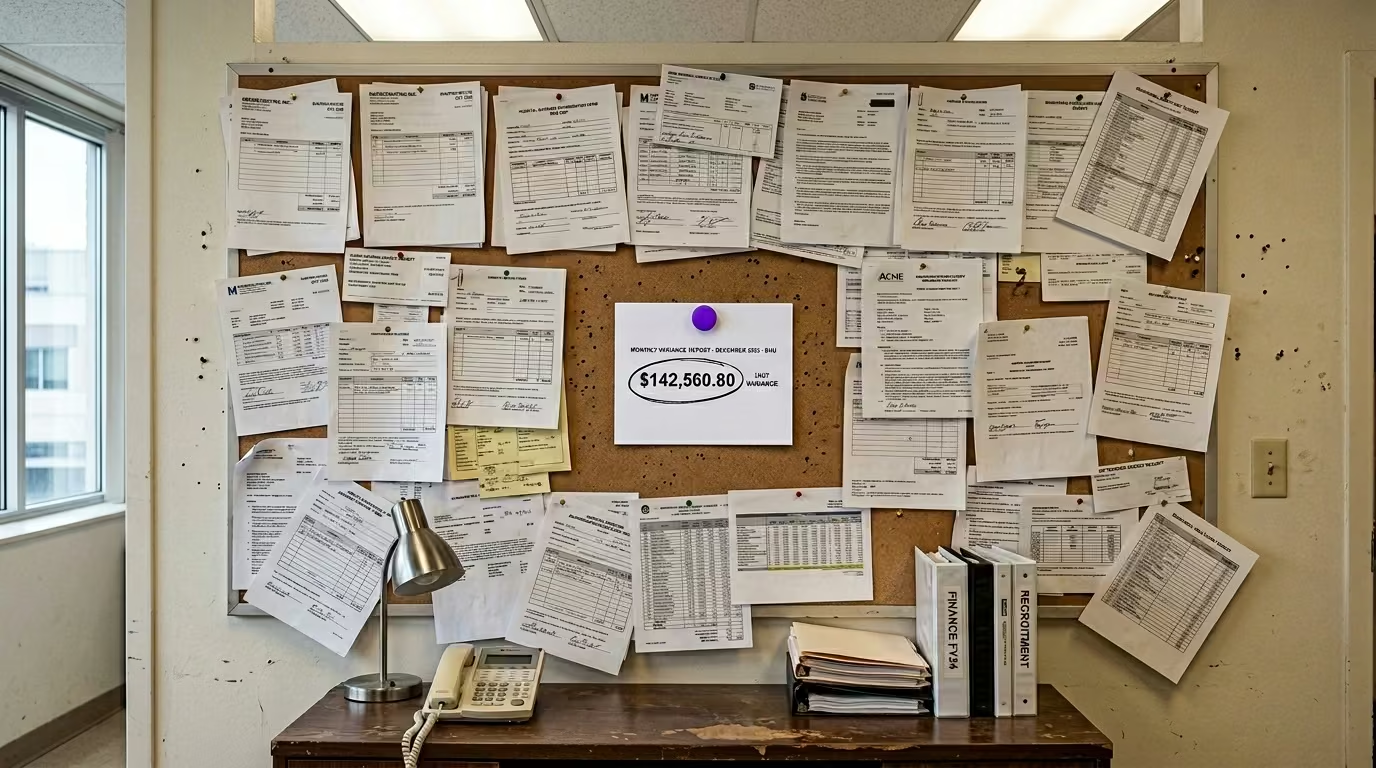
Medical director feeds clinical safety brief into governance mail slot in hospital corridor

Key Takeaways

  • Your quality committee tables safety technology when peer outcomes arrive as clinical data rather than the oversight metrics they already track and act on
  • Peer psychiatric facilities document assault reductions, faster response times, and workforce stability gains that map directly to quality indicator categories your committee reviews
  • A bounded pilot on one high-risk unit gives your committee a measurable decision point, reducing organizational risk while building the evidence base internally

Your clinical safety brief keeps stalling. You brought peer outcome data to the quality committee twice. Both times, the committee acknowledged the evidence, asked clarifying questions, and moved the item to next quarter’s agenda. The data was solid. The framing missed. Governance audiences table clinical evidence when it arrives in a language they can’t act on.

Why Clinical Conviction Stalls Internally

Psychiatric and substance abuse hospitals face the highest workplace violence rate in healthcare: 110.4 incidents per 10,000 workers [1]. Your quality committee likely knows this. The number describes a clinical problem, and committees approve governance actions. That gap is where your brief dies.

Boards tracking performance through focused quality dashboards with governance-aligned metrics produce better outcomes than those reviewing broad clinical data [2]. The pattern holds for quality committees. When safety evidence arrives as a clinical concern, it competes with dozens of other agenda items. When it arrives as a governance metric tied to accreditation, workforce stability, or regulatory compliance, it gets a different hearing.

No one should face violence while trying to help others heal. The shift you need is a different frame around the evidence you already have.

Framing Peer Outcomes for Governance Audiences

Three translation moves convert your peer clinical data into language committees act on:

  1. Clinical outcome → quality oversight metric. A 40% assault reduction is a clinical outcome. Reframe it: “Comparable psychiatric facilities documented a 40% reduction in assault frequency, tracked as a process quality indicator alongside response time and reporting infrastructure.” Now it fits the quality dashboard.
  2. Safety improvement → regulatory compliance lever. Joint Commission accreditation loss risks suspension of Medicare and Medicaid funding worth millions annually for typical hospitals [3]. Connect peer safety outcomes to Joint Commission’s 2022 workplace violence prevention standards, and the committee hears compliance risk reduction. For additional peer evaluation framing, the CMO Peer Evaluation Guide maps these connections in detail.
  3. Staff safety → workforce stability. At one ROAR deployment, staff who said they’d consider leaving due to safety concerns dropped from 22% to 7% [4]. That single metric is simultaneously a safety outcome for you, a retention number for your CEO, and a financial data point for your CFO. Lead with whichever version matches your audience.

Peer Data Your Quality Committee Needs

Quality committees evaluate three indicator types: structural, process, and outcome. Your clinical safety brief should map peer data to all three.

Indicator TypeWhat It MeasuresDocumented Peer Outcome
ProcessIncident response speed93% of incidents resolved in under 2 minutes
OutcomeAssault frequency change40% reduction within six months at a comparable psychiatric facility
StructuralReporting infrastructureMost nurses lack a clear, reliable way to report incidents

Peer outcomes sourced from ROAR deployment data [4].

Present these as trending categories. Your committee reviews dozens of items per meeting. A brief that maps to their existing indicator framework gets read. A brief that requires them to build a new mental model gets tabled.

See how one behavioral health provider documented these results across their facilities.

Objections Medical Staff Will Raise

Your physicians will push back. Prepare documented responses:

  1. “This will disrupt the therapeutic milieu (the treatment environment).” Safety is foundational to all other treatment: no intervention works when safety is compromised [5]. One peer medical director reported zero disruption to patient care or additional workload during deployment [4].
  2. “We already have de-escalation training.” De-escalation training reduces aggression. Technology covers what happens after prevention: the response gap training leaves open.
  3. “This will add workflow burden.” Workflow burden ranks below funding and privacy concerns as an adoption barrier in behavioral health [6]. Your CNO can confirm that staff satisfaction at peer facilities improved after deployment.

A behavioral health safety specialist can help you map peer outcomes to your committee's indicator framework.

Contact Us

Requesting the Clinical Pilot Approval

Ask for a bounded measurement period rather than system-wide commitment.

Define the pilot in terms your committee already approves: one high-risk unit, defined duration, three success criteria the committee selects in advance. Decision-makers approve bounded commitments with clear governance checkpoints far more readily than open-ended investments [7]. Staff preparedness at one pilot site doubled, jumping from 38% to 76% within the evaluation period [4].

This pilot structure works best when the quality committee defines success criteria before deployment begins. Committees that define criteria after seeing results introduce selection bias into the governance review.

At the end of the measurement period, the committee reviews the data and decides on expansion. They approve a familiar governance action.

Safety should be a promise, not just a priority. You now have a clinical safety brief built for the audiences that approve investments. The peer data categories, the reframing techniques, the objection responses, and the bounded pilot ask are ready for your next quality committee meeting. The translation, the part that stalled your committee, is handled. You have the brief, the reframes, and the ask.

PEER EVIDENCE

Ready to Present Your Clinical Safety Brief?

See the documented outcomes from psychiatric facilities comparable to yours, framed for governance review.

References

  1. Sheps Center, University of North Carolina. Workplace Violence in Healthcare Brief, 2025. https://www.shepscenter.unc.edu/wp-content/uploads/2025/01/Y10.01_Brief-1.pdf
  2. Jiang HJ, Lockee C, Bass K, Fraser I. Board oversight of quality: any differences in process of care and mortality? Journal of Healthcare Management, 2009. https://pmc.ncbi.nlm.nih.gov/articles/PMC3876189/
  3. Facilio. Healthcare Joint Commission Compliance, 2024. https://facilio.ae/blog/healthcare-joint-commission-compliance/
  4. ROAR for Good internal deployment data, 2024.
  5. Bowers L, et al. Therapeutic milieu and safety interventions in psychiatric inpatient care. BMC Psychiatry, 2022. https://pmc.ncbi.nlm.nih.gov/articles/PMC9514247/
  6. Barnett ML, et al. Barriers to technology-based interventions in behavioral health. Psychiatric Services, 2015. https://pmc.ncbi.nlm.nih.gov/articles/PMC4362852/
  7. Greenhalgh T, et al. Bounded commitments and pilot governance in healthcare innovation. Implementation Science, 2024. https://pmc.ncbi.nlm.nih.gov/articles/PMC10773379/

Safety Board Presentation: Slides That Get Approved

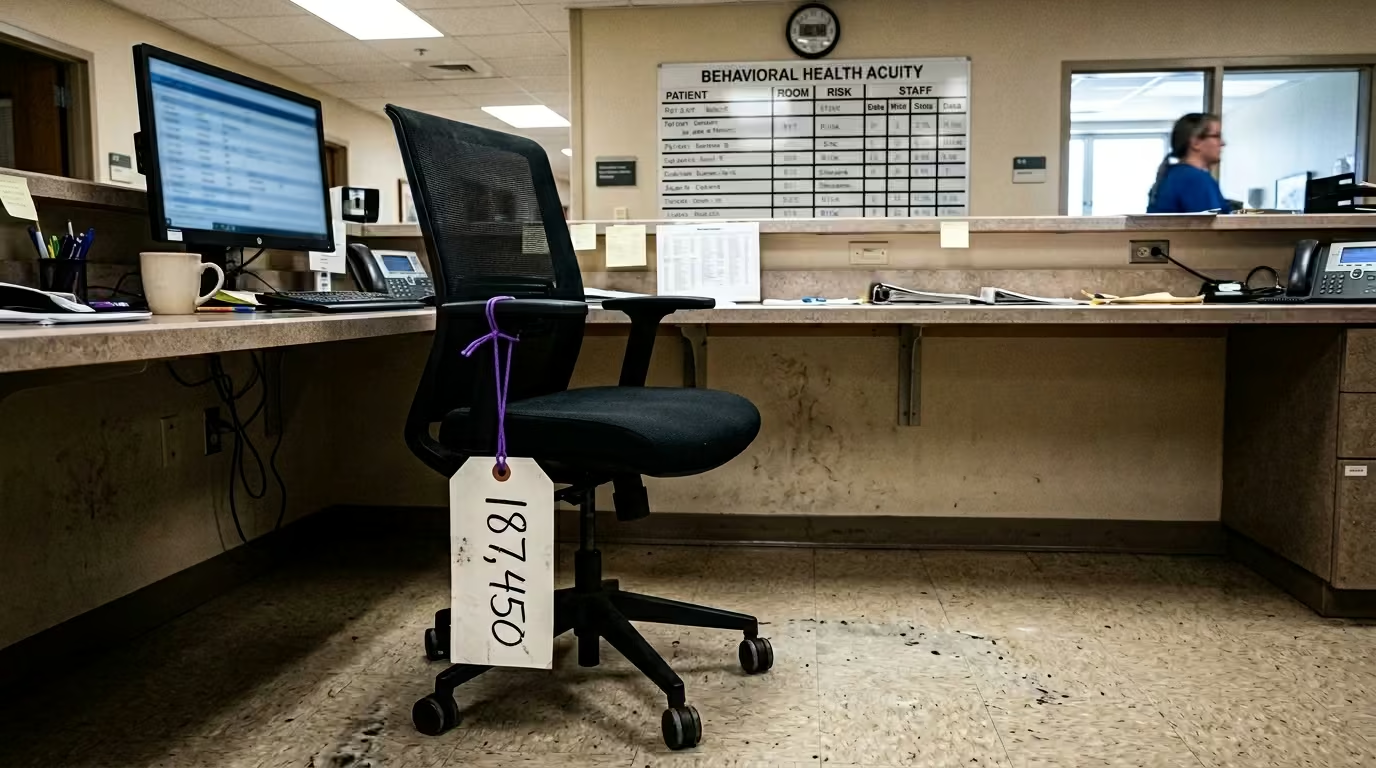
Board safety presentation structure comparison: origami crane and crumpled paper on boardroom table

Key Takeaways

  • Most safety board presentations fail because of structure. Directors need regulatory obligation, peer outcomes in governance language, and a bounded ask they can approve in one meeting.
  • Your board decides based on a fraction of actual incidents. Naming that data gap on your first slide reframes the conversation from operational request to governance risk.
  • A bounded pilot at defined facilities with quarterly success metrics gives directors a small, specific commitment to approve rather than an open-ended investment to debate.

Your next safety board presentation will probably get tabled. The evidence won’t be the problem. Your slides won’t match how directors make governance decisions. Three structural mistakes kill board approval before your strongest data point lands:

  • Leading with incident stories instead of regulatory obligation
  • Presenting operational metrics instead of governance language
  • Closing with a general recommendation instead of a specific ask

Fix the structure, and the evidence you already have starts working.

Why Safety Board Presentations Fail

The core problem is a data gap your directors can sense but can’t name. 81% of workplace violence incidents in healthcare go unreported [1]. Directors recognize when data feels incomplete. Their response is predictable: defer.

Directors protect the organization from decisions they can’t fully assess, and deferral is how they do it [2].

The cost of that deferral is concrete. Loss of Joint Commission accreditation puts Medicare and Medicaid funding at risk [3]. Your board is choosing between a planned investment and an unplanned loss. Safety should be a promise, not just a priority, and that promise starts with giving directors the full picture.

Boundary condition: This slide sequence works when the board is evaluating a safety investment for the first time. If a prior proposal was rejected, address that history directly before slide one.

Your Safety Board Presentation: Slide Architecture That Moves Directors

Boards typically expect capital proposals in a specific sequence: strategic alignment, performance review against plan, and corrective action when needed [2]. Your slides should follow that same logic.

SlideWhat Goes On ItWhat Directors Conclude
1. Regulatory ObligationJoint Commission 2025 standards; your current gap; the 81% underreporting reality“We have a compliance exposure we haven’t fully measured.”
2. Violence ScaleBehavioral health incident rates: 110 per 10,000 workers, five times the rate at nursing facilities [1]“Our setting carries disproportionate risk.”
3. Peer OutcomesA behavioral health facility cut incidents 39% in one quarter; two peer facilities reduced workers’ comp claims 24% and 50% [3]“Comparable organizations acted and measured the results.”
4. Financial ImpactWorkforce retention trends tied to safety investment, framed in your organization’s turnover cost per role“The math supports the investment.”
5. The AskBounded pilot: defined sites, 90-day timeline, quarterly review“This is a decision I can make today.”

This sequence matters. Regulatory obligation establishes why the board must act. Scale establishes why behavioral health specifically. Peer outcomes prove it works. Financial impact proves it pays. The ask gives directors something small enough to approve.

Framing Peer Evidence for Governance

Directors carry three governance duties that Joint Commission’s 2025 behavioral health workplace violence prevention standards implicate directly [2]:

  • Duty of care: ensuring the organization takes reasonable steps to protect staff from foreseeable harm
  • Duty of loyalty: acting in the organization’s best interest rather than deferring out of personal caution
  • Duty of obedience: complying with regulatory requirements, including new Joint Commission standards

Your peer evidence slide needs to speak that language. An operational metric like “40% assault reduction” becomes a governance statement: “Peer facilities demonstrated measurable risk reduction within the board’s quarterly review cycle.”

Facilities using automated duress systems passed 100% of Joint Commission and OSHA inspections with zero citations [3]. That’s governance duty satisfied in a single line.

Two in five healthcare workers have considered leaving over safety concerns [1]. Frame that as workforce risk your directors own. Your directors need to hear that framed as liability they can act on.

See how one behavioral health provider documented these results across their facilities.

Board Objections and Ready Responses

Your directors will ask five questions. Here are the answers, in governance language.

  1. “Can’t we just improve training?” Training reduces how often incidents start. It can’t stop an incident already in motion, and that gap is where staff get hurt.
  2. “What’s the real exposure?” OSHA penalties reach $165,514 per willful violation in 2025, with multiple violations possible per inspection [4]. Joint Commission accreditation loss puts Medicare and Medicaid funding at risk.
  3. “Who else is doing this?” A national behavioral health provider cut assaults 40% in six months [3].
  4. “What if it doesn’t work?” Organizations that deploy safety technology stay with it. Retention among facilities that implement runs above 99%.
  5. “Why now?” Joint Commission’s behavioral health standards took effect January 2025. Your next survey could include these requirements.

A behavioral health safety specialist can help you build the peer evidence slide for your next board meeting.

Contact Us

Defining the Ask That Gets Approved

The difference between a safety board presentation that gets tabled and one that gets approved is the final slide. Directors approve bounded pilots with clear evaluation criteria.

Structure your ask around four elements:

  • Defined scope: your highest-risk facilities
  • 90-day timeline with specific milestones
  • Success metrics the board reviews at the next quarterly meeting
  • A clear decision point to expand, modify, or stop

A peer facility manager reported zero disruption to patient care and zero added workload during deployment [3]. That’s the risk reduction your directors need on the final slide.

You have the evidence. You have the slide sequence. You have responses to every question your directors will ask. Pick the next board meeting on the calendar. Print the slide architecture. Read your five objection responses out loud. The difference is 15 minutes of preparation built for the people in the room.

BOARD READINESS

Ready to Build Your Board Presentation?

See what peer behavioral health organizations documented and get the evidence your directors need.

References

  1. AHRQ. Addressing Workplace Violence and Creating a Safer Workplace. https://psnet.ahrq.gov/perspective/addressing-workplace-violence-and-creating-safer-workplace
  2. PwC. Annual Corporate Directors Survey: Health Industries. https://www.pwc.com/us/en/services/governance-insights-center/library/annual-corporate-directors-survey/health-industries.html
  3. ROAR for Good – Internal Data, 2024. Internal data
  4. Safety+Health Magazine. (2025). OSHA Penalty Amounts for 2025. https://www.safetyandhealthmagazine.com/articles/25870-osha-penalty-amounts-for-2025

Nursing Safety Brief for CFO Approval: A One-Page Guide

Nurse turnover cost data: empty nursing station chair with six-figure price tag in behavioral health unit

Key Takeaways

  • Your nursing safety brief stalls with the CFO because incident counts fail to map to the cost categories finance already tracks each month.
  • Three line items on the CFO’s report already contain your safety case: workers’ comp claims, agency spend from open positions, and unit-level turnover costs that compound quarterly.
  • A 12-week pilot on one high-acuity unit gives the CFO a testable commitment with 90-day checkpoints rather than an enterprise-level risk.

You’ve rehearsed this pitch before. You know which units lose nurses to violence, which shifts run on agency staff, and which incident reports keep stacking up. But every time you bring that nursing safety brief to the CFO, the response is the same: concern, a nod, and “let’s revisit next quarter.”

The data you carry is real. The format is the problem.

Why Your Safety Pitch Stalls

The CFO evaluates spending through cost categories, not incident reports. When you lead with injury counts and staff complaints, you’re speaking the language that works on your units. Cost categories are the language that works in the budget meeting. Each percentage point of RN turnover costs the average hospital an additional $289,000 per year [1], and behavioral health specialty turnover runs at 22.8%, nearly 40% above the national RN average [1]. Your pitch lands when those numbers are the opening line, not the supporting detail.

At a peer behavioral health facility, the share of nurses considering leaving over safety concerns dropped from 22% to 7% after the organization addressed duress response [2]. That shift converts directly to avoided replacement costs the CFO can calculate from their own data.

Three Cost Categories the CFO Already Tracks

Your one-pager needs three sections, each tied to a line item the CFO reviews monthly.

Cost CategoryWhat the CFO SeesWhat’s Driving It
Workers’ comp claimsClaims filed from high-acuity unitsViolence-related injuries generating direct claim costs and lost-time wages
Agency spendTravel nurse invoices at $93.81/hour versus $55.79 for staff nurses [1]Violence-driven vacancies that take longer to fill than voluntary departures
Unit-level turnoverPositions open an average of 83 days per RN vacancy [1]Experienced nurses transferring or leaving units where they feel unsafe

Peer behavioral health facilities that addressed the root cause documented workers’ comp claim reductions of 24% to 50% [2]. Those numbers give your CFO a peer benchmark, which carries more weight than a projection.

See how one behavioral health provider documented these results across their facilities.

Pulling Numbers From Your Units

You need 30 minutes with three data sources you already access:

  • Your unit staffing report (agency hours by unit)
  • Your incident log (reports by unit and shift)
  • Workers’ comp claims filed from your floors

One critical detail for the CFO: 81% of workplace violence incidents go unreported [3]. Your current numbers are a floor. Name that gap in your one-pager. It strengthens the case because it shows the CFO that cost exposure is likely larger than what the data currently reflects.

Facility-specific numbers earn credibility that industry averages never will. When you walk in with your unit’s agency hours, your unit’s claim count, and your unit’s turnover rate, the conversation changes. Safety starts looking like cost control.

Pushback the CFO Will Raise

Expect three objections. Prepare for each.

“Show me the financial payback, not incident reduction.” You already have it. Your one-pager leads with cost categories. Peer facilities document 93% of incidents resolved in under two minutes [2], a metric the CFO can track from day one of a pilot.

“Our injury rate is below industry standard.” Unit-level data tells a more accurate story. Behavioral health units face violence at roughly 14 times the rate of most other industries [4]. Your acute psych unit’s numbers likely differ from the hospital average. Pull the unit-specific data.

“Other facilities do fine without this.” Facilities that appear to be doing fine are often the ones that haven’t measured the cost yet. Nurses who’ve normalized violence rarely name it on the way out, and 60% of nurses say violence has pushed them to change jobs, leave, or seriously consider leaving [5]. The peer facilities that measured it acted on what they found.

Need help pulling the right unit-level numbers for your one-pager? A behavioral health safety specialist can walk through the data with you.

Contact Us

Building the Nursing Safety Brief That Gets Approved

Close your one-pager with a specific ask: a 12-week pilot on your highest-acuity unit. Give the CFO four metrics they can verify at 30, 60, and 90 days:

  1. Response time to duress alerts
  2. Staff perception of safety (survey-based)
  3. Workers’ comp claims filed on the pilot unit
  4. Agency hours on that unit

At one peer facility, staff reporting they felt “very prepared” to respond to an incident doubled within the pilot period, from 38% to 76% [2]. That early signal is what converts a pilot into a permanent line item. The board-ready evidence table consolidates these metrics into a single attachable summary for the next budget cycle.

You already have the conviction. Now you have the structure: three cost categories with your unit’s numbers, responses to the objections you’ll hear, and a specific ask the CFO can approve without enterprise-level risk. No one should choose between advocating for their staff and speaking the CFO’s language. This nursing safety brief lets you do both.

FINANCIAL CASE

Ready to build your one-pager with real data?

A safety specialist can walk you through the unit-level numbers peer organizations used to earn CFO approval, including the 90-day checkpoints that converted pilots into permanent budget lines.

References

  1. NSI Nursing Solutions, Inc. 2025 NSI National Health Care Retention & RN Staffing Report. https://www.nsinursingsolutions.com/documents/library/nsi_national_health_care_retention_report.pdf
  2. ROAR for Good, Internal Deployment Data, 2024.
  3. AHRQ PSNet. Addressing Workplace Violence and Creating a Safer Workplace. https://psnet.ahrq.gov/perspective/addressing-workplace-violence-and-creating-safer-workplace
  4. Sheps Center, University of North Carolina. Workplace Violence in Healthcare, 2021-2022. https://www.shepscenter.unc.edu/wp-content/uploads/2025/01/Y10.01_Brief-1.pdf
  5. National Nurses United. 2024 Workplace Violence Report. https://www.nationalnursesunited.org/workplace-violence

Finance Safety Brief: One-Pager to Align Your C-Suite

Hospital finance corkboard with nurse turnover cost invoices and single circled total

Key Takeaways

  • Your finance safety brief gets agreement but not funding because each stakeholder in the approval chain evaluates spending through a different financial lens.
  • Your board, CEO, and CNO each need a different proof point to say yes, and all three data points already exist in reports you run monthly.
  • A 90-day pilot on your highest-acuity unit gives every stakeholder a measurable checkpoint, converting agreement into a funded line item.

Your finance safety brief is ready. The numbers are solid. You presented the violence-turnover connection at last quarter’s executive meeting, and everyone agreed. The CNO sees it on the units. The CEO sees it in the agency invoices. You see it in the claims data. Yet nothing got funded. Your analysis is correct. The gap is that each audience needs a different proof point to move from nodding to approving.

Why Your Finance Safety Brief Stalls Before the Vote

The $289,000-per-point figure you’ve already cited lands differently depending on who hears it [1]. The board evaluates investment through claims trajectory. The CEO evaluates it through operational cost control. The CNO evaluates it through staff impact. One comprehensive deck serves none of those lenses well. That’s why the same correct analysis produces agreement in the room and silence in the budget.

When violence drives departures, the financial exposure compounds across every line item you track. Better packaging converts the analysis you already have into approvals. The shift starts with speaking each stakeholder’s financial language.

Three Proof Points, Three Audiences

The one-pager that clears has three rows. Each row speaks to one stakeholder in the language they already use to evaluate spending.

AudienceTheir QuestionYour Proof Point
Board“What’s driving our claims trend?”Average trauma-related workers’ comp claim costs $68,231 [2]. Peer behavioral health organizations documented 24-50% claims reductions after investing in staff duress systems [3].
CEO“Which vacancies are preventable?”Travel nurses cost $93.81/hour versus $55.79 for staff nurses [1]. Each violence-driven vacancy fills that gap for roughly three months.
CNO“What would actually make nurses stay?”60% of nurses have changed jobs or considered leaving because of workplace violence [4]. Peer facilities saw intent-to-leave drop from 22% to 7% after deploying duress technology [3].

The board needs loss history they can trace to a trend line. The CEO needs controllable cost lines. The CNO needs retention proof tied to what’s happening on the floor. Three numbers from three reports you already produce.

See how one behavioral health provider documented these results across their facilities.

Packaging the Data They Trust

Three numbers from reports already on your desk are all the one-pager requires: the workers’ comp quarterly summary, the staffing and agency cost report, and HR’s turnover report by unit.

One critical framing note: 81% of workplace violence incidents go unreported [5]. Whatever your current reports show is a floor. When you present the one-pager, name that gap. It turns a static number into a trajectory argument, which is what the board actually responds to.

For the CNO’s row, include an operational metric they can verify independently. At peer behavioral health facilities, 93% of incidents resolved in under two minutes [3]. That kind of response-time data builds cross-audience trust because it’s verifiable through incident logs, not modeled in a spreadsheet. Each percentage point of RN turnover your organization avoids saves roughly $289,000 per year [1], so even a small shift in the CNO’s retention numbers translates directly to the board’s bottom line.

Objections You Will Hear First

Three conversations, three predictable pushbacks.

StakeholderObjectionResponsePeer Evidence
Board“Our claims are within tolerance.”Current claims reflect reported incidents only. Nearly 45% of nurses say their employers ignore reported violence [4]. The question: what happens to the experience modifier when reporting improves?Peer facilities documented 24-50% claims reductions within 12 months of deployment [3].
CEO“Can’t we handle this with training?”Training and duress response solve different problems. Training shapes behavior before an incident. Duress ensures response when behavior escalates beyond training.Peer facilities documented a 39% drop in violent incidents within three months [3].
CNO“My nurses won’t wear another device.”Adoption shows up in satisfaction scores, not just system reports. Staff at peer organizations embraced the technology within weeks.Peer facilities saw intent-to-leave drop from 22% to 7% post-deployment [3].

Want to see how your three proof points compare to peer organizations? A behavioral health safety specialist can walk through the benchmarks with you.

Contact Us

The Pilot Request That Clears

The ask is specific: one high-acuity unit, a 90-day window with monthly check-ins, four metrics.

Track these at each checkpoint:

  • Response time from alert to resolution
  • Staff safety perception scores
  • Workers’ comp claims filed on the unit
  • Agency hours on the pilot unit

This structure addresses the violence-driven share of turnover, the portion your data can already isolate by unit and incident type. It gives every stakeholder in the approval chain a measurable checkpoint they can evaluate against their own criteria.

No one should face violence while trying to help others heal. The reports you already run contain everything the finance safety brief needs. The board-ready evidence table consolidates those numbers into a single attachable summary. The one-pager structure is in your hands. The board meeting, the CEO check-in, and the CNO conversation are the three steps between your analysis and a funded pilot.

FINANCIAL CASE

Ready to populate your one-pager with peer data?

A behavioral health safety specialist can help you package the same three proof points peer CFOs used for board, CEO, and CNO approval. The conversation starts with your data.

References

  1. NSI Nursing Solutions, Inc. 2025 NSI National Health Care Retention & RN Staffing Report. https://www.nsinursingsolutions.com/documents/library/nsi_national_health_care_retention_report.pdf
  2. National Safety Council. Workers’ Compensation Costs. https://injuryfacts.nsc.org/work/costs/workers-compensation-costs/
  3. ROAR for Good. Internal Data, 2024.
  4. National Nurses United. Workplace Violence Report, 2024. https://www.nationalnursesunited.org/sites/default/files/nnu/documents/0224_Workplace_Violence_Report.pdf
  5. AHRQ PSNet. Addressing Workplace Violence and Creating a Safer Workplace. https://psnet.ahrq.gov/perspective/addressing-workplace-violence-and-creating-safer-workplace

Safety Board Presentation: A 3-Question Pitch Framework

Board presentation folder with crossed-out dates on healthcare desk, staffing board gaps visible behind

Key Takeaways

  • Board conversations about safety spending follow three predictable questions, and preparing concise, evidence-backed answers for each one puts you in control of the room.
  • Every percentage point of nursing turnover your organization avoids translates directly to avoided cost, turning a safety conversation into a workforce economics proposal.
  • A phased pilot with three defined checkpoints converts board anxiety into a testable commitment they can approve in a single meeting.

You’ve had the incident data for quarters. Your CNO made the request. Your CFO keeps flagging agency costs that climb every cycle. What you don’t have is the safety board presentation that gets a governance committee to say yes in one meeting. The gap between your conviction and their approval is a packaging problem, and it closes when you stop framing this as a safety expense and start framing it as a workforce economics proposal with a defined test period.

The Board Meeting You Keep Postponing

Behavioral health facilities face violence rates roughly 14 times higher than most other industries [1]. States keep expanding behavioral health infrastructure, and organizations that lose experienced nurses will lose ground to those that keep them. But knowing the problem never built the presentation. So the safety line item gets bumped behind capital projects with tighter narratives. Safety should be a promise, not just a priority. Your board needs to see it as one.

Three Questions Every Safety Board Presentation Must Answer

Directors evaluate safety spending the same way they evaluate any capital request: financial discipline, peer comparison, accountability. Prepare for three questions, and you control the room.

#QuestionBoard-Ready Answer
1“What’s the financial return?”Each percentage point of nursing turnover your organization avoids saves roughly $289,000 a year [2]. Ask your CFO to pull your current turnover rate before the meeting. The math writes itself.
2“Does this actually work?”At a peer behavioral health organization, the share of staff considering leaving over safety dropped from 22% to 7% within 90 days of deploying a nurse duress system [3]. That gives your board a workforce stability metric they can track against your own baseline.
3“What’s our exposure if we don’t act?”The American Hospital Association identifies behavioral health access as a board-level governance responsibility. When experienced nurses leave because they feel unsafe, the board loses the capacity to fulfill its mission. Nurses facing high violence exposure are 5x more likely to plan to leave [4].

Workforce Data That Survives Scrutiny

Your board will scrutinize sources. They’ll challenge any number that looks like a vendor claim. Give them data points they can verify independently.

Data PointAmountSource
Cost to replace one bedside RN (2024)$61,110NSI National Healthcare Retention Report [2]
Workers’ comp claim reduction at peer organizations24%-50%Peer behavioral health deployment outcomes [3]

Behavioral health nurses require specialized training that extends vacancy periods and raises onboarding costs beyond general acute care roles. Every departure your organization prevents avoids both the replacement cost and the agency premium that fills the gap. Those numbers land differently when your board sees them next to the safety investment that prevents the vacancy in the first place.

See how one behavioral health provider documented these outcomes across their facilities.

Objections Your Board Members Will Raise

“Why can’t we just improve our de-escalation training?” U.S. hospitals already spend $1.4 billion annually on violence prevention training [2]. De-escalation training builds knowledge and confidence, but research hasn’t shown it consistently reduces actual assault rates [5]. Training teaches staff what to do. A duress response system determines how fast help arrives when training isn’t enough. Organizations that added duress response infrastructure saw staff preparedness jump from 38% to 76% [3]. That’s the gap your board should be evaluating.

“What are other organizations our size doing?” Peer behavioral health systems that deployed duress technology are staying with it because the outcomes persist. Staff perception of safety drives retention independently of how often violence actually occurs [4]. No one should face violence while trying to help others heal. Your peer organizations reached that conclusion and acted on it.

Need help tailoring the pilot proposal and financial framing for your board? A behavioral health safety specialist can walk through it with you.

Contact Us

The Safety Board Presentation Ask That Works in Sixty Seconds

Request a 90-day pilot on your highest-acuity unit with three checkpoints the board will review:

  1. Day 30: Staff safety perception survey (baseline already exists in most organizations)
  2. Day 60: Response time data from the pilot unit
  3. Day 90: Intent-to-leave comparison against pre-pilot baseline

Frame this as a testable hypothesis. If the pilot unit shows measurable improvement, the board evaluates expansion. If it doesn’t, the commitment ends. Early signals tend to appear fast, within the pilot window your board will review.

You now have the three answers, the objection responses, and the sixty-second ask. The safety board presentation you’ve been postponing has a script. The next governance meeting is the right one to use it.

BOARD-READY DATA

Ready to Build Your Board Case?

You have the script. A behavioral health safety specialist can help you tailor the pilot proposal, the financial framing, and the checkpoint structure to your board's expectations.

References

  1. Sheps Center, University of North Carolina. Workplace Violence in Healthcare, 2021-2022. https://www.shepscenter.unc.edu/wp-content/uploads/2025/01/Y10.01_Brief-1.pdf
  2. NSI Nursing Solutions. 2024 National Health Care Retention & RN Staffing Report. https://www.nsinursingsolutions.com/documents/library/nsi_national_health_care_retention_report.pdf
  3. ROAR for Good. Internal deployment data, 2024.
  4. Staff safety perception and retention in psychiatric wards. https://pmc.ncbi.nlm.nih.gov/articles/PMC12715384/
  5. Systematic review of de-escalation training outcomes in psychiatric settings. https://pmc.ncbi.nlm.nih.gov/articles/PMC12542813/

HR Safety Brief: Nurse Duress Budget Approval

Nurse turnover cost analysis one-pager on leather portfolio beside open office door in healthcare admin wing

Key Takeaways

  • Your CFO needs three data points on one page to approve nurse duress funding: the violence-driven turnover share, workers’ comp exposure, and a peer retention result
  • Every percentage point of turnover improvement saves the average hospital $289,000 per year, turning your safety argument into a budget line the CFO can model
  • A phased pilot on your highest-acuity unit lowers the approval threshold and gives the CFO a built-in checkpoint before broader commitment

You’ve had this conversation before. You walk into the CFO’s office with exit interview data showing safety concerns drive departures. The CFO nods. The CEO agrees it matters. Nothing gets funded. This HR safety brief exists because your packaging is the barrier, not your data. Finance evaluates spending in a language HR rarely uses, and closing that gap is the fastest path to approval. The full financial picture of nurse duress and turnover frames why this conversation matters at the board level.

What Your HR Safety Brief Needs to Include

The decision you’re building toward is specific: budget approval for nurse duress on your highest-acuity unit. That decision requires alignment from your CFO, CEO, and nursing leadership.

StakeholderWhat They EvaluateWhat They Need From You
CFOFinancial justificationShort, verifiable metrics tied to numbers they already track
CEOStrategic alignmentConnection to workforce stability and organizational risk
Nursing leadershipOperational feasibilityEvidence that frontline staff will use it and that response protocols are defined

Behavioral health demands its own benchmarks. Psychiatric and substance abuse hospitals reported 110.4 workplace violence incidents per 10,000 workers [1]. That rate demands a different conversation than medical-surgical units face. Your one-pager needs to reflect that severity. This one-pager addresses the violence-driven share of turnover, the piece most within your control. The three methods for isolating that share give you the numbers your CFO can’t dispute.

“Your packaging is the barrier, not your data.”

Three Points That Move Executives

Your one-pager needs exactly three data points. Each one should fit in a single sentence and be independently verifiable.

Data PointWhat It SaysWhy It Works
Violence-driven turnover share38% of behavioral health nurses cite safety concerns in exit interviews, second only to compensationIsolates the share your CFO cannot attribute to pay
Dollar translationEach percentage point of RN turnover costs the average hospital $289,000 per year [2]Converts your retention argument into a number the CFO can model against investment cost
Peer retention resultAt one behavioral health facility, staff considering leaving due to safety dropped from 22% to 7% after investing in duress infrastructure [3]Shows the CFO this works somewhere comparable

Lead with the dollar figure. When you say “turnover improved three points,” the CFO hears “$867,000 in avoided cost.” That sentence opens the conversation. Your CFO’s five-category turnover cost framework is where that number gets validated against facility-specific data.

The workers’ comp line strengthens the case. One behavioral health system documented 24 to 50% reductions in workers’ comp claims after deploying duress infrastructure [3]. That metric your CFO can verify independently through your existing claims data.

Talk to us about building your internal case for nurse duress funding.

Contact Us

Packaging Data for Budget Conversations

The three data points above are the content. Format carries equal weight. Most healthcare CFOs prefer a single-page summary with three financial metrics, followed by a short appendix. Build your one-pager in this sequence:

  1. Lead with the cost your CFO already knows. Replacing one bedside RN costs $61,110 on average [2]. Multiply that by your violence-driven departures. That’s your baseline.
  2. Layer the workers’ comp exposure. This gives the CFO a second financial metric they can verify against your own claims history.
  3. Hold employer brand and staff preparedness metrics for the CEO conversation. Strategic alignment matters more to the CEO than financial proof. Save those for the right audience. Peer CHROs ranking three workforce dimensions confirm that the organizations leading on this metric packaged their data the same way.

No one should face violence while trying to help others heal. Your one-pager makes that conviction financially legible.

Handling the Pushback You Will Hear

Three objections appear most frequently in budget conversations about nurse duress. Knowing them in advance changes the dynamic.

  1. “Staff won’t actually use it.” Staff adopt tools that respond fast. Peer organizations using duress infrastructure report strong adoption among nursing staff within the first six months.
  2. “ROI is unproven in our setting.” One peer organization documented a 40% reduction in assaults against staff within six months [3]. That’s a measurable outcome in a comparable environment.
  3. “This belongs in the security budget, not HR.” Violence-driven turnover is a workforce cost. You own workforce stability. The departures show up in your retention numbers, your agency spend, your engagement scores. The budget line follows the accountability. See how one provider built the case and achieved measurable results.

Making the Ask That Gets Approved

Request a phased pilot on your highest-acuity unit. The majority of behavioral health organizations that succeeded with duress systems used a three-phase approach:

  1. Phase 1: Pilot on one to two highest-acuity units
  2. Phase 2: Department-wide rollout
  3. Phase 3: Enterprise deployment

A phased pilot lowers the approval threshold. It gives your CFO a built-in checkpoint before broader commitment. Organizations that start with this approach rarely stop. The retention gap that compensation can’t close is what makes this investment stick.

Safety is an investment, not an expense. The one-pager is built. The objection responses are ready. The ask is a phased pilot, not a full capital request. You have what you need to start that conversation.

FINANCIAL CASE

Ready to build your internal case for nurse duress?

See the specific retention, workers' comp, and adoption outcomes referenced in this article. A behavioral health safety specialist can walk you through what a phased pilot looks like for your highest-acuity unit.

References

  1. Sheps Center for Health Services Research. Workplace Violence in Healthcare Settings, 2025. https://www.shepscenter.unc.edu/wp-content/uploads/2025/01/Y10.01_Brief-1.pdf
  2. NSI Nursing Solutions, Inc. 2024 National Health Care Retention & RN Staffing Report. https://www.nsinursingsolutions.com/documents/library/nsi_national_health_care_retention_report.pdf
  3. ROAR for Good. Internal deployment data, 2024.

HR Safety Brief: Perception Metrics That Predict Turnover

Key Takeaways

  • This brief gives CHROs the specific perception metrics, financial translation, and talking points needed to present safety as a workforce planning investment
  • The comparison between current measurement approaches and perception-informed approaches shows exactly where the data gap exists
  • A 30-day action checklist turns this from a concept into a pilot your CFO can approve

Your board sees turnover numbers and exit interview themes. What they don’t see is the perception data that predicted those departures months earlier. This HR safety brief gives you the specific metrics and financial framing to change that conversation. For the full research behind these numbers, see the complete guide to staff safety in psychiatric hospitals.

Current State vs. Perception-Informed HR Safety Brief

What You Present NowWhat Perception Data Adds
Turnover rate (lagging, reported after departure)Intent-to-leave scores by unit (leading, captured quarterly)
Exit interview themes (“safety concerns”)Specific perception gap: importance rated high, satisfaction rated low
Incident reports (81% of incidents unreported [1])Staff perception of organizational response, measured directly
Annual engagement composite scoreUnit-level safety perception scored separately, tracked quarterly
Cost-per-hire and time-to-fillAnnualized retention savings per perception point improvement

The left column describes what most behavioral health HR teams bring to the board today. The right column is what peer CHROs at leading programs are already presenting. The difference is whether your board conversation explains departures after they happen or predicts them before they do.

Key Data Points for Your HR Safety Brief

Bring these to your next CFO or board conversation. Each one connects safety perception to a financial or workforce outcome.

“The difference is whether your board conversation explains departures after they happen or predicts them before they do.”

Retention cost anchor. Each percentage point of nursing turnover costs roughly $289,000 annually [2]. Behavioral health replacement costs typically run higher due to smaller candidate pools. The full financial breakdown shows how these numbers scale across different facility sizes.

Before-and-after proof. Facilities that measured perception and intervened recorded intent-to-leave dropping from 22% to 7%, with safety sentiment lifting up to 38 points [3]. The full evidence set provides the data behind these outcomes.

Engagement connection. Safety perception is one of the strongest drivers of overall engagement [4]. When perception drops, engagement follows. When engagement drops, turnover follows. This means safety investment protects engagement scores your board already tracks.

Reporting gap. 81% of workplace violence incidents go unreported [1]. Your incident data reflects a fraction of what staff actually experience. Perception measurement captures what incident reports miss.

Ready to build the perception metrics into your next board presentation?

Contact Us

Your 30-Day Action Checklist

  • Pull safety-specific items from your existing engagement survey and score them separately by unit. Start with your highest-turnover behavioral health unit.
  • Add two to three intent-to-stay questions tied directly to safety perception on your next pulse survey
  • Work with your CSO to confirm incident reporting workflows include visible follow-up that reporting staff can see
  • Build one slide translating the $289,000-per-point retention anchor into your facility’s specific behavioral health turnover cost
  • Identify one unit for a focused measurement pilot and establish a baseline safety perception score before any changes
  • Brief your CFO with the measurement framework as a workforce planning investment, not a wellness initiative

See how one behavioral health provider documented these results across their facilities.

Safety perception is measurable, movable, and directly tied to retention outcomes. The CHRO who presents this HR safety brief with perception data alongside turnover data changes the board conversation from explaining departures to predicting and preventing them. CNOs tracking this data at the unit level are already seeing the results in their staffing stability.

EXECUTIVE EVIDENCE

Turn Safety Perception Into Board-Ready Retention Data

Behavioral health CHROs using perception measurement are presenting the leading indicator their boards have never seen.

References

  1. AHRQ PSNet. Addressing Workplace Violence and Creating a Safer Workplace. https://psnet.ahrq.gov/perspective/addressing-workplace-violence-and-creating-safer-workplace
  2. NSI Nursing Solutions. 2025 National Health Care Retention & RN Staffing Report. https://www.nsinursingsolutions.com/documents/library/nsi_national_health_care_retention_report.pdf
  3. ROAR for Good. Internal data, 2024. Internal data
  4. Press Ganey. Safety: A Critical Starting Point. https://www.pressganey.com/resources/blog/safety-critical-starting-point/

Nursing Safety Brief: Unit-Level Perception Data

Overflowing suggestion box in clean hospital corridor showing ignored staff safety input

Key Takeaways

  • This brief gives CNOs the specific perception metrics and talking points to bring into unit meetings, replacing reassurance with shareable numbers
  • The comparison between current approaches and perception-informed approaches shows exactly where the credibility gap exists with staff
  • A pre-meeting checklist ensures you walk into the next unit discussion with data your charge nurses can reference at shift handoff

When your charge nurse asks “Is this actually making a difference?”, you need more than reassurance. This nursing safety brief gives you the specific perception data points to answer that question with numbers, not promises. For the full research behind why perception predicts retention, see the complete guide to staff safety in psychiatric hospitals.

Current Approach vs. Perception-Informed Nursing Safety Brief

What You Bring to Unit Meetings NowWhat Perception Data Adds
Incident reports (most incidents unreported [1])Measured staff perception of organizational response
Annual engagement composite scoreUnit-level safety perception scored separately, tracked quarterly
Reassurance that “leadership cares about safety”Before-and-after perception metrics staff can verify against their own experience
General encouragement after incidentsSpecific data points charge nurses can reference at shift handoff
No answer when staff ask “what changed?”Documented shifts: preparedness, satisfaction, confidence

The left column describes what most CNOs bring to staff discussions today. The right column is what peer CNOs at leading programs are sharing with their units. The difference is whether your staff meeting builds credibility or erodes it. For the CHRO-level metrics your HR partner needs, that companion brief covers the corporate side.

Talking Points for Your Next Staff Discussion

These are recorded before-and-after metrics from behavioral health facilities that measured perception and intervened [2]. Give your charge nurses these numbers so they can reference them at shift handoff when staff ask whether leadership is paying attention.

On preparedness: “Before we put our safety system in place, 38% of staff felt very prepared for an incident. That number is now 76%. Three out of four of your colleagues feel ready.”

“The difference is whether your staff meeting builds credibility or erodes it.”

On satisfaction: “Staff satisfaction with safety went from 57% to 73% in three months. That’s a 16-point shift in one quarter.”

On confidence: “Nearly 80% of team members report increased confidence in handling safety concerns since we started.”

After sharing each point, pause. Ask your nurses what matches their experience and what doesn’t. The goal is conversation, not presentation. The units where numbers don’t match what staff feel are the ones that need the most attention from you.

Not every unit will mirror these results. The full evidence set provides context on how these outcomes varied across facility types and timelines. What matters for your unit meeting is whether you can show movement, not whether you hit the same benchmarks.

Want to see what these perception metrics look like for your units?

Contact Us

Pre-Meeting Checklist

Before your next unit meeting, confirm you can answer these:

  • Can you state your unit’s current “feeling prepared” percentage, or only the facility average? If you don’t have unit-level data yet, the unit-level perception guide walks through how to start.
  • Do you have before-and-after data from the most recent quarter, not just annual survey results?
  • Have your charge nurses seen the numbers directly, or only heard about them secondhand?
  • Can you name one specific concern your staff raised last month that the data either supports or contradicts?
  • When staff report an incident, do they see documented follow-up? If the answer is “we don’t know,” start there. The CNO confidence guide on perception data covers how to close that visibility gap.

See how one behavioral health provider documented these results across their facilities.

Your nurses have been telling you that safety is their most pressing concern. This nursing safety brief gives you measured proof that your response is producing results they can feel on the unit. Walk in with the numbers. Let the data speak for the investment your team has made.

UNIT-LEVEL DATA

Walk Into Your Next Unit Meeting With the Numbers That Matter

Behavioral health CNOs using perception data are replacing reassurance with proof staff can feel on the floor.

References

  1. AHRQ PSNet. Addressing Workplace Violence and Creating a Safer Workplace. https://psnet.ahrq.gov/perspective/addressing-workplace-violence-and-creating-safer-workplace
  2. ROAR for Good. Internal data, 2024. Internal data

Coverage Architecture Brief: Bluetooth Panic Button Systems

Hospital hallway during power outage showing active BLE beacons for bluetooth panic button brief coverage

Key Takeaways

  • Coverage gaps in parking lots, stairwells, and outdoor areas aren’t a technology footnote. They’re an institutional risk that belongs in front of leadership.
  • Framing the ask as a site assessment rather than a purchase commitment lowers the barrier and lets the evidence build the case on its own.
  • A short, evidence-backed bluetooth panic button brief gives CSOs the language to translate physical security findings into terms that move a CEO or CFO to action.

Every facility has coverage gaps the security team already knows about. The parking structure. The stairwell between locked units. The outdoor courtyard. These locations show up on incident reports and disappear from safety system coverage maps, and the pattern repeats quarter after quarter.

The question for CSOs isn’t whether the gaps exist. It’s how to get leadership to act on them. This bluetooth panic button brief gives you the framing, the evidence, and the objection responses to walk into that conversation ready.

The Risk Your Coverage Gaps Create

Coverage gaps carry three categories of institutional risk that leadership needs to hear in their language.

  • Liability exposure. Psychiatric aides face workplace violence at roughly 39 times the national average [1]. When incidents happen in documented dead zones where the safety system can’t reach, the facility’s awareness of those gaps becomes part of the liability picture. You knew. The system couldn’t respond.
  • Compliance vulnerability. Joint Commission workplace violence prevention standards took effect in July 2024 for behavioral health settings [2]. Surveyors are asking for coverage proof in parking structures and outdoor areas. Dead zones aren’t a technical detail. They’re a finding waiting to happen. Loss of accreditation puts Medicare and Medicaid funding at risk [3].
  • Retention impact. Nurses at competing facilities are asking during interviews whether the duress system works in the parking garage at shift change [4]. Facilities with visible, verified safety coverage are winning the staffing battle in a market where every departure costs months of recruiting and training.

How to Frame the Ask

The most effective framing isn’t “we need to buy a new system.” It’s “we need to assess what our current system actually covers.”

That reframe matters because it changes the decision from a capital expenditure approval to an information-gathering step. A site assessment confirms whether dead zones and high-incident locations overlap. If they do, the evidence makes the next ask for you. If they don’t, you’ve documented that your coverage is sound.

See how one behavioral health provider used this approach to document results across their facilities.

Here’s a structure for the recommendation:

  • The problem: Our safety system doesn’t reach the locations where incidents happen most. Here are the last 12 months of incident data overlaid on our coverage map.
  • The risk: We have documented awareness of these gaps. Joint Commission surveyors are now asking for coverage proof in these specific areas.
  • The solution: WiFi-independent safety systems that reach every zone without touching our clinical network or requiring construction.
  • The evidence: Peer facilities report documented coverage across all zones, resilience during power outages on battery backup, and deployment in days with zero disruption to patient care [5].
  • The ask: Approve a site assessment to confirm the scope of our coverage gaps. The assessment itself builds the evidence for whatever comes next.

Objections You’ll Hear

Leadership will push back. Here’s what to expect and how to respond.

ObjectionResponse
“Our WiFi covers the whole building.”WiFi coverage maps are tested with doors open. Run a test in the parking garage and stairwell with doors locked. The results will speak for themselves.
“This sounds expensive.”A site assessment costs nothing. Deployment runs around $182 per badge with no wiring and no construction [5]. Compare that to one workers’ comp claim from an incident in an uncovered zone.
“Our technology team is already stretched.”The system runs on its own network. It doesn’t touch clinical infrastructure and doesn’t add work for technology staff.
“We’ll address it next budget cycle.”Surveyors don’t schedule around your budget timeline. Neither do incidents. The assessment takes days, not months.

If you're preparing a leadership briefing on coverage gaps, we can help you build the evidence package.

Contact Us

What This Bluetooth Panic Button Brief Gets You

You don’t need to make the full case in one meeting. You need leadership to approve one step: a site assessment that maps your coverage gaps against your incident data.

Once that assessment confirms what your team already knows, the evidence does the rest. The parking lot, the stairwell, and the outdoor courtyard don’t have to remain the places where your safety program goes quiet. This bluetooth panic button brief gives you the language to make sure they won’t.

STAFF SAFETY

Start With a Site Assessment

Map your coverage gaps against your incident data. The evidence builds the case for everything that comes next.

References

  1. Bureau of Labor Statistics. https://www.bls.gov/iif/factsheets/workplace-violence-2021-2022.htm
  2. Joint Commission. https://www.jointcommission.org/en-us/knowledge-library/newsletters/joint-commission-online/17-jul-24
  3. Facilio. https://facilio.ae/blog/healthcare-joint-commission-compliance/
  4. KLAS Research. https://engage.klasresearch.com/blog/leveraging-technology-to-keep-healthcare-workers-safe/5919/
  5. ROAR for Good – Internal Data, 2024.

IT Planning Brief: Bluetooth Panic Button Architecture

Two hospital wing models comparing tangled wired network versus clean beacon coverage

Key Takeaways

  • The coverage gaps on your RF heat map are the same locations on your incident reports, and that overlap is the strongest argument for infrastructure-independent safety architecture.
  • Presenting the case internally requires translating technical architecture into risk reduction, cost comparison, and documented performance evidence leadership can act on.
  • The most common objections from leadership have clear, evidence-backed answers that a prepared CTO can address in a single meeting.

Your CSO requests safety coverage in the B-wing stairwell. Your RF heat map confirms it is a dead zone. The vendor’s WiFi-dependent system cannot reach it.

This bluetooth panic button technical brief helps you package that problem and its solution into an internal recommendation your leadership team can approve.

The Risk Your Current System Creates

Psychiatric aides experience workplace violence at 543.6 cases per 10,000 workers, the highest rate of any occupational group [1]. The incidents concentrate in stairwells, seclusion rooms, and outdoor walkways where WiFi coverage is weakest.

Behavioral health facilities are built with concrete, metal-reinforced doors, and ligature-resistant construction that blocks wireless signals [2]. More than 200 U.S. counties lack reliable broadband for healthcare operations [3]. The coverage gaps align almost perfectly with the locations where incidents happen.

For leadership, the framing is straightforward: the safety system you approved works in the administrative corridors. It fails in the stairwell where your staff member was assaulted last quarter. That is an organizational risk, not a technology inconvenience.

The Architecture Difference in One Paragraph

BLE mesh architecture runs on its own private network, completely independent of facility WiFi. Battery-powered beacons form a self-healing mesh that covers every area of the facility, including parking lots, stairwells, and outdoor zones WiFi cannot reach. During a four-hour power outage at one facility, the mesh kept operating while WiFi went down [4]. For the full technical comparison of WiFi-dependent, hardwired, and BLE mesh approaches, see the bluetooth panic button guide.

The Evidence Summary for Your Recommendation

When you present to leadership, these are the numbers that matter:

What Leadership AsksWhat You Can Show
Does it actually work in our dead zones?100% facility coverage verified through site surveys with room-level accuracy, including parking lots, stairwells, and outdoor areas [4]
How reliable is it?99.9% SLA-verified uptime across behavioral health deployments, meeting the healthcare life-safety threshold [4][5]
What happens during a power outage?BLE mesh operated through a 4-hour outage with 6 to 8 hours of battery backup [4]
What does it cost?$182 per badge, with no wiring, no construction, and no clinical network changes [4]
How fast can we deploy?Days of beacon placement, with zero disruption to patient care [4]
Does it add risk to our network?Runs on a dedicated private network with HITRUST r2 and SOC 2 Type II certification, completely separate from clinical systems [4][6]

See how one behavioral health provider documented these results across their facilities.

Objections You Will Hear (And How to Address Them)

“Why can’t we just extend WiFi to those areas?”

The construction materials that create dead zones (concrete, metal-reinforced doors, ligature-resistant hardware) are permanent features of behavioral health facilities [2]. Adding access points helps in some areas but cannot solve structural signal loss through dense walls and locked doors. The dead zones are architectural, not coverage configuration problems.

“What about our existing investment in WiFi infrastructure?”

BLE mesh runs on a separate private network. It does not replace, modify, or add load to your existing WiFi. Your current infrastructure stays exactly as it is. The mesh operates alongside it for safety-specific functions only.

“You are not asking leadership to approve a purchase. You are asking them to approve a site assessment that will confirm whether the coverage gaps on your heat map match the incident patterns in your data.”

“What is the ongoing maintenance burden for our technology staff?”

Battery-powered beacons last multiple years between replacements. The mesh is self-healing, meaning it reroutes automatically when a beacon goes down. There is no ongoing network management, no access point monitoring, and no clinical system integration burden beyond initial setup.

“How do we know the vendor’s claims hold up?”

Request documented, SLA-verified uptime from comparable behavioral health deployments. Require a site survey conducted under realistic conditions (doors locked, equipment running). Ask for evidence from an actual power outage event. The CTO evaluation checklist provides the full framework for verifying vendor claims.

The coverage gaps on your heat map already tell the story. See what closing those gaps looks like with a site assessment.

Contact Us

How to Structure the Recommendation

Your internal brief should fit on one page and cover five points:

  • The problem: Dead zones on your RF heat map overlap with high-incident locations. Your current safety system fails in those areas.
  • The risk: Staff are unprotected in the locations where violence is most likely. Regulatory standards now require documented coverage across all facility areas [7].
  • The solution: Infrastructure-independent BLE mesh architecture that covers every zone without touching your clinical network.
  • The evidence: Documented uptime, coverage, and deployment data from comparable behavioral health facilities.
  • The ask: Approval to proceed with a site assessment that documents your specific coverage gaps before any deployment commitment.

That last point matters. You are not asking leadership to approve a purchase. You are asking them to approve a site assessment that will confirm whether the coverage gaps on your heat map match the incident patterns in your data. The evidence does the rest.

SITE ASSESSMENT

Ready to Build the Internal Case?

ROAR's behavioral health technology specialists help CTOs document coverage gaps and build the evidence brief for leadership approval. Start with a site assessment that confirms whether your dead zones match your incident data.

References

  1. Bureau of Labor Statistics. Workplace Violence in Healthcare and Social Assistance: 2021-2022. https://www.bls.gov/iif/factsheets/workplace-violence-2021-2022.htm
  2. Comport. Before Breaking Ground: How Wireless Assessments Enhance Networks in Healthcare. https://comport.com/resources/healthcare-it-services/before-breaking-ground-how-wireless-assessments-enhance-networks-in-healthcare/
  3. KFF Health News. Dead Zone: Rural Hospitals, Outdated Internet. https://kffhealthnews.org/news/article/dead-zone-rural-hospitals-outdated-internet-disconnect-care-disparities/
  4. ROAR for Good. Internal Data, 2024.
  5. Web Alert. Uptime SLA Explained: 99.9% vs 99.99% Availability. https://web-alert.io/blog/uptime-sla-explained-99-9-vs-99-99-availability
  6. HITRUST Alliance. https://hitrustalliance.net
  7. The Joint Commission. Workplace Violence Prevention Program. https://www.jointcommission.org/en-us/knowledge-library/workforce-safety-and-well-being-resource-center/workplace-violence-prevention/workplace-violence-prevention-program

Nursing Safety Brief: Survey Evidence Checklist for Units

Nursing safety brief second-shift test showing confident CNA facing surveyor at 11 PM with purple water bottle

Key Takeaways

  • Surveyors evaluate nursing units on documented evidence across four categories: response capability, incident tracking, staff readiness, and investigation follow-through.
  • The gap between manual and automated documentation shows where most unit-level citations originate.
  • A pre-survey checklist helps CNOs verify their units can produce evidence on demand across all shifts.

Surveyors don’t evaluate your violence prevention program from a conference room. They walk your units, interview your charge nurses, and pull random incidents to trace the follow-up trail. This nursing safety brief covers what your units need to produce when that happens, organized by the evidence categories surveyors actually assess.

Manual vs. Automated Evidence at the Unit Level

The documentation challenge for nursing units is specific: staff focused on patient care during a crisis don’t stop to log timestamps. 81% of workplace violence incidents go unreported by healthcare workers who experienced them [1], and only about a third of nurses say their employer gives them a clear way to report incidents at all [2]. Manual records reflect what staff remember to document after the fact, not what actually happened.

That gap shows up when surveyors start pulling records:

Evidence AreaManual ApproachAutomated Approach
Response timesAnecdotal estimates from charge nursesDocumented response data with unit-level trending
Incident trackingPaper logs with gaps, filed hours laterTimestamped records captured as incidents happen
Staff readinessSign-in sheets proving attendanceCompetency verification with preparedness data
Investigation follow-throughInitial report filed, corrective actions undocumentedFull trail from report through root cause and resolution
Shift consistencyDay shift prepared, night shift uncertainAll shifts documented equally through daily system use

Facilities with documented safety systems show 93% of incidents resolved in under 2 minutes [3]. That’s the benchmark surveyors compare your unit data against.

“The test: can your charge nurse produce any of these within 30 minutes of a surveyor request? If producing evidence requires calls to multiple departments or hours of spreadsheet compilation, that’s the gap to address.”

See how one behavioral health provider documented these results across their facilities.

Your Unit-Level Evidence Checklist

CNOs should verify their units can produce evidence across four categories. These are what surveyors request during unit walkthroughs:

Response capability:

  • Response time data with trending by unit and shift for the past 90 days
  • System reliability records showing consistent availability across your facility
  • Evidence that response capability is consistent between day shift and night shift

Incident tracking:

  • Timestamped incident records with location data for every logged event
  • Trending analysis showing patterns by unit, shift, and time of day
  • Numbers that reflect your facility’s actual acuity level, not artificially low counts that signal underreporting

Staff readiness:

  • Training completion records with competency verification for permanent staff, travelers, and agency nurses
  • Evidence that staff on every shift can describe violence prevention protocols in their own words, not just reference a policy binder
  • Documentation that training covers de-escalation specific to your patient population

Investigation follow-through:

  • Complete investigation files for every documented incident: root cause analysis, corrective actions, completion dates, and communication back to reporting staff
  • Evidence that system changes resulted from investigations, not just that reports were filed
  • Surveyors pull 5-10 random incidents and review the full trail for each [4]. Every one needs to hold up.

The test: can your charge nurse produce any of these within 30 minutes of a surveyor request? If producing evidence requires calls to multiple departments or hours of spreadsheet compilation, that’s the gap to address.

Want to see what unit-level survey evidence looks like for your nursing team?

Request a Demo

Pre-Survey Verification

Before your next survey window, run through these five checks at the unit level:

  • Pull your incident data for one unit over the past 90 days. How long does it take, and does it require compiling from multiple sources?
  • Ask a charge nurse from night shift to walk through the duress response protocol. Does she describe it as naturally as your day-shift leads would?
  • Review the last 5 incident investigations on your highest-acuity unit. Does each show documented root cause, corrective action, and completion dates?
  • Check whether your traveler and agency nurses completed the same training as permanent staff, with competency verification attached.
  • Confirm your governance reporting includes quarterly unit-level safety data presented to leadership with documented discussion.

Start with the night-shift test. That single conversation tells you whether your nursing safety brief preparation has reached the staff surveyors will actually interview, or whether it stopped at the day-shift huddle.

SURVEY READINESS

Prepare Your Nursing Units with Documented Evidence

CNOs at behavioral health facilities with documented safety systems walk into surveys knowing their units can prove capability. See what that looks like.

References

  1. Agency for Healthcare Research and Quality (AHRQ) PSNet. “Addressing Workplace Violence and Creating a Safer Workplace.” 2023. https://psnet.ahrq.gov/perspective/addressing-workplace-violence-and-creating-safer-workplace
  2. National Nurses United. “High and Rising Rates of Workplace Violence.” February 2024. https://www.nationalnursesunited.org/sites/default/files/nnu/documents/0224_Workplace_Violence_Report.pdf
  3. ROAR for Good. Internal Data, 2024.
  4. The Joint Commission. “Workplace Violence Prevention Program.” https://www.jointcommission.org/en-us/knowledge-library/workforce-safety-and-well-being-resource-center/workplace-violence-prevention/workplace-violence-prevention-program

Safety Board Presentation: Accreditation Evidence Guide

Safety board presentation evidence gap - surveyor hand reaching for purple metrics folder bypassing thick policy binder

Key Takeaways

  • A board-ready safety presentation covers four areas: response capability, incident trending, staff readiness, and governance reporting.
  • Framing safety technology as risk mitigation and workforce retention resonates with boards more than compliance language.
  • A five-item pre-presentation checklist helps CEOs verify they can back up every slide with documented evidence.

Accreditation survey windows create board questions. When your board asks whether the organization is ready, a safety board presentation built on documented evidence gives you a fundamentally different conversation than one built on policy summaries. This brief gives you the structure, the metrics, and the checklist to walk in prepared.

Why Your Board Needs to See This

Accreditation loss suspends Medicare and Medicaid billing. For behavioral health systems, that puts millions in annual revenue at risk [1]. Joint Commission surveyors now verify that violence prevention programs produce documented outcomes, and they expect leadership to show personal engagement with those outcomes [2].

Your board evaluates you partly on your ability to prepare the organization for successful surveys [3]. This presentation gives them the evidence that you have.

The Evidence Your Board Should See

Your safety board presentation should cover four evidence areas. These are the same categories surveyors evaluate during accreditation visits, translated into board-level metrics.

Evidence AreaWhat to PresentWhy It Matters to the Board
Response capabilityAverage response time data by unit and shiftShows the program works with measurable speed, not just policies
Incident trendingQuarter-over-quarter data showing incident volume and resolution patternsDemonstrates whether the program is improving outcomes over time
Staff readinessTraining completion rates with competency verificationProves staff can demonstrate capability when surveyors interview them
Governance reportingQuarterly review records showing leadership engagement with safety dataSatisfies the Joint Commission requirement that incidents reach governance [2]

Facilities with documented safety systems can produce this evidence in minutes [4]. If your team needs days to compile the same data, that gap is worth addressing before your next survey window.

See how one behavioral health provider documented these results across their facilities.

How to Frame It for Your Board

Boards respond to three lenses. Structure your safety board presentation around them:

  • Risk mitigation. Accreditation protection is insurance language boards understand. OSHA penalties for willful workplace violence violations now exceed $165,000 per violation [5]. Position documented safety systems as protection against regulatory and financial exposure.
  • Program effectiveness. Facilities with documented safety technology show measurable incident reduction in the first year [4]. Present before-and-after data that demonstrates your program produces outcomes, not just compliance artifacts.
  • Workforce stability. Staff who feel protected stay longer. Each percentage point change in RN turnover costs roughly $289,000 annually [6]. Documented safety systems show measurable improvement in staff confidence [4], and that connection between safety investment and retention resonates with boards watching staffing costs.

When a board member asks the follow-up question about what happens if you pass accreditation but still have an incident, the answer is straightforward: documented evidence shows you had a functioning system when it occurred.

“When a board member asks what happens if you pass accreditation but still have an incident, the answer is straightforward: documented evidence shows you had a functioning system when it occurred.”

Want to see what board-ready accreditation evidence looks like for your facility?

Request a Demo

Your Pre-Presentation Checklist

Before you present to your board, verify you can back up every claim:

  • Pull response time data for the most recent quarter. Can you produce it in under 5 minutes, broken out by unit?
  • Check your incident trending data. Does it show quarter-over-quarter patterns, or just a snapshot?
  • Confirm training completion rates include competency verification, not just attendance records.
  • Review your governance reporting trail. Can you show the board has received quarterly safety updates with documented discussion?
  • Test the 6-month lookback: pick a random incident from 6 months ago and reconstruct the full timeline. How long does it take?

If any of those checks stall, you’ve found the gap to close before your next safety board presentation. Start with the response time pull. That single test tells you whether your evidence infrastructure is ready or whether you’re presenting promises instead of proof.

ACCREDITATION READINESS

Present Documented Evidence at Your Next Board Meeting

Behavioral health facilities with documented safety systems pass Joint Commission surveys with confidence. See what board-ready evidence looks like.

References

  1. Facilio. “Healthcare CMMS for Joint Commission Compliance in 2025.” https://facilio.ae/blog/healthcare-joint-commission-compliance/
  2. The Joint Commission. “R3 Report 42: Workplace Violence Prevention in Behavioral Health Care and Human Services.” https://www.jointcommission.org/en-us/standards/r3-report/r3-report-42/
  3. American Hospital Association. “Effective CEO Performance Evaluation and Board Governance.” https://trustees.aha.org/effective-ceo-performance-evaluation
  4. ROAR for Good. Internal Data, 2024.
  5. Safety + Health Magazine. “OSHA and MSHA Civil Penalty Amounts Going Up.” January 2025. https://www.safetyandhealthmagazine.com/articles/26317-osha-and-msha-civil-penalty-amounts-going-up
  6. NSI Nursing Solutions, Inc. “2025 National Health Care Retention & RN Staffing Report.” March 2025. https://www.nsinursingsolutions.com/documents/library/nsi_national_health_care_retention_report.pdf