
Security Safety Outcomes: Peer Reference Guide for CSOs

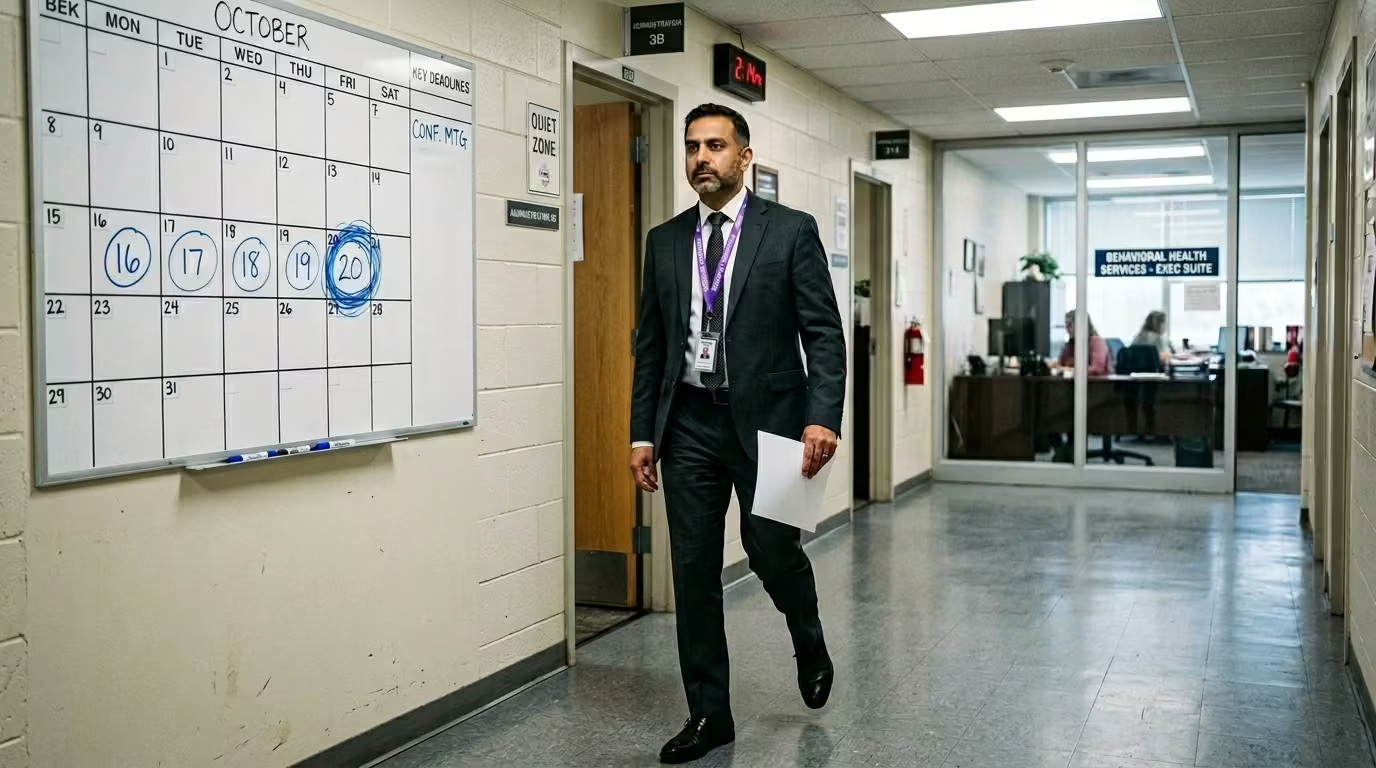
Security director walks toward executive suite carrying peer findings document past five-day deadline calendar

Key Takeaways

  • Informal peer conversations produce impressions that die in budget meetings. A structured process with specific questions surfaces the operational metrics your COO needs to approve spending.
  • Matching peer facilities on security profile — facility type, acuity, campus layout — determines whether the evidence you collect is credible enough to justify investment at your organization.
  • A one-page findings summary that connects response times and coverage data to organizational costs gives executive leadership something they can act on immediately.

To build a budget case your COO will approve, you need peer security data from comparable behavioral health facilities. Impressions from a conference hallway won’t survive the scrutiny. This guide gives you a repeatable process for collecting security safety outcomes from peer directors, interpreting what you hear, and packaging findings that connect to organizational costs.

What Structured Peer Outreach Produces

Structured outreach changes what you collect. Instead of impressions, you get specific numbers: response times, coverage percentages, false alarm rates, adoption data. ROAR deployments across 350+ behavioral health facilities show what those numbers look like when measured. In those facilities, 93% of incidents resolve in under two minutes [1].

Structured calls surface that kind of metric. Hallway conversations produce impressions.

Think of it like the difference between checking your bank balance and guessing what’s in your account. One survives a budget meeting. The other doesn’t.

Before you start, confirm these prerequisites:

  • Your own facility’s incident rates, response times, and current coverage gaps (you need a baseline for comparison)
  • A list of 5-8 peer contacts from your IAHSS network or vendor reference lists
  • Calendar access for scheduling 3-5 calls over 2-4 weeks
  • A security supervisor available to assist with site visit observations

Can you name your own facility’s average response time right now? If you can’t, pull that number before your first peer call. You can’t evaluate someone else’s metrics without knowing your own.

Matching Facilities by Security Profile

A peer at a 20-bed psychiatric unit inside a 400-bed general hospital operates in a fundamentally different security environment than you do at a standalone facility. Regulatory requirements differ between standalone psychiatric hospitals and psychiatric units within general hospitals [2]. Matching on bed count alone produces misleading comparisons.

Psychiatric settings face 110.4 incidents per 10,000 workers, far above any other healthcare environment [3]. That severity makes precise matching essential.

Match on at least three of these five criteria:

  1. Facility type: Standalone psychiatric hospital vs. psychiatric unit within a general hospital
  2. Acuity and patient mix: Ratio of involuntary to voluntary admissions
  3. Campus layout: Single building vs. multi-building, including outdoor transition areas and parking structures
  4. Security staffing model: In-house vs. contracted, 24/7 vs. limited hours, armed vs. unarmed
  5. Current technology: What duress or alerting systems are already in place, and whether coverage reaches every area of the facility

Verbal and physical abuse from patients accounts for 30.6% of top risks in behavioral health security [1]. Your peer facility should share that risk profile. If it doesn’t, weight the evidence lower.

Can you name at least three criteria that make your selected peer comparable, and at least one way it differs? That distinction matters when you present findings.

Seven Questions for Peer Security Directors

On a 30-minute reference call, these seven questions surface metrics instead of impressions. Ask them in this order if time is short. The first three produce the most executive-relevant data.

#QuestionWhat It SurfacesWhat a Strong Answer Sounds Like
1What’s your average time from alert to responder arrival?Response time“Under two minutes, verified by alert logs”
2Are there any areas where staff can’t activate an alert?Coverage gaps“Full facility coverage, including stairwells and parking”
3What percentage of alerts turn out to be accidental or false?False alarm rateA specific percentage, not “very few”
4Has the system gone down during an actual incident?Reliability“99.9% uptime, SLA-verified”
5What percentage of staff carry or wear the device on a typical shift?Adoption rateA number above 85%, with context on privacy concerns
6Did incident reporting rates change after deployment?Reporting cultureSpecific before/after numbers
7What was the biggest unexpected result, positive or negative?Implementation realitiesCandid answer with specifics

Currently, 81% of workplace violence incidents in healthcare go unreported [4]. Question 6 matters because it reveals whether the system changed that pattern or left it intact.

See how one behavioral health provider documented these results across their facilities.

After each call, check: did you get a specific number for response time, coverage, false alarm rate, and adoption? Or just a general impression? If you got impressions, schedule a follow-up or find a better-matched peer.

When Peer Answers Raise Concerns

Two peers will sometimes give you opposite feedback. One reports fast response times and high adoption. The other describes staff resistance and unreliable coverage. The difference usually falls into one of three categories:

CategorySignals to Listen ForWhat to Do
Vendor problemSystem failures during emergencies, coverage gaps the vendor promised to fix, unresponsive supportAsk a third peer. If the pattern repeats, it’s the vendor.
Implementation problemLow adoption despite good technology, inconsistent use across shifts, staff complaints about training or privacyAsk about the rollout process and leadership support. Privacy concerns are the most common barrier to wearable safety technology adoption [5].
Environment mismatchThe peer facility doesn’t match yours on three or more criteria from Section 2Weight this feedback lower. Seek a better-matched peer.

One diagnostic signal stands out. 44.8% of nurses report that their employers ignore violence incidents after they’re reported [6]. If a peer’s staff say the same thing post-deployment, the system hasn’t changed the culture.

When staff still feel ignored after deployment, the implementation failed. The technology worked as designed. Power outage resilience is another signal worth asking about. If a peer reports the system stayed live during an outage, that’s a reliability indicator worth documenting separately.

Can you distinguish whether negative feedback reflects a vendor problem, an implementation problem, or an environment mismatch? If you can’t yet, ask more questions before recording the finding.

A behavioral health safety specialist can help you identify matched peer facilities for your reference calls.

Contact Us

Presenting Security Safety Outcomes to Executive Leadership

Your COO and CFO don’t need your raw call notes. They need a one-page summary that connects what you found to costs they already track.

MetricYour Facility BaselinePeer Facility ResultCost Connection
Response time[Your current average]Under 2 minutesEach minute of delay increases injury severity and workers’ comp claims
Coverage[% of facility covered]100% facility coverageDead zones create liability exposure in areas staff avoid
Incident reduction[Current trend]40% reduction in staff assaults [1]Fewer assaults reduce injury costs and overtime backfill
Staff retention impact[Your turnover rate]Measurable improvement: ask for before/after numbersHealthcare workers frequently cite safety concerns as a reason for considering leaving their roles [6]

Fill in your baseline from your own data. Fill in peer results from your calls. The cost connection column translates operational metrics into language your CFO already uses.

Your job is to present the operational evidence with cost connections. Your CFO builds the financial model. You provide the inputs.

TaskWho Owns ItCSO’s Role
Peer facility selectionCorporate security sets criteriaApprove final list based on comparability
Reference callsCorporate security conductsPersonally conduct 2-3 calls to assess credibility
Site visit observationsSecurity supervisor documentsPersonally observe response drills and staff interactions
Findings compilationCorporate security compilesReview, validate, and sign off
Executive presentationCSO presents to COO/CFOOwn the presentation and answer operational questions

Compressed timeline (1 week): If your COO needs evidence before next month’s budget meeting, match on acuity and bed count only. Conduct two phone calls using questions 1, 2, and 5. Ask for ranges if peers can’t provide exact metrics. Flag assumptions clearly: “Based on 2 peer calls matched on acuity and bed count. Full matching to follow in Q[X].” Complete in five business days: Day 1 identify and schedule, Days 2-3 conduct calls, Day 4 compile, Day 5 finalize.

You don’t need to fix everything by next quarter. Start with one well-matched peer call and one clean findings page.

You now have a process that turns peer conversations into documented evidence. Your next reference call has seven questions calibrated to your security priorities. Your next site visit has a checklist. And your next budget request has a one-page summary connecting security safety outcomes to costs your COO and CFO already track.

PEER EVIDENCE

Ready to Start Your Peer Reference Calls?

Get matched with behavioral health facilities comparable to yours and start collecting the security safety outcomes your COO needs.

References

  1. ROAR for Good. Internal Data, 2024.
  2. CMS. Psychiatric Hospitals Certification and Compliance. https://www.cms.gov/medicare/health-safety-standards/certification-compliance/psychiatric-hospitals
  3. Sheps Center, UNC. Workplace Violence in Healthcare Settings, 2021-2022. https://www.shepscenter.unc.edu/wp-content/uploads/2025/01/Y10.01_Brief-1.pdf
  4. AHRQ Patient Safety Network. Addressing Workplace Violence and Creating Safer Workplace. https://psnet.ahrq.gov/perspective/addressing-workplace-violence-and-creating-safer-workplace
  5. PMC. Barriers to Adoption of Wearable Sensors in Workplace Safety. https://pmc.ncbi.nlm.nih.gov/articles/PMC9307130/
  6. National Nurses United. Workplace Violence Report, 2024. https://www.nationalnursesunited.org/sites/default/files/nnu/documents/0224_Workplace_Violence_Report.pdf

Dead Zone Coverage: Bluetooth Panic Button Safety Guide

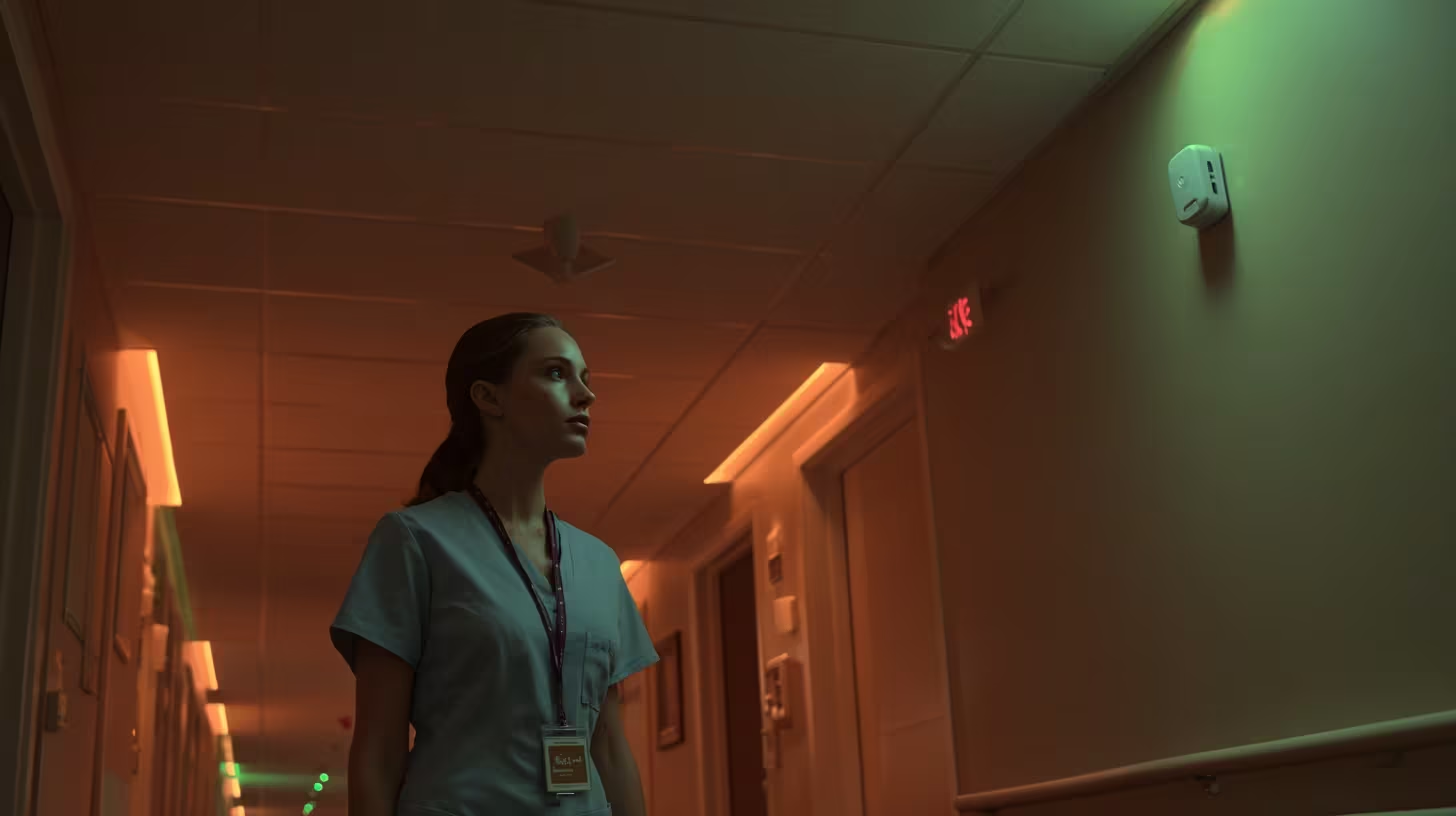
Nurse fading transparent near stairwell door showing bluetooth panic button safety coverage gap

Key Takeaways

  • The locations where workplace violence happens most often in behavioral health facilities are the same locations where WiFi-dependent safety systems lose signal, and you can find that overlap with data you already have.
  • A structured walkthrough process using incident reports and coverage maps shows you where bluetooth panic button safety gaps are and builds the evidence case for closing them.
  • Deploying coverage in highest-risk zones first, then expanding facility-wide, gives security leaders a defensible, documented safety program that holds up under survey scrutiny.

Your monthly incident reports keep telling the same story. The stairwell between units. The parking lot after second shift. The outdoor courtyard during patient transport. These locations show up month after month because they are where your WiFi-dependent bluetooth panic button safety system goes silent.

Reinforced concrete and metal fire doors block WiFi signals. The same construction materials that keep patients contained are the ones that create dead zones for staff. The coverage map and the incident map overlap in exactly the wrong places.

This guide walks through how to find those gaps, document them, and close them with technology that works where WiFi can’t.

Start With What You Already Have: Incident Data and Coverage Maps

Before evaluating any new technology, build the case with data that already sits in your systems.

Pull your last 12 months of incident location data. Your violence prevention committee, your CNO, or your risk management team should have this. Then get current WiFi coverage maps from your technology staff. Overlay the two datasets. Across behavioral health facilities, the pattern is consistent: the areas where incidents cluster are the areas where coverage drops.

What you are looking for:

  • Which incident locations fall inside documented WiFi dead zones
  • Whether the same locations appear repeatedly across months
  • Which high-traffic staff areas (parking lots, stairwells, outdoor walkways) have no coverage at all
  • Whether your coverage maps were tested with doors in their normal locked position or standing open

That last point matters more than most people realize. WiFi signal tests run with doors propped open produce coverage maps that look nothing like what your facility actually looks like day to day. Reinforced doors in locked position block enough signal to turn a covered corridor into a dead zone.

For multi-site teams, this assessment must happen at each facility separately. Construction materials and layouts vary building to building, and a coverage map from one location tells you nothing about another.

The Locations That Matter Most

Focus your coverage checks on the locations you worry about most, not the locations easiest to cover.

LocationWhy It MattersWhat to Test
Parking lots and structuresWhere a large share of healthcare violence happens [1]Test at facility perimeter and every level of parking structures
StairwellsAmong the highest-risk areas for staff injury [2]Test with fire doors in closed and locked position
Outdoor transition areasNothing covers the open space between buildingsTest at maximum distance between buildings
Elevator cabsMetal enclosure blocks most wireless signals [2]Test at each floor with doors closed
Older building wingsThick walls and old construction block signals even moreTest in corridors and patient rooms, not just common areas

Walk these locations yourself with a test device. Press the panic button in the parking garage on level three. Press it in the stairwell with the fire door shut. Press it in the outdoor walkway between buildings at the farthest point from either entrance.

If the alert doesn’t go through, your staff already know. They figured out which zones are dead long before any formal audit confirmed it.

See how one behavioral health provider documented coverage results across their facilities.

What Closes the Gap

The dead zone problem is structural. WiFi can’t reach these areas because the building materials physically block the signal. Extending WiFi or running wires into a parking garage or a concrete stairwell is expensive, disruptive, and often still unreliable.

Standalone wireless safety systems operate on their own network, independent of facility WiFi [3]. Battery-powered beacons require no wiring, run for years on standard batteries, and go in areas that wired systems could never reach. If one beacon goes down, the network routes around it automatically.

What that means for your walkthrough: the parking structure, the stairwell, and the outdoor courtyard all become covered zones. During a four-hour power outage at one facility, the safety system kept running on battery power with six to eight hours of backup while WiFi went dark [4].

For the full technical breakdown of how this architecture works, the CTO evaluation guide covers it in detail.

If your walkthrough confirmed dead zones in high-risk areas, we can help you map a deployment plan.

Contact Us

Bluetooth Panic Button Safety: Who Owns What

Bluetooth panic button safety deployment works when responsibilities are clear from the start.

TaskCorporate SecurityFacility Security DirectorCSO Role
Coverage standardsEstablish enterprise-wide requirementsExecute within corporate standardsDefine what “complete coverage” means for each site
Gap assessmentProvide assessment frameworkConduct site-specific walkthroughReview results against incident data
Deployment oversightMonitor enterprise rolloutExecute facility deploymentVerify coverage in previously uncovered zones
Compliance recordsEstablish documentation standardsMaintain site-specific evidenceEnsure evidence package is survey-ready

Joint Commission workplace violence prevention standards took effect in July 2024 for behavioral health settings [5], and surveyors have started asking for coverage proof in parking structures and outdoor areas. Loss of accreditation puts Medicare and Medicaid funding at risk [6]. The technology alone doesn’t protect you in a survey. The evidence package does.

Get your current incident numbers on record before deployment. You need a documented before-and-after comparison. Without it, proving program effectiveness to leadership and surveyors becomes a credibility problem.

Your Assessment Checklist for This Week

You don’t need to wait for budget approval or a vendor selection to start. The assessment itself is free and builds the case for everything that follows.

  • Pull 12 months of incident location data and overlay it against current WiFi coverage maps. Where do the clusters land relative to your dead zones?
  • Walk your parking structures, stairwells, and outdoor transition areas with a test device. Can you trigger and receive an alert from every location where staff actually work?
  • Confirm with facilities management whether WiFi access points sit on backup generator circuits. If they don’t, document the gap.
  • Verify you can pull up audit logs within 30 minutes of a surveyor request. Surveyors don’t schedule these asks in advance.
  • Ask your violence prevention committee: can staff name the zones where they don’t trust the system? That list is your real coverage audit.

Start with the parking lot that showed up on last month’s incident report. With the assessment complete and gaps documented, bluetooth panic button safety coverage can extend to every location where incidents actually happen. One zone at a time is how coverage gaps close for good.

STAFF SAFETY

Close the Dead Zones in Your Facility

Bluetooth panic button safety coverage that reaches every parking lot, stairwell, and outdoor area where your staff work.

References

  1. ASPR TRACIE / American Hospital Association. https://files.asprtracie.hhs.gov/documents/on-campus-hospital-armed-assailant-planning-considerations.pdf
  2. Office of Justice Programs. https://www.ojp.gov/pdffiles/cptedpkg.pdf
  3. NCBI. https://pmc.ncbi.nlm.nih.gov/articles/PMC11435828/
  4. ROAR for Good – Internal Data, 2024.
  5. Joint Commission. https://www.jointcommission.org/en-us/knowledge-library/workforce-safety-and-well-being-resource-center/workplace-violence-prevention/workplace-violence-prevention-program
  6. Facilio. https://facilio.ae/blog/healthcare-joint-commission-compliance/

Coverage Architecture Brief: Bluetooth Panic Button Systems

Hospital hallway during power outage showing active BLE beacons for bluetooth panic button brief coverage

Key Takeaways

  • Coverage gaps in parking lots, stairwells, and outdoor areas aren’t a technology footnote. They’re an institutional risk that belongs in front of leadership.
  • Framing the ask as a site assessment rather than a purchase commitment lowers the barrier and lets the evidence build the case on its own.
  • A short, evidence-backed bluetooth panic button brief gives CSOs the language to translate physical security findings into terms that move a CEO or CFO to action.

Every facility has coverage gaps the security team already knows about. The parking structure. The stairwell between locked units. The outdoor courtyard. These locations show up on incident reports and disappear from safety system coverage maps, and the pattern repeats quarter after quarter.

The question for CSOs isn’t whether the gaps exist. It’s how to get leadership to act on them. This bluetooth panic button brief gives you the framing, the evidence, and the objection responses to walk into that conversation ready.

The Risk Your Coverage Gaps Create

Coverage gaps carry three categories of institutional risk that leadership needs to hear in their language.

  • Liability exposure. Psychiatric aides face workplace violence at roughly 39 times the national average [1]. When incidents happen in documented dead zones where the safety system can’t reach, the facility’s awareness of those gaps becomes part of the liability picture. You knew. The system couldn’t respond.
  • Compliance vulnerability. Joint Commission workplace violence prevention standards took effect in July 2024 for behavioral health settings [2]. Surveyors are asking for coverage proof in parking structures and outdoor areas. Dead zones aren’t a technical detail. They’re a finding waiting to happen. Loss of accreditation puts Medicare and Medicaid funding at risk [3].
  • Retention impact. Nurses at competing facilities are asking during interviews whether the duress system works in the parking garage at shift change [4]. Facilities with visible, verified safety coverage are winning the staffing battle in a market where every departure costs months of recruiting and training.

How to Frame the Ask

The most effective framing isn’t “we need to buy a new system.” It’s “we need to assess what our current system actually covers.”

That reframe matters because it changes the decision from a capital expenditure approval to an information-gathering step. A site assessment confirms whether dead zones and high-incident locations overlap. If they do, the evidence makes the next ask for you. If they don’t, you’ve documented that your coverage is sound.

See how one behavioral health provider used this approach to document results across their facilities.

Here’s a structure for the recommendation:

  • The problem: Our safety system doesn’t reach the locations where incidents happen most. Here are the last 12 months of incident data overlaid on our coverage map.
  • The risk: We have documented awareness of these gaps. Joint Commission surveyors are now asking for coverage proof in these specific areas.
  • The solution: WiFi-independent safety systems that reach every zone without touching our clinical network or requiring construction.
  • The evidence: Peer facilities report documented coverage across all zones, resilience during power outages on battery backup, and deployment in days with zero disruption to patient care [5].
  • The ask: Approve a site assessment to confirm the scope of our coverage gaps. The assessment itself builds the evidence for whatever comes next.

Objections You’ll Hear

Leadership will push back. Here’s what to expect and how to respond.

ObjectionResponse
“Our WiFi covers the whole building.”WiFi coverage maps are tested with doors open. Run a test in the parking garage and stairwell with doors locked. The results will speak for themselves.
“This sounds expensive.”A site assessment costs nothing. Deployment runs around $182 per badge with no wiring and no construction [5]. Compare that to one workers’ comp claim from an incident in an uncovered zone.
“Our technology team is already stretched.”The system runs on its own network. It doesn’t touch clinical infrastructure and doesn’t add work for technology staff.
“We’ll address it next budget cycle.”Surveyors don’t schedule around your budget timeline. Neither do incidents. The assessment takes days, not months.

If you're preparing a leadership briefing on coverage gaps, we can help you build the evidence package.

Contact Us

What This Bluetooth Panic Button Brief Gets You

You don’t need to make the full case in one meeting. You need leadership to approve one step: a site assessment that maps your coverage gaps against your incident data.

Once that assessment confirms what your team already knows, the evidence does the rest. The parking lot, the stairwell, and the outdoor courtyard don’t have to remain the places where your safety program goes quiet. This bluetooth panic button brief gives you the language to make sure they won’t.

STAFF SAFETY

Start With a Site Assessment

Map your coverage gaps against your incident data. The evidence builds the case for everything that comes next.

References

  1. Bureau of Labor Statistics. https://www.bls.gov/iif/factsheets/workplace-violence-2021-2022.htm
  2. Joint Commission. https://www.jointcommission.org/en-us/knowledge-library/newsletters/joint-commission-online/17-jul-24
  3. Facilio. https://facilio.ae/blog/healthcare-joint-commission-compliance/
  4. KLAS Research. https://engage.klasresearch.com/blog/leveraging-technology-to-keep-healthcare-workers-safe/5919/
  5. ROAR for Good – Internal Data, 2024.

When WiFi Fails: Bluetooth Panic Button Confidence

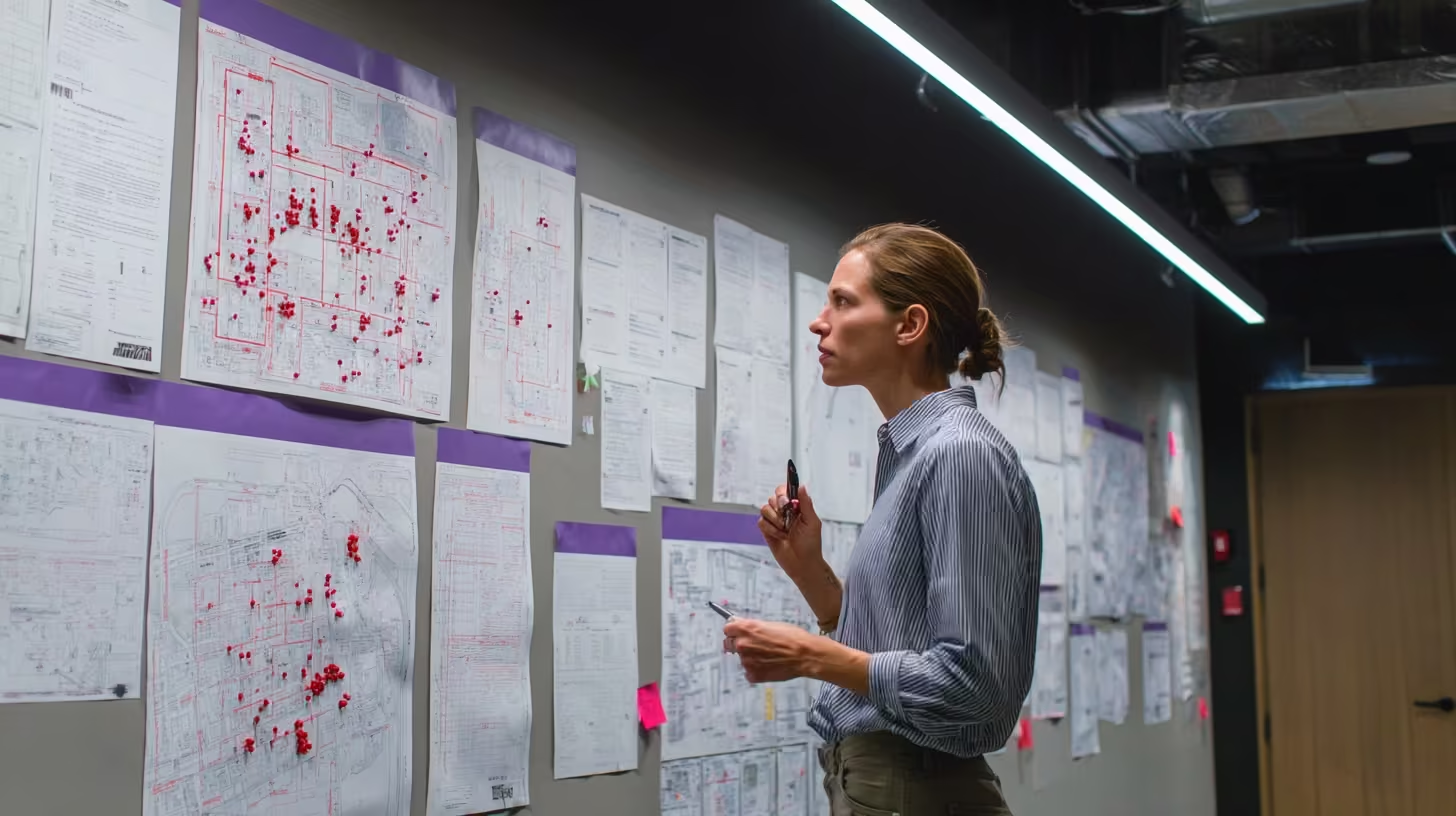
healthcare security bluetooth panic button — security director annotating incident location wall with beacon deployment plan

Key Takeaways

  • Security leaders who can map their facility’s coverage gaps carry the weight of knowing exactly where staff are unprotected, and every incident in a flagged location deepens that burden.
  • Bluetooth panic button confidence requires protection that works in parking lots, stairwells, and outdoor areas independent of facility WiFi, because those are the zones where violence concentrates.
  • When verified coverage reaches every zone, staff trust in the safety program shifts measurably and the anxiety of managing around known blind spots lifts.

The locations that show up most often on incident reports are the same locations where WiFi-dependent safety systems lose signal. Parking lots. Stairwells. Outdoor transition areas between buildings. Security directors know this because they have walked those zones, flagged them, and watched the same locations appear in reports quarter after quarter.

That overlap is what makes bluetooth panic button confidence feel out of reach. You can see exactly where the gaps are. You know incidents will keep happening there. And with a WiFi-dependent system, you have no way to close them.

Where Incidents Concentrate and Coverage Disappears

Parking lots account for roughly one in four to two in five healthcare workplace violence incidents [1]. Stairwells and outdoor transition zones follow close behind. Psychiatric and substance abuse hospitals record more than 110 violent incidents for every 10,000 workers [2], and the worst of it happens in areas with the weakest coverage.

Security leaders describe the same pattern when they overlay incident data onto coverage maps. The clusters sit directly on top of the dead zones. The areas flagged for safety concerns are the same areas where the safety system goes quiet.

For CSOs, this creates a specific kind of burden. You can see the risk. You have documented it. And the current system can’t reach it.

What Your Staff Already Know

Staff figure out coverage gaps faster than any formal audit. More than eight in ten psychiatric nurses faced workplace violence in the past year, and more than half experienced physical attacks [3]. Yet roughly the same proportion of healthcare workers who experience violence never fully report it [4].

The connection between those two numbers runs through your dead zones. When staff learn which areas are covered and which aren’t, behavior shifts:

  • Devices stop getting carried in zones where signals drop
  • Incidents in dead zones go unreported because no one will respond anyway
  • New hires learn from colleagues which hallways and parking levels to avoid after dark
  • Violence prevention committees hear the same question repeatedly: “What’s the point if it doesn’t reach the parking lot?”

That informal knowledge is your real coverage audit. And it tells a different story than the vendor’s coverage map.

See how one behavioral health provider documented these results across their facilities.

The Joint Commission issued workplace violence prevention standards effective July 2024 for behavioral health settings [5], and state-level panic button mandates need devices to work reliably across entire facilities [6]. Assessors have started asking for coverage proof in parking structures and outdoor areas. The dead zones that staff already know about are becoming the dead zones that surveyors will document.

When Bluetooth Panic Button Confidence Becomes Real

The shift happens when the safety system stops depending on WiFi. Standalone wireless safety networks operate on their own infrastructure, separate from facility WiFi, separate from the hospital network [7]. They reach the zones that WiFi can’t: parking lots, stairwells, outdoor walkways, older building sections with dense construction.

What that means in practice: protection that reaches the parking structure on level P3. The stairwell between locked units. The outdoor courtyard where staff take breaks. Every location that appeared on incident reports and disappeared from coverage maps.

During a four-hour power outage at one facility, the safety system kept running on battery power with six to eight hours of backup [8]. WiFi went down. Lighting went down. The safety network stayed live in every zone because it never depended on the infrastructure that failed.

For a security leader who has spent years managing around known blind spots, that shift changes what the role feels like day to day.

If your facility has coverage gaps you already know about, we can help you map them and fix them.

Contact Us

What Changes When Every Zone Is Covered

When verified coverage reaches every area of the facility, things change for security leaders and for frontline staff.

What CSOs carry with coverage gapsWhat changes with verified full coverage
Knowing which zones are unprotected and waiting for the next incident thereEvery zone documented and covered, including the locations that previously had no protection
Staff distrust visible in underreporting and devices left behindStaff confidence measurable in reporting rates and how often devices are actually carried
Survey anxiety about coverage questions with no good answerCoverage proof for every room and area an assessor might ask about
Incident reports that confirm the same dead zones quarter after quarterThe pattern breaks because the dead zones no longer exist

Behavioral health facilities report up to a 38-point jump in staff responses to “I feel safe at work” after deploying coverage that reaches every zone [8]. Results vary by facility size and how visibly the deployment was communicated, but the direction is consistent: when staff believe the system works everywhere, their relationship with the safety program changes.

What shifts for CSOs:

  • The gap between what you know and what you can fix closes
  • Your incident reports stop pointing to the same blind spots
  • Coverage becomes something you can show a surveyor, not something you explain around
  • The weight of knowing where people are unprotected lifts

Bluetooth panic button confidence is specific. It means verified protection in every parking lot, stairwell, and outdoor area where your staff work and where incidents happen. The dead zones on this morning’s incident report can be the last ones your facility carries.

STAFF SAFETY

Coverage That Reaches Every Zone in Your Facility

Bluetooth panic button confidence starts with verified protection in every parking lot, stairwell, and outdoor area where your staff work.

References

  1. ASPR TRACIE / American Hospital Association. https://files.asprtracie.hhs.gov/documents/on-campus-hospital-armed-assailant-planning-considerations.pdf
  2. Sheps Center UNC. https://www.shepscenter.unc.edu/wp-content/uploads/2025/01/Y10.01_Brief-1.pdf
  3. NCBI. https://pmc.ncbi.nlm.nih.gov/articles/PMC6345477/
  4. American Nurses Association. https://www.nursingworld.org/content-hub/resources/workplace/unreported-workplace-violence—why-is-this-so-common/
  5. Joint Commission. https://www.jointcommission.org/en-us/knowledge-library/workforce-safety-and-well-being-resource-center/workplace-violence-prevention/workplace-violence-prevention-program
  6. Noonlight. https://www.noonlight.com/blog/panic-buttons-the-common-thread-in-frontline-worker-safety-laws
  7. NCBI. https://pmc.ncbi.nlm.nih.gov/articles/PMC11435828/
  8. ROAR for Good – Internal Data, 2024.

Peer CSO Safety Insights: WiFi-Free Duress Systems

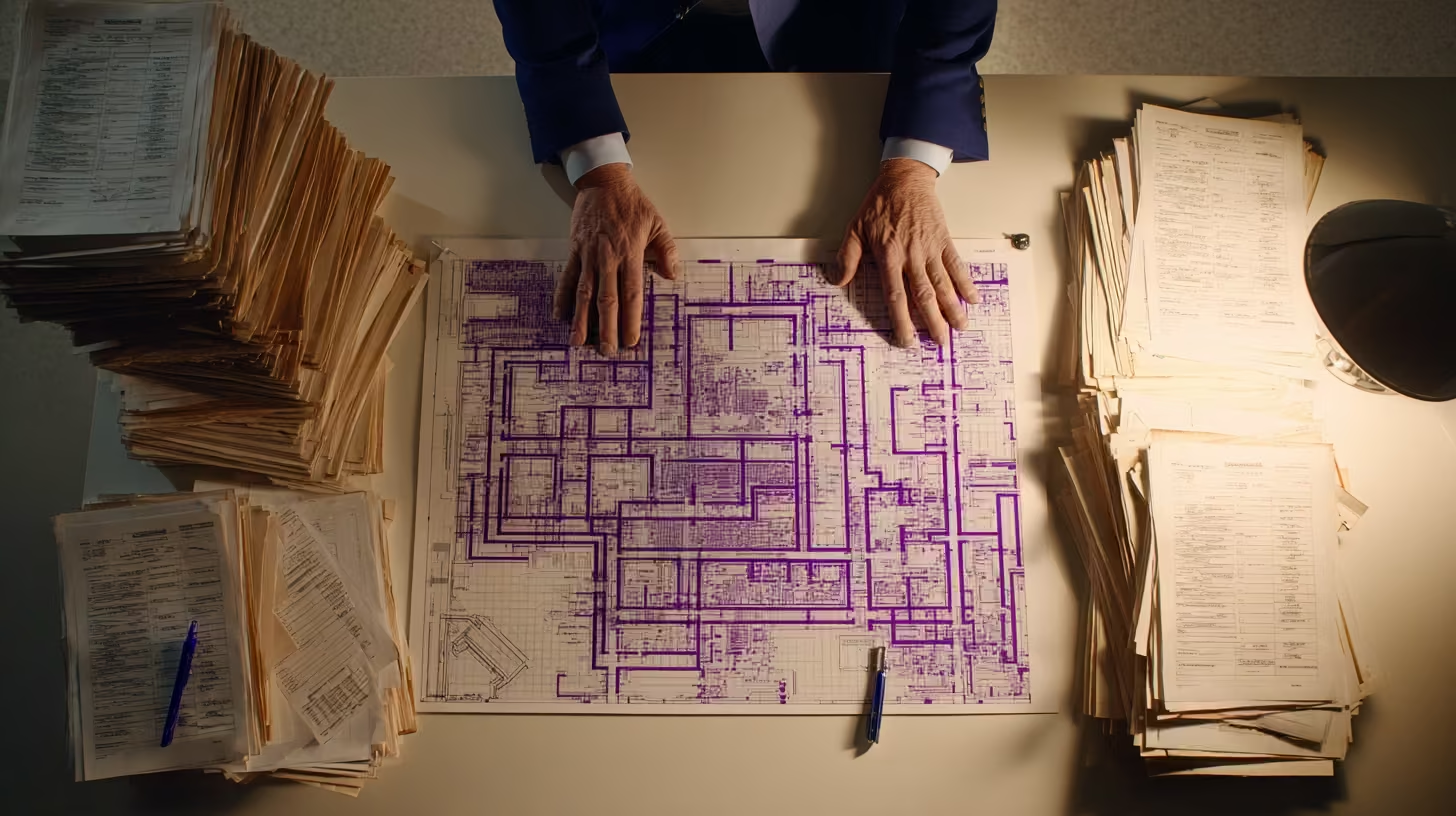
Peer CSO safety insights shown as security director reviewing complete facility coverage map with purple routes

Key Takeaways

  • Security directors at peer behavioral health facilities stopped trying to extend WiFi into dead zones and shifted to safety systems that don’t depend on facility networks at all.
  • The peer conversation changed after high-profile infrastructure failures proved that WiFi-dependent duress systems fail at the exact moment facilities are most chaotic.
  • Facilities that made the switch are reporting consistent coverage in every zone, resilience during outages, and a measurable edge in staff recruitment and retention.

Peer CSO safety insights from behavioral health facilities with the same infrastructure challenges keep pointing to one conclusion: the problem security directors solved wasn’t WiFi quality. It was WiFi dependency.

The security leaders who moved first didn’t wait for a perfect network. They stopped asking their technology staff to fix coverage in parking garages and stairwells, and started evaluating systems that bypass facility WiFi entirely.

The Day the Infrastructure Question Got Answered

On July 19, 2024, a defective software update crashed millions of Windows systems worldwide, disrupting healthcare delivery across at least a dozen major U.S. hospital systems [1]. Electronic health records went down. Monitoring platforms went dark. Staff across multiple facilities hit blue error screens at the same time [2].

For security directors whose duress systems ran on that same network infrastructure, the outage proved what many had suspected: WiFi-dependent safety technology fails at the exact moment a facility is most chaotic.

That event accelerated a conversation that was already building. Psychiatric aides face workplace violence at roughly 39 times the national average [3]. The incidents concentrate in parking structures, stairwells, and outdoor transition areas, the same locations where WiFi signals degrade or disappear [4]. Peer security directors had been tracking that overlap for years. The outage shifted the conversation from “we should look at this eventually” to “we can’t justify not acting on it.”

Within months, the security directors who moved first were sharing results with peers at regional conferences and industry roundtables. The message was consistent: once you stop treating dead zones as a WiFi problem and start treating them as an architecture decision, the path forward gets simple.

What Peer Security Directors Stopped Doing

The shift wasn’t about finding better WiFi. It was about removing WiFi from the equation.

Security directors at peer facilities describe a common cycle: months spent coordinating with technology staff to extend network coverage to parking garages and outdoor areas, only to discover the new equipment still couldn’t hold a reliable signal through two floors of poured concrete. Buildings constructed decades ago with dense materials produce dead zones that no amount of network funding fixes [4].

What peers stopped doing versus what they started doing:

What peers stoppedWhat peers started
Requesting WiFi extensions to parking structures and outdoor areasEvaluating safety systems that run on their own dedicated network
Waiting for technology staff to solve coverage gapsDeploying battery-powered systems that require no wiring and no network changes
Accepting vendor coverage claims based on lab conditionsRequiring site-specific verification with doors in locked position
Treating dead zones as an IT problemReframing dead zones as a solvable design problem

That last row is the core of the shift. The parking garage isn’t uncovered because your technology team failed. It’s uncovered because the system you chose depends on infrastructure that can’t reach it.

See how one behavioral health provider documented these results across their facilities.

What Peer CSO Safety Insights Reveal After the Switch

The facilities that deployed WiFi-independent systems are reporting three things consistently.

  • Coverage that holds during outages. During a four-hour power outage at one facility, the safety system stayed live on battery backup with six to eight hours of reserve while WiFi went dark [5]. For security directors who had been managing around known gaps, that was the proof point that mattered most: the system worked when everything else didn’t.
  • Staff who actually carry and use devices. When coverage reaches every zone, staff behavior changes. Devices stop getting left in lockers. Reporting rates go up. Violence prevention committees stop hearing “what’s the point if it doesn’t work in the parking lot.”
  • A recruitment edge. This is the piece that surprised peer security directors. Nurses at competing facilities are asking during interviews whether the duress system works in the parking garage at shift change [6]. That level of specificity tells you what candidates have experienced at previous employers, or heard from colleagues who left. Facilities with visible, verified safety coverage are using it as a retention and recruitment tool in a market where staffing is already stretched thin.

The retention angle feeds back into everything else. Facilities with lower turnover have more experienced staff, better incident documentation, and stronger evidence packages when surveyors arrive. The safety investment pays forward in ways that don’t show up on the original budget request.

Worth noting: these outcomes come from early adopters. Facilities with unusual layouts, multi-level parking structures, or long outdoor corridors between buildings may see different timelines. But the direction is consistent across every peer deployment reported so far.

If your facility still runs WiFi-dependent safety systems, we can show you what peers switched to and why.

Contact Us

Where This Leaves Your Program

Joint Commission workplace violence prevention standards took effect in July 2024 for behavioral health settings [7], and surveyors are increasingly asking for coverage proof in parking structures and outdoor areas. Security directors at peer facilities aren’t just meeting that standard. They’re documenting performance data that goes beyond what surveyors require.

The gap between early movers and everyone else is widening. Peer facilities that switched to WiFi-independent systems are now in their second year of documented performance data. They have:

  • Before-and-after incident comparisons
  • Coverage verification records for every zone
  • Response time metrics broken out by facility area

Facilities still running WiFi-dependent systems will be starting from scratch.

Peer facilities are documenting outcomes, winning staffing battles, and passing surveys with evidence packages that leave nothing for assessors to question.

Your facility’s dead zones, the parking structure, the stairwell between units, the outdoor courtyard, don’t have to stay that way. Peer CSO safety insights point to one consistent conclusion: the architecture to close those gaps exists, and the facilities that adopted it are already documenting the results.

STAFF SAFETY

Your Peers Already Made the Switch

Security directors at peer facilities deployed WiFi-independent safety systems and are documenting the results. See what that looks like for your facility.

References

  1. ABC News. https://abcnews.com/Health/12-major-hospitals-health-systems-affected-global-outage/story?id=112103722
  2. PubMed Central. https://pmc.ncbi.nlm.nih.gov/articles/PMC12276631/
  3. Bureau of Labor Statistics. https://www.bls.gov/iif/factsheets/workplace-violence-2021-2022.htm
  4. The Fast Mode. https://www.thefastmode.com/expert-opinion/34308-reliable-wireless-service-in-hospitals-needs-and-challenges
  5. ROAR for Good – Internal Data, 2024.
  6. KLAS Research. https://engage.klasresearch.com/blog/leveraging-technology-to-keep-healthcare-workers-safe/5919/
  7. Joint Commission. https://www.jointcommission.org/en-us/knowledge-library/newsletters/joint-commission-online/17-jul-24

Security Safety Brief Checklist for Survey Evidence

Ghostlike security officer rushing past surveyor who sees no evidence

Key Takeaways

  • Surveyors evaluate security directors on documented evidence of response capability, incident tracking, system reliability, and coverage verification.
  • A comparison of manual versus automated approaches shows where documentation gaps create citation risk.
  • A pre-survey checklist helps security directors verify they can produce every record a surveyor might request.

When a surveyor asks for your response time trending data from the past quarter, how long does it take you to produce it? Security directors with automated systems pull up a dashboard. Security directors with manual logs start digging through spreadsheets, hoping the gaps aren’t obvious. This security safety brief gives you the checklist to know which side of that line you’re on before the surveyor arrives.

Manual vs. Automated Evidence

The core problem is straightforward: surveyors verify action through documented evidence, and manual records have structural gaps that automated systems don’t. 81% of workplace violence incidents go unreported by healthcare workers who experienced them [1]. When logging depends on staff memory after a crisis, records capture what people remember to write down, often hours later, often incomplete.

The comparison matters for every evidence area surveyors assess:

Evidence AreaManual ApproachAutomated Approach
Response timesAnecdotal estimates, no timestampsDocumented response data with historical trending
Incident trackingHandwritten logs with gaps and delaysTimestamped records with location data
System reliabilityUnknown or estimated uptimeDocumented reliability records exportable on demand
Coverage verificationAssumed coverage across the facilityDocumented coverage maps including outdoor areas
Investigation follow-throughInitial report filed, trail goes coldFull trail from report through corrective action

Facilities with documented safety systems show 93% of incidents resolved in under 2 minutes [2]. That number matters because surveyors compare your data against what they’ve seen at peer facilities. When your data shows longer times or doesn’t exist, the conversation shifts.

“The test for each item: can you produce it within 30 minutes of a surveyor request? If any category requires hours of manual compilation, that’s the gap to close first.”

See how one behavioral health provider documented these results across their facilities.

Your Survey Evidence Checklist

Security directors should be able to produce evidence across four categories when surveyors arrive. This is what they’ll ask for:

Response capability:

  • Response time data with trending by unit and shift for the past 90 days
  • System reliability records showing consistent availability
  • Coverage verification confirming no dead zones in patient care areas, stairwells, parking structures, and outdoor spaces

Incident tracking:

  • Timestamped incident records with location data
  • Trending analysis showing patterns by unit, shift, and time of day
  • Investigation documentation showing root cause, corrective action, and resolution for each incident

Staff awareness:

  • Training completion records with competency verification, not just sign-in sheets
  • Staff preparedness data showing your team can describe protocols when asked
  • Evidence that training covers all shifts equally, including nights and weekends

Leadership accountability:

  • Governance reporting records showing incidents reach leadership
  • Quarterly safety review documentation with evidence of discussion and follow-up
  • Audit trails showing continuous monitoring, not just periodic checks

The test for each item: can you produce it within 30 minutes of a surveyor request? If any category requires hours of manual compilation, that’s the gap to close first.

Want to see what automated survey evidence looks like for your security team?

Request a Demo

Pre-Survey Verification

Before your next survey window, run through these five checks:

  • Export your response time data for the past 90 days. Does it take minutes or does it take a phone call to get started?
  • Walk your facility’s parking structures, stairwells, and outdoor areas. Can staff activate duress from every location?
  • Pull 5 random incidents from the past year. Does each one have documented investigation follow-up with findings and corrective actions?
  • Ask 3 night-shift staff to describe the response protocol. Do their answers match what day shift would say?
  • Check whether your governance reporting shows quarterly safety reviews with documented leadership engagement.

Start with the 90-day export. That single test tells you whether your security safety brief is built on documented evidence or on estimates you’ll have to defend when a surveyor is standing in front of you.

SURVEY READINESS

Build Your Survey Evidence Package Before Surveyors Arrive

Security directors at behavioral health facilities with documented safety systems produce evidence surveyors request in minutes. See what that looks like.

References

  1. Agency for Healthcare Research and Quality (AHRQ) PSNet. “Addressing Workplace Violence and Creating a Safer Workplace.” 2023. https://psnet.ahrq.gov/perspective/addressing-workplace-violence-and-creating-safer-workplace
  2. ROAR for Good. Internal Data, 2024.

Peer CSO Safety Insights: Survey-Ready Documentation

Surveyor interviewing nurse in hospital hallway during accreditation evaluation

Key Takeaways

  • Peer security directors who pass surveys confidently share one trait: they can produce evidence on demand rather than compiling it under pressure.
  • The gap between leaders and everyone else comes down to whether evidence generates continuously or gets assembled manually before the surveyor arrives.
  • Knowing where you stand relative to peer benchmarks is the first step toward closing that gap.

When a surveyor asks for your response time trending data, how long does it take you to produce it? Peer security directors at leading behavioral health facilities answer in seconds. They pull up a dashboard, show incidents by unit and shift, and move on. Others spend 45 minutes compiling data from multiple systems while the surveyor waits. That gap in evidence speed is the clearest peer CSO safety insights benchmark, and it predicts survey outcomes more reliably than policy completeness.

How Peer CSOs Prepare Differently

The security directors who pass surveys confidently haven’t built better policies. They’ve built better systems for generating and keeping records. The difference shows up in four areas:

“The security directors who pass surveys confidently haven’t built better policies. They’ve built better systems for generating and keeping records.”

Evidence availability. Leaders produce any record a surveyor requests within minutes. Their systems generate response time logs, incident trending, and coverage verification as a byproduct of daily operations. They’re not preparing for the survey. They’re exporting what already exists.

Investigation completeness. When surveyors pull a random incident and trace the follow-up, leaders can show the full trail: initial report, investigation notes, corrective actions, resolution. Nearly half of nurses say incidents are simply ignored after being reported. [3] Leaders have closed that gap. Average programs haven’t.

Coverage verification. Surveyors test duress activation in unexpected locations: stairwells, parking structures, loading docks. Leaders can show documented coverage across the full facility including outdoor areas. [4] Most security directors feel confident about their main units. The parking structure at shift change is where the hesitation starts.

Staff readiness across shifts. Surveyors interview staff on nights and weekends deliberately. [2] Leaders prepare all shifts equally. Average programs focus on day shift and hope for the best.

The Peer Benchmark

Where do you stand against peer security directors preparing for the same surveys?

Evidence AreaLeading ProgramsMost Programs
Response time dataAvailable in seconds, historical trending on dashboard45+ minutes to compile, or unavailable
Incident investigationFull trail for every logged incidentInitial reports without follow-up
Coverage verificationDocumented across full facility including outdoor areasAssumed coverage, gaps unknown
System reliabilityDocumented uptime records“It seems to work”
Governance reportingExportable audit logs, monthly review documentedInconsistent committee minutes

Facilities with documented safety systems show 93% of incidents resolved in under 2 minutes. [4] That’s the benchmark surveyors compare your program against. They’ve seen it at other facilities in your region. When your data shows longer times or doesn’t exist at all, the conversation shifts.

81% of workplace violence incidents go unreported. [1] Leaders address this by making reporting automatic. Average programs acknowledge the problem and leave the manual process in place.

If you want to see where your evidence capability stands against peer benchmarks, we can walk you through it.

Contact Us

What Separates Confident Surveys from Anxious Ones

Peer CSOs who describe their survey experience as confident rather than stressful share a common thread: the evidence was already there. They didn’t prepare for the survey. They showed what their systems had been generating all along.

Facilities with documented safety technology have passed every Joint Commission and OSHA inspection in tracked deployments. [4] Staff who interact with these systems regularly report feeling significantly more prepared to respond to incidents. [4] That confidence carries into surveyor interviews. Staff who’ve seen the system work can describe it naturally. Staff who’ve never tested it stumble.

The body language alone tells the story. A security director who opens a dashboard is having a different conversation than one who’s flipping through binders.

See how one behavioral health provider documented these results across their facilities.

Your Readiness Self-Check

Before your next survey window, test yourself against peer benchmarks:

  • Evidence speed test. Can you produce 12-month incident trending by unit in under 5 minutes? If it takes a phone call to your technology team, that’s your answer.
  • Investigation completeness. Pull 5 random incidents from the past year. Does each have documented investigation follow-up with findings and corrective actions?
  • Coverage walkthrough. Walk your facility’s outdoor areas, parking structures, and stairwells. Can staff activate duress from every location?
  • Night shift readiness. Ask 3 night shift staff to describe the response protocol. Do their answers match what day shift would say?
  • Governance proof. Can you show exportable records proving leadership reviewed trends monthly? Not slides. Actual minutes with documented discussion.

You don’t need to match every peer benchmark by next month. Start by knowing where you stand. Pull your response time data for the past 90 days. That number tells you what to work on first. The peer CSO safety insights that matter most are the ones that show you where your gaps are before a surveyor finds them.

PEER BENCHMARKS

See How Your Evidence Capability Compares

Leading security directors produce survey evidence in seconds. See what peer-level readiness looks like with documented safety systems.

References

  1. Agency for Healthcare Research and Quality (AHRQ) PSNet. Addressing Workplace Violence and Creating a Safer Workplace. 2023. https://psnet.ahrq.gov/perspective/addressing-workplace-violence-and-creating-safer-workplace
  2. Joint Commission. Workplace Violence Prevention Program. https://www.jointcommission.org/en-us/knowledge-library/workforce-safety-and-well-being-resource-center/workplace-violence-prevention/workplace-violence-prevention-program
  3. National Nurses United. High and Rising Rates of Workplace Violence. February 2024. https://www.nationalnursesunited.org/sites/default/files/nnu/documents/0224_Workplace_Violence_Report.pdf
  4. ROAR for Good. Internal Data, 2024.

Security Program Confidence: Survey-Ready Evidence

Key Takeaways

  • The anxiety security directors feel before surveys comes from the gap between knowing their program works and being able to prove it on demand.
  • Most violence prevention programs perform well operationally but fail to generate the documented evidence surveyors require, and that records gap is where citations live.
  • Confidence replaces anxiety when evidence generates continuously, so survey readiness becomes a byproduct of daily operations rather than a preparation sprint.

The hardest part of survey readiness for security directors isn’t the program itself. It’s the uncertainty. You know your team responds well. You’ve seen them handle situations. But when a surveyor asks for documented proof of what happened three months ago, your security program confidence depends on whether your records captured it or whether you’re reconstructing it from memory, shift reports, and text messages between charge nurses.

That gap between what your program accomplishes and what your records can prove is where the anxiety lives.

Where the Uncertainty Comes From

Survey prep sits differently on security directors than on anyone else in the organization. Accreditation loss can suspend Medicare and Medicaid funding worth millions annually. [1] OSHA penalties for willful violations reach over $165,000 per violation. [2] These aren’t abstract compliance concerns. They’re career-defining moments where your records either hold or they don’t.

The weight gets heavier when you realize what the data says about your records. 81% of workplace violence incidents go unreported by the workers who experienced them. [4] Only about a third of nurses say their employer gives them a clear way to report incidents. [5] Your incident logs probably represent a fraction of what actually happens on your units.

You know this. Your CNO knows this. And when a surveyor pulls up your incident data and starts asking questions, that gap becomes visible.

The anxiety comes from one place: the gap between what your program does and whether the evidence exists to prove it. You’ve built something that works. The question is whether your records show it.

“The anxiety comes from one place: the gap between what your program does and whether the evidence exists to prove it. You’ve built something that works. The question is whether your records show it.”

Why Good Programs Fail Surveys

Manual records fail because they depend on human action during crisis moments. Staff focused on de-escalation don’t stop to log timestamps. Charge nurses managing chaos don’t record response sequences. The incidents that test your program most are the ones least likely to be documented.

Think about the last serious incident on your units. Your team responded. The situation was resolved. But did anyone capture the response time? Did the follow-up get documented in the same system as the initial report? Can you pull up that incident right now and show a surveyor the complete trail?

If you paused on any of those questions, you’ve found the gap.

Surveyors evaluate four evidence categories: staff awareness, response capability, incident tracking, and leadership accountability. [3] They don’t accept “we respond quickly.” They want documented evidence showing how quickly, how consistently, and whether performance is improving. When you can’t produce that data, the surveyor doesn’t see your program’s effectiveness. They see a records gap.

The paradox is real: the better your program works operationally, the more frustrating it is when your records can’t prove it.

If the gap between what your program does and what your records show is keeping you up at night, we can help you close it.

Contact Us

What Closing the Gap Actually Feels Like

The shift from anxiety to confidence happens when evidence generation becomes automatic. Instead of reconstructing incidents from six different sources, your system captures them as they happen. Timestamps, location data, response sequences, all recorded without anyone stopping mid-crisis to fill out a form.

Facilities with documented safety systems show 93% of incidents resolved in under 2 minutes. [3] That number matters to surveyors, but what matters more to you as a security director is being able to pull it up in 30 seconds when someone asks. The data is already there. You’re not building a case. You’re showing what your system already knows.

That changes the survey conversation completely. A surveyor asks for response time trending from last quarter. You open a dashboard. Incidents by unit, by shift, by time of day. The data is current because it updates continuously. The surveyor notes the information and moves on.

No scramble. No three hours reconstructing a timeline. No wondering if you missed something.

See how one behavioral health provider documented these results across their facilities.

From Anxiety to Confidence

Behavioral health facilities with documented safety technology have passed every Joint Commission and OSHA inspection in tracked deployments. [3] Beyond compliance, they show roughly 40% reduction in violent incidents within the first year. [3] The same records that satisfy surveyors drive actual improvement in safety outcomes.

But technology alone doesn’t eliminate the anxiety. Someone still has to review the data, spot patterns, and follow up on outliers. The difference is that the foundation, the documented evidence surveyors request, exists automatically. The work shifts from creating records to using them.

Your next survey window opens. For the first time, you’re not dreading it. When the surveyor asks for any record from the past quarter, you produce it in under 30 minutes. Not because you prepared, but because the system captured it.

Security program confidence isn’t about working harder before surveys. It’s about having systems that record what your program accomplishes every day, so when someone asks for proof, you already have it.

SURVEY CONFIDENCE

Replace Survey Anxiety with Documented Evidence

Facilities with documented safety systems have passed every Joint Commission and OSHA inspection in tracked deployments. See what confidence looks like.

References

  1. Facilio. “Healthcare CMMS for Joint Commission Compliance in 2025.” https://facilio.ae/blog/healthcare-joint-commission-compliance/
  2. Safety + Health Magazine. “OSHA and MSHA Civil Penalty Amounts Going Up.” January 2025. https://www.safetyandhealthmagazine.com/articles/26317-osha-and-msha-civil-penalty-amounts-going-up
  3. ROAR for Good. Internal Data, 2024.
  4. Agency for Healthcare Research and Quality (AHRQ) PSNet. “Addressing Workplace Violence and Creating a Safer Workplace.” 2023. https://psnet.ahrq.gov/perspective/addressing-workplace-violence-and-creating-safer-workplace
  5. National Nurses United. “High and Rising Rates of Workplace Violence.” February 2024. https://www.nationalnursesunited.org/sites/default/files/nnu/documents/0224_Workplace_Violence_Report.pdf
Security Safety System Evidence for Surveys | Checklist

Incident report forms fading to invisible representing 81 percent unreported workplace violence

Key Takeaways

  • Surveyors request specific security evidence: response time data, system reliability records, incident investigation trails, and coverage verification. Having these ready on demand is the difference between passing and scrambling.
  • The records gap security directors face comes from proving policies work through documented operational data, not from missing policies themselves.
  • Preparing your evidence package means knowing exactly what surveyors will ask for and being able to produce it within 30 minutes.

When a surveyor asks “what’s your average response time this quarter,” you either pull up a dashboard or you start guessing. That moment defines your survey. Your security safety system either generates the evidence surveyors want continuously, or you’re assembling it manually while the surveyor makes notes. This guide covers the specific records surveyors request from security directors, where the gaps usually hide, and how to organize your evidence package so you can produce it on demand.

The Records Surveyors Request from You

Each of the four evidence categories surveyors assess requires specific records. As security director, you own or co-own most of them. The challenge isn’t knowing what’s required. It’s having the records actually exist when someone asks.

Response Capability

This is your primary evidence area. Surveyors want three timestamps for any incident they pull: when the alert was activated, when it was acknowledged, and when someone arrived. Whether you track this through badge swipes, radio logs, or duress system exports, they expect all three. [2]

For trending, prepare a report showing response times by unit, shift, and time period. Weekend overnight shifts typically show longer times, and surveyors know this. They’ll check those windows specifically.

Facilities with documented response times show 93% of incidents resolved in under 2 minutes. [3] That’s the benchmark surveyors compare you against.

System Reliability

Surveyors check whether your security safety system works when staff need it. They want uptime records and coverage maps showing protection across the full facility, including parking lots and stairwells. [3]

Think of coverage maps like a roof inspection. They’re only as good as your last walkthrough. Systems drift. New construction creates gaps. A map from 18 months ago doesn’t prove current coverage.

Incident Investigation

Surveyors pull random incidents and trace the investigation: what happened, what was found, what changed. [4] They also want annual worksite analysis showing identified risks and documented mitigation actions. [5]

81% of workplace violence incidents go unreported. [7] Surveyors know your logs probably undercount reality. They’re checking whether your system captures what actually happens, not whether your numbers are low.

Training Records

This area is co-owned with your CNO, but surveyors may ask you about it. Training records need competency verification (pre/post assessments with passing scores), not just sign-in sheets. [1] Contract workers, volunteers, and consulting providers must be included.

Evidence AreaWhat Surveyors WantYour Production Window
Response time trendingTimestamps by unit, shift, and incident typeWithin 30 minutes
System reliabilityUptime records and current coverage mapsWithin 30 minutes
Incident investigationEach incident with findings and corrective actionsWithin 24 hours
Worksite analysisIdentified risks with mitigation actions and completion datesWithin 24 hours
Training competencyPre/post assessments for all staff including contractorsWithin 24 hours

Where Security Directors Get Cited

These aren’t theoretical risks. They’re the specific gaps that show up in survey findings.

Underreporting. If your incident logs show significantly fewer events than peer facilities, surveyors will probe for reporting barriers. You need to show you’re aware of the gap and actively addressing it. [8]

Missing investigation follow-up. Nearly half of nurses say incidents are simply ignored after being reported. [8] Surveyors pull random incidents and check for investigation notes. Excellent capture with zero follow-up is worse than moderate capture with complete investigations.

Unaddressed risks. Identifying a dead zone in the parking garage and leaving it unaddressed for 8 months is worse than never identifying it. [6] Worksite analysis without documented mitigation actions fails surveyor review.

Inconsistency across sites. If your organization has multiple facilities, surveyors may visit any one. A records gap at one site is an organizational gap. Accreditation loss risks suspension of Medicare and Medicaid funding. [9]

If your survey window is approaching and you need help building your evidence package, we can walk you through it.

Contact Us

How Automated Records Change This

Facilities with documented safety technology have passed every Joint Commission and OSHA inspection in tracked deployments. [3] The reason is straightforward: automated systems generate the evidence surveyors request as a byproduct of daily operations.

Evidence AreaManual ApproachAutomated Approach
Response timesEstimates from memoryTimestamped logs with historical trending
Incident trackingPaper forms, inconsistent completionAutomatic records with location data
Coverage verificationVerbal assuranceDocumented maps with dead zone elimination
Audit trailsCompiled before surveyExportable reports on demand

Technology doesn’t guarantee compliance. But it eliminates the scramble that makes compliance feel impossible.

See how one behavioral health provider documented these results across their facilities.

Your Pre-Survey Checklist

If your survey window is less than 90 days out, focus on the three highest-citation areas first: response time records, training competency verification, and incident investigation follow-up. Everything else matters, but these are where surveys fail.

  • Export test. Can you produce response time trending within 30 minutes? Time yourself.
  • Investigation completeness. Pull 5 random incidents from the past 12 months. Does each have investigation notes, findings, and corrective actions?
  • Coverage walkthrough. Walk your facility’s perimeter, stairwells, and low-traffic areas. Does your security safety system cover every location?
  • Night shift readiness. Ask 3 night shift staff: “What do you do if a patient becomes aggressive?” If they hesitate, that’s what the surveyor will see too.
  • Worksite analysis review. Are identified risks paired with mitigation actions and completion dates?

Mock interviews across shifts reveal whether staff understanding is consistent or concentrated among day shift leadership. Surveyors test this deliberately. [6]

Facilities that generate records continuously don’t prepare for surveys the traditional way. They export the evidence that already exists. When surveyors arrive, the records are ready.

SURVEY READINESS

Build Your Evidence Package with Automated Records

Facilities with documented safety systems have passed every Joint Commission and OSHA inspection in tracked deployments. See what survey-ready evidence looks like.

References

  1. American Society for Clinical Pathology. CMS Orders State Surveyors to Focus on Hospitals’ Workplace Violence Prevention Programs. https://www.ascp.org/news/news-details/2023/01/19/cms-orders-state-surveyors-to-focus-on-hospitals-workplace-violence-prevention-programs
  2. Joint Commission. Preventing Workplace Violence. https://www.jointcommission.org/en-us/standards/national-performance-goals/preventing-workplace-violence
  3. ROAR for Good. Internal Data, 2024.
  4. Joint Commission. Data Collection for Workplace Violence Prevention. https://www.jointcommission.org/en-us/knowledge-library/workforce-safety-and-well-being-resource-center/workplace-violence-prevention/data-collection
  5. Joint Commission. Worksite Analysis for Workplace Violence Prevention. https://www.jointcommission.org/en-us/knowledge-library/workforce-safety-and-well-being-resource-center/workplace-violence-prevention/worksite-analysis
  6. Joint Commission. Workplace Violence Expectations Presentation. https://swflcoalition.org/wp-content/uploads/2024/01/thursday_-_1330_-_the_joint_commission_workplace_violence_expectations_-_robert_neil.pdf
  7. AHRQ PSNet. Addressing Workplace Violence and Creating a Safer Workplace. https://psnet.ahrq.gov/perspective/addressing-workplace-violence-and-creating-safer-workplace
  8. National Nurses United. Workplace Violence Report 2024. https://www.nationalnursesunited.org/sites/default/files/nnu/documents/0224_Workplace_Violence_Report.pdf

  9. Facilio. Healthcare Joint Commission Compliance. https://facilio.ae/blog/healthcare-joint-commission-compliance/