

Peer CEO Safety Insights: 3 Signals You’re Behind

Boardroom table with quarterly safety report showing repeated governance meeting wear patterns

Key Takeaways

  • Since July 2024, leading behavioral health CEOs moved from evaluating safety technology to deploying it and reporting outcomes to their boards, while most peers are still deciding
  • A significant governance gap separates organizations keeping pace from those falling behind, visible in how boards treat safety as a governed priority versus a delegated task
  • Three signals reveal where your organization stands relative to peers: board briefing history, incident capture rates, and staff safety sentiment trends

How does your organization’s safety governance compare to peer behavioral health systems?

If you assume your peers are still weighing options, the field has already moved past you. Since the Joint Commission raised workplace violence prevention standards in July 2024, behavioral health split quietly into organizations that acted and organizations that didn’t notice. The peer CEO safety insights that matter now center on how far the gap has grown.

The Field Moved Without Announcing It

Behavioral health facilities face the highest violence rates in healthcare: 110.4 incidents per 10,000 workers [1]. That number alone put safety on board agendas. Then the Joint Commission made it unavoidable.

Effective July 2024, new standards require accredited behavioral health organizations to show functional violence prevention programs. That means demonstrated response capabilities, continuous data collection, post-incident support, and documented leadership accountability [2].

The American Hospital Association puts the industry-wide cost of workplace violence at $18.27 billion annually [3]. Boards started asking a simple question: what’s our share of that number?

Most organizations are further behind than they expected. The pressure arrived fast. The response has been uneven. And the gap between those who moved and those still evaluating is now visible in:

  • Accreditation outcomes
  • Workforce stability
  • Board confidence

What Leading CEOs Prioritized First

The organizations ahead of the curve share a pattern. They treated safety technology as a board-governed commitment with executive ownership.

Boards that set strategic goals for safety and demand progress reports are associated with better outcomes, research suggests [4]. Leading CEOs turned that research into four specific board-level commitments.

Governance BehaviorWhat Leaders Did
1. Board-level safety briefingPresented measurable goals and outcome data quarterly
2. Dedicated budget line itemMoved safety from discretionary to committed spending
3. Executive accountabilityNamed a C-suite owner with direct board reporting
4. Outcome reporting cadenceReported results to the board every quarter

Organizations that followed this governance model passed 100% of Joint Commission and OSHA inspections with zero citations after deployment [5].

Those are board-reportable outcomes from organizations comparable to yours.

Where Most Organizations Stall Out

Think of these stalling patterns like a slow leak in your roof. You don’t notice the damage until something important gets ruined.

Stalling PatternWhat It Looks LikeWhat Peers Did Instead
The accountability gapSafety stays on the executive discussion list but never reaches the board as a governed priority. Without a named owner reporting outcomes, progress fragments across departments.Named a C-suite owner and added safety to the quarterly board agenda within 60 days.
The data illusionOrganizations assume their incident reports reflect reality. 81% of workplace violence incidents go unreported [6]. You’re making governance decisions based on a fraction of what’s actually happening.Deployed technology-enabled capture that surfaces incidents manual systems miss entirely.
The disruption assumptionCEOs delay because they expect technology deployment will strain operations. At one organization, the manager reported zero disruption to patient care and no additional workload during rollout [5].Committed to deployment and found the operational strain they feared was absent.

Most organizations share these blind spots. They’re common across the field.

A behavioral health safety specialist can help you benchmark your governance position against peer organizations.

Contact Us

Three Signals Peer CEO Safety Insights Reveal

You can check your position against peer behavioral health organizations this week. Three signals tell you where you stand.

SignalWhat Leaders ShowWhat Lagging Organizations ShowYour Check
Board briefing historyQuarterly safety briefings with outcome dataNo board-level safety discussion in the past 12 monthsHas your board received a safety technology briefing this year?
Incident capture rateTechnology-enabled capture far exceeding manual reportingRelying on manual systems where only 31.7% of staff have a clear way to report [7]Does your system capture more than half of actual incidents?
Staff safety sentimentSignificant lifts in “I feel safe at work” scores [5]No baseline measurement takenHave you measured staff sentiment, and has it improved?

These benchmarks are drawn from ROAR customer outcomes and industry reporting data. No single published survey of behavioral health safety technology adoption rates exists.

Top-performing peers cut assaults by 40% within six months of deploying safety technology [5]. That’s the benchmark. If you haven’t measured your own trajectory, you can’t compare. And your board will eventually ask.

See how one behavioral health provider documented these results across their facilities.

Closing the Gap Before Boards Notice

The distance between your current position and the leader tier is closable. Here’s what peer organizations chose:

  • Organizations that closed this gap started with a board safety briefing. Even acknowledging the gap demonstrates leadership.
  • They requested peer reference conversations. Comparable behavioral health systems that deployed safety technology are available to share their experience.
  • They defined measurable outcomes before deployment. Peer organizations that measured staff preparedness saw it double, from 38% to 76%, within a pilot period [5].

Picking metrics before deployment gives your board the before-and-after story.

Boards are asking about workplace violence prevention with more specificity than they did a year ago. The peer CEO safety insights are clear. The CEOs answering with documented outcomes and accreditation-ready evidence committed early and built their results over time.

You don’t need to fix everything by next quarter. One board briefing. One peer conversation. One set of baseline metrics. That’s how organizations ahead of you started.

PEER BENCHMARKS

Ready to Close the Gap?

See where your safety governance stands relative to peer behavioral health organizations and what closing the gap looks like.

References

  1. Sheps Center, University of North Carolina. Workplace Violence in Healthcare, 2021-2022. https://www.shepscenter.unc.edu/wp-content/uploads/2025/01/Y10.01_Brief-1.pdf
  2. The Joint Commission. New and Revised Workplace Violence Prevention Requirements, July 2024. https://www.jointcommission.org/en-us/knowledge-library/newsletters/joint-commission-online/17-jul-24
  3. American Hospital Association. Workplace and Community Violence Cost Hospitals More Than $18 Billion, 2025. https://www.aha.org/press-releases/2025-06-02-new-aha-report-finds-workplace-and-community-violence-cost-hospitals-more-18-billi
  4. Jiang HJ, Lockee C, Bass K, Fraser I. Board oversight of quality: any differences in process of care and mortality? Journal of Healthcare Management. https://pmc.ncbi.nlm.nih.gov/articles/PMC3876189/
  5. ROAR for Good. Internal Data, 2024.
  6. Agency for Healthcare Research and Quality. Addressing Workplace Violence and Creating a Safer Workplace. https://psnet.ahrq.gov/perspective/addressing-workplace-violence-and-creating-safer-workplace
  7. National Nurses United. Workplace Violence Report, 2024. https://www.nationalnursesunited.org/sites/default/files/nnu/documents/0224_Workplace_Violence_Report.pdf
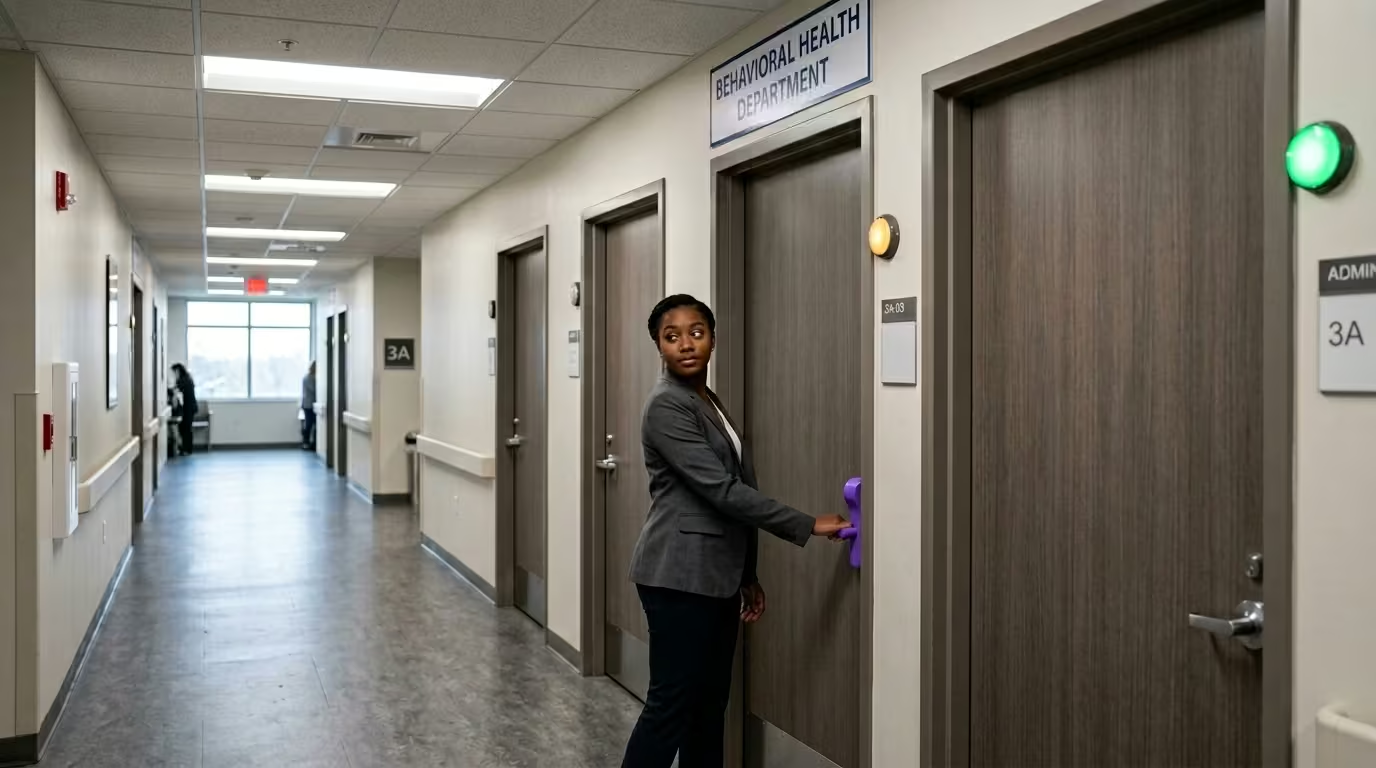

Peer CHRO Safety Insights: 3 Workforce Dimensions Ranked

CHRO peer turnover benchmarking: healthcare leader at unlit office door looking toward green-lit peer door in corridor

Key Takeaways

  • Leading behavioral health HR teams connect nurse duress data to retention dashboards, workers’ comp reviews, and union talks rather than leaving it in security’s system.
  • Most behavioral health organizations have safety systems producing data that HR never uses for workforce decisions, and the gap between leaders and the field is growing each quarter.
  • The pattern keeping most HR teams behind: treating deployment as a finished purchase rather than the start of ongoing workforce data connection.

Leading behavioral health CHROs have stopped treating nurse duress as a security purchase. They’ve moved safety data onto retention dashboards, into workers’ comp reviews, and onto the table during union talks. The real peer CHRO safety insights question is whether HR owns the data your system produces. This guide maps where peer HR teams actually stand across three workforce dimensions so you can find your spot on the curve.

How Peer CHROs Frame Nurse Duress: Safety Insights for Workforce Strategy

A growing group of CHROs now treats nurse duress as a workforce strategy tool, not a line item in security’s budget. The reason: 60% of nurses have changed jobs, left, or considered leaving because of workplace violence [1].

When the majority of your nursing workforce factors violence into whether they stay, the problem belongs to whoever owns retention. That’s you. The CHROs pulling ahead claimed that data stream and connected it to the workforce decisions they make each quarter.

Three Workforce Dimensions That Matter

Peer CHROs who lead on safety focus on three specific dimensions. Each one connects safety technology to an HR-owned metric.

DimensionWhat Leaders DoWhat It Produces
1. Retention DashboardsConnect safety incident data to turnover dashboards and exit interview themesVisibility into which departures are violence-driven and which units need help
2. Workers’ Comp ManagementCross-reference duress response times with injury claims each quarterA cost-reduction pattern that gives HR leverage in CFO budget talks
3. Labor RelationsReference safety technology outcomes during union talks and contract negotiationsEvidence that shifts grievance discussions toward partnership

On retention, organizations where HR connected safety data saw intent-to-leave over safety concerns drop from 22% to 7% [2]. That’s the kind of shift that shows up in your next engagement survey.

On workers’ comp, peer organizations report 24% to 50% reductions in claims after connection [2]. Each trauma-related workers’ comp claim averages $68,231 [3]. When HR connects response data to claims reviews, the pattern between faster response and fewer claims becomes visible.

Between 2022 and 2024, 43% of newly negotiated RN contracts in behavioral health included workplace violence prevention language [4]. CHROs who bring deployment outcome data to the table shift the conversation from grievance to shared progress.

See how one behavioral health provider documented these results across their facilities.

Where Most HR Teams Actually Stand

Survey data suggests the field breaks into four groups.

Integration LevelWhat It Looks LikeEstimated Share
LeadersSafety data connected to retention dashboards, workers’ comp, and labor relationsA small share of behavioral health organizations
AdvancingConnected on 1-2 dimensions, piloting on othersA growing share
TrackingIncidents tracked centrally, but HR doesn’t use the data for workforce decisionsRoughly half of behavioral health organizations
Not StartedSafety remains entirely a security or facilities functionA significant share of hospital CHROs report this

Most organizations land in “Tracking.” That’s common, and it’s where most of your peers are too. It means the data exists but hasn’t been connected to the workforce systems you already run.

What separates the leaders? Organizations at the top tier report staff satisfaction climbing measurably within a single quarter after connection [2]. Meanwhile, 59% of hospitals have a formal retention strategy, but few connect those strategies to safety data [5]. The retention program and the safety program run on parallel tracks. Leaders merged them.

Want to see how your HR team's integration compares to peer organizations? A behavioral health safety specialist can walk through the dimensions with you.

Contact Us

The Pattern Keeping HR Teams Behind

The sticking point is how organizations categorize the purchase after deployment. When safety technology gets treated as a completed project, the data it produces stays in security’s system. HR sees a summary report at best. The incident details, response times, and resolution metrics that would change workforce decisions never reach your dashboards.

This matters more than most CHROs realize. 81% of workplace violence incidents go unreported [6]. The data security captures is already incomplete. Without HR connection, the picture gets even thinner. You can’t build a retention strategy around data you can’t see.

Three structural barriers keep most HR teams from claiming safety data:

  • Separate budget ownership between security and HR
  • Misaligned metrics between departments
  • Organizational habit of treating safety as someone else’s job

Each barrier is solvable. Solving them requires HR to claim the data directly.

Matching Your Peer CHRO Safety Insights to Action

Peer CHROs who moved to the leader tier followed a consistent sequence. Most started by forming an HR-security joint steering committee. That single step created shared ownership of the data.

From there, the path depends on where you stand today:

  • Not Started: Form an HR-security steering committee to establish shared data access
  • Tracking: Launch a shared dashboard pilot connecting safety data to your biggest gap dimension
  • Advancing: Link safety data to retention forecasting and include it in your next board report

Organizations that completed the full connection pathway report combined improvements: faster emergency response and measurable decreases in workers’ comp claims within the same period [2]. These results come from organizations that completed the full connection pathway; the outcomes reflect what’s possible when HR claims the data, rather than a guarantee for every deployment context.

You can assess your position in a single meeting. Check three things:

  1. Does safety incident data flow into your HR retention dashboards?
  2. Do your workers’ comp reviews include duress response metrics?
  3. Did your most recent union conversation reference your safety technology investment?

Peer CHROs who lead on these dimensions started with the same check. The difference is they claimed the data before someone else defined what it meant. Start with whichever question you answered “no” to first. That’s how most leading organizations began, and it’s where peer CHRO safety insights turn into action. An HR safety brief built for budget approval gives you the format to turn these dimensions into a funded ask.

PEER INSIGHTS

See How Your Integration Compares to Peers

Leading HR teams already connect safety data to retention, workers' comp, and labor relations. A behavioral health safety specialist can show you what the path from tracking to full connection looks like for your organization.

References

  1. National Nurses United. 2024 Workplace Violence Report. https://www.nationalnursesunited.org/sites/default/files/nnu/documents/0224_Workplace_Violence_Report.pdf

  2. ROAR for Good. Internal Deployment Data, 2024.
  3. National Safety Council. Workers’ Compensation Costs. https://injuryfacts.nsc.org/work/costs/workers-compensation-costs/
  4. National Nurses United. 2024 Workplace Violence Report (contract analysis). https://www.nationalnursesunited.org/sites/default/files/nnu/documents/0224_Workplace_Violence_Report.pdf

  5. NSI Nursing Solutions. 2025 National Health Care Retention & RN Staffing Report. https://www.nsinursingsolutions.com/documents/library/nsi_national_health_care_retention_report.pdf
  6. AHRQ PSNet. Addressing Workplace Violence and Creating a Safer Workplace. https://psnet.ahrq.gov/perspective/addressing-workplace-violence-and-creating-safer-workplace

Peer CFO Safety Insights: 3 Indicators That Reveal Cost Gaps

CFO adding peer benchmarking turnover data to behavioral health administration bulletin board

Key Takeaways

  • Most behavioral health CFOs track workers’ comp, agency spend, and unit turnover separately. Peer organizations pulling ahead connect all three to workplace violence as one cost driver.
  • The gap between top-performing and lagging behavioral health facilities on violence-linked costs is large enough to reshape a budget cycle, and most CFOs can’t see where they fall.
  • You can score your facility this quarter using three numbers from reports already on your desk, with no new data requests needed.

If you compared your workers’ comp claims trajectory, your violence-driven agency spend, and your high-acuity unit turnover against peer behavioral health CFOs, would you land in the top quartile or the bottom half?

Most CFOs can’t answer that. These peer CFO safety insights reveal that three indicators separate the organizations controlling these costs from those absorbing them quietly. The numbers are already on your desk. You just need to read them differently.

Peer CFO Safety Insights Start with Exposure

Behavioral health facilities face violence at roughly 14 times the rate of general hospitals [1]. That gap in exposure is why a growing share of behavioral health CFOs now track violence-linked financial indicators as standard practice. They’re pulling numbers from reports they already receive and reading them through a different lens: from “we know violence is a problem” to “we track its financial footprint every quarter.”

Most organizations haven’t made that shift yet, and that’s common across the field. The majority of hospitals still lack a formal retention strategy that connects retention data to violence-specific cost drivers [2]. That disconnect is where the measurement gap begins.

Three Indicators Top-Quartile CFOs Track

Three financial metrics separate prepared organizations from reactive ones. Each lives somewhere in your monthly reports. The difference is whether you connect them.

Indicator 1: Workers’ comp claims trajectory. The direction and speed of change matters more than the current total. Peer behavioral health organizations that addressed the root cause documented claims reductions of 24-50% [3]. If your claims are flat or rising while peers show that kind of decline, the gap is costing you in premiums.

Indicator 2: Agency spend tied to violence-driven vacancies. Travel nurses cost roughly 68% more per hour than staff nurses [2]. That premium compounds fast when departures trace back to violence on high-acuity units. The indicator that matters is the share of agency spend driven by positions that opened after a violence-related departure.

Indicator 3: Unit-level turnover on high-acuity floors. Facility-wide averages hide the floors where violence exposure concentrates. Each percentage point of RN turnover costs the average hospital about $289,000 per year [2]. When your highest-acuity psychiatric unit runs well above the facility average, that variance represents real dollars buried in a blended number.

The pattern across leading facilities: they review all three together, connected to the same root cause.

Where Most Facilities Actually Fall

Peer behavioral health organizations cluster into distinct performance tiers across these three indicators.

TierClaims TrajectoryAgency Spend (% of Clinical Labor)Unit-Level RN Turnover (High-Acuity)
Leaders (Top Quartile)Declining 20-50% year-over-year8-12%15-20%
Above AverageDeclining modestly12-20%20-25%
AverageFlat or rising slightly20-28%25-35%
Below AverageRising >10% year-over-year28-35%+35-45%+

The financial distance between tiers is significant. Peer organizations in the leader tier report MOD score improvements visible within six months [3]. That timeline matters because it’s fast enough to affect your next insurance renewal cycle.

If your facility lands in the average or below-average tier, you’re in the majority. Most behavioral health organizations are earlier on this curve than they expected. The question isn’t whether you’re behind. It’s whether you can see the gap clearly enough to close it.

See how one behavioral health provider documented these results across their facilities.

What Keeps CFOs in the Bottom Half

Two organizational patterns keep most CFOs from moving up the distribution, even when they have the underlying data.

Data silos. Your workers’ comp summary goes to Risk Management. Agency invoices go to the staffing office. Turnover data goes to HR. The three reports never land on the same desk connected to the same root cause:

  • Workers’ comp claims classified as general workplace injury
  • Agency invoices coded to unit staffing budgets
  • Turnover reports rolled into facility-wide HR metrics

And the data feeding those reports is already incomplete: 81% of workplace violence incidents go unreported [4]. You can’t track what you can’t see.

Misattribution. Violence-driven costs get classified as general turnover, general workers’ comp, or general agency spend. The violence connection disappears into broad categories. That breaks the chain between an event on the floor and a line item in your budget.

Organizations that break through these patterns share a common trait: they link incident data to financial outcomes so all three indicators show up in the same report.

Want to see how your three indicators compare to peer organizations? A behavioral health safety specialist can walk through the benchmarks with you.

Contact Us

Scoring Your Facility This Quarter

You don’t need new data. You need three numbers from reports already on your desk.

  1. Workers’ comp claims for the past four quarters (from your Risk Management quarterly summary). Chart the trajectory. Is it flat, rising, or declining? Compare against the 20-50% decline that leader-tier peers achieve.
  2. Agency spend as a percentage of clinical labor cost, isolated to your behavioral health units (from staffing invoices + labor cost report). Compare against the 8-12% leader range.
  3. Unit-level RN turnover for your highest-acuity inpatient psychiatric floor (from HR unit-level turnover report, separate from facility average). Compare against the 15-20% leader range.

Start with the indicator where your number sits furthest from the leader range. That’s where peer CFOs are focusing first, and it’s where the return shows up fastest. You don’t need to fix everything this quarter. One gap closed with connected measurement shifts the trajectory on all three. These peer CFO safety insights give you the same starting point the top quartile used. A one-pager that aligns your C-suite turns the scoring exercise into a funded next step.

PEER INSIGHTS

See Where Your Facility Falls Among Peers

A short benchmarking conversation can show you how your three indicators compare to organizations that have already closed the gap. No new data requests needed.

References

  1. Sheps Center, University of North Carolina. Workplace Violence in Healthcare, 2021-2022. https://www.shepscenter.unc.edu/wp-content/uploads/2025/01/Y10.01_Brief-1.pdf
  2. NSI Nursing Solutions. 2025 National Health Care Retention & RN Staffing Report. https://www.nsinursingsolutions.com/documents/library/nsi_national_health_care_retention_report.pdf
  3. ROAR for Good. Internal Deployment Data, 2024.
  4. AHRQ PSNet. Addressing Workplace Violence and Creating a Safer Workplace. https://psnet.ahrq.gov/perspective/addressing-workplace-violence-and-creating-safer-workplace

Peer CEO Safety Insights: Behavioral Health Adoption

Nurse turnover cost shown through vacant behavioral health workstation with accumulated mail and purple inbox tray

Key Takeaways

  • The behavioral health field has split into three adoption tiers for nurse duress infrastructure, and most CEOs can’t tell their board which tier their organization occupies
  • Early movers are already presenting measurable workforce stability gains to their boards, creating a competitive distance that grows every quarter
  • Three indicators reveal where your organization stands relative to peers: documented response protocols, silent alerting capability, and whether your board has received a formal safety investment briefing

If you polled ten behavioral health CEOs on where their organization stands on nurse duress adoption, most would guess. The field has moved further than it looks from where you sit. Roughly a third of behavioral health organizations have already deployed. Another third is in active evaluation. The rest are still discussing. These peer CEO safety insights matter because the competitive distance between those groups grows every quarter. The financial exposure behind that distance is bigger than most CEOs realize.

The Adoption Curve Most CEOs Can’t See

Psychiatric and substance abuse hospitals report 110.4 violent incidents per 10,000 workers, the highest rate of any healthcare setting [1]. That number explains why the adoption curve has accelerated. Based on available data, behavioral health organizations generally fall into three groups:

TierCharacteristics
Early MoversDeployed duress infrastructure 12+ months ago; reporting workforce outcomes to boards; using safety data in recruitment
Active EvaluatorsIn formal evaluation or pilot phase; triggered by regulatory shifts or board questions; 6-12 months from a deployment decision
Discussion PhaseAware of the issue but no formal evaluation underway; relying on training-only approaches; falling further behind each quarter

Note: These tiers are constructed from deployment data, regulatory timelines, and retention benchmarking. No single published survey tracks adoption rates across the full field.

“If you polled ten behavioral health CEOs on where their organization stands on nurse duress adoption, most would guess.”

That’s part of the problem. Most CEOs lack visibility into where peers actually stand.

What Triggered Peers to Act

Early movers responded to a pattern of converging pressures arriving in the same quarter:

  1. Regulatory momentum. ANA, ENA, and ACEP jointly called on Congress to pass workplace violence prevention legislation, signaling that professional organizations now treat violence as a workforce sustainability crisis [2]. States are following with panic button mandates and compliance deadlines.
  2. Financial exposure from accreditation risk. Joint Commission accreditation loss risks suspension of Medicare and Medicaid funding worth $2 to $5 million annually [3]. That number gets a board’s attention faster than incident reports.
  3. Workforce data. Across 116,345 nurses from 67 hospitals, those experiencing high workplace violence were five times more likely to leave their positions [4]. Peer CEOs recognized that violence was the single largest controllable driver of nursing turnover.

When all three pressures landed in the same quarter, discussion became deployment. The three organizational conditions that predict success are what separated the ones that succeeded from the ones that stalled.

Workforce Outcomes Early Movers Report

The organizations that moved first are now 12 to 18 months into documenting results. At one behavioral health facility that deployed purpose-built duress infrastructure, the share of employees considering leaving due to safety concerns dropped from 22% to 7% within 90 days. Staff assaults fell 40% within six months [5].

Each percentage point of RN turnover costs the average hospital an additional $289,000 per year [6]. A shift of 15 points in intent-to-leave translates into retention savings your CFO can validate against your own staffing data. The executive safety guide walks through how to direct your team to quantify that number.

If your organization hasn’t seen numbers like these yet, that’s common across the field. The difference is timing, not capability. See how one provider achieved these results.

Where Waiting Organizations Lose Ground

The peer organizations that deployed are pulling ahead on three fronts simultaneously. Think of it like compound interest working in reverse: the longer you wait, the more it costs across every line item.

  • Recruitment takes longer. The average time to fill a registered nurse vacancy is 83 days [6]. Every nurse who leaves over safety concerns creates a gap that takes nearly three months to close. When competitors deploy visible safety infrastructure, candidates notice.
  • Agency costs keep climbing. Travel nurses cost roughly 70% more per hour than staff nurses [6]. Peer organizations that acted are shrinking this line item. Organizations that haven’t are still paying the premium.
  • Accreditation readiness weakens. Joint Commission standards now emphasize organizational accountability for violence prevention. Surveyors assess whether you’ve identified violence hazards and put evidence-based strategies in place. Without documented infrastructure, your next survey conversation gets harder.

Early movers gain workforce stability, which reduces agency spend, which strengthens accreditation readiness. Each quarter of delay reverses that sequence. Your CFO will want a plan for translating early deployment signals into board-ready proof before lagging metrics confirm the return.

Talk to us about where your organization sits on the adoption curve and what the next step looks like.

Contact Us

Peer CEO Safety Insights: Locating Your Organization

Three indicators reveal where your organization sits relative to peers. The pattern across leading facilities is that they answered these questions before they deployed.

IndicatorWhat “Yes” MeansWhat “No” Means
Your organization has a documented duress response protocol beyond de-escalation trainingYou have a foundation in place. You’re likely an Active Evaluator or Early Mover.You’re in the Discussion Phase. Peer organizations that deployed started here.
Frontline staff can silently summon help from every area of every facility, including stairwells and units with poor WiFiYou have technology infrastructure deployed. You’re likely an Early Mover.You’re relying on verbal calls or overhead pages, the approach peer organizations are replacing.
Your board received a formal staff safety investment briefing in the past 12 monthsYour board is engaged and expects updates. You’re positioned to move forward.Your board may not know this is a strategic issue. Early movers report that board engagement accelerated everything else.

Organizations like yours are choosing to assess where they stand now, while the adoption curve is still moving. The ones reporting the strongest outcomes started with the same three questions above. They answered honestly, identified their tier, and directed their executive teams to close the distance. A three-question pitch framework structures that board conversation into the format governance committees approve.

You now have the map most behavioral health CEOs don’t. You know where the field has moved, what pushed early movers to act, and what they’re reporting to their boards. Most peer organizations that moved started with one honest conversation at the board level. That’s how it tends to begin.

PEER INSIGHTS

Know Where You Stand Before the Field Moves On

Most organizations that reported the strongest workforce outcomes started with one honest assessment of their current tier. We help leadership teams map where they are and build a path forward that fits their board's timeline.

References

  1. UNC Sheps Center for Health Services Research. Workplace Violence in Healthcare Brief, 2025. https://www.shepscenter.unc.edu/wp-content/uploads/2025/01/Y10.01_Brief-1.pdf
  2. American Nurses Association, Emergency Nurses Association, and American College of Emergency Physicians. ANA, ENA & ACEP Sound the Alarm on Violence Against Nurses, 2024. https://www.nursingworld.org/news/news-releases/2024/ana-ena–acep-sound-the-alarm-on-violence-against-nurses/
  3. Facilio. Healthcare Joint Commission Compliance. https://facilio.ae/blog/healthcare-joint-commission-compliance/
  4. PMC. Workplace Violence and Nurse Turnover Intent, 2024. https://pmc.ncbi.nlm.nih.gov/articles/PMC12811911/
  5. ROAR for Good. Internal Data, 2024.
  6. NSI Nursing Solutions. 2025 National Health Care Retention & RN Staffing Report. https://www.nsinursingsolutions.com/documents/library/nsi_national_health_care_retention_report.pdf

Peer CNO Safety Insights: Where You Stand on Adoption

Nurse turnover cost conference agenda abandoned on table with active behavioral health unit visible through glass wall

Key Takeaways

  • Only one in three nurses feels safe at work, and behavioral health organizations are splitting into those acting on nurse duress and those still talking about it
  • Peer organizations that deployed duress systems with CNO-led sponsorship and frontline nurse input saw violent incidents drop sharply within one quarter
  • The CNOs pulling ahead share one trait: they matched their next move to their current adoption stage instead of waiting for perfect conditions

Your organization falls somewhere on the nurse duress adoption spectrum. So does every behavioral health system competing for the same nurses you’re trying to keep. The gap between organizations acting on peer CNO safety insights and those still discussing them is widening each quarter. Where you stand relative to peers shapes more than safety outcomes. It shapes which nurses stay and which ones leave. The full financial picture of nurse duress and turnover shows what that gap costs per quarter.

Where Behavioral Health Organizations Stand Today

The field is moving faster than most CNOs realize. Three forces are converging at once.

Only 33% of nurses report feeling safe at work [1]. Most behavioral health organizations are earlier on this spectrum than they expected. That number isn’t unique to your facility. It’s the baseline across the industry.

“81% of workplace violence incidents go unreported. If your incident data looks manageable, it probably reflects reporting gaps rather than actual safety.”

In behavioral health, the exposure is sharper. Mental health workers face assaults at four times the rate of healthcare workers overall [2]. The regulatory pressure is tightening alongside it. Joint Commission standards effective July 2024 now require accredited hospitals to maintain a violence prevention program led by a designated leader and supported by a team from across departments. State panic button mandates are adding compliance deadlines.

And the workforce reality compounds both. Organizations that haven’t addressed the safety gap are losing nurses to facilities that have. Nurses talk to each other about where they feel safe. That word-of-mouth shapes your applicant pool more than any job posting. The emotional toll on CNOs who carry this gap compounds with every incident report.

What Peer CNO Safety Insights Reveal About Early Adopters

The organizations seeing results share operational patterns, not just technology budgets. Three traits show up consistently:

TraitWhat It Means in Practice
CNO-led sponsorshipThe CNO owned it personally. Strong leadership commitment to violence prevention reduced the odds of violence on hospital units by roughly 68% [2].
Frontline nurse involvement before go-liveStaff who helped select and shape the approach used it consistently. That’s the difference between adoption and abandonment.
Defined response protocols before deploymentThe fastest alert means nothing if nobody knows what happens next. Who responds, in what order, within what timeframe. Leaders built that protocol first.

The results speak in peer terms. Organizations with these traits in place saw violent incidents drop 39% within the first three months and 40% within six months [3]. See how one provider achieved these results.

The Gap Between Intending and Acting

Most organizations have nurse duress on a committee agenda and nowhere else. That’s common. It’s also where the gap compounds.

Think of it like a slow leak in a basement. You don’t see the damage until the foundation shifts. 60% of nurses have changed jobs, left, or considered leaving because of workplace violence [4]. In behavioral health, where your units replace more than a third of their nursing staff every year, each departure hits harder and takes longer to recover from.

Here’s what peer organizations that acted are reporting:

  • Intent-to-leave among staff dropped from 22% to 7% after deployment [3]
  • Staff safety perception improved measurably within months
  • Vacancy pressure eased as fewer departures meant fewer positions to fill

That shift showed up within months, not years. Every quarter your organization discusses without deploying, peer facilities widen the gap. Building your unit-level turnover cost gives you the number worth knowing before your next budget conversation. The number is worth knowing before your next budget conversation.

Talk to us about how your organization's safety response compares to peer facilities at your adoption stage.

Contact Us

Three Patterns That Keep Organizations Stuck

If your organization has been in the planning stage for more than two quarters, one of these patterns likely applies.

  1. Waiting for perfect conditions. The budget isn’t finalized. The committee hasn’t met. Leadership wants more data. Meanwhile, peers move forward with imperfect information and adjust as they go. Waiting is the most expensive pattern because it costs 12 to 18 months of preventable turnover.
  2. Past technology failures creating skepticism. Your nurses may have already tried a system that didn’t work. Behavioral health staff have described previous safety technology as ineffective due to poor design and disconnect from the realities of patient care [5]. That skepticism is earned. The difference is whether frontline nurses had a voice in the selection.
  3. Underreporting that hides the true scope. 81% of workplace violence incidents go unreported [6]. If your incident data looks manageable, it probably reflects reporting gaps rather than actual safety.

The organizations that broke through these patterns share one thing: they stopped waiting for the problem to fully reveal itself and started building the response. The three organizational conditions that predict success are what separated the ones that broke through from the ones that stalled.

Matching Your Next Move to Your Stage

The adoption spectrum has four positions. Each one has a specific next step. The pattern across leading facilities is clear: they picked the move that matched where they were, not where they wished they were.

Your Current StageWhat Defines ItYour Next Move
Pre-planningNo formal discussion of nurse duress technologyPull unit-level incident counts for the past 90 days. That number starts the conversation.
PlanningSafety committee has discussed it, no timelineGet frontline nurse input on what they actually want. Identify one high-acuity unit for a pilot.
PilotingSingle-unit pilot underwayDefine the response protocol before expanding. Who responds, in what order, within what timeframe.
DeployedActive system across facilitiesBenchmark your outcomes against peers. Peer deployments show sub-2-minute average response times [3] and measurably improved staff confidence in handling safety concerns.

Organizations in the deployed tier are already using their safety data as a recruitment tool. Employer brand scores and staff review sentiment improve after safety rollouts, giving those facilities an edge in a market where every experienced nurse has options.

The CNOs pulling ahead match their next move to where they are right now. Wherever your organization sits on this spectrum, these peer CNO safety insights point the same direction: one stage forward changes the trajectory for your nurses, your units, and the experienced staff you can’t afford to lose. A nursing safety brief built for CFO approval gives you the format to turn your stage-matched next move into a funded ask.

You don’t need to solve everything this quarter. The peer organizations gaining ground started with a single unit and a clear protocol. That’s how most of them began.

PEER INSIGHTS

See Where You Stand Among Peer Organizations

The organizations pulling ahead started with a benchmarking conversation, not a commitment. We can walk through your response times, incident patterns, and staff perception data to show where you fall on the adoption spectrum.

References

  1. AONL Workplace Violence Symposium White Paper. https://www.aonl.org/system/files/media/file/2025/02/WorkplaceViolenceSymposiumWhitePaper.pdf
  2. CDC. Workplace Violence Prevention in the Mental Health Setting. https://stacks.cdc.gov/view/cdc/181386
  3. ROAR for Good. Internal Data, 2024. Internal data
  4. National Nurses United. 2024 Workplace Violence Report. https://www.nationalnursesunited.org/sites/default/files/nnu/documents/0224_Workplace_Violence_Report.pdf
  5. PMC. Rehabilitation Professionals’ Perspectives and Experiences with Violence Prevention Technology. https://pmc.ncbi.nlm.nih.gov/articles/PMC10464386/
  6. AHRQ PSNet. Addressing Workplace Violence and Creating Safer Workplace. https://psnet.ahrq.gov/perspective/addressing-workplace-violence-and-creating-safer-workplace

Peer CHRO Safety Insights: Retention Benchmarks

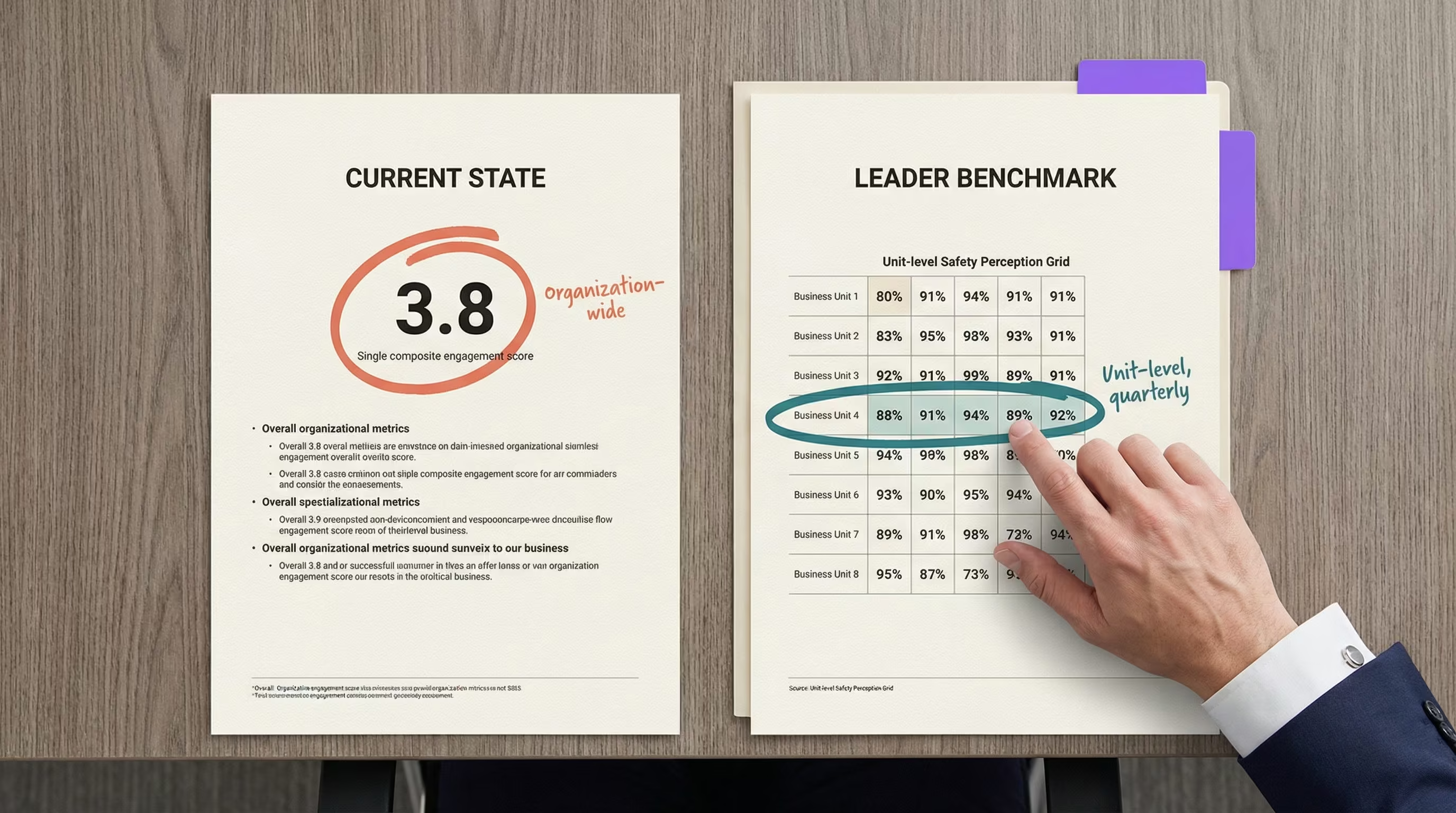
CHRO safety perception benchmark — two printed summaries showing composite lagging score vs unit-level leader benchmark side by side

Key Takeaways

  • Leading CHROs measure safety perception at the unit level quarterly, while most programs still rely on annual engagement composites that mask the units in crisis
  • The gap between leaders and most programs comes down to whether perception data is connected to intent-to-stay, turning it from a culture metric into a workforce planning tool
  • Peer organizations that acted on perception data saw measurable retention improvements within 90 days of establishing baselines

Every CHRO in behavioral health knows safety concerns drive turnover. The difference between the CHROs who keep losing staff and those who’ve stabilized their hardest units isn’t awareness of the problem. It’s what they measure and when they measure it.

This piece shows what peer CHRO safety insights reveal about how leading behavioral health organizations track safety perception differently, and where most programs fall short. For the full research behind why perception predicts retention, see the complete guide to staff safety in psychiatric hospitals.

What Peer CHRO Safety Insights Reveal About Measurement

The operational gap between leading programs and most behavioral health HR operations shows up across four dimensions. In each case, the difference isn’t budget or technology. It’s measurement precision and speed.

Measurement level: unit vs. composite. Most CHROs review safety perception as part of a facility-wide engagement score. Leaders pull safety-specific items and score them by unit. The difference matters because a facility might report 72% positive safety perception overall while one behavioral health unit sits at 41%. That unit is a retention emergency, invisible in the composite. How to build this measurement framework covers the specific instruments and delegation structure.

Measurement frequency: quarterly vs. annual. Most programs measure safety culture once a year through their engagement survey. Leaders run quarterly pulses on safety perception specifically, capturing directional trends that predict retention shifts 90 days out. Annual measurement can only confirm what already happened. Quarterly measurement surfaces what’s about to happen.

Data connection: standalone vs. correlated. Most programs treat safety perception as a standalone culture metric. Leaders connect perception scores to intent-to-stay data at the unit level, which turns safety perception into a workforce planning tool their CFO can act on. The facilities that made this connection recorded intent-to-leave dropping from 22% to 7% [1].

Onboarding attention: ignored vs. tracked. Most programs wait for the annual survey to capture new hires’ safety perception. Leaders measure perception during the first 90 days of onboarding, because a new nurse’s sense of whether the organization takes safety seriously forms fast and is remarkably durable once set. The CHROs ahead of the curve treat that onboarding window as the highest-leverage moment for perception formation.

Where Leaders and Most Programs Compare

DimensionMost ProgramsLeading Programs
Measurement levelFacility-wide or organization-wide compositeUnit-level, scored separately from engagement
Measurement frequencyAnnual (buried in engagement survey)Quarterly safety-specific pulse + annual full assessment
Retention connectionSafety perception and turnover tracked separatelyPerception scores correlated with intent-to-stay by unit
Onboarding perceptionFirst captured at annual surveyMeasured within first 90 days
Action on dataSurvey results reviewed and filedUnit-level declines trigger CSO coordination and charge nurse coaching
Financial framingSafety positioned as a wellness benefitSafety framed as workforce planning investment with per-point ROI

The financial framing matters for the CFO conversation. Each percentage point of nursing turnover costs roughly $289,000 annually [2]. Leaders don’t present safety perception as a culture initiative. They present it as the leading indicator that explains why their next quarter’s turnover moved, with the full retention data to back it up.

“The CHROs pulling ahead aren’t measuring turnover more carefully. They’re measuring something upstream: the safety perception shift that predicts turnover months before a resignation letter arrives.”

Ready to see where your program stands against peer benchmarks?

Contact Us

Assessing Where Your Program Stands

Run through this self-check against the leader benchmarks above. Be honest about where your program sits today.

  • Can you pull unit-level safety perception scores right now, or would you have to dig through a composite engagement survey?
  • Do your safety perception scores connect to intent-to-stay data, or are they standalone metrics?
  • When was the last time a unit-level perception decline triggered a specific intervention (not a policy review, but a visible action staff could see)?
  • Do new hires on behavioral health units get a safety perception check within their first 90 days, or do they wait for the annual survey?
  • Can you tell your CFO the annualized cost of turnover on your highest-risk unit in a single number?

If more than two answers point to the “most programs” column, that’s the gap. The HR brief on safety perception metrics provides the specific data points to start closing it.

One finding worth flagging: facilities that run safety culture surveys without visibly acting on results see declining response rates and worsening scores [3]. Measurement without visible follow-through is counterproductive. The programs achieving leader-level results pair measurement with action staff can see. Peer CNOs tracking unit-level data describe the same pattern from the clinical side.

Pull your safety-specific items from your engagement survey and score them by unit. That single step, done this week, tells you whether you’re operating as a leader or running the same measurement approach as everyone else. The CHROs who stabilized their behavioral health units started with that one data pull. Within 90 days, they had the peer CHRO safety insights that changed the retention conversation entirely.

PEER BENCHMARKS

See How Your Safety Perception Program Compares

Leading behavioral health CHROs are using perception measurement as a workforce planning tool. Find out where your program stands.

References

  1. ROAR for Good. Internal data, 2024. Internal data
  2. NSI Nursing Solutions. 2025 NSI National Health Care Retention & RN Staffing Report. https://www.nsinursingsolutions.com/documents/library/nsi_national_health_care_retention_report.pdf
  3. AHRQ PSNet. Culture of Safety. https://psnet.ahrq.gov/primer/culture-safety

Peer CNO Safety Insights: Unit-Level Metrics

Peer CNO safety insights: executive in glass office unable to hear distressed nurses in hallway

Key Takeaways

  • Leading CNOs measure safety perception at the unit level quarterly, while most programs rely on facility-wide composites that hide the units in crisis
  • The peer gap shows up in four dimensions: measurement level, frequency, retention connection, and whether charge nurses receive explicit safety communication coaching
  • Self-assessment against peer benchmarks reveals whether your units are operating with leading indicators or reacting to turnover after it happens

The CNOs retaining behavioral health nurses while peers lose them at 22.8% annually aren’t working with different staff or lower-acuity patients. They’re working with different data. Specifically, they’re measuring something at the unit level that most programs only capture in annual facility-wide composites, if they capture it at all.

This piece shows what peer CNO safety insights reveal about how leading programs track perception differently from the clinical side. For the full research behind why perception predicts retention, see the complete guide to staff safety in psychiatric hospitals.

What Peer CNO Safety Insights Reveal About Unit-Level Measurement

The gap between leading CNOs and most behavioral health nursing programs shows up across four dimensions. In each case, the difference is operational, not budgetary.

Measurement level: unit vs. facility. Most CNOs receive safety perception data as a facility-wide composite from their annual engagement survey. Leaders score safety-specific items by unit. The difference matters because a facility might report acceptable safety perception overall while one behavioral health unit has collapsed. That unit is a staffing emergency you can’t see in the composite. The unit-level perception guide covers how to build this measurement step by step.

Measurement frequency: quarterly vs. annual. Most programs measure safety culture once a year. Leaders run quarterly pulses on their behavioral health units specifically, using short validated instruments that take under 10 minutes per nurse. Annual measurement can only confirm what already happened. Quarterly measurement surfaces what’s about to happen, giving you a 90-day window to intervene before turnover shows up.

Charge nurse coaching: explicit vs. assumed. Most programs expect charge nurses to communicate safety commitment without specific language or coaching. Leaders provide explicit talking points for shift handoff, post-incident follow-up, and rounding. Leadership quality accounts for about 34% of the variation in whether nurses stay or leave [1], and charge nurses are the frontline of that leadership on every shift. CNOs using perception data for staffing decisions describe charge nurse coaching as the intervention with the shortest distance between action and measurable perception shift.

Response visibility: documented vs. uncertain. Most programs can’t tell you how quickly help arrives when staff call for it on a specific unit, or whether the reporting nurse sees documented follow-up. Leaders work with their CSO to verify timestamped response data and ensure follow-up is visible. When 81% of violence incidents go unreported [2], the reason is usually that staff decided reporting changes nothing. Visible follow-up breaks that cycle. The nursing safety brief on perception data provides the specific talking points for that CSO conversation.

Where Leading CNOs and Most Programs Compare

DimensionMost ProgramsLeading Programs
Measurement levelFacility-wide composite from engagement surveyUnit-level safety perception scored separately
Measurement frequencyAnnualQuarterly safety-specific pulse + annual full assessment
Charge nurse coachingGeneral expectation to “communicate safety”Explicit language for shift handoff, post-incident, and rounding
Response time verificationRelies on estimates or anecdotal reportsTimestamped data verified with CSO by unit
Retention connectionSafety perception and turnover tracked separatelyPerception scores correlated with intent-to-stay by unit
Action on declining scoresReviewed at next annual planning cycleUnit-level declines trigger immediate investigation and intervention

Facilities that have made the connection between perception and retention recorded intent-to-leave dropping from 22% to 7% [3]. The full evidence set behind these outcomes shows what happens when perception becomes an operational priority at the unit level.

“The CNOs retaining behavioral health nurses while peers lose them aren’t working with different staff or lower-acuity patients. They’re working with different data.”

Want to see what unit-level perception measurement looks like in practice?

Contact Us

Assessing Where Your Units Stand

Run through this self-check against the peer benchmarks above.

  • Can you produce unit-level safety perception scores for each behavioral health unit, or only a facility composite?
  • When was the last time a perception decline on a specific unit triggered a visible intervention your staff could see?
  • Do your charge nurses have explicit safety commitment language for shift handoff, or is communication left to individual discretion?
  • Can you verify actual response times on your highest-acuity unit with timestamped data from your CSO?
  • Do your nurses know what changed as a result of the last safety survey they completed?

If more than two answers point to the “most programs” column, that’s the gap. The CHRO measurement framework covers the corporate infrastructure needed to support what you build at the unit level.

One pattern worth flagging: facilities that run safety surveys without visibly acting on results see declining response rates and worsening scores [2]. Measurement without visible follow-through teaches staff that surveys are performative. The programs achieving leader-level results pair every measurement cycle with action staff can see.

See how one behavioral health provider documented these results across their facilities.

The charge nurse who says “it wasn’t that bad” during rounding isn’t describing the incident. She’s describing her expectation that reporting won’t change anything. The CNOs closing that gap are the ones retaining nurses others lose. Start with one unit, one validated pulse survey, and one 90-day measurement cycle. That’s how the peer CNO safety insights separating top programs from the 22.8% average begin.

PEER BENCHMARKS

See How Your Unit-Level Safety Data Compares

Leading behavioral health CNOs are using perception measurement to retain nurses others lose.

References

  1. PMC. Leadership Quality and Nurse Retention. https://pmc.ncbi.nlm.nih.gov/articles/PMC10806563/
  2. AHRQ PSNet. Culture of Safety. https://psnet.ahrq.gov/primer/culture-safety
  3. ROAR for Good. Internal data, 2024. Internal data

Peer CSO Safety Insights: WiFi-Free Duress Systems

Peer CSO safety insights shown as security director reviewing complete facility coverage map with purple routes

Key Takeaways

  • Security directors at peer behavioral health facilities stopped trying to extend WiFi into dead zones and shifted to safety systems that don’t depend on facility networks at all.
  • The peer conversation changed after high-profile infrastructure failures proved that WiFi-dependent duress systems fail at the exact moment facilities are most chaotic.
  • Facilities that made the switch are reporting consistent coverage in every zone, resilience during outages, and a measurable edge in staff recruitment and retention.

Peer CSO safety insights from behavioral health facilities with the same infrastructure challenges keep pointing to one conclusion: the problem security directors solved wasn’t WiFi quality. It was WiFi dependency.

The security leaders who moved first didn’t wait for a perfect network. They stopped asking their technology staff to fix coverage in parking garages and stairwells, and started evaluating systems that bypass facility WiFi entirely.

The Day the Infrastructure Question Got Answered

On July 19, 2024, a defective software update crashed millions of Windows systems worldwide, disrupting healthcare delivery across at least a dozen major U.S. hospital systems [1]. Electronic health records went down. Monitoring platforms went dark. Staff across multiple facilities hit blue error screens at the same time [2].

For security directors whose duress systems ran on that same network infrastructure, the outage proved what many had suspected: WiFi-dependent safety technology fails at the exact moment a facility is most chaotic.

That event accelerated a conversation that was already building. Psychiatric aides face workplace violence at roughly 39 times the national average [3]. The incidents concentrate in parking structures, stairwells, and outdoor transition areas, the same locations where WiFi signals degrade or disappear [4]. Peer security directors had been tracking that overlap for years. The outage shifted the conversation from “we should look at this eventually” to “we can’t justify not acting on it.”

Within months, the security directors who moved first were sharing results with peers at regional conferences and industry roundtables. The message was consistent: once you stop treating dead zones as a WiFi problem and start treating them as an architecture decision, the path forward gets simple.

What Peer Security Directors Stopped Doing

The shift wasn’t about finding better WiFi. It was about removing WiFi from the equation.

Security directors at peer facilities describe a common cycle: months spent coordinating with technology staff to extend network coverage to parking garages and outdoor areas, only to discover the new equipment still couldn’t hold a reliable signal through two floors of poured concrete. Buildings constructed decades ago with dense materials produce dead zones that no amount of network funding fixes [4].

What peers stopped doing versus what they started doing:

What peers stoppedWhat peers started
Requesting WiFi extensions to parking structures and outdoor areasEvaluating safety systems that run on their own dedicated network
Waiting for technology staff to solve coverage gapsDeploying battery-powered systems that require no wiring and no network changes
Accepting vendor coverage claims based on lab conditionsRequiring site-specific verification with doors in locked position
Treating dead zones as an IT problemReframing dead zones as a solvable design problem

That last row is the core of the shift. The parking garage isn’t uncovered because your technology team failed. It’s uncovered because the system you chose depends on infrastructure that can’t reach it.

See how one behavioral health provider documented these results across their facilities.

What Peer CSO Safety Insights Reveal After the Switch

The facilities that deployed WiFi-independent systems are reporting three things consistently.

  • Coverage that holds during outages. During a four-hour power outage at one facility, the safety system stayed live on battery backup with six to eight hours of reserve while WiFi went dark [5]. For security directors who had been managing around known gaps, that was the proof point that mattered most: the system worked when everything else didn’t.
  • Staff who actually carry and use devices. When coverage reaches every zone, staff behavior changes. Devices stop getting left in lockers. Reporting rates go up. Violence prevention committees stop hearing “what’s the point if it doesn’t work in the parking lot.”
  • A recruitment edge. This is the piece that surprised peer security directors. Nurses at competing facilities are asking during interviews whether the duress system works in the parking garage at shift change [6]. That level of specificity tells you what candidates have experienced at previous employers, or heard from colleagues who left. Facilities with visible, verified safety coverage are using it as a retention and recruitment tool in a market where staffing is already stretched thin.

The retention angle feeds back into everything else. Facilities with lower turnover have more experienced staff, better incident documentation, and stronger evidence packages when surveyors arrive. The safety investment pays forward in ways that don’t show up on the original budget request.

Worth noting: these outcomes come from early adopters. Facilities with unusual layouts, multi-level parking structures, or long outdoor corridors between buildings may see different timelines. But the direction is consistent across every peer deployment reported so far.

If your facility still runs WiFi-dependent safety systems, we can show you what peers switched to and why.

Contact Us

Where This Leaves Your Program

Joint Commission workplace violence prevention standards took effect in July 2024 for behavioral health settings [7], and surveyors are increasingly asking for coverage proof in parking structures and outdoor areas. Security directors at peer facilities aren’t just meeting that standard. They’re documenting performance data that goes beyond what surveyors require.

The gap between early movers and everyone else is widening. Peer facilities that switched to WiFi-independent systems are now in their second year of documented performance data. They have:

  • Before-and-after incident comparisons
  • Coverage verification records for every zone
  • Response time metrics broken out by facility area

Facilities still running WiFi-dependent systems will be starting from scratch.

Peer facilities are documenting outcomes, winning staffing battles, and passing surveys with evidence packages that leave nothing for assessors to question.

Your facility’s dead zones, the parking structure, the stairwell between units, the outdoor courtyard, don’t have to stay that way. Peer CSO safety insights point to one consistent conclusion: the architecture to close those gaps exists, and the facilities that adopted it are already documenting the results.

STAFF SAFETY

Your Peers Already Made the Switch

Security directors at peer facilities deployed WiFi-independent safety systems and are documenting the results. See what that looks like for your facility.

References

  1. ABC News. https://abcnews.com/Health/12-major-hospitals-health-systems-affected-global-outage/story?id=112103722
  2. PubMed Central. https://pmc.ncbi.nlm.nih.gov/articles/PMC12276631/
  3. Bureau of Labor Statistics. https://www.bls.gov/iif/factsheets/workplace-violence-2021-2022.htm
  4. The Fast Mode. https://www.thefastmode.com/expert-opinion/34308-reliable-wireless-service-in-hospitals-needs-and-challenges
  5. ROAR for Good – Internal Data, 2024.
  6. KLAS Research. https://engage.klasresearch.com/blog/leveraging-technology-to-keep-healthcare-workers-safe/5919/
  7. Joint Commission. https://www.jointcommission.org/en-us/knowledge-library/newsletters/joint-commission-online/17-jul-24

Peer CTO Panic Button Insights: Evaluation Criteria

CTO verifying panic button signal coverage in hospital stairwell with signal meter

Key Takeaways

  • Technology leaders at behavioral health facilities are shifting their evaluations from feature comparisons to infrastructure independence, driven by the overlap between dead zones and incident locations.
  • The peer benchmark for approval is documented evidence from comparable deployments, not vendor targets or portfolio-wide averages.
  • Behavioral health facilities with limited technology staff are choosing architecture that deploys in days and runs independently, because evaluation cycles that stall for months never reach deployment.

Your coverage map looks great on paper. Then you pull up the incident data and realize assaults cluster in the exact spots where WiFi drops: stairwells, parking lots, the walkway between buildings.

That is the gap peer CTOs at behavioral health facilities keep running into. And it is why peer CTOs have landed on a consistent approach to evaluating WiFi-independent safety systems.

Why the Coverage Map Stopped Being Enough

The infrastructure behind this shift is straightforward. Healthcare facility age metrics have risen from 8.6 years in 1994 to over 11 years by 2015, with many buildings past the point where infrastructure works reliably [1].

These buildings were built for durability and patient safety. Wireless signals were never part of the design. WiFi coverage maps rarely align with incident location data.

Government-sector mental health workers experience the highest rate of nonfatal workplace violence at 77.1 incidents per 1,000 workers [2]. Those incidents concentrate where WiFi coverage fails: stairwells, parking lots, outdoor transition areas, and older wings with dense construction materials [3].

“The moment that changes the conversation is the overlay. Pull up heat maps of where assaults occur, then lay WiFi signal strength over the same corridors and stairwells. The gaps line up almost perfectly.”

The moment that changes the conversation is the overlay. Pull up heat maps of where assaults occur, then lay WiFi signal strength over the same corridors and stairwells. The gaps line up almost perfectly. That single visualization moves the evaluation from “we should look into this” to “we need to solve this.”

What Peer Evaluations Focus On (And What They Skip)

Technology leaders at top-performing facilities follow a consistent evaluation approach. They test five specific claims against documented evidence.

What peers prioritize:

  • Outage records over uptime targets. Peers ask vendors for uptime records from facilities like theirs, not portfolio-wide averages that can mask poor performance at individual sites. The distinction between “targets 99.9%” and “documents 99.9%” is where peer evaluations separate from typical vendor evaluations.
  • Site walkthroughs over coverage diagrams. Peers require signal testing with metal-reinforced doors closed and locked, not propped open during a demo walkthrough. Marketing diagrams do not substitute for someone walking the grounds with a signal meter.
  • Current certifications over compliance roadmaps. Peers require current HITRUST r2 and SOC 2 Type II, independently verifiable. “In progress” is not a certification [4][5].
  • System integration over feature counts. Peers check whether alert data flows to their existing incident management and nurse call systems [6]. A long feature list means nothing if the system cannot connect to the tools your clinical and security teams already use.
  • Comparable facility data over general case studies. Peers ask for site survey results from facilities with similar construction materials, building age, and campus layout to theirs.

For the full evaluation framework covering all five categories with specific evidence requests, see the bluetooth panic button guide. For a step-by-step process to run the evaluation internally, see the CTO evaluation checklist.

What peers stopped doing is equally telling. They stopped asking “what features does it have?” and started asking “can you prove it works in a building like mine?”

The Walkthrough That Changes the Conversation

Peer CTOs describe a consistent pattern when they physically test coverage claims.

The transition zone between a building’s main entrance and the parking structure is often 40 to 60 feet of no coverage under WiFi-dependent systems. Peers who walked this zone with a signal tester found the gap was larger than any vendor diagram suggested.

BLE mesh architecture addresses this differently. Battery-powered beacons placed through the transition zone, parking structure, and outdoor walkways provide coverage without any WiFi dependency. Verified deployments confirm 100% facility coverage through site surveys with room-level accuracy [7].

The power outage test is the other proof point peers cite consistently. During a four-hour power outage at one facility, WiFi access points went down. The BLE mesh kept operating with up to eight hours of battery life [7]. Peers describe that moment as when the architecture difference became real.

See how one behavioral health provider documented these results across their facilities.

Beacon placement eliminates the transition zone vulnerability. But coverage still requires a physical site survey under realistic conditions. Peers who skipped the walkthrough and relied on vendor diagrams regretted it.

Peer CTOs started with one step: overlaying incident data onto their coverage map. See what that analysis reveals for your facility.

Contact Us

How Peers With Stretched Technology Staff Made the Decision

Behavioral health facilities typically run technology operations with 15 to 25 staff, compared to 50 to 100 or more in comparable acute care settings [1]. That number shapes every technology decision.

Peers in this position describe the same calculus: a system that requires months of network planning and ongoing technical maintenance will stall in evaluation indefinitely. Their teams are already stretched. The deciding factor was deployment speed and maintenance burden.

What peers at comparable facilities report from their deployments:

  • Time to value under six months from initial assessment to full operation [7]
  • Zero disruption to patient care during setup [7]
  • No wiring, no network configuration, no additional infrastructure burden on clinical systems
  • Battery-powered beacons with multi-year life, eliminating ongoing maintenance cycles
  • Deployment measured in days of beacon placement, not months of network planning

Results will vary based on facility size, building materials, and how many legacy systems your team already supports. But the peer pattern is clear: leaders chose architecture that could be operational before their next board meeting.

Peer CTOs at top-performing behavioral health facilities share a common approach: they focus on infrastructure independence over vendor promises, require documented performance data over projected targets, and validate coverage through site walkthroughs rather than marketing materials.

PEER INSIGHTS

Ready to See How Your Coverage Compares?

ROAR's behavioral health technology specialists work with CTOs at facilities like yours. For technology leaders evaluating WiFi-independent architecture, we provide site assessments that document coverage gaps before deployment.

References

  1. Henderson Engineers. Healthcare’s Aging Infrastructure Problem. https://www.hendersonengineers.com/insight_article/healthcares-aging-infrastructure-problem/
  2. American Psychiatric Association. Resource Document: Prevention of Patient Assaults. https://www.psychiatry.org/getattachment/b0a01574-03fb-4d11-a4e5-4429ad8f5bcb/Resource-Document-Prevention-of-Patient-Assaults.pdf
  3. KFF Health News. Dead Zone: Rural Hospitals’ Outdated Internet. https://kffhealthnews.org/news/article/dead-zone-rural-hospitals-outdated-internet-disconnect-care-disparities/
  4. Vanta. HITRUST and SOC 2. https://www.vanta.com/collection/hitrust/hitrust-and-soc-2
  5. CensiNet. SOC 2 vs HITRUST: Choosing the Right Certification. https://censinet.com/perspectives/soc-2-vs-hitrust-choosing-the-right-certification
  6. Enter Health. Enhancing Healthcare Integration: REST APIs. https://www.enter.health/post/enhancing-healthcare-integration-rest-apis-speed-scalability-security
  7. ROAR for Good. Internal Data, 2024.

Peer CNO Safety Insights: Survey-Ready Evidence Systems

Peer CNO safety insights revealing incident reports disappearing through wall slot to nowhere

Key Takeaways

  • Peer CNOs who pass surveys confidently can show what happens after staff report an incident, not just that staff reported.
  • The shift from episodic preparation to continuous evidence generation is the common thread among nursing leaders whose teams demonstrate capability on demand.
  • Knowing where your investigation follow-through stands against peer benchmarks tells you exactly where to focus before your next survey.

Nearly half of nurses say workplace violence incidents are simply ignored after being reported. [1] Surveyors know this pattern. When they pull a random incident from your logs and ask to see the investigation trail, the answer reveals whether your program is actively managed or just actively documented. Peer CNO safety insights from facilities passing surveys confidently point to the same differentiator: it’s not whether your team reports incidents. It’s whether you can show what happened next.

How Peer CNOs Prepare Differently

Nursing leaders at survey-ready facilities have made a common shift. They’ve moved from preparing for surveys as a periodic event to building systems that generate evidence continuously. The difference shows up in how their teams handle the everyday moments that surveyors eventually ask about.

Investigation follow-through. When surveyors pull a random incident, peer CNOs can show the full trail: initial report, investigation notes, corrective actions, resolution, and communication back to the reporting staff member. Most facilities have the initial report. The trail goes cold after that.

“Most facilities have the initial report. The trail goes cold after that.”

Staff readiness across shifts. Surveyors interview nurses on nights and weekends deliberately. [3] Peer CNOs prepare all shifts equally by embedding safety discussions into shift huddles and post-incident debriefs, building current awareness rather than relying on annual training recall. [5]

Evidence speed. Survey-ready CNOs produce 90 days of incident data by unit within minutes. At-risk facilities spend hours compiling scattered records from multiple systems. When a surveyor is standing in your facility, that time gap defines the conversation.

Reporting culture. Only about a third of nurses say their employer gives them a clear way to report incidents. [1] Peer CNOs have addressed this by removing reporting barriers through automated capture. When reporting becomes effortless, the data starts reflecting reality rather than a fraction of it.

The Peer Benchmark

Where does your nursing program stand against peer CNOs preparing for the same surveys?

AreaSurvey-Ready ProgramsMost Programs
Investigation follow-throughEvery incident has documented findings and corrective actionsReports filed, investigation sporadic or missing
Evidence production90 days of data by unit in under 5 minutesHours of manual compilation from scattered systems
Staff interviewsNurses demonstrate protocols confidently across all shiftsDay shift strong, night shift vague
Response capabilityDocumented response times with historical trendingAnecdotal estimates
Reporting completenessAutomated capture reflecting actual incident volumeManual logs capturing a fraction of events

Facilities with documented safety systems show 93% of incidents resolved in under 2 minutes. [2] That benchmark matters because surveyors have seen it at other facilities. When your data shows longer times or doesn’t exist, the comparison works against you.

81% of workplace violence incidents go unreported. [4] Peer CNOs don’t treat this as an abstract problem. They treat it as a gap that automated capture can close, so their numbers actually reflect what’s happening on the units.

If you want to see where your investigation follow-through stands against peer benchmarks, we can walk you through it.

Contact Us

What Survey Confidence Looks Like for Nursing Leaders

Peer CNOs who describe survey experiences as confident rather than stressful share a pattern: their teams interact with safety systems daily, so describing protocols to a surveyor feels natural.

In facilities with documented safety systems, the share of staff who feel “very prepared” to respond to incidents nearly doubled after deployment. [2] Staff who’ve practiced response protocols show the kind of knowledge surveyors recognize immediately. Staff who attended annual training and haven’t touched the system since show vague recollection. The difference becomes obvious within 30 seconds of a surveyor conversation.

Facilities with documented safety technology have passed every Joint Commission and OSHA inspection in tracked deployments. [2] But the outcome peer CNOs emphasize isn’t the pass rate. It’s that their charge nurses can walk a surveyor through the response protocol, pull up response time data, and show investigation follow-through without needing to call anyone or check a binder.

See how one behavioral health provider documented these results across their facilities.

Your Readiness Self-Check

Before your next survey window, test yourself against peer benchmarks:

  • Investigation trail test. Pull 5 random incidents from the past 90 days. Does each have documented investigation findings, corrective actions, and communication back to the reporting staff?
  • Evidence speed test. Can you produce 90 days of incident data by unit within 5 minutes? If it takes a phone call to get started, that’s your answer.
  • Night shift readiness. Ask 3 nurses from different shifts to demonstrate the duress response protocol. Do their answers align?
  • Reporting reality check. Does your incident count reflect what your night shift nurses would describe in a confidential conversation, or does it look artificially low?
  • Post-incident process. When staff report an incident, do they know what happens next? If they believe reports disappear into a void, your reporting culture has a gap surveyors will find.

Start with the investigation trail test. Pull those 5 incidents. What you find will tell you exactly where your program stands relative to peer CNO safety insights, and where to focus before surveyors arrive.

PEER BENCHMARKS

See How Your Nursing Program Compares

Peer CNOs produce 90 days of incident data by unit in minutes. See what survey-ready evidence systems look like for nursing leadership.

References

  1. National Nurses United. Workplace Violence Report 2024. https://www.nationalnursesunited.org/sites/default/files/nnu/documents/0224_Workplace_Violence_Report.pdf

  2. ROAR for Good. Internal Data, 2024.
  3. Joint Commission. Workplace Violence Prevention Program. https://www.jointcommission.org/en-us/knowledge-library/workforce-safety-and-well-being-resource-center/workplace-violence-prevention/workplace-violence-prevention-program
  4. Agency for Healthcare Research and Quality (AHRQ) PSNet. Addressing Workplace Violence and Creating a Safer Workplace. 2023. https://psnet.ahrq.gov/perspective/addressing-workplace-violence-and-creating-safer-workplace
  5. Vizient. Workplace Violence Prevention: Supporting Inpatient Behavioral Health Bedside Staff. https://www.vizientinc.com/insights/blogs/2024/workplace-violence-prevention-supporting-inpatient-behavioral-health-bedside-staff

Peer CSO Safety Insights: Survey-Ready Documentation

Surveyor interviewing nurse in hospital hallway during accreditation evaluation

Key Takeaways

  • Peer security directors who pass surveys confidently share one trait: they can produce evidence on demand rather than compiling it under pressure.
  • The gap between leaders and everyone else comes down to whether evidence generates continuously or gets assembled manually before the surveyor arrives.
  • Knowing where you stand relative to peer benchmarks is the first step toward closing that gap.

When a surveyor asks for your response time trending data, how long does it take you to produce it? Peer security directors at leading behavioral health facilities answer in seconds. They pull up a dashboard, show incidents by unit and shift, and move on. Others spend 45 minutes compiling data from multiple systems while the surveyor waits. That gap in evidence speed is the clearest peer CSO safety insights benchmark, and it predicts survey outcomes more reliably than policy completeness.

How Peer CSOs Prepare Differently

The security directors who pass surveys confidently haven’t built better policies. They’ve built better systems for generating and keeping records. The difference shows up in four areas:

“The security directors who pass surveys confidently haven’t built better policies. They’ve built better systems for generating and keeping records.”

Evidence availability. Leaders produce any record a surveyor requests within minutes. Their systems generate response time logs, incident trending, and coverage verification as a byproduct of daily operations. They’re not preparing for the survey. They’re exporting what already exists.

Investigation completeness. When surveyors pull a random incident and trace the follow-up, leaders can show the full trail: initial report, investigation notes, corrective actions, resolution. Nearly half of nurses say incidents are simply ignored after being reported. [3] Leaders have closed that gap. Average programs haven’t.

Coverage verification. Surveyors test duress activation in unexpected locations: stairwells, parking structures, loading docks. Leaders can show documented coverage across the full facility including outdoor areas. [4] Most security directors feel confident about their main units. The parking structure at shift change is where the hesitation starts.

Staff readiness across shifts. Surveyors interview staff on nights and weekends deliberately. [2] Leaders prepare all shifts equally. Average programs focus on day shift and hope for the best.

The Peer Benchmark

Where do you stand against peer security directors preparing for the same surveys?

Evidence AreaLeading ProgramsMost Programs
Response time dataAvailable in seconds, historical trending on dashboard45+ minutes to compile, or unavailable
Incident investigationFull trail for every logged incidentInitial reports without follow-up
Coverage verificationDocumented across full facility including outdoor areasAssumed coverage, gaps unknown
System reliabilityDocumented uptime records“It seems to work”
Governance reportingExportable audit logs, monthly review documentedInconsistent committee minutes

Facilities with documented safety systems show 93% of incidents resolved in under 2 minutes. [4] That’s the benchmark surveyors compare your program against. They’ve seen it at other facilities in your region. When your data shows longer times or doesn’t exist at all, the conversation shifts.

81% of workplace violence incidents go unreported. [1] Leaders address this by making reporting automatic. Average programs acknowledge the problem and leave the manual process in place.

If you want to see where your evidence capability stands against peer benchmarks, we can walk you through it.

Contact Us

What Separates Confident Surveys from Anxious Ones

Peer CSOs who describe their survey experience as confident rather than stressful share a common thread: the evidence was already there. They didn’t prepare for the survey. They showed what their systems had been generating all along.

Facilities with documented safety technology have passed every Joint Commission and OSHA inspection in tracked deployments. [4] Staff who interact with these systems regularly report feeling significantly more prepared to respond to incidents. [4] That confidence carries into surveyor interviews. Staff who’ve seen the system work can describe it naturally. Staff who’ve never tested it stumble.

The body language alone tells the story. A security director who opens a dashboard is having a different conversation than one who’s flipping through binders.

See how one behavioral health provider documented these results across their facilities.

Your Readiness Self-Check

Before your next survey window, test yourself against peer benchmarks:

  • Evidence speed test. Can you produce 12-month incident trending by unit in under 5 minutes? If it takes a phone call to your technology team, that’s your answer.
  • Investigation completeness. Pull 5 random incidents from the past year. Does each have documented investigation follow-up with findings and corrective actions?
  • Coverage walkthrough. Walk your facility’s outdoor areas, parking structures, and stairwells. Can staff activate duress from every location?
  • Night shift readiness. Ask 3 night shift staff to describe the response protocol. Do their answers match what day shift would say?
  • Governance proof. Can you show exportable records proving leadership reviewed trends monthly? Not slides. Actual minutes with documented discussion.

You don’t need to match every peer benchmark by next month. Start by knowing where you stand. Pull your response time data for the past 90 days. That number tells you what to work on first. The peer CSO safety insights that matter most are the ones that show you where your gaps are before a surveyor finds them.

PEER BENCHMARKS

See How Your Evidence Capability Compares

Leading security directors produce survey evidence in seconds. See what peer-level readiness looks like with documented safety systems.

References

  1. Agency for Healthcare Research and Quality (AHRQ) PSNet. Addressing Workplace Violence and Creating a Safer Workplace. 2023. https://psnet.ahrq.gov/perspective/addressing-workplace-violence-and-creating-safer-workplace
  2. Joint Commission. Workplace Violence Prevention Program. https://www.jointcommission.org/en-us/knowledge-library/workforce-safety-and-well-being-resource-center/workplace-violence-prevention/workplace-violence-prevention-program
  3. National Nurses United. High and Rising Rates of Workplace Violence. February 2024. https://www.nationalnursesunited.org/sites/default/files/nnu/documents/0224_Workplace_Violence_Report.pdf

  4. ROAR for Good. Internal Data, 2024.

Peer CEO Safety Insights: Survey Preparation Benchmarks

Peer CEO survey readiness benchmark showing prepared executives versus empty seat

Key Takeaways

  • Peer behavioral health CEOs who pass accreditation surveys consistently can produce documented evidence of their violence prevention program on demand, not just policy binders.
  • The gap between organizations that pass with confidence and those that scramble comes down to whether evidence generates continuously or gets compiled under pressure.
  • A five-item readiness self-check helps CEOs benchmark their preparation against peers before their next survey window.

Your board chair calls four months before the Joint Commission survey window opens. The question is simple: can you prove your violence prevention program works? Peer CEO safety insights from behavioral health organizations that consistently pass point to the same thing: it comes down to what evidence you can produce when someone asks.

The CEO Accountability Shift

Behavioral health CEOs used to delegate survey preparation to compliance teams and check the box before the visit. That approach worked when surveyors mainly reviewed policy binders in conference rooms.

The stakes have changed. Accreditation loss can suspend Medicare and Medicaid billing immediately, and for behavioral health systems that depend on those revenue streams, that threatens the organization’s survival [1]. OSHA penalties for willful workplace violence violations now exceed $165,000 per violation [2]. Peer CEOs who’ve absorbed these realities treat survey readiness as a board-level priority, not something that lives in an operations report.

The shift is straightforward: boards now ask CEOs to demonstrate that safety investments produce measurable outcomes. Peer CEOs who can pull response time data, incident trends, and audit logs on demand have a fundamentally different board conversation than those who point to policies and training sign-in sheets.

How Peer CEOs Prepare Differently

Evidence availability. Leading programs have safety systems that create the documentation surveyors need, automatically. When a surveyor requests incident trending data, peer CEOs produce it within minutes. Most programs start compiling manually, a process that can take days when surveyors are already on-site [3].

Governance reporting. Peer CEOs present safety data to their boards quarterly, treating violence prevention metrics the same way they treat financial performance or patient satisfaction. Most programs report safety metrics reactively, usually only when an incident forces the conversation.

Delegation clarity. Peer CEOs maintain named accountability for every survey deliverable: who owns what, by when, with specific timelines. Most programs assume someone owns each piece without confirming it. Survey readiness breaks down the moment everyone assumes someone else has a deliverable covered.

Implementation approach. Leading programs deploy safety technology that requires no hospital network dependency and minimal operational disruption. Peer behavioral health systems with 8-15 facilities achieve enterprise deployment within 4-6 months while maintaining normal operations [4]. Most programs approach technology implementation as a multi-year capital project.

The Peer Benchmark

The clearest difference between peer-leading programs and average ones shows up in how fast evidence reaches a surveyor’s hands.

Evidence AreaPeer-Leading ProgramsMost Programs
Incident trend analysisAutomated dashboard exportable in minutesManual compilation requiring days
Response time documentation93% resolved under 2 minutes, system-documented [4]Anecdotal estimates with no supporting data
Continuous monitoring proofExportable audit logs covering 90+ daysSnapshots from the last audit prep
Staff awareness recordsVerified training completion above 95%Incomplete training records with gaps
Investigation follow-throughDocumented root cause, corrective action, and outcome for each incidentInitial report filed, follow-up trail goes cold

See how one behavioral health provider documented these results across their facilities.

“The organizations that pass surveys with confidence aren’t better at preparing. They’re better at generating evidence continuously so preparation becomes unnecessary.”

Peer CEO safety insights point to one consistent pattern: the organizations that pass surveys with confidence aren’t better at preparing. They’re better at generating evidence continuously so preparation becomes unnecessary.

Board-Ready Preparation

Peer CEOs who present safety investment with confidence at the board level frame it through three lenses:

  • Risk mitigation. Accreditation protection is the language boards understand. A single serious incident that triggers regulatory citations, litigation, and potential accreditation loss threatens revenue streams worth millions annually [1]. Safety technology is insurance against that cascade.
  • Regulatory alignment. Documented safety systems check the boxes surveyors care about: continuous monitoring, incident tracking, and leadership accountability [5]. Peer CEOs present technology as something that reduces citation risk, not as equipment.
  • Workforce stability. Staff who feel protected stay longer. Each percentage point change in RN turnover costs the average hospital roughly $289,000 annually [6]. Organizations with documented safety systems report measurable improvement in “I feel safe at work” sentiment [4], and that connection between safety investment and retention resonates with boards watching staffing costs climb.

When a board member asks whether the organization is ready for the next survey, peer CEOs answer with documented outcomes. That conversation is fundamentally different from reassuring the board that policies are in place.

Want to see how your organization compares to peer benchmarks for survey readiness?

Request a Demo

Your Readiness Self-Check

Before your next survey window, test yourself against peer benchmarks:

  • Pull your incident trending data for the past 90 days. Does it take minutes or days to produce?
  • Ask your CNO whether night-shift staff can articulate violence prevention protocols without checking a reference card.
  • Review the last 5 incident investigations. Does each one show documented root cause analysis, corrective action, and outcome, or does the trail stop at the initial report?
  • Check whether your board has received quarterly safety metrics in the past 12 months, with trend data showing program impact.
  • Verify that your delegation framework names specific owners for every survey deliverable, with timelines attached.

If more than one of those gave you pause, you’ve identified the gaps a surveyor would find.

Start with the 90-day data pull. That single number, how long it takes to produce incident trending data on demand, tells you more about your survey readiness than any policy review. Peer CEO safety insights from leaders who’ve been through this come down to one thing: fix the evidence speed first, and the rest follows.

SURVEY READINESS

Benchmark Your Survey Preparation Against Peer CEOs

Organizations with documented safety systems pass Joint Commission surveys with confidence. See what peer-level evidence looks like at your facility.

References

  1. Facilio. “Healthcare CMMS for Joint Commission Compliance in 2025.” August 5, 2025. https://facilio.ae/blog/healthcare-joint-commission-compliance/
  2. Safety + Health Magazine. “OSHA and MSHA Civil Penalty Amounts Going Up.” January 9, 2025. https://www.safetyandhealthmagazine.com/articles/26317-osha-and-msha-civil-penalty-amounts-going-up
  3. Barrins & Associates. “Evidence Production Timelines in Healthcare Accreditation.” https://www.barrinsandassociates.com/
  4. ROAR for Good. “Internal Data.” 2024.
  5. The Joint Commission. “R3 Report 42: Workplace Violence Prevention in Behavioral Health Care and Human Services.” https://www.jointcommission.org/en-us/standards/r3-report/r3-report-42/
  6. NSI Nursing Solutions, Inc. “2025 National Health Care Retention & RN Staffing Report.” March 2025. https://www.nsinursingsolutions.com/documents/library/nsi_national_health_care_retention_report.pdf