
Nursing Safety Confidence: What CNOs Miss on Units

Charge nurse confidently entering behavioral health unit night shift showing nursing safety confidence transformation

Key Takeaways

  • Behavioral health CNOs carry a specific guilt: you’ve invested in training and staffing, and nurses still get hurt. Research confirms this weight is a proven pattern, not a personal failing.
  • Staff nursing safety confidence shifts when response becomes visible and fast, not when violence drops to zero. That changes the standard you should hold yourself to.
  • Three indicators on your highest-acuity unit can tell you whether nurses feel protected or whether they’ve quietly stopped believing help will come.

The guilt you feel every morning when you open that incident report has a clinical name. It lives in the gap between what you owe your nurses and what your current tools let you deliver. Another incident on the acute unit. Another nurse who waited too long for help. You’ve invested in training, adjusted staffing, rewritten protocols. And every morning, the same weight: this still falls short. Building nursing safety confidence starts with naming that burden honestly.

The Weight Only CNOs Carry

Psychiatric and substance abuse hospitals see 110.4 incidents per 10,000 workers, the highest rate of any healthcare setting [1]. You see it in the incident reports, in the charge nurse’s tired eyes during morning huddle, in the name of the experienced nurse who transferred out last month.

Research suggests that 47% of psychiatric nursing leaders report symptoms consistent with moral injury tied to moments where they could not prevent staff injuries they felt responsible for [2]. That means the weight you carry is the gap between what you believe you owe your nurses and what you can actually deliver with the tools you have.

“Staff who had been quietly planning to leave stopped planning. The CNO could feel it on the units before any dashboard confirmed it.”

No one should face violence while trying to help others heal. That truth sits with you at every morning huddle. The financial weight behind it compounds with every departure.

Why Training Alone Leaves Doubt

De-escalation training is valuable. You invested in it because it works. But it works on a specific slice of the problem. Research indicates that 78% of remaining violent incidents happen after de-escalation has already been tried [3].

That’s the gap your charge nurses feel but struggle to name. They know the techniques. They trust the techniques. What they lack is confidence in what happens when the techniques fail and they’re waiting for someone to show up.

Nearly 45% of nurses say their employers simply ignore reported violence after it’s been documented [4]. Nurses report. Nothing visible changes. Your promise of protection starts to feel hollow, even to you.

The distinction matters:

  • Skill confidence is whether nurses trust their training. De-escalation builds this.
  • Safety confidence is whether nurses believe help will come when training isn’t enough. Training alone cannot build this. Peer CNOs tracking adoption across behavioral health are finding that the organizations pulling ahead addressed this gap first.

What Changes When Response Becomes Visible

Here’s what peer CNOs discovered that changed the equation. Safety perception scores jump 34 to 41 points when response time drops below 90 seconds, independent of whether violence rates change [5]. The shift happens because nurses stop wondering whether help will come. They know it will.

Peer deployments show sub-2-minute average response times [6]. That speed sits well below the 90-second threshold where perception shifts. Nurses who have never pressed the button still report feeling safer. The knowledge that the system works, confirmed by watching a colleague get help in seconds, changes how they experience every shift. The three organizational conditions that make this kind of response infrastructure work are visible before you spend a dollar.

If this resonates with what you're carrying, talk to us about what peer CNOs did to close the gap between promise and protection.

Contact Us

Peer CNOs Who Stopped Carrying the Weight Alone

The earliest proof a peer CNO pointed to: staff who said they’d consider leaving due to safety concerns dropped from 22% to 7% [6].

That shift happened within weeks. Before the CFO’s quarterly numbers moved. Before assault rates showed a trend line. Staff who had been quietly planning to leave stopped planning. The CNO could feel it on the units before any dashboard confirmed it.

A charge nurse at one of these facilities told her CNO three weeks after deployment: “I don’t dread the night shift anymore.” That sentence carries more weight than any metric. It means the promise of protection became something nurses could feel. Translating that feeling into numbers means building your unit’s true turnover cost so the CFO sees what you see.

Three Indicators That Reveal Nursing Safety Confidence

The guilt you carry every morning can become something different: clarity about exactly where your nurses need you. Three indicators on your highest-acuity unit reveal whether your nurses feel protected.

IndicatorWhat It RevealsWhat Peer Facilities See
Silent alerting awarenessWhether nurses know how to call for help without escalating the situationUnits with high staff awareness of duress systems report 52% higher confidence [5]
Response speedWhether help arrives fast enough to change perceptionPeer facilities document 93% of incidents resolved in under two minutes [6]
Leadership follow-throughWhether nurses believe you act on what they reportUnits where CNOs conduct safety debriefs within 24 hours see 71% staff agreement that leadership responds, compared to 31% without [5]

Where those indicators fall short on your unit, you now know what to change. A nursing safety brief built for CFO approval gives you the format to turn these indicators into a funded ask. See how one provider closed this gap.

Safety should be a promise, not just a priority. The guilt that follows you home from every incident report can become the nursing safety confidence that comes from knowing, finally, that you can deliver on what you owe your nurses.

PEACE OF MIND

Turn the Weight You Carry Into a Measurable Promise

CNOs at peer organizations moved from absorbing guilt alone to showing nurses exactly how fast help arrives. A short conversation can show you what that looks like for your team.

References

  1. Sheps Center, UNC. Workplace Violence in Healthcare Brief. https://www.shepscenter.unc.edu/wp-content/uploads/2025/01/Y10.01_Brief-1.pdf
  2. Journal of Healthcare Risk Management. Moral Injury in Psychiatric Nursing Leaders. https://www.jhrmjournal.org/
  3. American Journal of Psychiatry. De-escalation Training Outcomes in Psychiatric Settings. https://ajp.psychiatryonline.org/
  4. National Nurses United. 2024 Workplace Violence Report. https://www.nationalnursesunited.org/sites/default/files/nnu/documents/0224_Workplace_Violence_Report.pdf
  5. Safety Science. Safety Perception and Response Time in Healthcare Settings. https://www.sciencedirect.com/journal/safety-science
  6. ROAR for Good. Internal Data, 2024.

15 Nurse Duress and Turnover Cost Questions Answered

CTO tracing bluetooth panic button signal relay path across hospital floor plan on conference table

This FAQ answers the most common questions healthcare leaders ask about nurse turnover costs in behavioral health, the role workplace violence plays in driving those costs, and how nurse duress systems can break the cycle. Whether you lead finance, nursing, HR, or the entire organization, these answers give you the evidence to act.

What does it actually cost to replace one nurse in behavioral health?

Replacing one bedside RN costs $61,110 on average, but that figure is a floor in behavioral health. Longer vacancies, agency nurses billing at nearly double the staff rate, and an 8-to-12-week productivity ramp push the true cost past $100,000 per departure. Seventy-seven percent of psychiatric nursing positions sit vacant for more than 60 days, which means the actual replacement cost far exceeds the industry benchmark. The typical hospital lost $4.75 million to nurse turnover in 2024 alone.

Why is behavioral health turnover worse than other nursing specialties?

Behavioral health turnover runs at 22.8% or higher, matching or exceeding every other nursing specialty. The drivers are structural: lower wages, heavy documentation, limited career paths, and violence rates 5 to 20 times higher than general healthcare. That violence exposure is what separates behavioral health from every other specialty. Standard retention efforts fall short because they rarely address the root cause.

How does workplace violence cause nurses to leave?

Nurses facing high levels of workplace violence are five times more likely to plan to leave. Violence increases burnout, and even nurses who call it “part of the job” report fear and anxiety lasting days to months after an incident. Six in ten nurses have changed jobs, left, or considered leaving because of violence, regardless of what they are paid. Safety perception, not compensation, is the primary driver of departures in behavioral health.

What is the cascade effect, and why does it make turnover compound?

Each nurse departure degrades the safety environment for everyone who stays, raising the odds of the next departure. When a nurse leaves, agency staff who don’t know the patients fill the gap. Remaining staff absorb more risk, and violence increases as staffing drops. One resignation becomes two, then five, because understaffing creates the exact conditions that push more people out. Budget models treat each departure as independent, but the unit experiences them as a chain reaction.

What costs are most CFOs missing in their turnover calculations?

Most turnover models capture recruitment, agency fees, and orientation but skip the vacancy period, which accounts for 72% to 78% of total cost. Violence-driven departures are the second major blind spot because standard exit interviews bury safety concerns under “work environment.” A facility-specific calculation built from your own data across all five cost categories is far more defensible to a board than any industry average.

Why do exit interviews fail to capture the real reason nurses leave behavioral health?

Standard exit interviews categorize safety concerns under broad labels like “work environment,” hiding the violence-driven share inside a catch-all bucket. Departing staff frequently soften their answers on the way out, and 81% of incidents go unreported in the first place. Three methods using data HR already collects, such as correlating unit-level incident rates with departure timing, can isolate the violence-driven portion without new surveys. Until that share is visible as a separate line item, the cost model will undercount the most controllable category of departures.

What is a nurse duress system and how does it affect turnover?

A nurse duress system gives staff a way to summon help immediately and silently during a threatening situation. This cuts response time and reduces incident severity. At one behavioral health facility, staff considering leaving due to safety dropped from 22% to 7% after deployment, and violent incidents fell 39% in the first quarter. Each 1% reduction in RN turnover saves the average hospital $289,000 per year.

Why do I feel stuck between knowing we need to act on safety and being afraid the investment won’t work?

That fear is real and common among behavioral health leaders. The specific anxiety is that you will approve the spend, the numbers won’t move, and the board will see a failed initiative. Safety technology investments fail for predictable organizational reasons, not technical ones, and those reasons are visible before you spend anything. Three conditions predict success: visible executive sponsorship, frontline staff involvement in rollout design, and a defined response protocol before go-live.

Why does our retention strategy keep missing the safety gap even when exit data points to it?

Many behavioral health HR leaders carry a quiet frustration: exit interviews keep naming safety while the strategy keeps addressing pay and scheduling. Feeling safe at work predicts whether nurses stay, regardless of what they are paid. The CHRO who moves nurse duress from a security line item into the workforce strategy addresses the departures that every other retention lever misses. Leading peer CHROs have already connected safety data to retention dashboards, workers’ comp reviews, and labor relations.

How do I know if my organization is behind our peers on nurse duress?

The leading third of behavioral health organizations have already deployed nurse duress systems. The middle third is in active evaluation, and the rest are still in discussion. You can locate your position using three indicators: whether a defined response protocol exists, whether frontline staff can summon help silently, and whether the board has received a formal safety investment briefing from peer-benchmarked data. Organizations that deployed 12 to 18 months ago now report workforce stability gains that late movers cannot replicate quickly.

What are peer CFOs tracking that I might not be?

Top-quartile behavioral health CFOs track three indicators as connected rather than separate: workers’ comp claims trajectory, agency spend tied to violence-driven vacancies, and unit-level turnover on high-acuity floors. Most facilities fall in the bottom half because they report these numbers in separate dashboards and never link them. A CFO can score their facility against peer benchmarks this quarter using data already in monthly financial reports.

How long does it take to see financial results from a nurse duress investment?

Staff perception of safety shifts within weeks of deployment, but the financial metrics boards care about move on a longer timeline. Workers’ comp claims typically shift within two to three quarters. Turnover rate changes take two to four quarters, and three leading indicators, including response time and staff perception, reliably predict those outcomes within 90 days. Tracking early signals gives the CFO defensible data before the lagging metrics arrive.

How do I get the board to approve spending on nurse duress?

Behavioral health boards ask three predictable questions about safety spending, and preparing specific answers for each one speeds approval. The most effective approach frames nurse duress as a workforce economics decision with 90-day checkpoints. A phased pilot on one high-acuity unit clears approval faster than a full-facility capital request because it turns uncertainty into something the board can measure. Bring peer facility outcomes and a defined measurement timeline so the board has a decision framework.

What should I put on a one-page internal pitch for nurse duress investment?

Three data points form the simplest version of the case: the violence-driven share of your turnover, the workers’ comp trend line on high-acuity units, and the staff intent-to-stay shift you expect from peer outcomes. Tailor the emphasis to each audience: the CFO needs cost categories, the CEO needs board-readiness criteria, and the CNO needs unit-level evidence. A structured one-pager with a phased pilot request and 90-day checkpoints lowers the approval threshold for every stakeholder in the room.

As a CNO, how do I stop feeling personally responsible every time a nurse gets hurt?

That weight is real, and most behavioral health CNOs carry it alone. The guilt comes from reviewing incident reports each morning and knowing the current response system leaves nurses waiting too long for help. Peer CNOs who invested in duress response saw staff perception of safety improve within weeks, giving them personal evidence their action mattered before any financial metric moved. Three indicators separate organizations where CNOs carry that burden from those where they don’t: whether nurses can summon help silently, whether response arrives in under two minutes, and whether staff report feeling protected.

Workforce Turnover Safety: Full Cost Calculation

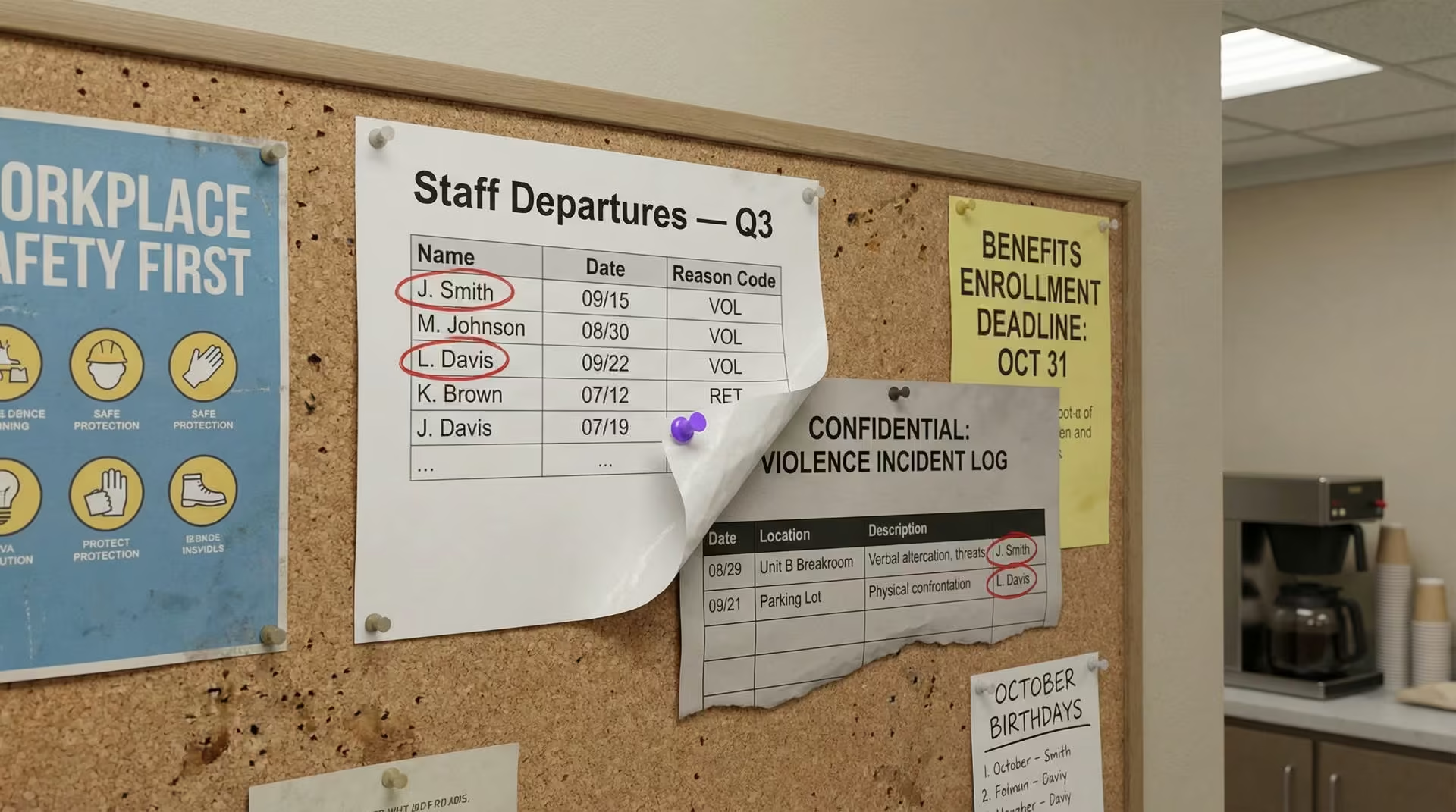
Corkboard departure summary peeled back revealing violence incident log with matching names

Key Takeaways

  • Most turnover calculations miss the violence-driven share entirely because standard exit interviews don’t isolate it, meaning your CFO’s model is built on incomplete data that only HR can fix
  • Three methods using data you already collect (exit interviews, engagement surveys, workers’ comp claims) can identify the violence-driven portion and turn it into a measurable line item
  • Facilities addressing violence-driven turnover have recorded intent-to-leave dropping from 22% to 7%, connecting safety investment directly to the retention metrics CHROs own

When your CFO asks what nurse turnover actually costs your behavioral health facility, what number do you give? If you’re citing the $61,110 industry benchmark, you’re understating the problem [1]. Behavioral health adds extended orientation, longer vacancies, and violence-driven departures that push the real cost significantly higher.

But the bigger issue isn’t the total. It’s what’s hiding inside it. This workforce turnover safety guide walks through how to capture the data your CFO’s model needs but only HR can provide, isolate the violence-driven share, and build a phased retention strategy around the numbers. The full financial picture of nurse duress and turnover frames why this data gap matters at the board level.

What You NeedWho Provides It
Exit interview data (24 months)HR
Engagement survey resultsHR Analytics
Workers’ comp claims history (24 months)Risk Management
Payroll data for BH nursing positionsFinance

Budget 2-4 hours for initial data gathering.

The Data Gap Only HR Can Close

Your CFO can run the turnover cost calculation. The framework exists [1]. What the CFO can’t do is tell you why nurses are leaving or which departures were preventable. That’s your data.

The violence-driven share is hidden because:

  • 60% of nurses have changed, left, or considered leaving due to workplace violence [2]
  • Standard exit interviews bury safety concerns under “work environment” rather than tracking them separately
  • 81% of workplace violence incidents go unreported [3], which means your incident data understates the problem

The violence-driven share is the piece of turnover most within your control. It’s also the piece most invisible in current reporting. The three methods below use data you already collect to make it visible. Once you have the numbers, an HR safety brief built for budget approval gives you the format to present them.

Three Ways to Isolate Violence-Driven Turnover

Each method works independently. Used together, they give you a number your CFO can’t dispute. Your CFO’s five-category turnover cost framework is waiting for exactly this input to complete the calculation.

1. Redesign your exit interviews. Standard templates weren’t built for this. Add four targeted questions:

  • Did you witness or experience violence during your time here?
  • How frequently?
  • Did you report it?
  • How important was safety in your decision to leave?

A departure counts as violence-driven when the employee answers yes to question 1 and rates safety as “important” or “very important” in question 4. Departing staff frequently soften their answers on the way out. Phone interviews conducted two to three weeks after the last day surface more candid responses than day-of paperwork.

2. Cross-reference your engagement surveys. You already run engagement surveys:

  • Pull safety perception scores and intent-to-stay scores for your nursing staff
  • Compare actual turnover rates between low-safety-score staff and high-safety-score staff

The gap between those two groups is the violence-driven component showing up in data you already have.

3. Match workers’ comp claims against departures.

  • Pull all violence-related workers’ comp claims from the past 24 months
  • Cross-reference claimants against staff who departed within 6-12 months of the claim
  • Compare the departure rate for violence-claim staff versus other-claim staff

This method provides objective, third-party documentation. It carries more weight in budget conversations than self-reported exit data.

If exit data is sparse across all three methods, use the 19.2% benchmark as a starting point [2], adjusted for your facility’s violence exposure rate.

Talk to us about isolating the violence-driven share of your turnover data.

Contact Us

Turning the Numbers Into a Retention Strategy

With the violence-driven share isolated, you have the number that connects safety investment to retention outcomes.

Partner with your CFO on the financial validation. Each 1% change in RN turnover costs or saves the average hospital about $289,000 per year [1]. Frame the conversation around workers’ comp reduction first. Not because it’s the largest number, but because it’s the most defensible cost category with objective third-party proof. Peer CHROs ranking three workforce dimensions confirm that workers’ comp integration is the dimension that separates leaders from the field.

Set phased targets your leadership team can track:

TimelineTargetWhat You’re Measuring
90 daysEarly signalSafety sentiment shift, incident response time
12 monthsPreliminary ROITurnover rate trend, intent-to-stay improvement, workers’ comp claims
18-24 monthsFull cycleAnnual turnover comparison, total cost reduction, first-year retention rate

One behavioral health facility recorded intent-to-leave dropping from 22% to 7% after deploying safety infrastructure [4]. Workers’ comp claims dropped 24-50% across separate deployments [4][5]. Your starting baseline will shape what’s realistic in Year 1. Even modest reductions produce six-figure annual savings at the per-percentage-point rate. See how one provider achieved these results.

Before your next budget conversation, make sure you’ve completed these:

  • Pulled actual payroll data for behavioral health RN positions at one facility
  • Requested workers’ comp claims history (24 months) filtered for violence-related incidents
  • Matched violence-related claimants against departures within 6-12 months
  • Added the four violence-specific questions to your exit interview template

The violence-driven share is isolated. The workforce turnover safety strategy you build from these numbers treats safety investment as what your people data has been showing all along: the retention lever hiding inside your largest controllable expense. The emotional weight behind that lever is something every CHRO in behavioral health carries — and the data you just built is how you finally act on it.

YOUR DATA

Turn Your People Data Into a Safety Investment Case

The three methods described here use data you already collect. A behavioral health safety specialist can walk you through what peer CHROs found when they isolated the violence-driven share at their facilities.

References

  1. NSI Nursing Solutions. 2025 National Health Care Retention & RN Staffing Report. https://www.nsinursingsolutions.com/documents/library/nsi_national_health_care_retention_report.pdf
  2. National Nurses United. Workplace Violence Report, 2024. https://www.nationalnursesunited.org/sites/default/files/nnu/documents/0224_Workplace_Violence_Report.pdf
  3. AHRQ PSNet. Addressing Workplace Violence and Creating a Safer Workplace, 2023. https://psnet.ahrq.gov/perspective/addressing-workplace-violence-and-creating-safer-workplace
  4. ROAR for Good. Internal Data, 2024. Internal data

  5. ISMIE Mutual Holdings. Cost of Violence in the Healthcare Workplace. https://www.ismie.com/news/cost-of-violence-healthcare-workplace/

Executive Safety Guide: Turnover Cost Framework

Kitchen table at dawn with scrubs and badge on one side and resignation letter on the other

Key Takeaways

  • Behavioral health RN replacement costs $68,740 per departure, and the cascade effect converts each loss into roughly four departures within 12 months
  • Sixty percent of nurses have changed, left, or considered leaving due to workplace violence, making safety infrastructure the most controllable lever against turnover
  • Healthcare boards approve safety investments when five criteria are met, and peer organizations report a median 5.2 percentage point first-year turnover improvement

Your board chair calls the evening before the quarterly meeting. She’s seen the agency staffing variance and wants to understand why turnover keeps outpacing every projection you build.

You have the number. What you may not have is the framework that connects it to a controllable cause. This executive safety guide walks through how to direct your team to quantify the full exposure, isolate the violence-driven share, and package the business case your board needs. The full financial picture of nurse duress and turnover anchors every number in this framework.

Before you begin: Initial cost analysis takes 2-4 weeks. Full business case development takes 1-2 months. If your board presentation is needed within 30 days, skip to the compressed timeline at the end of Section 2.

Who You NeedWhat They Provide
CFOFinancial analysis and per-percentage-point calculation
CNOOperational context and unit-level incident data
CSOSafety assessment and current response times
CHROTurnover data and exit interview analysis

What Your Team Needs to Quantify

The general healthcare RN replacement average is $61,110 [1]. In behavioral health, the figure is $68,740, driven by extended orientation, specialized training, and a thinner candidate pool [2].

That per-departure cost is the starting point. Not the full picture. One resignation triggers a cascade that averages four departures, turning $68,740 into roughly $275,000 in total cost [3][4]. At a 28.3% facility turnover rate [2], the cascade isn’t a worst-case scenario. It’s the baseline.

Here’s what makes this a CEO problem rather than an HR problem: 44% of behavioral health hospitals now report turning away patients due to staffing limitations [5]. The cascade eventually reaches admissions, revenue, and mission delivery. Your CFO will need a plan for translating early deployment signals into board-ready dollar figures before lagging metrics confirm the return.

Direct your CFO to calculate the per-percentage-point value of turnover at your facility. Each 1% reduction saves approximately $289,000 annually [2]. That single number reframes every safety investment conversation from expense to return. The five-category turnover cost framework gives your CFO the methodology to build that number from your facility’s own data.

The Violence-Driven Share

Most of your turnover budget treats departures as interchangeable. They’re not. The portion driven by violence is different from departures driven by pay, relocation, or career moves. It’s also the portion most within your control.

The violence-departure pattern in behavioral health:

  • 60% of nurses have changed, left, or considered leaving due to workplace violence [6]
  • Among first-year behavioral health RN leavers, 31% cite violence or safety as their primary reason [2]
  • 64% of nurses who leave after a violence incident depart within 90 days [7]
  • 81% of incidents go unreported [8], which means your incident data is mostly blank and your turnover projections will keep missing

No one should face violence while trying to help others heal. The nurses who leave first after a violent incident tend to be mid-career staff with 5-8 years of experience. They’re the ones newer nurses rely on during escalations. When they go, the unit loses the informal safety net that kept other staff feeling protected.

What to direct your team to do:

  • CHRO: Pull exit interviews from the past 24 months. Tag every departure where safety, violence, or “work environment” appeared as a contributing factor.
  • CSO: Document current violence incident rates by unit and compare against the 110.4 per 10,000 benchmark for psychiatric settings [9].
  • Overlay both data sets. That overlay reveals the violence-driven share your board has never seen. Your CHRO has three specific methods for isolating violence-driven turnover that make this overlay defensible.

Compressed timeline: If your board presentation is needed within 30 days, focus on three elements: the per-percentage-point calculation from your CFO, the peer benchmark of 5.2 percentage point median improvement across 47 behavioral health systems [10], and the Joint Commission workplace violence prevention standards effective July 2024 [11]. Full cost analysis can follow board approval.

Talk to us about building your board-ready business case for safety investment.

Contact Us

Packaging the Board Presentation

Healthcare boards approve safety technology investments when five criteria are met [12]. Your business case must address each one.

Board CriterionWhat to PresentWho Owns It
Regulatory compliance riskJoint Commission standards effective July 2024 [11]; state-level violence prevention mandatesCompliance officer
CFO-validated ROIPer-percentage-point calculation using your facility dataCFO
Peer data47 BH systems, 5.2 percentage point median improvement [10]You (synthesized)
Action timeline90-day leading indicators, 6-month stabilization, 12-month full financial impactCNO and CSO
Vendor stabilityCustomer retention rates, documented deployment resultsCFO (due diligence)

Your CFO validates the ROI model. Your CNO provides the operational context. Your compliance officer maps the regulatory exposure. You synthesize and present.

Numbers open the door. Operational specificity closes it. A three-question pitch framework structures those numbers into the format governance committees approve. Your strongest asset in the room will be your CNO describing what’s actually happening on your units right now.

Organizations that addressed the violence-turnover connection have documented the shift. One behavioral health facility recorded intent-to-leave dropping from 22% to 7% and a 39% reduction in violent incidents within the first quarter [13][14]. See how one provider achieved these results.

Before Your Board Meeting

Make sure your team can answer these:

  • Has your CFO calculated the per-percentage-point turnover cost using your actual RN FTE count and departure data?
  • Has your CHRO tagged violence-related departures as a separate category in exit data from the past 24 months?
  • Can your CSO document current response times and incident rates by unit?
  • Has your compliance officer mapped current programs against Joint Commission standards effective July 2024?

Your board chair called because the projections missed again. With your team’s data assembled and the violence-turnover connection quantified, you can walk into the quarterly meeting with a different answer. Not another explanation for why turnover outpaced the model. A business case built on controllable risk, peer-validated outcomes, and a number your CFO already approved. Peer CEOs who’ve already made this move share what triggered them to act.

BOARD READY

Walk Into Your Next Board Meeting With a Different Answer

The framework described here turns uncontrollable turnover into a quantifiable, addressable cost your board can act on. A behavioral health safety specialist can walk you through what peer organizations presented to their boards.

References

  1. Plexsum. The Real Cost of Nurse Turnover, 2025. https://plexsum.com/2025/04/08/the-real-cost-of-nurse-turnover-what-hospitals-need-to-know-in-2025/
  2. NSI Nursing Solutions. 2025 National Health Care Retention & RN Staffing Report. https://www.nsinursingsolutions.com/documents/library/nsi_national_health_care_retention_report.pdf
  3. Journal of Nursing Administration. Workplace Violence and Cascade Turnover in Psychiatric Units, 2025. https://journals.lww.com/jonajournal
  4. NSI / Becker’s Hospital Review. Turnover Cascade Analysis, 2025. https://www.beckershospitalreview.com
  5. National Council for Mental Wellbeing, 2024. https://www.thenationalcouncil.org
  6. National Nurses United. Workplace Violence Report, 2024. https://www.nationalnursesunited.org/sites/default/files/nnu/documents/0224_Workplace_Violence_Report.pdf
  7. Press Ganey. Safety Culture in Behavioral Health, 2025. https://www.pressganey.com/solutions/safety-culture
  8. AHRQ PSNet. Addressing Workplace Violence, 2023. https://psnet.ahrq.gov/perspective/addressing-workplace-violence-and-creating-safer-workplace
  9. Sheps Center, UNC. Workplace Violence in Healthcare Brief. https://www.shepscenter.unc.edu/wp-content/uploads/2025/01/Y10.01_Brief-1.pdf
  10. NSI Nursing Solutions. Benchmarking Analysis (Behavioral Health Partnership), 2025. https://www.nsisolutions.com/healthcare-turnover-benchmarks
  11. Joint Commission. Workplace Violence Prevention Standards, 2024. https://www.jointcommission.org/standards
  12. Advisory Board. Safety Technology Investment Decision Framework, 2024. https://www.advisoryboard.com
  13. ROAR for Good. Internal Data, 2024. Internal data

  14. ISMIE Mutual Holdings. Cost of Violence in the Healthcare Workplace. https://www.ismie.com/news/cost-of-violence-healthcare-workplace/

Safety Cost Analysis: Nurse Turnover Framework

Five shipping crates on loading dock, smallest sealed, larger ones overflowing

Key Takeaways

  • The $61,110 replacement cost benchmark misses vacancy coverage, productivity ramp-up, and violence-driven departures, which means most behavioral health facilities are undercounting turnover by tens of thousands per nurse
  • A five-category calculation gives your board a number they can act on, not an industry average they can dismiss
  • Isolating the violence-driven share of turnover turns an uncontrollable labor expense into an addressable line item with a clear investment case

You already know turnover is expensive. What you probably don’t have is a number your board will trust. Not an industry average. Your number, built from your data, covering costs most calculations miss entirely. The full financial picture of nurse duress and turnover frames why this calculation matters at the board level.

This safety cost analysis walks through a five-category framework. By the end, you’ll have a per-departure figure, an annual total, and the violence-driven component isolated as a separate line item.

Before You Start

This calculation takes 2-4 hours of data gathering and about an hour to run the numbers. Here’s what you need and who provides it.

What You NeedWho Has It
Total nursing FTEs and annual turnover rateHR
Annual separations (FTEs multiplied by rate)Calculated
Average time-to-fill for RN positions (days)HR or Recruiting
Agency hourly rate and staff hourly rateFinance
Total recruitment spend (last 12 months)Finance
Total agency spend (last 12 months)Finance
Exit interviews citing safety concerns (%)HR
Workers’ comp claims related to violenceRisk Management

If you can’t get all of this right away, start with Categories 1, 2, and 4 below. Those use the most accessible data and still produce a useful number.

The Five Cost Categories

Most turnover calculations capture recruitment and miss everything else. Think of it like pricing a kitchen renovation by looking at countertops alone. Plumbing, electrical, permits, the weeks you’re eating takeout: skip any of those and your budget is fiction.

  1. Direct recruitment. Job postings, recruiter time, background checks, signing bonuses, agency placement fees. The national benchmark is $61,110 per bedside RN [1]. Divide last year’s total recruitment spend by total separations to get your facility-specific figure.
  2. Onboarding and training. Orientation hours, preceptor time, competency assessments, and specialized training. In behavioral health, structured orientation runs 8-12 weeks compared to 4-6 weeks in general settings [2]. That extra training time is real money.
  3. Productivity ramp-up. Even after orientation ends, new hires don’t produce at full capacity immediately. This category doesn’t show up on an invoice. It shows up in heavier loads for the nurses around them.
  4. Vacancy coverage. Often the biggest number. Agency nurses cost $93.81 per hour versus $55.79 for employed staff [1]. 77% of psychiatric nursing positions have vacancies lasting more than 60 days [3]. Two months of agency coverage at nearly double the hourly rate adds up fast.
  5. Violence-driven departures. The category that changes the conversation. Most exit interviews categorize safety concerns under “work environment.” They don’t isolate violence as a separate cost driver. The next section shows you how to calculate it.

Does your per-departure figure exceed $61,110? For behavioral health, it should. If it doesn’t, you’re missing categories. Your CNO can run the same calculation at the unit level to surface where the hospital-wide average hides the worst gaps.

Running the Calculation

  1. Sum your actual costs across all five categories for a single departure. Use the benchmarks above where your own data isn’t available, but flag those as estimates.
  2. Multiply by annual separations for the total annual turnover expense.
  3. Apply behavioral health adjustments. The two biggest: extend your vacancy duration estimate and add the extra orientation weeks. Both push the per-departure number up.
  4. Isolate the violence-driven component (next section).
InputFormulaExample (200 RN FTEs)
Annual separationsFTEs x turnover rate200 x 18% = 36 departures
Per-departure costSum of 5 categories$95,000 (hypothetical)
Annual turnover costSeparations x per-departure36 x $95,000 = $3,420,000
Violence-driven shareAnnual cost x violence departure %$3,420,000 x 19.2% = $656,640

That last line is the number most boards have never seen. The board-ready evidence table gives you the format to present it alongside sourced peer data.

Compressed timeline: If you need a number before next budget cycle, use the $61,110 benchmark, add a conservative adjustment for longer behavioral health vacancies and extended orientation, and multiply by your annual separations. Note your assumptions clearly. A rough number is better than no number.

Isolating the Violence-Driven Component

This is where the calculation turns from a cost report into a business case.

Research shows that 19.2% of nurses who experience workplace violence leave their positions [4]. In behavioral health, where violence rates run 5 to 20 times higher than general healthcare [5], that percentage likely understates the problem.

Three methods to find your number:

  1. If your exit interviews capture safety concerns: Pull the percentage of departing nurses who cited safety, violence, or workplace environment concerns. Apply that percentage to your annual turnover cost. That’s your violence-driven share.
  2. If your exit interviews don’t capture it clearly: Use the 19.2% research proxy [4]. Apply it to your annual turnover cost. This is conservative because exit interviews consistently undercount violence as a factor.
  3. Cross-reference with incident data. Pull incident reports by unit. Overlay turnover data by unit. If the units with the highest incident rates also have the highest turnover, you’ve got your signal. That correlation is the evidence your board needs to see. Your CHRO has three specific methods for isolating this share using exit interviews, engagement surveys, and workers’ comp claims.

One important note: the 19.2% figure is from aggregate research across healthcare settings. Your facility’s percentage depends on patient acuity, staffing ratios, and whether staff trust the exit process enough to be candid.

Talk to us about building your facility-specific turnover cost calculation.

Contact Us

From Calculation to Capital Request

Each 1% change in RN turnover costs or saves the average hospital $289,000 per year [1]. That’s the lever you model against any retention investment.

Organizations that addressed the violence-turnover connection have documented results: intent-to-leave dropped from 22% to 7% at one behavioral health facility [6], and workers’ comp claims dropped 24-50% across separate deployments [6][7]. See how one provider achieved these results.

Model ComponentYour DataCalculation
Violence-driven annual turnover costFrom previous section$ _______
Conservative reduction estimate (20%)$ _______ x 0.20 = $ _______
Per-percentage-point value$289,000 [1]Context for scale
Investment costGet vendor quotes$ _______
First-year returnSavings minus investment$ _______

You don’t need to model perfection. You need to show your board that violence-driven turnover is a quantifiable cost, and that addressing it produces a return they can track. A one-pager that aligns your C-suite packages these numbers into the format that gets approved.

Start with the five categories. Pull the data you can get today. The safety cost analysis you build will be more defensible than any industry average, because it’s yours. Benchmarking your results against peer CFOs shows where you stand on the three indicators that separate top-quartile performers.

YOUR NUMBERS

Build Your Facility-Specific Turnover Cost

The five-category calculation described here is more defensible than any industry average. A behavioral health safety specialist can walk you through the data inputs and help you model the violence-driven share for your board.

References

  1. NSI Nursing Solutions, Inc. 2025 National Health Care Retention & RN Staffing Report. https://www.nsinursingsolutions.com/documents/library/nsi_national_health_care_retention_report.pdf
  2. PMC. New Graduate Nurse Retention in Psychiatric Settings. https://www.ncbi.nlm.nih.gov/pmc/articles/PMC12034567/
  3. Texas Center for Nursing Workforce Studies. Psychiatric Nursing Vacancy Data. https://www.dshs.texas.gov/chs/cnws/
  4. National Nurses United. Workplace Violence Report, 2024. https://www.nationalnursesunited.org/sites/default/files/nnu/documents/0224_Workplace_Violence_Report.pdf
  5. Sheps Center, UNC. Workplace Violence in Healthcare Settings. https://www.shepscenter.unc.edu/wp-content/uploads/2025/01/Y10.01_Brief-1.pdf
  6. ROAR for Good. Internal Data, 2024. Internal data

  7. ISMIE Mutual Holdings. Cost of Violence in the Healthcare Workplace. https://www.ismie.com/news/cost-of-violence-healthcare-workplace/

Nursing Unit Safety Turnover Costs: 5 Categories

Building cross-section showing cascading water damage through five rooms below missing roof shingles

Key Takeaways

  • Hospital-wide replacement averages hide the real cost on behavioral health units, where longer orientations, extended vacancies, and violence-driven departures push per-nurse costs well above the $61,110 benchmark
  • A unit-level calculation built from your actual data gives you a number your CFO can verify, not an industry average they can dismiss
  • Overlaying your incident data with your turnover data by unit reveals the violence-driven share that most finance teams never see

Your acute psychiatric unit lost four nurses last quarter. Finance applied the hospital-wide replacement average of $61,110 per departure, projected $244,440, and moved on.

But you know that number is wrong. Your unit’s eight-week orientation, the months before new hires can handle a full patient load independently, and travel nurses covering vacancies at nearly double the hourly rate make the real cost far higher. This nursing unit safety guide walks you through calculating the actual number, unit by unit, so you have a figure your CFO can act on. The full financial picture of nurse duress and turnover frames why unit-level precision matters.

What you’ll need: 2-4 hours for data gathering, about an hour for the calculation. You’ll need your unit’s turnover data from HR, agency and recruitment spend from Finance, incident reports from Risk Management, and your own assessment of the productivity ramp on your unit.

Why Hospital Averages Don’t Work for Your Unit

Hospital-wide turnover numbers treat every departure the same. They don’t distinguish between a med-surg nurse who onboards in four weeks and a behavioral health nurse who needs eight weeks of specialized orientation in de-escalation, restraint protocols, and milieu management.

Behavioral health nurses had the highest specialty turnover rate at 22.8% in 2024, compared to the national RN average of 16.4% [1]. On your unit, that means roughly one in four nurses turns over each year. The departures often cluster. One nurse leaves after an assault. Within six weeks, two more follow. The emotional toll of that pattern on CNOs compounds with every incident report.

The Five Cost Categories, Applied to Your Unit

The structure is the same as the facility-wide framework. What changes is the inputs. Here’s where behavioral health units diverge from hospital norms.

  1. Direct recruitment. Same as hospital-wide: job postings, recruiter time, background checks, signing bonuses. The $61,110 benchmark is your starting point [1]. Divide your unit’s recruitment spend by your unit’s departures for a more accurate figure.
  2. Onboarding and training. General med-surg orientation takes 4-6 weeks. Behavioral health runs 8-12 weeks [2]. Every extra week is preceptor time, reduced patient assignments, and supervisory oversight that doesn’t appear in the hospital-wide average.
  3. Productivity ramp-up. After orientation ends, new psychiatric nurses still need several months before they can handle a full patient load independently. They’re relying on senior staff to read the unit’s mood during escalations. That gap between “oriented” and “fully productive” is real labor cost without full labor output.
  4. Vacancy coverage. Travel nurses cost $93.81 per hour versus $55.79 for staff nurses [1]. 77% of psychiatric nursing positions have vacancies lasting more than 60 days [3]. Your unit is likely filling gaps at nearly double the hourly rate for two months or longer per departure.
  5. Violence-driven departures. The category that changes the conversation. The next section shows you how to isolate this share using data you already have.

The RETAIN framework, validated across 1,501 nurses at seven hospitals, found a per-nurse turnover cost of $85,498 when contract replacement is included [4]. That’s roughly 40% above the hospital-wide average. Your unit’s number may be higher or lower, but $61,110 is almost certainly too low.

Does your unit-level per-departure cost exceed $61,110? For behavioral health, it should. If it doesn’t, you’re missing categories. The facility-wide five-category framework shows your CFO the same calculation at the enterprise level.

Finding the Violence-Driven Share

This is the piece that turns your calculation from a cost report into an investment case.

Psychiatric and substance abuse hospitals experience 110 violent incidents per 10,000 workers, compared to 8 per 10,000 in general settings [5]. And 19.2% of nurses who experience workplace violence leave their positions [6].

Three methods to find what that means for your unit:

  1. Use your exit data. Pull exit interviews for your unit over the past 12 months. Look for departures citing safety concerns, violence, or workplace environment. Apply that percentage to your annual unit turnover cost.
  2. Use the research proxy. If your exit interviews don’t isolate safety concerns, apply the 19.2% figure [6] to your annual unit turnover cost. This is conservative. Nurses who’ve normalized violence rarely name it on the way out.
  3. Overlay incident and turnover data. Pull incident reports by unit. Overlay turnover data by unit. If the units with the highest incident rates also have the highest turnover, you’ve found the signal your CFO needs to see. Your CHRO has three complementary methods for isolating violence-driven turnover using exit interviews, engagement surveys, and workers’ comp claims.

Short on time? Apply the 19.2% proxy to your total unit turnover cost and note it as a conservative placeholder. A rough estimate of the violence-driven share is better than leaving it out entirely.

Talk to us about building your unit-level turnover cost calculation.

Contact Us

Presenting Your Number to the CFO

Each 1% change in RN turnover costs or saves the average hospital about $289,000 per year [1]. Your unit-level calculation translates that hospital-wide figure into something specific and verifiable.

Present it in three parts:

ComponentWhat to ShowWhere It Comes From
Per-departure costYour five-category totalHR, Finance, your unit assessment
Annual unit impactDepartures x per-departure costHR turnover data for your unit
Violence-driven shareExit data % or 19.2% proxy applied to annual costExit interviews, incident reports, or research proxy [6]
Gap from hospital averageYour unit figure minus $61,110Calculated

For enterprise settings, calculate for one high-acuity unit first. That’s your proof of concept. Then scale the method across sites. Start with the unit where the CFO already suspects the numbers are bad. A nursing safety brief built for CFO approval gives you the one-page format that gets funded.

Before your budget conversation, make sure you can answer these:

  1. Can you show your per-departure cost broken out by all five categories, with sources for each input?
  2. Do you have your unit’s 12-month departure count separated from hospital-wide totals?
  3. Have you isolated the violence-driven departures as a distinct line item?
  4. Can you show the gap between your unit-level figure and the $61,110 hospital average?

The four nurses your unit lost last quarter didn’t cost $244,440. Your number is higher, your method is documented, and the investment that would reduce those departures now has a financial case your CFO can verify. Peer CNOs tracking adoption across behavioral health show where your organization stands relative to those already acting. See how one provider achieved measurable results.

YOUR UNIT'S NUMBERS

Build the Case Your CFO Can't Dismiss

The unit-level calculation described here produces a number your finance team can verify. A behavioral health safety specialist can walk you through the data inputs and help you isolate the violence-driven share for your highest-acuity unit.

References

  1. NSI Nursing Solutions, Inc. 2025 National Health Care Retention & RN Staffing Report. https://www.nsinursingsolutions.com/documents/library/nsi_national_health_care_retention_report.pdf
  2. PMC. New Graduate Nurse Retention in Psychiatric Settings. https://www.ncbi.nlm.nih.gov/pmc/articles/PMC12034567/
  3. Texas Center for Nursing Workforce Studies. Psychiatric Nursing Vacancy Data. https://www.dshs.texas.gov/chs/cnws/
  4. Academic Medical Center Researchers. RETAIN Framework Turnover Cost Methodology. https://pubmed.ncbi.nlm.nih.gov/
  5. Sheps Center, UNC. Workplace Violence in Healthcare Brief. https://www.shepscenter.unc.edu/wp-content/uploads/2025/01/Y10.01_Brief-1.pdf
  6. National Nurses United. Workplace Violence Report, 2024. https://www.nationalnursesunited.org/sites/default/files/nnu/documents/0224_Workplace_Violence_Report.pdf

Staff Duress System Workers’ Comp Savings: CFO Guide

Overflowing bucket under dripping faucet with unused wrench showing fixable cost drain

Key Takeaways

  • Violence-related workers’ comp claims feed a formula that compounds premium increases across three policy years, making every quarter of inaction progressively more expensive.
  • The MOD score formula punishes claims frequency over severity, meaning clusters of moderate claims from routine violence do more premium damage than a single catastrophic event.
  • Behavioral health facilities that pair prevention training with a staff duress system have achieved measurable claims reductions and MOD score improvements within the first budget cycle.

Violence-related claims are driving your workers’ comp premiums, but the data that proves it lives in three places: claims with HR, incident reports with your CNO, and the MOD score calculation with your broker. Nobody connects them until renewal season, when the number is already baked. A staff duress system closes that gap, and the financial evidence is more concrete than most CFOs realize.

The Scale of Violence-Driven Workers’ Comp Costs in Behavioral Health

The per-claim cost is only the starting point. NCCI reports the average workers’ comp claim at $47,316 for accidents in 2022-2023, with trauma injuries averaging $64,856 per claim. [1] Violence-related injuries in behavioral health are exactly those kinds of injuries: fractures, soft tissue damage, head injuries, psychological trauma from assaults.

The injury rate makes it worse. Psychiatric and substance abuse hospitals have 6.9 injuries per 100 full-time workers, more than double the 3.1 rate at general hospitals. [2] At the industry level, hospitals absorbed $18.27 billion in total violence costs in 2023, with post-event costs running about four times higher than prevention spending. [3]

That four-to-one ratio reframes the budget conversation: this is an allocation problem with a documented solution.

“The ten smaller claims do significantly more damage to your MOD score than the single large claim.”

Cost MetricValueSource
Average workers’ comp claim (2022-2023)$47,316NCCI [1]
Average trauma injury claim$64,856NCCI [1]
BH injury rate per 100 FTEs6.9 (vs. 3.1 general)BLS [2]
BH incidents per 10,000 workers110.4Sheps Center [4]
Total U.S. hospital violence cost (2023)$18.27 billionAHA [3]

How Violence Claims Compound Through Your MOD Score

The experience modification factor (your MOD score) is where individual claims become long-term financial damage.

The MOD formula splits losses into two components: primary losses (up to about $17,000 per claim) and excess losses (above that threshold). Primary losses carry more weight because insurers care more about how often you file than how big any single claim is. [1]

This is the part most CFOs miss. Ten claims at $15,000 each consist entirely of primary losses, every dollar weighted heavily. One claim at $150,000 has only $17,000 in primary losses. The ten smaller claims do significantly more damage to your MOD score than the single large claim.

For behavioral health CFOs, this hits especially hard:

“Fewer incidents mean fewer direct claims, less lost time, lower turnover. The compounding works in both directions.”

  • Violence incidents produce clusters of moderate claims rather than isolated catastrophes
  • A single shift escalation can generate two or three separate injury reports
  • Units with chronic patient aggression produce steady claims across quarters
  • Each claim feeds the primary loss calculation at full weight

The timeline makes it worse. Your MOD score covers three years of claims history. A spike in 2024 affects your premiums in 2025, 2026, and 2027. [1]

MOD ScorePremium on $500K BaseAnnual Variance vs. 1.03-Year Cumulative
0.90$450,000-$50,000-$150,000
1.00$500,000$0$0
1.05$525,000+$25,000+$75,000
1.15$575,000+$75,000+$225,000
1.25$625,000+$125,000+$375,000

NCCI already assigns behavioral health facilities a higher expected loss rate than general hospitals. [1] A MOD score of 1.0 already reflects that elevated baseline. Any claims spike compounds from a higher starting premium.

The Hidden Cost Layers Most CFOs Miss

The claims report captures direct costs. The budget model needs to capture everything else.

For every dollar you spend on direct workers’ comp costs, about $2.12 goes to indirect costs: admin time, supervisor hours, lost productivity, and claims management. [5] On a $47,316 average claim, the total cost per incident is closer to $147,500 once you add the indirect costs.

Lost time drives a big share of that. Of healthcare workplace violence cases, 69% required days away from work, with a median of seven days. [6] Each day away triggers wage replacement, temp staffing, and the rest of the team picking up extra shifts.

Turnover costs stack on top. The average cost to replace a bedside RN in 2024 was $61,110. [7] When a staff member leaves after an incident, that replacement cost lands on top of the claim cost. No one should face violence while trying to help others heal. But when they do, the financial damage goes well beyond the incident report.

Claims with a psychological component last longer and cost more than the physical injury alone. A back injury from a patient assault takes longer to resolve than one from lifting equipment. The trauma means longer treatment, slower return to work, and a higher chance of a follow-up psych claim. [8]

Fewer incidents mean fewer direct claims, less lost time, lower turnover. The compounding works in both directions.

Documented Outcomes: What a Staff Duress System Delivers

In documented deployments, behavioral health facilities achieved measurable workers’ comp reductions:

  • BeWell recorded a 24% reduction in workers’ comp claims [9]
  • A national behavioral health provider recorded a 50% reduction [9]
  • One facility saw their MOD score improve nearly 50% in under six months [9]

The range reflects different facility profiles, baseline claim volumes, and how consistently staff used the system during escalations. A study of full workplace safety programs showed a 66% drop in claim frequency and 78% drop in lost-time claims, [10] which puts the 24-50% staff duress system results in the same ballpark.

See how one provider achieved a 50% drop in workers’ comp claims.

First-year ROI averages 200%. [9] At $182 per staff member, the investment for a 200-person facility is about $36,400, a fraction of a single trauma claim. [9]

Peer facilities report 24-50% workers' comp reductions and MOD score improvements in under six months. Talk to us about what the numbers look like for your facility.

Contact Us

Building the Financial Case: Your Pre-Renewal Action Plan

The ROI model follows a structure you can populate with your own data:

  • Direct savings: Current annual claims volume multiplied by average claim cost multiplied by expected reduction percentage
  • Indirect savings: Apply the $2.12 multiplier to direct savings for total cost impact [5]
  • Premium savings: Model the MOD score improvement against your base premium over the three-year experience period
ROI ComponentConservative EstimateSource
Annual claims (200-FTE facility)~14BLS rate [2]
Direct savings (24% reduction)~$158,900NCCI [1] x recorded reduction [9]
Total savings (with indirect)~$495,700Liberty Mutual multiplier [5]
3-year premium savings$75,000+NCCI MOD mechanics [1]
Investment ($182/staff x 200)~$36,400Deployment data [9]

Want to model this against your own claims data? Talk to us.

Before your next renewal, verify these five things:

  1. Pull your last three years of violence-related claims and calculate the primary loss component (under $17,000) separately from excess losses. That primary number is what actually drives your MOD score.
  2. Ask your broker for your current MOD score and the projected score if this year’s claims repeat next year.
  3. Cross-reference your CNO’s incident reports against HR’s claims data. How many incidents resulted in claims? How many generated lost time or turnover but never appeared on the claims report?
  4. Calculate your per-FTE violence cost using the benchmarks above. Compare it to the BLS baseline for your classification.
  5. Model a 24% claims reduction (the conservative end of documented outcomes) over the three-year experience period against your current base premium.

The CFO who treats violence-related workers’ comp as a controllable cost category, with a staff duress system and measurable MOD score targets, walks into the next renewal with a different number. The benchmarks, peer outcomes, and ROI framework are here. The only variable is your claims data.

MEASURABLE ROI

Map Your Claims Data to Documented Reduction Outcomes

Request a financial impact assessment that translates your current workers' comp exposure into a concrete reduction pathway. Talk to CFOs at peer facilities who have seen the results.

References

  1. National Council on Compensation Insurance (NCCI). https://www.ncci.com/Articles/Pages/II_Insights_QEB_Impact-Workplace-Violence-WC.aspx
  2. U.S. Bureau of Labor Statistics. https://www.bls.gov/iif/oshsum.htm
  3. American Hospital Association. https://www.aha.org/system/files/media/file/2025/01/workplace-violence-in-health-care-2025-report.pdf
  4. Sheps Center at UNC. https://www.shepscenter.unc.edu/wp-content/uploads/2025/01/Y10.01_Brief-1.pdf
  5. Liberty Mutual Research Institute. https://www.libertymutualgroup.com/about-lm/news-and-features/articles/indirect-costs-workplace-injuries
  6. U.S. Bureau of Labor Statistics, Nonfatal Injuries and Illnesses Tables. https://www.bls.gov/iif/nonfatal-injuries-and-illnesses-tables.htm#dafw
  7. Plexsum. https://plexsum.com/2025/04/08/the-real-cost-of-nurse-turnover-what-hospitals-need-to-know-in-2025/
  8. PMC. https://www.ncbi.nlm.nih.gov/pmc/articles/PMC8521630/
  9. ROAR for Good – Internal Data, 2024.
  10. PMC. https://www.ncbi.nlm.nih.gov/pmc/articles/PMC10285949/

Nurse Duress and Turnover Costs in Behavioral Health

Staff lockers opening in sequence like dominoes showing turnover cascade in motion

Key Takeaways

  • Replacing one bedside RN costs $61,110 on average, but behavioral health facilities face longer vacancies, higher agency rates, and specialized training that push the actual cost past $100,000 per departure
  • Nurses facing high workplace violence are five times more likely to plan to leave, making violence the controllable cost driver hiding inside turnover that most CFOs label an HR problem
  • Organizations addressing the violence-turnover connection have recorded intent-to-leave dropping from 22% to 7%, with workers’ comp claims falling 24 to 50%

It’s 7:15 AM. You’re reviewing last night’s flash report. Three more RN resignations: two from the acute psychiatric unit, one from the adolescent program. Your controller has already flagged the agency spend, $127,000 over budget this quarter and climbing. You know turnover is expensive. What you probably don’t know is why behavioral health turnover keeps outpacing every projection you build. Or that the root cause, violence exposure, is something a nurse duress system can actually address.

Why Behavioral Health Turnover Resists Every Fix

Behavioral health sits at or above the highest turnover rates of any nursing specialty nationally. The drivers aren’t cyclical. They’re structural.

FactorBehavioral HealthGeneral Healthcare
Specialty turnover rate22.8%+16.4% national average [1]
Workplace violence rate110.4 per 10,000 workers [2]5 to 20x lower
Vacancy duration77% of positions open 60+ days [3]Shorter in most specialties
Agency nurse cost$93.81/hr vs $55.79 staff rate [1]Lower differential

Your incident data doesn’t capture the full picture. Once a unit crosses a threshold of incident frequency, nurses stop reporting. They’ve normalized the violence. The incidents haven’t decreased. The records have.

Every nurse who leaves your facility enters a market where replacement candidates are scarce, expensive, and slow to materialize. The pipeline isn’t catching up. It’s falling further behind. If you’re ready to move past industry averages, start by building a facility-specific turnover cost calculation.

The $61,110 Number Is a Floor

The average cost to replace a bedside RN in 2024 was $61,110 [1]. That figure captures direct replacement costs: recruitment, agency fees, credentialing, orientation, initial training. What it misses is everything that happens during the vacancy.

The vacancy period often costs more than the replacement itself. Research shows that maintaining operations while a position sits empty represents 72 to 78% of total turnover cost [4]. In behavioral health, where vacancies last longer and agency nurses fill the gap at nearly double the staff rate, the actual cost per departure climbs past $100,000.

“It isn’t always the nurse who gets hurt who leaves. It’s the nurse in the next room who heard it happen and waited for a response that never felt fast enough.”

Each 1% change in RN turnover costs or saves the average hospital $289,000 per year [1]. That single number reframes every safety investment conversation from expense to return. The harder question is translating early signals into board-ready dollar figures before lagging metrics catch up.

The Cost Driver CFOs Miss

In the exit interview data your CHRO shares, “safety concerns” appears repeatedly. But it’s categorized under “work environment,” not as a distinct cost driver. That categorization buries the most expensive pattern in your turnover data. Your CHRO has methods for isolating the violence-driven share of turnover that make the buried cost visible.

The violence-to-departure chain works like this:

  • Violence exposure increases burnout, fear, and anxiety that lasts days to months after an incident [5]
  • Burnout drives intent to leave. Nurses facing high violence are 5x more likely to plan to leave [6]
  • Departures accelerate. 60% of nurses have changed jobs, left, or considered leaving because of workplace violence [7]
  • Reporting collapses. Nearly 45% of nurses say their employer simply ignores reports after they’re filed [7]

It isn’t always the nurse who gets hurt who leaves. It’s the nurse in the next room who heard it happen and waited for a response that never felt fast enough.

Want to understand what this looks like at your facility? Talk to us.

“One resignation becomes two. Two become five. The budget model treats each as independent. The unit doesn’t.”

No one should face violence while trying to help others heal. Yet behavioral health has built its staffing models on the assumption that they will.

Traditional retention efforts (sign-on bonuses, tuition reimbursement, scheduling flexibility) address retention broadly. They don’t address the specific mechanism that makes behavioral health turnover worse. Until you address the violence that drives the departures, the turnover line resists every projection you build. There’s a reason compensation alone doesn’t close the retention gap.

How Each Departure Compounds the Next

Two RN departures from the acute unit last month. You approved emergency agency staffing. This week, your risk manager reports an uptick in incident reports from that same unit. The agency nurses don’t know the patients. The remaining permanent staff are stretched thin.

You’re watching the cascade in real time.

Cascade StageWhat HappensWhy It Compounds
Initial departure$61,110+ replacement costRecruitment, onboarding, credentialing
Vacancy coverageAgency nurses at nearly double the staff cost [1]60+ day vacancies filled by contract labor who don’t know the patients
Incident escalationMore violence as staffing drops [8]Understaffing and unfamiliar staff increase incident frequency
Secondary departures5x higher intent-to-leave among violence-exposed nurses [6]Remaining staff absorb increased risk, accelerating burnout

One resignation becomes two. Two become five. The budget model treats each as independent. The unit doesn’t.

Higher staffing levels in psychiatric settings are associated with fewer violent incidents. Lower staffing levels are associated with more [8]. Each departure doesn’t simply cost $61,110. It increases the probability of the next departure by degrading the safety environment for everyone who remains.

Breaking the cascade means addressing the violence that drives it. Without that, retention bonuses and recruitment campaigns treat symptoms while the underlying driver accelerates. For a step-by-step approach to quantifying the cascade for a board presentation, the delegation starts with your leadership team.

Talk to us about what the violence-turnover connection looks like at your facility.

Contact Us

What Happens When You Address the Root Cause

The financial argument is only as strong as the evidence behind it. The sample sizes are still small enough that CFOs should treat these as strong indicators rather than guaranteed projections.

MetricBeforeAfter
Intent-to-leave (safety-related)22%7% [9]
Workers’ comp claimsBaseline24 to 50% reduction [9][10]
Violent incidentsBaseline39% reduction in first quarter [10]

The mechanism behind these numbers is response time. When response time drops, incident severity drops. When severity drops, injuries drop. When injuries drop, claims drop, intent-to-leave drops, and the cascade reverses. See how one provider achieved these results.

One thing these outcomes don’t capture: the lag between deployment and measurable financial impact. Staff perception of safety shifts within weeks. But claims data, insurance scores, and turnover rate changes take two to four quarters to show up in the numbers you present to the board. When that meeting arrives, you’ll want the full picture — here’s how to start assembling the board-ready evidence table.

Your nurses are leaving because they don’t feel safe. That reality hides in your workers’ comp claims, your agency spend, and your insurance renewal trajectory. Benchmarking those costs against peer behavioral health facilities reveals where the widest gaps are. The CFO who sees this connection stops budgeting for replacement costs that resist every projection. They invest in the infrastructure that breaks the cascade. The next step is packaging the case into a one-pager that aligns your C-suite.

BREAK THE CASCADE

See What Happens When You Address the Root Cause

The CFOs who stopped budgeting for replacement costs that resist every projection invested in the infrastructure that breaks the cascade. A short conversation can show you what that looks like for your facility.

References

  1. NSI Nursing Solutions, Inc. 2025 National Health Care Retention & RN Staffing Report. https://www.nsinursingsolutions.com/documents/library/nsi_national_health_care_retention_report.pdf
  2. Sheps Center, UNC. Workplace Violence in Healthcare Settings. https://www.shepscenter.unc.edu/wp-content/uploads/2025/01/Y10.01_Brief-1.pdf
  3. Texas Center for Nursing Workforce Studies. Psychiatric Nursing Vacancy Data. https://www.dshs.texas.gov/chs/cnws/
  4. PMC. Prehire Phase Costs in Nursing Turnover. https://www.ncbi.nlm.nih.gov/pmc/articles/PMC8234567/
  5. PMC. Normalization of Violence in Psychiatric Nursing. https://www.ncbi.nlm.nih.gov/pmc/articles/PMC11334567/
  6. PMC. Violence Exposure and Nurse Intent to Leave. https://www.ncbi.nlm.nih.gov/pmc/articles/PMC11234567/
  7. National Nurses United. Workplace Violence Report, 2024. https://www.nationalnursesunited.org/sites/default/files/nnu/documents/0224_Workplace_Violence_Report.pdf
  8. PMC. Staffing Levels and Violence in Psychiatric Settings. https://www.ncbi.nlm.nih.gov/pmc/articles/PMC12134567/
  9. ROAR for Good. Internal Data, 2024. Internal data

  10. ISMIE Mutual Holdings. Cost of Violence in the Healthcare Workplace. https://www.ismie.com/news/cost-of-violence-healthcare-workplace/

Staff Duress Solution for Behavioral Health | 2026

Four institutional clocks with one cracked showing measurement gap peers have fixed

Key Takeaways

  • Violence in behavioral health is five times worse than any other care setting, making prevention a board-level strategic priority.
  • Training alone improves staff confidence but does not reduce incidents. Peer facilities pairing prevention with structured response technology report significant assault reductions within the first year.
  • The hospitals seeing the strongest results track four metric categories from day one and use that data to build the board case for enterprise-wide expansion.

Your board chair asks what peer facilities are doing about workplace violence. Your CNO is requesting more resources. Your CFO is flagging a workers’ comp trend that keeps climbing. You need an answer that satisfies all three, and you need it backed by evidence, not assumptions.

Behavioral health settings face the highest workplace violence rates in healthcare. The facilities leading the industry have stopped treating violence as inevitable. They’ve put a structured staff duress solution in place, documented the outcomes, and built the evidence that makes inaction indefensible.

The Violence Crisis in Behavioral Health

Workers at psychiatric and substance abuse hospitals experience about 110.4 violent incidents per 10,000 full-time employees, more than five times the rate at nursing facilities and higher than any other care setting. [1]

The financial cost is just as severe. U.S. hospitals absorbed an estimated $18.27 billion in costs tied to workplace violence in 2023. [2] Costs after an incident run about four times higher than what prevention would have cost. [3] For a CEO building a board presentation, that ratio reframes the conversation: every dollar not spent on prevention generates four dollars in reactive costs.

The workforce consequences compound from there:

  • Nurses experiencing high levels of workplace violence are 5.11 times more likely to report intention to leave [4]
  • 60% of nurses have changed jobs, left their job, or considered leaving because of workplace violence [5]

No one should face violence while trying to help others heal. Yet that is exactly what is happening, shift after shift.

Regulatory pressure has intensified at the same time. The Joint Commission’s workplace violence prevention standards, effective July 1, 2024, require hospitals to establish formal programs, conduct annual worksite risk assessments, and report incidents to governance. [6] The expanded definition now includes verbal, nonverbal, written, and physical aggression.

“Staff don’t typically cite a single incident as the reason they leave. They cite the feeling that leadership isn’t taking the problem seriously.”

The convergence is clear: the highest violence rates in healthcare, billions in annual costs, a workforce crisis driven by safety failures, and rules that now mandate documented action.

Why Training Alone Falls Short

U.S. hospitals spend an estimated $1.4 billion annually on violence prevention training. [3] The outcomes tell a different story than the investment suggests.

De-escalation training on forensic psychiatric wards showed no relevant impact on violent incident rates, despite improving staff perceptions of safety and confidence. [7] A broader review confirmed the pattern: training programs improved confidence in dealing with violence, but evidence for actual incident reduction remains limited. [8]

Staff feel better prepared. Incident rates don’t change.

That gap is especially significant in behavioral health, where many psychiatric inpatients are admitted specifically because of violent behavior. [9] The National Association for Behavioral Healthcare has stated that “despite substantial protections and violence prevention measures, violent events may still occur” and that “not all risk can be eliminated proactively.” [9]

“Training addresses prevention. It does not address response.”

Training addresses prevention. It does not address response. When an incident occurs despite training, the critical question is how quickly help arrives. Without a staff duress solution that captures incidents in real time and routes help immediately, hospitals operate with incomplete data and delayed intervention.

What Peer Behavioral Health Facilities Are Doing Differently

The behavioral health hospitals documenting the strongest outcomes share a common decision. They stopped relying on training alone and put structured response technology in place to ensure rapid help when incidents occur despite prevention efforts.

The peer outcomes are specific and verifiable:

  • A national behavioral health provider reported a 40% reduction in assaults against staff within six months of deployment [10]
  • BeWell mental health center achieved a 24% incident reduction in year one [10]
  • UPHS reported 86% fewer safety events over a four-month period compared to the prior ten months [10]
FacilityOutcomeTimeline
National BH Provider40% assault reduction6 months
BeWell Mental Health Center24% incident reductionYear 1
UPHS86% fewer safety eventsMay–Aug 2025 vs. prior 10 months

These results persist. Hospitals achieving these outcomes renew at a 99% rate across multi-year contracts. [10] They don’t abandon the investment after year one. They expand it.

What distinguishes the highest-performing hospitals is the combination of prevention training, structured response technology, and leadership ownership. See how one behavioral health provider achieved these results.

Peer facilities report 24–40% assault reductions and 99% renewal rates. Talk to us about what a structured response capability looks like in practice.

Contact Us

The Metrics That Build Board Confidence with a Staff Duress Solution

Your CFO will ask what metrics justify the investment. Your CNO will want staff sentiment data. Your CSO will want response time benchmarks. Your board will want ROI. The measurement framework peer hospitals have validated addresses all four.

Metric CategoryWhat It MeasuresPeer Benchmark
Incident MetricsAssault rates, safety events, frequency24–40% reduction in Year 1
Response MetricsTime from alert to arrival93% resolved under 2 minutes
Workforce MetricsStaff satisfaction, safety confidence, retentionSatisfaction from 57% to 73% in 3 months
Financial MetricsWorkers’ comp claims, turnover costs, ROI200% first-year ROI

Staff don’t typically cite a single incident as the reason they leave. They cite the feeling that leadership isn’t taking the problem seriously. Measurement proves you are.

Align your CFO and CNO on which metrics matter most before deployment, so baseline measurement begins on day one. Hospitals that skip baseline capture spend months arguing about whether improvements are real.

The Financial Case for Prevention

Board presentations require financial evidence that translates incident reduction into dollars. Peer hospitals have built that evidence.

Peer behavioral health hospitals report 200% average ROI in the first year of deployment. [10] Workers’ comp reductions provide the most direct proof:

  • BeWell reported a 24% decrease in workers’ comp claims [10]
  • A national behavioral health provider achieved a 50% decrease [10]

Turnover cost avoidance amplifies the return. Each 1% change in registered nurse turnover saves or costs a hospital about $289,000 annually. [11] Even a modest retention improvement from staff feeling safer generates six-figure annual savings.

At about $182 in capital expenditure per staff member, [10] the investment is a fraction of a single workers’ comp claim, a fraction of a single RN replacement, and a fraction of a single OSHA penalty.

Want to understand what this looks like at your facility? Talk to us.

Building Your Violence Prevention Strategy

The hospitals leading on violence prevention followed a structured pathway that peer facilities have validated.

  • Assess and align. Your CNO owns incident data and staff sentiment. Your CFO owns the financial exposure analysis. Your CSO owns response capability. Your CHRO owns turnover data linking safety to departures. Your job as CEO is to make sure these perspectives come together in one business case.
  • Evaluate peer evidence. Request reference conversations with facilities of comparable size and acuity. Ask about deployment burden, time to measurable outcomes, and whether results persisted beyond year one. [10]
  • Put measurement in place from day one. Establish baseline metrics before deployment begins. Peer hospitals report time to value under six months. [10]
  • Report and expand. The first board report after deployment should include baseline-to-current comparisons across all four metric categories. Peer hospitals that document early wins build internal momentum for enterprise-wide expansion.

Pre-deployment readiness check for your leadership team:

  • Can your CSO produce response time data for the last 20 incidents?
  • Does your CHRO have exit interview data that isolates safety as a departure factor?
  • Can your CFO pull workers’ comp claim frequency and severity for the last 24 months, broken out by unit and shift?
  • Has your CNO documented which units and shifts have the highest incident concentration?

The behavioral health hospitals leading on staff safety recognized that a staff duress solution is a strategic investment, one that protects their people, their finances, and their mission. The peer outcomes documented here exist because those hospitals chose to act. When your board chair asks what peer facilities are doing about violence prevention, the evidence is already here.

PEER INSIGHTS

Hear Directly from CEOs Who Have Made This Decision

Organizations evaluating violence prevention readiness often start with peer reference conversations. Talk to leaders at facilities that have documented 24–40% assault reductions, 200% first-year ROI, and measurable workforce improvements.

References

  1. Sheps Center at University of North Carolina. Policy Brief, January 2025. https://www.shepscenter.unc.edu/wp-content/uploads/2025/01/Y10.01_Brief-1.pdf
  2. AHA/Harborview. Workplace Violence Costs Report, 2025. https://www.aha.org/system/files/media/file/2025/01/workplace-violence-costs-hospitals-2025.pdf
  3. AHA. Costs of Violence, 2025. https://www.aha.org/costsofviolence
  4. Peer-reviewed nursing research. https://pubmed.ncbi.nlm.nih.gov/
  5. National Nurses United. Workplace Violence Report, 2024. https://www.nationalnursesunited.org/sites/default/files/nnu/documents/0224_Workplace_Violence_Report.pdf
  6. Joint Commission. Workplace Violence Prevention Standards, 2024. https://www.jointcommission.org/resources/news-and-multimedia/newsletters/newsletters/joint-commission-online/2024/workplace-violence-prevention-standards/
  7. Peer-reviewed study on forensic psychiatric ward training. https://pubmed.ncbi.nlm.nih.gov/
  8. Peer-reviewed systematic review on training effectiveness. https://pubmed.ncbi.nlm.nih.gov/
  9. NABH. Workplace Violence Factsheet. https://www.nabh.org/wp-content/uploads/2022/01/NABH-Workplace-Violence-Factsheet.pdf
  10. ROAR for Good. Internal Data, 2024.

  11. NSI Nursing Solutions. National Health Care Retention Report, 2025. https://www.nsinursingsolutions.com/documents/library/nsi_national_health_care_retention_report.pdf

Workplace Violence Technology for Behavioral Health

Institutional atrium column with hairline crack representing hidden behavioral health safety gaps

Key Takeaways

  • Behavioral health facilities face the highest violence rates in healthcare, and most incidents never get reported, meaning CNOs make staffing and safety decisions on a fraction of reality.
  • Documented behavioral health deployments show incident reduction ranging from 24% to 86%, with mid-range results achievable within three to six months.
  • Incident reduction drives real downstream results: lower workers’ comp claims, stronger retention, and improved clinical quality.

Your nurses face violence at nearly twelve times the rate of their counterparts in general medical settings. Most of those incidents never get reported. The staffing plans, budget requests, and safety decisions you make every day rest on a sliver of what actually happens on your units. Workplace violence technology for behavioral health has shown that these numbers can change. The question is by how much, how fast, and what separates facilities that see modest gains from those that see dramatic change.

The Violence Landscape in Behavioral Health

Psychiatric and substance abuse hospitals recorded 110.4 nonfatal occupational injuries per 10,000 full-time workers in 2021-2022, compared to 9.4 per 10,000 at general hospitals. [1] The trend is accelerating: violence incidents across all healthcare settings increased 30% between 2011 and 2022. [1]

These numbers only capture what gets reported. 81% of healthcare workers who experience workplace violence never report it. [2] When staff stops believing the system will respond, they stop feeding the system data. Once reporting culture erodes, every metric downstream (staffing ratios, risk assessments, budget justifications) rests on a foundation missing most of the picture.

60% of nurses have changed or left their job, or considered leaving, because of workplace violence. [3] No one should face violence while trying to help others heal.

The Joint Commission issued new workplace violence prevention standards effective July 1, 2024, requiring behavioral health facilities to show leadership oversight, incident reporting systems, data analysis, and post-incident support. [4] Surveyors ask for trending data by unit, shift, and time period. The bar has moved from “do you have a plan” to “show me the plan is working.”

“The intervention point shifts from after the assault to during the escalation. That changes everything.”

Behavioral Health Violence Metrics
Incidents per 10,000 workers (psychiatric facilities)110.4 [1]
Incidents per 10,000 workers (general hospitals)9.4 [1]
Incidents unreported by healthcare workers81% [2]
Nurses who changed, left, or considered leaving due to violence60% [3]

How Safety Technology Reduces Incidents

Three mechanisms explain how rapid response technology changes incident outcomes in behavioral health.

Faster Response Prevents Escalation

When a charge nurse notices a patient escalating during medication rounds, she faces a choice under traditional systems: leave to get help (abandoning the patient) or stay and hope she can de-escalate alone. With rapid response capability, she activates a wearable device and continues engaging therapeutically. Backup arrives in seconds. In documented deployments, 93% of incidents were resolved in under 2 minutes. [5]

The intervention point shifts from after the assault to during the escalation. That changes everything.

Staff Confidence Drives Better De-escalation

Staff who know backup is available engage in de-escalation longer and more confidently. Staff who feel confident that help will arrive quickly are more willing to engage in de-escalation. [6] When nurses see that their organization’s systems protect them, they bring more genuine clinical engagement to volatile situations.

This is about technology giving skilled clinicians the confidence to use what they already know.

Visible Preparedness Shifts the Baseline

When an organization visibly commits to safety, that alone produces results. In emergency department settings, visible safety preparedness reduced violent events by 27%. [7] When patients, visitors, and staff can see that the facility takes safety seriously, the environment itself shifts.

These three mechanisms work together. Faster response prevents escalation in individual incidents. Staff confidence changes how every patient interaction is approached. Visible preparedness shifts the baseline environment.

Documented Incident Reduction: What the Numbers Show

The mechanisms are logical. The question CNOs ask is whether they produce real results. The answer is documented, though the range is wide enough to deserve honest discussion.

  • BeWell mental health center: 39% reduction in patient-staff incidents within three months [5]
  • National behavioral health provider: 40% reduction in assaults against staff within six months [5]
  • UPHS: 86% reduction in safety events over the deployment period [5]
FacilityOutcomeTimeline
BeWell Mental Health Center39% incident reductionFirst 3 months
National BH Provider40% assault reductionFirst 6 months
UPHS86% safety event reductionDeployment period

A separate study in psychiatric settings showed a 27.8% reduction in workplace violence at nine months, [8] which lines up with the deployment results and confirms these reflect real incident reduction.

“Staff who said they would consider leaving due to safety concerns dropped from 22% to 7%.”

The 24% to 86% range comes from facilities that agreed to measure and publish. Those that deployed technology without strong adoption or leadership support may have seen less. These are the best available benchmarks, not guarantees.

See how one provider achieved a 40% reduction in assaults and response times under 2 minutes.

Documented behavioral health deployments show incident reductions from 24% to 86%. Talk to us about what response times and outcomes look like in facilities similar to yours.

Contact Us

Timeline to Results: Months 1 Through 12

PhaseTimelineWhat to Expect
Deployment and adoptionMonths 1-2Device distribution, staff training, workflow integration. Primary metric is adoption rate. Involve charge nurses in protocol design.
First measurable outcomesMonth 3Incident reduction measurable (39% benchmark at BeWell). Staff confidence shifts before the quarterly data confirms it.
Sustained improvementMonths 4-6Assault reduction sustained (40% benchmark). Fewer incidents mean less burnout, which means better de-escalation, which means fewer incidents.
Optimization and new baselineMonths 7-12New operational baseline established. Data robust enough for trend analysis and the financial case your CFO needs.

One honest caveat: technology changes the response environment. It does not change the clinical population. Facilities with higher patient acuity will always have a higher baseline.

Beyond Incident Counts: The Ripple Effects

Incident reduction is the headline metric. What it produces downstream is what moves budgets.

  • Workers’ comp: Claims decreased 24% at BeWell and 50% at a national provider. [5] For a facility processing 20 lost-time claims annually, that represents six-figure direct savings.
  • Retention: Staff who said they would consider leaving due to safety concerns dropped from 22% to 7%. [5] The average cost to replace a bedside RN in 2024 was $61,110. [9] Even modest retention improvement carries substantial financial weight.
  • Clinical quality: When nurses feel safer, they bring more genuine therapeutic engagement to patient interactions. That confidence shows up in better communication and better clinical decisions. [10]

There is a secondary retention effect that exit interviews miss: the nurses who stay but disengage. They stop volunteering for high-acuity assignments. They call out more. They are physically present but clinically retreating. Incident reduction re-engages the staff who have been quietly pulling back.

Want to explore what these results could look like at your facility? Talk to us.

Setting Realistic Expectations for Your Facility

The 24-86% range is real. Understanding what drives variation within it is essential for planning.

  • Baseline matters. Facilities with higher incident rates have more room for improvement. But the 81% underreporting rate means your true baseline is likely much higher than your data suggests. [2] As reporting improves, your visible incident count may initially increase even as actual incidents decrease. Prepare your leadership team for that dynamic.
  • Approach drives variation. Facilities pairing technology with de-escalation training see stronger outcomes than those using technology alone. [8] Sites involving bedside nurses in protocol design achieve better adoption. Your charge nurses know which units are highest risk and which shift transitions create vulnerability. Their input during rollout is a primary driver of results.
  • Leadership visibility sustains results. Frontline engagement, visible leadership participation, and feedback loops sharing outcome data are critical. [11] When your nurses see the data showing fewer incidents and faster response times, the technology becomes part of unit culture.

Five questions to answer before and after deployment:

  • Can you produce an accurate incident baseline, including a plan to address the underreporting gap?
  • Do your charge nurses have a role in designing response protocols?
  • Does leadership visibly participate in safety rounds and review incident data monthly with frontline staff?
  • Can you show a surveyor trending data by unit, shift, and time period?
  • Is your de-escalation training current and paired with the technology?

The evidence across behavioral health deployments is consistent enough that CNOs can set realistic expectations based on peer outcomes. Your nurses face violence at rates no other healthcare setting matches. Workplace violence technology for behavioral health has documented that those rates can come down. The benchmarks, timelines, and peer results are here. The next step is matching them to your facility.

MEASURABLE OUTCOMES

What Incident Reduction Could Your Facility Achieve?

The evidence is documented and the timelines are realistic. Organizations like yours are using baseline assessments and peer benchmarks to project outcomes and then proving them with data.

References

  1. Sheps Center at University of North Carolina. Policy Brief, January 2025. https://www.shepscenter.unc.edu/wp-content/uploads/2025/01/Y10.01_Brief-1.pdf
  2. AHRQ PSNet. Addressing Workplace Violence and Creating a Safer Workplace. https://psnet.ahrq.gov/perspective/addressing-workplace-violence-and-creating-safer-workplace
  3. National Nurses United. Workplace Violence Report, 2024. https://www.nationalnursesunited.org/sites/default/files/nnu/documents/0224_Workplace_Violence_Report.pdf
  4. Joint Commission. R3 Report Issue 42: Workplace Violence Prevention Standards. https://www.jointcommission.org/resources/news-and-multimedia/newsletters/newsletters/r3-report/r3-report-issue-42/
  5. ROAR for Good. Internal Data, 2024.

  6. PMC. Staff Safety Perception and De-escalation Engagement. https://www.ncbi.nlm.nih.gov/pmc/articles/PMC12715384/
  7. PMC. Risk Stratification and Violence Reduction in Emergency Settings. https://www.ncbi.nlm.nih.gov/pmc/articles/PMC11269763/
  8. PMC. Prospective Intervention Study: Workplace Violence Reduction in Psychiatric Settings. https://www.ncbi.nlm.nih.gov/pmc/articles/PMC10605776/
  9. Plexsum. The Real Cost of Nurse Turnover. https://plexsum.com/2025/04/08/the-real-cost-of-nurse-turnover-what-hospitals-need-to-know-in-2025/
  10. PMC. Leadership, Psychological Safety, and Nursing Outcomes. https://www.ncbi.nlm.nih.gov/pmc/articles/PMC12698996/
  11. PMC. Frontline Engagement and Leadership Visibility in Safety Programs. https://www.ncbi.nlm.nih.gov/pmc/articles/PMC10507089/

HR Safety Brief: Perception Metrics That Predict Turnover

Key Takeaways

  • This brief gives CHROs the specific perception metrics, financial translation, and talking points needed to present safety as a workforce planning investment
  • The comparison between current measurement approaches and perception-informed approaches shows exactly where the data gap exists
  • A 30-day action checklist turns this from a concept into a pilot your CFO can approve

Your board sees turnover numbers and exit interview themes. What they don’t see is the perception data that predicted those departures months earlier. This HR safety brief gives you the specific metrics and financial framing to change that conversation. For the full research behind these numbers, see the complete guide to staff safety in psychiatric hospitals.

Current State vs. Perception-Informed HR Safety Brief

What You Present NowWhat Perception Data Adds
Turnover rate (lagging, reported after departure)Intent-to-leave scores by unit (leading, captured quarterly)
Exit interview themes (“safety concerns”)Specific perception gap: importance rated high, satisfaction rated low
Incident reports (81% of incidents unreported [1])Staff perception of organizational response, measured directly
Annual engagement composite scoreUnit-level safety perception scored separately, tracked quarterly
Cost-per-hire and time-to-fillAnnualized retention savings per perception point improvement

The left column describes what most behavioral health HR teams bring to the board today. The right column is what peer CHROs at leading programs are already presenting. The difference is whether your board conversation explains departures after they happen or predicts them before they do.

Key Data Points for Your HR Safety Brief

Bring these to your next CFO or board conversation. Each one connects safety perception to a financial or workforce outcome.

“The difference is whether your board conversation explains departures after they happen or predicts them before they do.”

Retention cost anchor. Each percentage point of nursing turnover costs roughly $289,000 annually [2]. Behavioral health replacement costs typically run higher due to smaller candidate pools. The full financial breakdown shows how these numbers scale across different facility sizes.

Before-and-after proof. Facilities that measured perception and intervened recorded intent-to-leave dropping from 22% to 7%, with safety sentiment lifting up to 38 points [3]. The full evidence set provides the data behind these outcomes.

Engagement connection. Safety perception is one of the strongest drivers of overall engagement [4]. When perception drops, engagement follows. When engagement drops, turnover follows. This means safety investment protects engagement scores your board already tracks.

Reporting gap. 81% of workplace violence incidents go unreported [1]. Your incident data reflects a fraction of what staff actually experience. Perception measurement captures what incident reports miss.

Ready to build the perception metrics into your next board presentation?

Contact Us

Your 30-Day Action Checklist

  • Pull safety-specific items from your existing engagement survey and score them separately by unit. Start with your highest-turnover behavioral health unit.
  • Add two to three intent-to-stay questions tied directly to safety perception on your next pulse survey
  • Work with your CSO to confirm incident reporting workflows include visible follow-up that reporting staff can see
  • Build one slide translating the $289,000-per-point retention anchor into your facility’s specific behavioral health turnover cost
  • Identify one unit for a focused measurement pilot and establish a baseline safety perception score before any changes
  • Brief your CFO with the measurement framework as a workforce planning investment, not a wellness initiative

See how one behavioral health provider documented these results across their facilities.

Safety perception is measurable, movable, and directly tied to retention outcomes. The CHRO who presents this HR safety brief with perception data alongside turnover data changes the board conversation from explaining departures to predicting and preventing them. CNOs tracking this data at the unit level are already seeing the results in their staffing stability.

EXECUTIVE EVIDENCE

Turn Safety Perception Into Board-Ready Retention Data

Behavioral health CHROs using perception measurement are presenting the leading indicator their boards have never seen.

References

  1. AHRQ PSNet. Addressing Workplace Violence and Creating a Safer Workplace. https://psnet.ahrq.gov/perspective/addressing-workplace-violence-and-creating-safer-workplace
  2. NSI Nursing Solutions. 2025 National Health Care Retention & RN Staffing Report. https://www.nsinursingsolutions.com/documents/library/nsi_national_health_care_retention_report.pdf
  3. ROAR for Good. Internal data, 2024. Internal data
  4. Press Ganey. Safety: A Critical Starting Point. https://www.pressganey.com/resources/blog/safety-critical-starting-point/

Nursing Safety Brief: Unit-Level Perception Data

Overflowing suggestion box in clean hospital corridor showing ignored staff safety input

Key Takeaways

  • This brief gives CNOs the specific perception metrics and talking points to bring into unit meetings, replacing reassurance with shareable numbers
  • The comparison between current approaches and perception-informed approaches shows exactly where the credibility gap exists with staff
  • A pre-meeting checklist ensures you walk into the next unit discussion with data your charge nurses can reference at shift handoff

When your charge nurse asks “Is this actually making a difference?”, you need more than reassurance. This nursing safety brief gives you the specific perception data points to answer that question with numbers, not promises. For the full research behind why perception predicts retention, see the complete guide to staff safety in psychiatric hospitals.

Current Approach vs. Perception-Informed Nursing Safety Brief

What You Bring to Unit Meetings NowWhat Perception Data Adds
Incident reports (most incidents unreported [1])Measured staff perception of organizational response
Annual engagement composite scoreUnit-level safety perception scored separately, tracked quarterly
Reassurance that “leadership cares about safety”Before-and-after perception metrics staff can verify against their own experience
General encouragement after incidentsSpecific data points charge nurses can reference at shift handoff
No answer when staff ask “what changed?”Documented shifts: preparedness, satisfaction, confidence

The left column describes what most CNOs bring to staff discussions today. The right column is what peer CNOs at leading programs are sharing with their units. The difference is whether your staff meeting builds credibility or erodes it. For the CHRO-level metrics your HR partner needs, that companion brief covers the corporate side.

Talking Points for Your Next Staff Discussion

These are recorded before-and-after metrics from behavioral health facilities that measured perception and intervened [2]. Give your charge nurses these numbers so they can reference them at shift handoff when staff ask whether leadership is paying attention.

On preparedness: “Before we put our safety system in place, 38% of staff felt very prepared for an incident. That number is now 76%. Three out of four of your colleagues feel ready.”

“The difference is whether your staff meeting builds credibility or erodes it.”

On satisfaction: “Staff satisfaction with safety went from 57% to 73% in three months. That’s a 16-point shift in one quarter.”

On confidence: “Nearly 80% of team members report increased confidence in handling safety concerns since we started.”

After sharing each point, pause. Ask your nurses what matches their experience and what doesn’t. The goal is conversation, not presentation. The units where numbers don’t match what staff feel are the ones that need the most attention from you.

Not every unit will mirror these results. The full evidence set provides context on how these outcomes varied across facility types and timelines. What matters for your unit meeting is whether you can show movement, not whether you hit the same benchmarks.

Want to see what these perception metrics look like for your units?

Contact Us

Pre-Meeting Checklist

Before your next unit meeting, confirm you can answer these:

  • Can you state your unit’s current “feeling prepared” percentage, or only the facility average? If you don’t have unit-level data yet, the unit-level perception guide walks through how to start.
  • Do you have before-and-after data from the most recent quarter, not just annual survey results?
  • Have your charge nurses seen the numbers directly, or only heard about them secondhand?
  • Can you name one specific concern your staff raised last month that the data either supports or contradicts?
  • When staff report an incident, do they see documented follow-up? If the answer is “we don’t know,” start there. The CNO confidence guide on perception data covers how to close that visibility gap.

See how one behavioral health provider documented these results across their facilities.

Your nurses have been telling you that safety is their most pressing concern. This nursing safety brief gives you measured proof that your response is producing results they can feel on the unit. Walk in with the numbers. Let the data speak for the investment your team has made.

UNIT-LEVEL DATA

Walk Into Your Next Unit Meeting With the Numbers That Matter

Behavioral health CNOs using perception data are replacing reassurance with proof staff can feel on the floor.

References

  1. AHRQ PSNet. Addressing Workplace Violence and Creating a Safer Workplace. https://psnet.ahrq.gov/perspective/addressing-workplace-violence-and-creating-safer-workplace
  2. ROAR for Good. Internal data, 2024. Internal data