
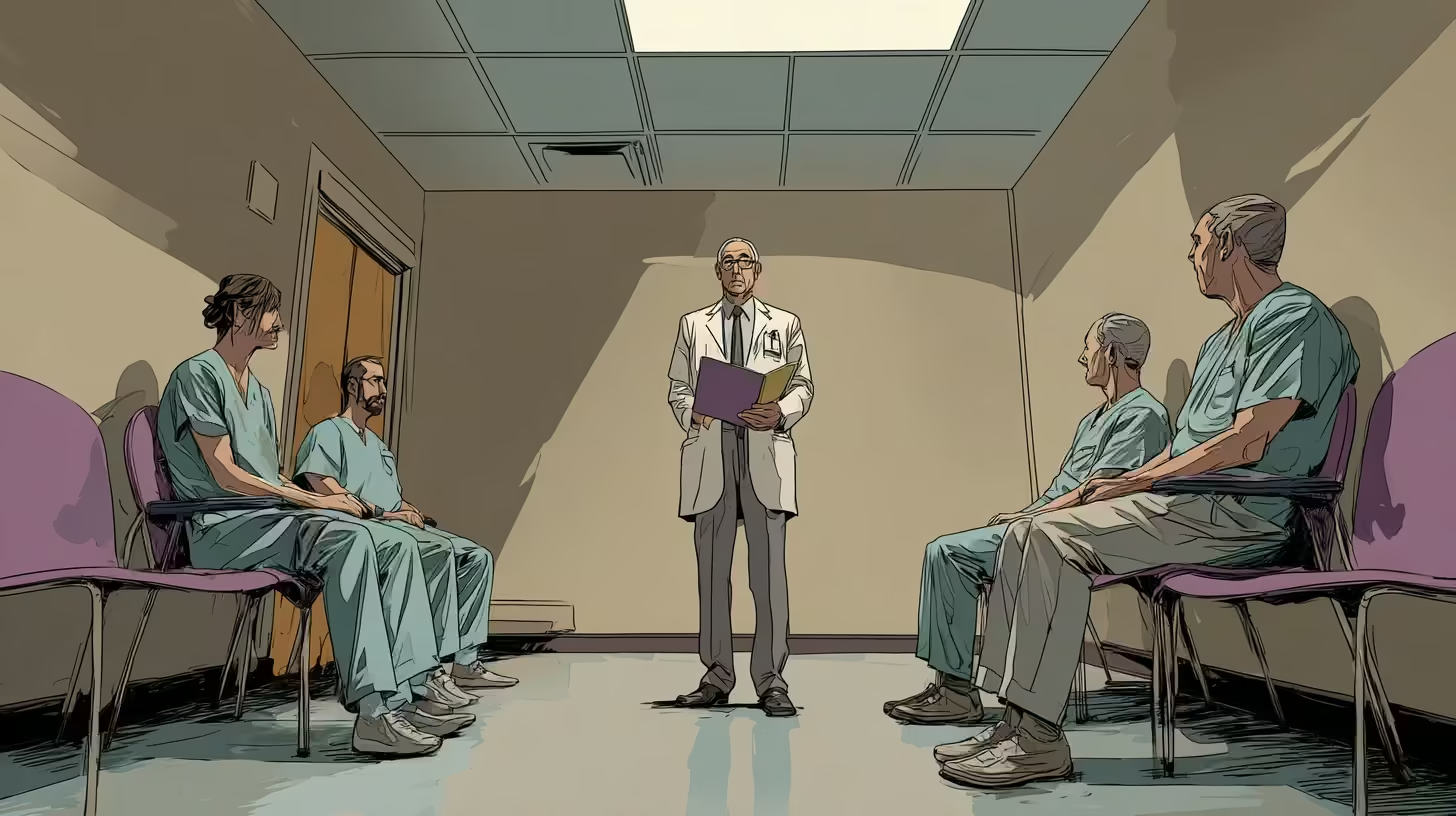
Clinical Safety Program Evidence for Joint Commission Surveys

Clinical safety program surveyor interview - three prepared staff, one empty chair with folder

Key Takeaways

  • Surveyors verify staff awareness through targeted interviews, and your medical staff’s answers determine whether your violence prevention program passes or fails.
  • The CMO’s role isn’t to prepare every team directly but to coordinate across departments so clinical staff, physicians, and APPs can all demonstrate competency on demand.
  • Documentation that shows active capability, not just policy existence, is what separates a confident survey from a citation.

When a surveyor turns to one of your physicians and asks them to describe your facility’s violence prevention protocols, what happens next depends on what you’ve built. Not the policy binder. Not the training sign-in sheet. Whether your medical staff can walk through the protocols in their own words, explain the alert system, and describe de-escalation techniques they’ve actually practiced. That’s the clinical safety program evidence surveyors evaluate, and preparing your clinical teams to deliver it is the CMO’s job.

What Surveyors Ask Your Clinical Staff

The 2024 Joint Commission standards require surveyors to verify staff awareness through direct interviews. They ask staff to: [1]

  • Describe what counts as workplace violence in their facility
  • Explain the alert protocol or emergency response procedure
  • Walk through de-escalation techniques they’ve been trained on
  • Explain how to report a violent incident

Your medical staff need to answer these confidently. Distributing policies isn’t enough. Staff need to articulate protocols in their own words and show they understand how to apply them.

Here’s what typically happens across behavioral health facilities: staff can recite policy language but stumble on specifics. “What do you do if a patient in the day room becomes aggressive toward another patient?” The answer shouldn’t require checking a laminated card.

In facilities with documented safety systems, staff who feel “very prepared” to respond to incidents nearly doubled after deployment. [2] Those gains require sustained reinforcement though. Without quarterly refreshers, preparedness scores tend to drift back toward baseline.

The CMO’s Coordination Role

Survey readiness isn’t something you prepare alone. Your role is making sure every department can demonstrate competency when a surveyor walks in.

OwnerDeliverableTimeline
CNOPreparation plans for nursing staff on the four surveyor questions30 days before survey window
CMO (you)Physician and APP competency verification, including attendings and locum tenens30 days before survey window
Unit ManagersRapid competency checks with sample staff from each unit14 days before survey window
HR/EducationLocum tenens and new attending orientation with documented competencyOngoing

Physicians are the gap most CMOs miss. Your attendings may know clinical protocols cold but can’t describe the duress alert sequence. APPs rotate across units and may not know facility-specific response procedures. Locum tenens are the highest risk. Surveyors may interview anyone, and a locum who started last week gets the same questions as a 10-year veteran.

If your survey window opens in less than 3 months and you have high physician turnover, prioritize locum tenens and new attendings first. The four questions above are the prep list.

Documentation Surveyors Request

Surveyors want specific evidence your program works, not just that it exists. They request response time data, system reliability records, incident investigation trails, and governance reporting. [3]

Surveyor RequestWhat They WantYour Production Window
Response time trendingAlert-to-arrival timestamps by unit, shift, and incident typeWithin 30 minutes
System reliabilityUptime records and coverage verificationWithin 30 minutes
Incident investigationEach incident with timeline, investigation notes, and resolutionWithin 24 hours
Governance reportingQuality committee minutes showing trending analysis reviewWithin 24 hours

Facilities with documented response times show 93% of incidents resolved in under 2 minutes. [2] That’s the kind of benchmark your quality committee can report to governance. Think of it like a flight recorder for every incident. You can’t argue with timestamps.

Work with your CSO to verify response time tracking exists. Make sure your compliance officer can pull incident investigation records. Your role as CMO is confirming these systems produce the evidence surveyors request within the timeframes above.

Joint Commission has issued over 100 requirements for improvement related to workplace violence since January 2022. [1] Governance reporting receives particularly high scrutiny. Surveyors check whether your quality committee minutes show actual discussion of violence prevention trends, not just slides presented.

If your survey window is approaching and you need help coordinating clinical team readiness, we can walk you through it.

Contact Us

Getting Your Program Survey-Ready

Facilities with documented safety technology show 39% reduction in patient-staff incidents in the first 3 months. [2] Worth noting: if your current incident capture is incomplete, numbers may actually increase early on as you capture events that previously went undocumented. That’s not failure. That’s visibility.

Pre-survey checklist:

  • Pull your last 3 quality committee minutes. Do they show documented discussion of violence prevention trends, or just slides?
  • Select 5 staff members randomly across units. Can each answer the four surveyor questions without prompting?
  • Request response time data for the past 90 days. Can your system produce it within 30 minutes?
  • Walk your facility’s perimeter areas, stairwells, and outdoor spaces. Does duress coverage extend to every location?
  • Review post-incident records for the past quarter. Is follow-up documented for each event?

For enterprise behavioral health organizations, consistency across facilities matters. Corporate sets standards, facilities execute. Surveyors may visit any site, and inconsistency across locations is a common citation area.

See how one behavioral health provider documented these results across their facilities.

Start with one question: can your medical staff articulate your clinical safety program protocols when a surveyor asks? If the answer is “I’m not sure,” that’s your first gap to close.

SURVEY READINESS

Prepare Your Clinical Teams with Documented Evidence

Facilities with documented safety systems show 93% of incidents resolved in under 2 minutes. See what survey-ready evidence looks like for your clinical program.

References

  1. The Joint Commission. Joint Commission Online – July 17, 2024. https://www.jointcommission.org/en-us/knowledge-library/newsletters/joint-commission-online/17-jul-24
  2. ROAR for Good. Internal Data, 2024.
  3. The Joint Commission. Data Collection. https://www.jointcommission.org/en-us/knowledge-library/workforce-safety-and-well-being-resource-center/workplace-violence-prevention/data-collection


Nursing Unit Safety: What Surveyors Check at Unit Level

Nursing unit safety incident board showing few posted cards while nurse shadow reveals many unreported held back

Key Takeaways

  • Surveyors evaluate violence prevention at the unit level through direct observation, staff interviews, and record review, not by reading policy binders in a conference room.
  • The biggest documentation gap is between what your units actually do and what they can prove on demand when a surveyor asks for records.
  • Preparing charge nurses and night shift staff to answer surveyor questions confidently matters as much as the documentation itself.

Surveyors don’t evaluate your violence prevention program from a conference room. They walk your units, interview your charge nurses, and ask staff to demonstrate protocols on the spot. The gap between having a strong nursing unit safety program and being able to prove it at the unit level is where most citations originate. This guide covers what surveyors actually check when they’re standing on your floor, where the documentation gaps hide, and how to close them before your next survey.

What Surveyors Check on Your Units

Joint Commission surveyors check violence prevention by watching it happen. They pick high-risk areas, pull actual incident records, and interview staff across different shifts. [1]

Here’s what most CNOs underestimate: surveyors deliberately test consistency across shifts and roles. They pay particular attention to night and weekend staff because that’s when things tend to slip. [2] Day shift might know the protocols cold. Night shift might know the policy exists but struggle to walk through the steps when asked directly.

Joint Commission has tightened the screws since 2022, issuing over 100 new requirements tied to workplace violence. [3] Behavioral health facilities face the highest scrutiny, and the stakes are real. Accreditation loss can put millions in annual Medicare and Medicaid funding at risk. [4]

Quick checks for your units:

  • Can your charge nurses on every unit demonstrate the duress response protocol on demand?
  • Do you have response time data for the past quarter that you can pull within 30 minutes?
  • Are your night shift and weekend staff as prepared as your day shift?

The Documentation Gap Most Units Miss

Your program may be effective. The question is whether your units can prove it when a surveyor asks.

81% of workplace violence incidents go unreported by healthcare workers who experienced them. [5] Nearly half of nurses say incidents are simply ignored by their employers after being reported. [6] When two-thirds of your nursing staff may not know how to document an incident in a way that creates the record surveyors expect, the gap isn’t about willingness. Staff have given up on a process that produces no visible results.

Automated systems close part of this gap by creating records automatically as events happen, removing the documentation burden that causes underreporting. But the system handles records, not culture. When incidents get ignored after reporting, that requires leadership follow-through. Surveyors check for that too.

Quick checks:

  • What percentage of incidents on your units are actually documented?
  • Can you produce investigation follow-up records for incidents from 6 months ago?
  • Do your training records show that staff actually learned something, or just that they showed up?

If your survey window is approaching and your units need documentation support, we can help you assess readiness.

Contact Us

Building Unit-Level Evidence

Surveyors want proof in four areas at the unit level, and most units can’t produce it. (For the full organizational breakdown, see the Joint Commission survey readiness guide.)

What Surveyors RequestWhat Most Units HaveWhat Survey-Ready Units Produce
Training records with competency scores [7]Sign-in sheets showing attendancePre/post assessments with passing scores
Timestamped response data [1]Anecdotal estimates (“usually pretty fast”)Continuous response time logs
Investigation findings and corrective actions [1]Incomplete incident reportsFull investigation trails with follow-through
Evidence of coverage across all areasAssumed coverageDocumented coverage with no dead zones

Here’s how surveyors test this: they pick a random incident from the past 6 to 12 months and ask to see the response records. They want timestamped proof of what happened and how fast. [1] Facilities with documented response times show 93% of incidents resolved in under 2 minutes. [8] That’s the kind of data surveyors can check immediately, and the kind most units can’t pull from manual logs.

Preparing Staff for Surveyor Questions

Surveyors ask your frontline nurses specific questions. Your staff either answer confidently or they don’t.

Common surveyor questions include: “What constitutes workplace violence in this facility?” “How do you report a workplace violence incident?” “Describe what you do if a patient becomes aggressive.” “How quickly can you get help if you need it?” [2]

Preparation ElementNurse ManagerCharge NurseYour Role as CNO
Question preparationTrain staff on expected questionsConduct unit-level drillsVerify consistency across units
Protocol demonstrationEnsure staff can show protocolLead practice sessionsObserve readiness during rounding
Shift coveragePrepare all shifts equallyBrief incoming shift staffAudit night and weekend preparedness

In facilities with documented safety systems, the share of staff who feel “very prepared” to respond to incidents nearly doubled after deployment. [8] That shift typically takes 45 to 90 days to settle across a facility, longer if turnover is high.

Don’t forget float staff and agency nurses. Surveyors may interview anyone on your unit. Agency staff know their clinical protocols but often don’t know your specific duress response sequence.

Getting Survey-Ready

If your survey window opens in less than 3 months, focus on these priorities:

  • Response time data first. If you can’t show response times for the past quarter, that’s your biggest gap.
  • Staff preparation on surveyor questions. Run through the six questions above with every shift on every unit.
  • Unit-by-unit assessment. Use the quick checks throughout this guide. The gaps you find will tell you exactly where to focus.
  • Night and weekend shift gaps. Address these immediately. Surveyors test consistency across shifts deliberately.

See how one behavioral health provider documented these results across their facilities.

Start with one unit. Run through the checks. The gaps you find will tell you exactly where to focus your nursing unit safety preparation before surveyors arrive.

SURVEY READINESS

Get Your Units Survey-Ready

Facilities with documented safety systems show 93% of incidents resolved in under 2 minutes. See what automated evidence looks like at the unit level.

References

  1. Joint Commission. Survey Activity Guides. https://www.jointcommission.org/en-us/knowledge-library/support-center/survey-or-review-preparation/survey-activity-guides
  2. Barrins & Associates. Preparing for Behavioral Health Outcomes. https://barrins-assoc.com/tjc-cms-blog/behavioral-health/preparing-for-behavioral-health-outcomes/
  3. Joint Commission. Preventing Workplace Violence. https://www.jointcommission.org/en-us/standards/national-performance-goals/preventing-workplace-violence
  4. Facilio. Healthcare Joint Commission Compliance. https://facilio.ae/blog/healthcare-joint-commission-compliance/
  5. AHRQ PSNet. Addressing Workplace Violence and Creating Safer Workplace. https://psnet.ahrq.gov/perspective/addressing-workplace-violence-and-creating-safer-workplace
  6. National Nurses United. Workplace Violence Report. https://www.nationalnursesunited.org/sites/default/files/nnu/documents/0224_Workplace_Violence_Report.pdf
  7. Joint Commission. Workplace Violence Prevention Program. https://www.jointcommission.org/en-us/knowledge-library/workforce-safety-and-well-being-resource-center/workplace-violence-prevention/workplace-violence-prevention-program
  8. ROAR for Good. Internal Data, 2024.

Security Safety System Evidence for Surveys | Checklist

Incident report forms fading to invisible representing 81 percent unreported workplace violence

Key Takeaways

  • Surveyors request specific security evidence: response time data, system reliability records, incident investigation trails, and coverage verification. Having these ready on demand is the difference between passing and scrambling.
  • The records gap security directors face comes from proving policies work through documented operational data, not from missing policies themselves.
  • Preparing your evidence package means knowing exactly what surveyors will ask for and being able to produce it within 30 minutes.

When a surveyor asks “what’s your average response time this quarter,” you either pull up a dashboard or you start guessing. That moment defines your survey. Your security safety system either generates the evidence surveyors want continuously, or you’re assembling it manually while the surveyor makes notes. This guide covers the specific records surveyors request from security directors, where the gaps usually hide, and how to organize your evidence package so you can produce it on demand.

The Records Surveyors Request from You

Each of the four evidence categories surveyors assess requires specific records. As security director, you own or co-own most of them. The challenge isn’t knowing what’s required. It’s having the records actually exist when someone asks.

Response Capability

This is your primary evidence area. Surveyors want three timestamps for any incident they pull: when the alert was activated, when it was acknowledged, and when someone arrived. Whether you track this through badge swipes, radio logs, or duress system exports, they expect all three. [2]

For trending, prepare a report showing response times by unit, shift, and time period. Weekend overnight shifts typically show longer times, and surveyors know this. They’ll check those windows specifically.

Facilities with documented response times show 93% of incidents resolved in under 2 minutes. [3] That’s the benchmark surveyors compare you against.

System Reliability

Surveyors check whether your security safety system works when staff need it. They want uptime records and coverage maps showing protection across the full facility, including parking lots and stairwells. [3]

Think of coverage maps like a roof inspection. They’re only as good as your last walkthrough. Systems drift. New construction creates gaps. A map from 18 months ago doesn’t prove current coverage.

Incident Investigation

Surveyors pull random incidents and trace the investigation: what happened, what was found, what changed. [4] They also want annual worksite analysis showing identified risks and documented mitigation actions. [5]

81% of workplace violence incidents go unreported. [7] Surveyors know your logs probably undercount reality. They’re checking whether your system captures what actually happens, not whether your numbers are low.

Training Records

This area is co-owned with your CNO, but surveyors may ask you about it. Training records need competency verification (pre/post assessments with passing scores), not just sign-in sheets. [1] Contract workers, volunteers, and consulting providers must be included.

Evidence AreaWhat Surveyors WantYour Production Window
Response time trendingTimestamps by unit, shift, and incident typeWithin 30 minutes
System reliabilityUptime records and current coverage mapsWithin 30 minutes
Incident investigationEach incident with findings and corrective actionsWithin 24 hours
Worksite analysisIdentified risks with mitigation actions and completion datesWithin 24 hours
Training competencyPre/post assessments for all staff including contractorsWithin 24 hours

Where Security Directors Get Cited

These aren’t theoretical risks. They’re the specific gaps that show up in survey findings.

Underreporting. If your incident logs show significantly fewer events than peer facilities, surveyors will probe for reporting barriers. You need to show you’re aware of the gap and actively addressing it. [8]

Missing investigation follow-up. Nearly half of nurses say incidents are simply ignored after being reported. [8] Surveyors pull random incidents and check for investigation notes. Excellent capture with zero follow-up is worse than moderate capture with complete investigations.

Unaddressed risks. Identifying a dead zone in the parking garage and leaving it unaddressed for 8 months is worse than never identifying it. [6] Worksite analysis without documented mitigation actions fails surveyor review.

Inconsistency across sites. If your organization has multiple facilities, surveyors may visit any one. A records gap at one site is an organizational gap. Accreditation loss risks suspension of Medicare and Medicaid funding. [9]

If your survey window is approaching and you need help building your evidence package, we can walk you through it.

Contact Us

How Automated Records Change This

Facilities with documented safety technology have passed every Joint Commission and OSHA inspection in tracked deployments. [3] The reason is straightforward: automated systems generate the evidence surveyors request as a byproduct of daily operations.

Evidence AreaManual ApproachAutomated Approach
Response timesEstimates from memoryTimestamped logs with historical trending
Incident trackingPaper forms, inconsistent completionAutomatic records with location data
Coverage verificationVerbal assuranceDocumented maps with dead zone elimination
Audit trailsCompiled before surveyExportable reports on demand

Technology doesn’t guarantee compliance. But it eliminates the scramble that makes compliance feel impossible.

See how one behavioral health provider documented these results across their facilities.

Your Pre-Survey Checklist

If your survey window is less than 90 days out, focus on the three highest-citation areas first: response time records, training competency verification, and incident investigation follow-up. Everything else matters, but these are where surveys fail.

  • Export test. Can you produce response time trending within 30 minutes? Time yourself.
  • Investigation completeness. Pull 5 random incidents from the past 12 months. Does each have investigation notes, findings, and corrective actions?
  • Coverage walkthrough. Walk your facility’s perimeter, stairwells, and low-traffic areas. Does your security safety system cover every location?
  • Night shift readiness. Ask 3 night shift staff: “What do you do if a patient becomes aggressive?” If they hesitate, that’s what the surveyor will see too.
  • Worksite analysis review. Are identified risks paired with mitigation actions and completion dates?

Mock interviews across shifts reveal whether staff understanding is consistent or concentrated among day shift leadership. Surveyors test this deliberately. [6]

Facilities that generate records continuously don’t prepare for surveys the traditional way. They export the evidence that already exists. When surveyors arrive, the records are ready.

SURVEY READINESS

Build Your Evidence Package with Automated Records

Facilities with documented safety systems have passed every Joint Commission and OSHA inspection in tracked deployments. See what survey-ready evidence looks like.

References

  1. American Society for Clinical Pathology. CMS Orders State Surveyors to Focus on Hospitals’ Workplace Violence Prevention Programs. https://www.ascp.org/news/news-details/2023/01/19/cms-orders-state-surveyors-to-focus-on-hospitals-workplace-violence-prevention-programs
  2. Joint Commission. Preventing Workplace Violence. https://www.jointcommission.org/en-us/standards/national-performance-goals/preventing-workplace-violence
  3. ROAR for Good. Internal Data, 2024.
  4. Joint Commission. Data Collection for Workplace Violence Prevention. https://www.jointcommission.org/en-us/knowledge-library/workforce-safety-and-well-being-resource-center/workplace-violence-prevention/data-collection

  5. Joint Commission. Worksite Analysis for Workplace Violence Prevention. https://www.jointcommission.org/en-us/knowledge-library/workforce-safety-and-well-being-resource-center/workplace-violence-prevention/worksite-analysis
  6. Joint Commission. Workplace Violence Expectations Presentation. https://swflcoalition.org/wp-content/uploads/2024/01/thursday_-_1330_-_the_joint_commission_workplace_violence_expectations_-_robert_neil.pdf
  7. AHRQ PSNet. Addressing Workplace Violence and Creating a Safer Workplace. https://psnet.ahrq.gov/perspective/addressing-workplace-violence-and-creating-safer-workplace
  8. National Nurses United. Workplace Violence Report 2024. https://www.nationalnursesunited.org/sites/default/files/nnu/documents/0224_Workplace_Violence_Report.pdf
  9. Facilio. Healthcare Joint Commission Compliance. https://facilio.ae/blog/healthcare-joint-commission-compliance/

Executive Safety Guide: Accreditation Survey Prep

Top-down view of a polished mahogany boardroom table featuring a purple leather portfolio, scattered audit documentation, and a tablet displaying green compliance checkmarks, all illuminated by warm late afternoon sunlight.

Key Takeaways

  • Your role during a survey isn’t to know every protocol detail but to show personal engagement with violence prevention outcomes, demonstrate leadership accountability, and present evidence to governance.
  • Survey readiness requires clear delegation with specific owners, timelines, and verification questions. The CEO who tries to own everything ends up proving nothing.
  • The gap between having a program and proving it works is where accreditation risk lives, and closing it means building systems that generate evidence continuously.

A surveyor asks for incident trending data from last quarter. The quality director looks at the CNO. The CNO looks at the technology team. Forty-five minutes later, someone’s pulling records from three different systems while the surveyor makes notes. That gap between “we have a program” and “we can prove it works” is where citations live, and it’s the CEO’s job to make sure the executive safety guide for your organization starts with clear ownership so no one is scrambling when the surveyor shows up.

What Your Role Actually Is

Surveyors don’t expect you to know every protocol detail. They expect you to show personal engagement with violence prevention outcomes. Specifically, they want to see that you can present incident trending data, articulate your investment rationale, describe how leadership rounding informs program improvements, and show that governance receives regular updates on program effectiveness. [2]

That’s leadership accountability, one of the four evidence categories surveyors assess. Your CMO, CNO, and CSO own the other three (staff awareness, response capability, incident tracking). Your job is making sure they can deliver, and that the board sees the results.

The stakes are real. Accreditation loss can suspend Medicare and Medicaid funding worth millions annually for behavioral health systems. [3] Surveyors know behavioral health facilities face the highest workplace violence rates in healthcare, [4] and they arrive expecting programs that match that reality.

The Delegation Framework

Survey readiness breaks down the moment everyone assumes someone else owns a deliverable. The fix is a delegation table with names, not departments.

DeliverableOwnerTimeline
Gap analysis against current standardsChief Quality OfficerMonths 1–2
Staff training audit with competency verificationCNOMonths 2–3
Mock survey coordination and corrective action planChief Quality OfficerMonths 3–4
Response capability testing and coverage verificationCSO / COOMonths 3–4
Audit log export demonstration and uptime recordsCTOMonths 3–4
Board communication on survey readinessYouMonth 6

Preparation takes 6 to 12 months ideally, though compressed timelines work with focused prioritization. [6] The key is starting with the gap analysis. Everything else builds from what it finds.

For multi-site systems, corporate leadership owns system-wide policy standards and technology platform decisions. Facility leaders own local execution, site-specific training completion, and staff interview readiness. Surveyors may visit any facility in your system, and inconsistency across sites is a common citation area.

Where CEOs Get Cited

Two deficiency patterns show up most often in behavioral health surveys: 56% cite inadequate training records and 55% cite leadership oversight gaps. [8] The training gap is your CNO’s problem to fix. The leadership gap is yours.

GapWhat Surveyors FindWhat to Do
Leadership accountabilityNo evidence of board updates, no documented roundingEstablish quarterly board reports, document leadership safety observations
Governance reportingQuality committee slides with no discussion or action itemsMinutes must show actual deliberation and decisions
Response capabilityNo response time data, coverage gaps in low-traffic areasWork with your CSO to verify documented technology with automated tracking
Training recordsAttendance without competency verificationCNO implements pre/post assessments with passing thresholds

Leadership accountability gaps are the ones surveyors hold you personally responsible for. If your board hasn’t received a violence prevention update in the past quarter, that’s your citation.

If your survey window is approaching and you need help building a delegation framework, we can walk you through it.

Contact Us

What Documented Technology Changes

Facilities with documented safety technology produce the evidence surveyors request within 30 minutes. [5] Manual systems take 6+ hours to compile the same records. That efficiency gap matters when a surveyor is standing in your facility making notes.

Facilities with documented response times show 93% of incidents resolved in under 2 minutes. [1] They’ve passed every Joint Commission and OSHA inspection in tracked deployments. [1] Beyond compliance, facilities show 39% reduction in patient-staff incidents in the first 3 months. [1]

But technology alone won’t fix a culture that discourages reporting or leadership that treats safety as a compliance checkbox. The technology produces the records. You have to make sure the organization actually acts on what those records show.

See how one behavioral health provider documented these results across their facilities.

Your Pre-Survey Verification

Complete these 30 days before your survey window opens:

  • Records production test. Ask your team to generate any requested evidence within 30 minutes. Time it. If they can’t, that’s your biggest gap.
  • Board minutes review. When did the board last receive a violence prevention update? Pull the minutes and verify documented discussion, not just slides.
  • Staff readiness spot-check. Walk to any unit and ask 3 staff members: “What happens if de-escalation fails?” Their answers tell you everything.
  • Response time data. Know your average incident response time this quarter. If you can’t answer that question, your systems aren’t producing what surveyors expect.
  • Mock survey results. Hospitals conducting mock surveys report 20–30% reduction in official survey findings. [7] If you haven’t done one, schedule it now.

Survey readiness shouldn’t require a sprint. When evidence generates continuously, any unannounced visit finds your team ready. Your executive safety guide is the delegation framework above, the verification checks in this section, and the confidence that comes from knowing your organization can prove what its program delivers.

ACCREDITATION READINESS

Lead Your Next Survey with Evidence

Facilities with documented safety systems have passed every Joint Commission and OSHA inspection in tracked deployments. See what survey-ready evidence looks like for your organization.

References

  1. ROAR for Good. Internal Data, 2024.
  2. The Joint Commission. Workplace Violence Prevention Program Standards. https://www.jointcommission.org/en-us/knowledge-library/workforce-safety-and-well-being-resource-center/workplace-violence-prevention/workplace-violence-prevention-program
  3. Facilio. Healthcare CMMS for Joint Commission Compliance in 2025. https://facilio.ae/blog/healthcare-joint-commission-compliance/
  4. Sheps Center at University of North Carolina. Workplace Violence Brief. https://www.shepscenter.unc.edu/wp-content/uploads/2025/01/Y10.01_Brief-1.pdf
  5. Barrins & Associates. https://pmc.ncbi.nlm.nih.gov/articles/PMC11554392/
  6. Checkpoint EHR / CARF Guidance. https://checkpointehr.com/practice-operations/what-is-carf-a-guide-for-therapists/
  7. The Joint Commission. Mock Surveys. https://www.jointcommission.org/en-us/products-and-services/advisory-services/accreditation-preparation/mock-surveys
  8. The Joint Commission. Workplace Violence Update, July 2024. https://circabehavioral.com/releases-workplace-violence-update-july-2024/

How to Position Workplace Violence Investment in Labor Relations

A hospital break room. Five nurses sit at a table during shift change — but only three are fully visible and in color. The other two (44.8%, roughly) are faded, desaturated, almost ghost-like, their forms translucent. They're present but unseen. They're speaking but unheard. The three visible nurses continue their conversation normally. On the table: coffee cups, one with a purple hospital logo. The faded nurses aren't dramatic or sad — they're simply... not registering.

Key Takeaways

  • Positioning safety investment in labor relations requires a structured narrative built for three audiences: the CFO, the CEO, and union representatives.
  • The same workforce data must be framed differently depending on whether you’re requesting budget approval or presenting at the bargaining table.
  • CHROs can verify the narrative worked within 90 days by tracking budget approval, grievance trajectory, and whether bargaining language shifted.

Most CHROs in behavioral health know safety investment matters for labor relations. The problem isn’t conviction. It’s that there’s no repeatable process for turning that conviction into a narrative that gets the CFO to approve the budget and gets the union to see it as a collaborative commitment rather than a reactive concession.

This article delivers that process. By the end, you’ll have a structured workflow for building the safety-as-labor-strategy narrative, packaging the data for each audience, and confirming it landed.


What This Process Produces

The output is a documented safety investment narrative the CHRO can use in three settings:

  • CFO budget conversations where the ask competes against recruitment bonuses, compensation adjustments, and benefits expansion
  • CEO strategic discussions where safety needs to connect to workforce stability and regulatory exposure
  • Union discussions where the investment needs to read as proactive commitment, not a response to pressure

The narrative connects the same underlying workforce data to what each audience cares about. The data doesn’t change. The framing does.


The Workforce Data You Need First

Before building the narrative, gather four data points you already have access to.

Data SourceWhat You’re Looking ForWhere to Find It
Exit interviews (last 12 months)Frequency of safety as a cited reason for leavingHR records, exit interview summaries
Engagement surveysSafety perception scores vs. other categoriesMost recent annual or pulse survey
Workers’ comp claimsViolence-related claim count and cost trendRisk management or insurance broker
Grievance filingsSafety-related complaints, formal and informalEmployee relations records

If safety shows up in more than 10% of exit interviews, your retention case is already strong [1]. If 45% of nurses say reported incidents get ignored [2], the grievance case is building whether you see it in formal filings yet or not. If workers’ comp claims for violence-related injuries are flat or rising, the CFO case writes itself.

You don’t need new research. You need to pull what you already track into one place.


Building the Labor Relations Narrative

The narrative has three versions, one per audience. Each uses the same data but frames it around what that audience tracks.

For the CFO: cost avoidance. Lead with workers’ comp trends and turnover cost. Each RN departure costs roughly $61,000 in recruiting, onboarding, and lost productivity [3]. If your intent-to-leave data shows 20%+ of staff citing safety, multiply that by your headcount and your replacement cost. Then show that peer organizations saw intent-to-leave drop from 22% to 7% after investing [4]. The CFO doesn’t need to care about safety to care about that number.

For the CEO: strategic risk. Lead with the grievance trajectory and regulatory exposure. If safety-related complaints are rising, even informally, that’s a leading indicator of formal organizing activity. Frame the investment as getting ahead of a labor relations risk before it reaches the board. CEOs respond to “this will be a board conversation in six months if we don’t act” faster than they respond to incident data.

For union representatives: visible commitment. Lead with what you’re prepared to invest, not what you’ve already done. Unions respond to forward-looking action more than backward-looking defense. Frame it as: “We agree staff deserve to feel safe. Here’s what we’re committing to, and here’s how we’ll measure whether it’s working.” Peer organizations that opened with shared values before presenting solutions saw representatives become advocates for adoption [4].


When the Standard Approach Won’t Work

Three situations require a modified process.

  • Active organizing campaign underway. If union organizing has already started, the narrative framing shifts. Anything you present will be read through the lens of “they’re only doing this because we forced them.” In this case, lead with the data you gathered before the campaign, show that the evaluation was already underway, and document the timeline. If you can’t show prior evaluation, acknowledge the timing honestly and focus on joint oversight of the implementation.
  • Multi-site system with uneven risk. Some facilities face acute safety pressure while others don’t. The narrative needs to address why you’re investing system-wide (because the workforce is mobile and the brand is shared) or why you’re piloting at high-risk sites first (because the data supports starting where the need is greatest). Don’t let the low-risk sites become an argument against investment at the high-risk ones.
  • No union presence, retention is the primary frame. If your facility isn’t unionized, the labor relations angle drops out and retention becomes the lead frame. The process is the same, but the CEO and CFO conversations center on exit interview data and replacement cost rather than grievance risk. The urgency argument shifts from “this will become a bargaining issue” to “this is already costing us staff we can’t replace.”

If you've got the data but need help packaging it for the budget conversation, we can walk through what peers have used.

Contact Us

How to Confirm the Narrative Landed

Track three signals within 90 days of presenting the narrative.

  • Budget approval. Did the CFO approve the investment? If not, what specific objection blocked it? The most common blocker is “show me peer data,” which means the narrative needs more external benchmarks. The second most common is “not this quarter,” which means the urgency framing didn’t land.
  • Grievance trajectory. Are safety-related complaints holding steady, declining, or still rising? If they’re declining after the investment was announced (even before deployment), the narrative is shifting how staff perceive organizational commitment.
  • Bargaining language. In your next union conversation, did the tone shift? Are representatives asking about implementation details rather than demanding action? If the conversation moved from “you haven’t done enough” to “how do we make this work,” the narrative landed.

If none of these signals show movement within 90 days, revisit the data packaging. The most common failure isn’t the wrong argument. It’s the right argument presented in the wrong audience’s language.


LABOR RELATIONS STRATEGY

Build the Narrative Before the Grievance Builds It for You

See how peer CHROs positioned safety investment to secure budget approval and shift union dynamics.

References

  1. AHRQ PSNet. “Addressing Workplace Violence and Creating a Safer Workplace.” 2023.
  2. National Nurses United. “High and Rising Rates of Workplace Violence Report.” February 2024.
  3. NSI Nursing Solutions. “2025 National Health Care Retention & RN Staffing Report.” 2025.
  4. ROAR for Good. “National Behavioral Healthcare Provider Case Study.” 2024.