

CHRO Workplace Violence Peer Benchmarks: Where the Field Is Moving

CHRO union safety strategy comparison — organized peer outcomes documents versus scattered pending grievances on executive desk

Key Takeaways

  • Peer CHROs in behavioral health are treating safety investment as a labor relations strategy, and the gap between early movers and those still waiting is showing up in measurable workforce outcomes.
  • The organizations with stable labor relations share a pattern: they invested in safety before the grievance forced it, and they can prove what changed.
  • Most organizations stall because they’re waiting for union pressure to justify the spend, which guarantees they negotiate from a reactive position.

The question behavioral health CHROs keep asking each other is simple: what are other organizations actually doing about workplace violence and union safety pressure? Not what they’re planning. Not what they’re evaluating. What they’ve done, and what happened after.

The answer is splitting the field. Some peer organizations have already invested and are documenting results. Others are still waiting, and the gap between the two groups is getting harder to close.


Where Peer CHROs Are Moving

Across behavioral health, CHROs are starting to treat safety investment as a workforce stability tool tied directly to labor relations, not as a security line item managed by operations.

The shift is driven by what unions are bringing to the table. Nearly half of nurses say their employers ignore reported violence [1]. Psychiatric and substance abuse hospitals see the highest violence rates in healthcare [2]. These aren’t new numbers, but they’re now showing up in grievance filings and bargaining proposals with increasing frequency.

Peer CHROs who’ve moved on this describe a common realization: waiting for the grievance to justify the investment means you’re always one step behind the conversation. The organizations documenting the strongest labor relations outcomes are the ones that invested before the demand arrived.


What Top-Performing Organizations Do Differently

Four patterns separate the organizations with stable labor dynamics from those still managing escalating safety grievances.

They invested before the ask. The strongest peer outcomes come from organizations where safety investment preceded formal union demands. In one multi-site deployment, staff who said they’d consider leaving over safety dropped from 22% to 7% [3]. That shift happened because the investment was visible before the grievance was filed, not after.

They measure what staff feel, not just what happens. Leading organizations track safety perception alongside incident counts. Staff sentiment scores went up by as much as 38 points after investment [3]. Unions care about what their members experience, not what the dashboard says. Organizations that track perception have evidence unions accept.

They share the data openly. Peer CHROs who gave union representatives access to adoption rates, sentiment trends, and outcome metrics turned potential adversaries into advocates. Transparency converted resistance into partnership at multiple documented sites.

They frame safety as retention, not security. Organizations that positioned safety investment under workforce stabilization got CFO and CEO support faster than those who kept it in the operations budget. Workers’ comp claims dropping 24% to 50% [3] speaks the CFO’s language without translation.


The Gap Between Leaders and Laggards

The performance difference between organizations that invested proactively and those still evaluating is measurable.

DimensionEarly MoversStill Waiting
Staff intent-to-leave over safetyDropped to single digitsRemains above 20%
Safety sentiment trajectoryMeasurable improvement documentedNo baseline to compare against
Union conversation toneCollaborative, focused on expanding what worksAdversarial, centered on what hasn’t been done
Workers’ comp trendDeclining claims, improving mod ratesFlat or rising
Board visibilitySafety metrics in workforce reportingSafety buried in operations reports

The gap isn’t just about outcomes. It’s about positioning. Organizations with documented investment enter every labor conversation with evidence. Organizations without it enter with explanations.

“Organizations with documented investment enter every labor conversation with evidence. Organizations without it enter with explanations.”


Where Most Organizations Get Stuck

The most common stalling point isn’t disagreement about whether safety matters. Every behavioral health CHRO knows it does. The stall happens in the space between knowing and acting.

  • Waiting for the “right” trigger. Many CHROs wait for a serious incident or a formal grievance to justify the budget request. But by the time the trigger arrives, the investment reads as reactive. The organizations with the strongest outcomes invested before external pressure forced it.
  • Treating it as a security decision. When safety investment stays in the security budget, the CHRO doesn’t own it. And if the CHRO doesn’t own it, the workforce data that makes the case never gets attached. The organizations that moved fastest put it in the HR budget from the start.
  • Underestimating how fast peers are moving. CHROs who assume they have time to evaluate are often surprised by how far ahead peer organizations already are. The gap compounds: early movers document results, which strengthens their position, which widens the distance from organizations still in evaluation mode.

If your organization is still in the evaluation column, a conversation about what peers are seeing might help clarify the path.

Contact Us

What Your Next Move Should Be

If you’re reading this and recognizing your organization in the “still waiting” column, here’s what peer CHROs recommend as the first step.

Check your own data against three signals:

  • Exit interview themes. Are departing staff citing safety? If safety shows up in more than 10% of exits, the retention case is already there.
  • Grievance trajectory. Are safety-related complaints increasing, even slightly? A rising trend means union representatives are building a record.
  • Engagement survey gaps. Do your safety perception scores lag behind other categories? That gap is exactly what organizers use to frame leadership as disconnected.

If any of those signals are present, the peer data says the same thing: the cost of waiting is higher than the cost of acting. And the organizations that acted first are the ones sitting across the bargaining table with evidence instead of explanations.


PEER BENCHMARKS

See Where Your Organization Stands

Peer CHROs are documenting workforce outcomes from proactive safety investment. Find out how your organization compares.

References

  1. National Nurses United. “High and Rising Rates of Workplace Violence Report.” February 2024.
  2. UNC Sheps Center. “Trends in Workplace Violence for Health Care Occupations and Facilities.” January 2025.
  3. ROAR for Good. “National Behavioral Healthcare Provider Case Study.” 2024.

What Enterprise Health System CTOs Are Requiring for Power Resilience—And Why You Should Too


Key Takeaways

  • Safety systems that depend on facility power or Wi-Fi fail precisely when violence risk peaks—during storms, infrastructure failures, and high-census events that strain both staff and systems.
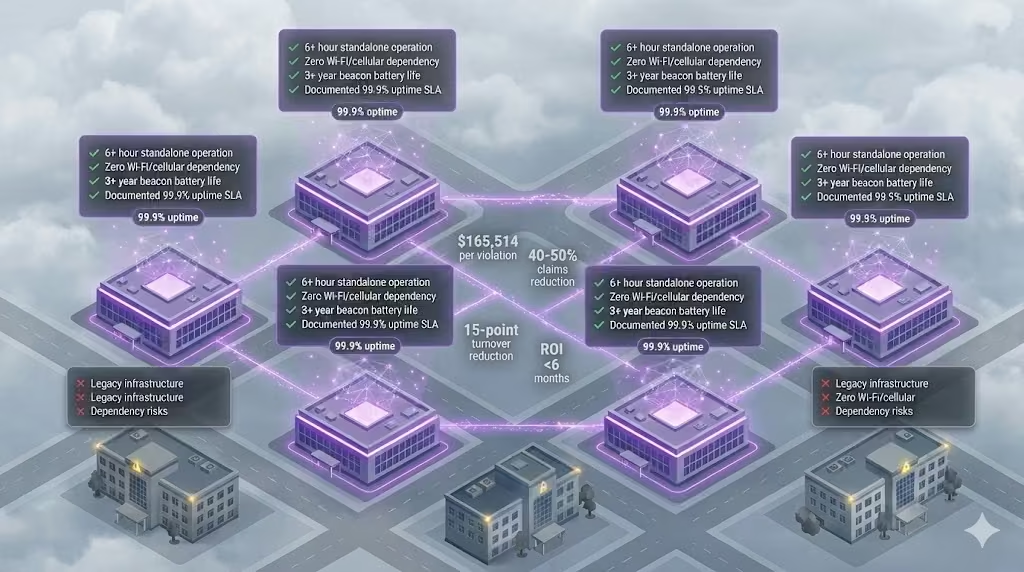
  • Four specifications now separate validated solutions from procurement risk: 6+ hour device operation, zero network dependency, 3-year beacon batteries, and documented outage performance with 99.9% uptime.
  • CTOs who require these standards position themselves as strategic enablers of operational resilience, defending their organizations against regulatory exposure and accreditation risks that follow system failures.

The Emerging Standard: What Peer Organizations Now Require

Enterprise health systems have begun requiring standalone power resilience as a procurement prerequisite—not a premium feature. In documented RFP cycles across behavioral health and integrated health systems, four specifications now appear as minimum requirements. Organizations still evaluating these capabilities as optional face a widening gap with peer institutions.

Healthcare workers face violence at five times the rate of other industries [1]. In behavioral health settings, 83% of nurses report experiencing violence in the preceding 12 months. Peer CTOs have recognized that the conditions generating incidents—storms, high-census events, infrastructure failures—are the same conditions that compromise Wi-Fi-dependent safety systems. This correlation has driven the shift toward standalone architecture requirements.

PEER STANDARDS

What are other CTOs requiring?

Four specifications now appear as minimum requirements in peer RFPs. See where you stand.

The four specifications appearing in peer RFPs:

1. Device operation without building power: 6+ hours minimum. In one documented deployment at an integrated health system, a four-hour power outage produced zero coverage gaps because devices operated independently on battery. Fully charged devices demonstrated 6–8 hours of continuous operation.

2. Network independence: Zero Wi-Fi or cellular dependency. Staff working in basements, stairwells, and parking garages—areas with poor Wi-Fi coverage—are often the most vulnerable to violence [2]. Standalone BLE mesh architecture eliminates this dependency entirely, providing 100% facility coverage including traditional dead zones.

3. Beacon battery life: 3+ years. Three-year batteries reduce total cost of ownership and eliminate rotating dead zones across multi-site deployments.

4. Documented outage performance: Real customer case studies. Validated solutions demonstrate 99.9% uptime verified by SLA, with 93% of incidents resolved in under two minutes. Customer retention rates of 99–99.5% on multi-year contracts signal sustained operational satisfaction.


The Gap: Where Most Organizations Fall Short

Organizations that have not updated procurement requirements face measurable exposure. The regulatory environment has shifted: $165,514 per willful OSHA violation [3], up to $75,000 per Joint Commission finding [4], and $2–5 million in annual funding at risk from accreditation loss.

The financial case peer organizations have used to close this gap centers on claims reduction data. Deployments demonstrate 40–50% reduction in workers’ compensation claims tied to violence and injury. At one behavioral health facility, claims decreased 24% in year one, contributing to a MOD score improvement of nearly 50%. A national behavioral health provider achieved 50% reduction in compensation claims within six months of deployment.

Concerned about the 44.8% gap? Let’s discuss how to close it

The turnover economics reinforce the business case. Each 1% reduction in RN turnover saves hospitals $263,000 annually in recruitment, training, and labor costs [5]. In one multi-site deployment, staff considering leaving due to safety concerns dropped from 22% to 7%—a 15 percentage point reduction in turnover intent. The cost to replace a single bedside RN reaches $61,110.

The capex efficiency supports straightforward approval. Documented deployments show $182 per staff member for complete solution implementation—a fraction of the $22,300 average cost per lost-time injury claim. Time to value under six months with 200% average first-year ROI provides board-defensible metrics.


Closing the Gap: How to Align with Peer Standards

When presenting to governance bodies, the peer-evidence approach proves effective. Leading health system technology leaders no longer evaluate power resilience as a premium feature—they require it as a procurement prerequisite, and their boards are approving the investment based on quantified returns.

Evidence from peer deployments warrants attention: standalone safety architecture operating during a documented four-hour facility outage with zero coverage gaps. Response times of 25–36 seconds for critical incidents. Customer retention of 99–99.5% across multi-year contracts.

A reasonable starting point: before the next contract renewal, validate current system behavior under simulated outage conditions. Disconnect facility power and Wi-Fi, then verify whether alerts still route to security. Document the results against the four specifications peer organizations now require.

WIDENING GAP

Peer CTOs already require this. Do you?

$165K per OSHA violation. $75K per Joint Commission finding. The standard has shifted.


Procurement Implications

The gap between organizations requiring these standards and those treating them as optional continues to widen. Peer CTOs who have adopted these requirements report stronger board support for safety infrastructure investments—the specifications provide objective criteria that shift the conversation from “should we invest more in safety?” to “does our current system meet the standard?”

Download the Power Resilience Benchmark Summary to share with your leadership team before your next vendor evaluation.

Concerned about the 44.8% gap? Let’s discuss how to close it


References

  1. CDC NIOSH – Occupational Violence
  2. Centegix – When Wearable Safety Solutions Become a Security Risk
  3. OSHA – Penalties
  4. Joint Commission – Preventing Workplace Violence Standards
  5. NSI Nursing Solutions – 2025 National Health Care Retention Report