
Nursing Safety Brief: Survey Evidence Checklist for Units

Nursing safety brief second-shift test showing confident CNA facing surveyor at 11 PM with purple water bottle

Key Takeaways

  • Surveyors evaluate nursing units on documented evidence across four categories: response capability, incident tracking, staff readiness, and investigation follow-through.
  • The gap between manual and automated documentation shows where most unit-level citations originate.
  • A pre-survey checklist helps CNOs verify their units can produce evidence on demand across all shifts.

Surveyors don’t evaluate your violence prevention program from a conference room. They walk your units, interview your charge nurses, and pull random incidents to trace the follow-up trail. This nursing safety brief covers what your units need to produce when that happens, organized by the evidence categories surveyors actually assess.

Manual vs. Automated Evidence at the Unit Level

The documentation challenge for nursing units is specific: staff focused on patient care during a crisis don’t stop to log timestamps. 81% of workplace violence incidents go unreported by healthcare workers who experienced them [1], and only about a third of nurses say their employer gives them a clear way to report incidents at all [2]. Manual records reflect what staff remember to document after the fact, not what actually happened.

That gap shows up when surveyors start pulling records:

Evidence AreaManual ApproachAutomated Approach
Response timesAnecdotal estimates from charge nursesDocumented response data with unit-level trending
Incident trackingPaper logs with gaps, filed hours laterTimestamped records captured as incidents happen
Staff readinessSign-in sheets proving attendanceCompetency verification with preparedness data
Investigation follow-throughInitial report filed, corrective actions undocumentedFull trail from report through root cause and resolution
Shift consistencyDay shift prepared, night shift uncertainAll shifts documented equally through daily system use

Facilities with documented safety systems show 93% of incidents resolved in under 2 minutes [3]. That’s the benchmark surveyors compare your unit data against.

“The test: can your charge nurse produce any of these within 30 minutes of a surveyor request? If producing evidence requires calls to multiple departments or hours of spreadsheet compilation, that’s the gap to address.”

See how one behavioral health provider documented these results across their facilities.

Your Unit-Level Evidence Checklist

CNOs should verify their units can produce evidence across four categories. These are what surveyors request during unit walkthroughs:

Response capability:

  • Response time data with trending by unit and shift for the past 90 days
  • System reliability records showing consistent availability across your facility
  • Evidence that response capability is consistent between day shift and night shift

Incident tracking:

  • Timestamped incident records with location data for every logged event
  • Trending analysis showing patterns by unit, shift, and time of day
  • Numbers that reflect your facility’s actual acuity level, not artificially low counts that signal underreporting

Staff readiness:

  • Training completion records with competency verification for permanent staff, travelers, and agency nurses
  • Evidence that staff on every shift can describe violence prevention protocols in their own words, not just reference a policy binder
  • Documentation that training covers de-escalation specific to your patient population

Investigation follow-through:

  • Complete investigation files for every documented incident: root cause analysis, corrective actions, completion dates, and communication back to reporting staff
  • Evidence that system changes resulted from investigations, not just that reports were filed
  • Surveyors pull 5-10 random incidents and review the full trail for each [4]. Every one needs to hold up.

The test: can your charge nurse produce any of these within 30 minutes of a surveyor request? If producing evidence requires calls to multiple departments or hours of spreadsheet compilation, that’s the gap to address.

Want to see what unit-level survey evidence looks like for your nursing team?

Request a Demo

Pre-Survey Verification

Before your next survey window, run through these five checks at the unit level:

  • Pull your incident data for one unit over the past 90 days. How long does it take, and does it require compiling from multiple sources?
  • Ask a charge nurse from night shift to walk through the duress response protocol. Does she describe it as naturally as your day-shift leads would?
  • Review the last 5 incident investigations on your highest-acuity unit. Does each show documented root cause, corrective action, and completion dates?
  • Check whether your traveler and agency nurses completed the same training as permanent staff, with competency verification attached.
  • Confirm your governance reporting includes quarterly unit-level safety data presented to leadership with documented discussion.

Start with the night-shift test. That single conversation tells you whether your nursing safety brief preparation has reached the staff surveyors will actually interview, or whether it stopped at the day-shift huddle.

SURVEY READINESS

Prepare Your Nursing Units with Documented Evidence

CNOs at behavioral health facilities with documented safety systems walk into surveys knowing their units can prove capability. See what that looks like.

References

  1. Agency for Healthcare Research and Quality (AHRQ) PSNet. “Addressing Workplace Violence and Creating a Safer Workplace.” 2023. https://psnet.ahrq.gov/perspective/addressing-workplace-violence-and-creating-safer-workplace
  2. National Nurses United. “High and Rising Rates of Workplace Violence.” February 2024. https://www.nationalnursesunited.org/sites/default/files/nnu/documents/0224_Workplace_Violence_Report.pdf
  3. ROAR for Good. Internal Data, 2024.
  4. The Joint Commission. “Workplace Violence Prevention Program.” https://www.jointcommission.org/en-us/knowledge-library/workforce-safety-and-well-being-resource-center/workplace-violence-prevention/workplace-violence-prevention-program


Nursing Safety Confidence: Survey Evidence Your Team Needs

Nursing safety confidence contrast between policy-clutching nurse and confident prepared nurse facing surveyor

Key Takeaways

  • The anxiety CNOs feel before surveys centers on whether their nursing teams can demonstrate capability on the spot, not whether the program itself works.
  • Most underreporting stems from staff who’ve given up on reporting processes that produce no visible results, and surveyors can see the gap in your numbers.
  • Confidence comes when your teams interact with safety systems daily, so describing protocols to a surveyor feels natural rather than rehearsed.

You know your nurses are capable. You’ve watched them de-escalate situations that could have turned violent. You’ve seen charge nurses manage crises with composure. But nursing safety confidence during a survey doesn’t come from what you’ve witnessed. It comes from what your team can show a surveyor who walks onto the unit unannounced and starts asking questions.

The questions that matter before any survey:

  • Can your charge nurse pull up response time data?
  • Can your night shift staff walk through the duress protocol without hesitating?
  • Can anyone on any unit describe what happens after an incident is reported?

That’s where the anxiety lives. Not in whether your program works, but in whether your team can prove it does.

The Gap Your Numbers Reveal

88% of healthcare workers who experienced violence never documented the incident in their facility’s reporting system. [1] Surveyors know this pattern. When they review your incident logs and the numbers look low, they don’t assume your facility is safe. They assume your system isn’t capturing reality.

The underreporting problem goes deeper than CNOs usually realize. Nearly half of nurses say incidents are simply ignored after being reported. [3] Only about a third say their employer gives them a clear way to report incidents at all. [3] Your nurses haven’t stopped documenting because they’re careless. They’ve stopped because the process feels pointless.

That’s the hardest part. You’re responsible for evidence your staff have given up generating.

“Your nurses haven’t stopped documenting because they’re careless. They’ve stopped because the process feels pointless. That’s the hardest part. You’re responsible for evidence your staff have given up generating.”

When a surveyor pulls your incident data, they’re not looking for low numbers. They’re looking for numbers that make sense given your patient population and acuity. If your behavioral health units show 12 documented incidents over 6 months, the surveyor will probe. And the answers your nurses give in confidential interviews will tell a different story than your logs.

What Surveyors See When They Interview Your Staff

Surveyors interview nurses across shifts, roles, and units without advance notice. [4] They ask staff to describe violence prevention procedures in their own words. They’re looking for genuine understanding, not rehearsed answers. [4]

Here’s the pattern across behavioral health units: staff who use safety systems daily can describe them naturally. Staff who last touched the system during orientation stumble. A surveyor asks your charge nurse “how quickly does help arrive when you activate the duress system?” She either has data or she has a guess. That moment shapes the next 30 minutes of your survey.

The gap between day shift and night shift readiness is where most CNOs get caught. Day shift staff see leadership regularly, get reminders, stay current. Night shift and weekend staff operate with less oversight, and surveyors deliberately test that inconsistency. [4]

Try this before your next survey: pull two nurses from different units, one from days, one from nights. Ask them “what happens if de-escalation fails?” If their answers don’t align, if they hesitate, that’s exactly what the surveyor will see.

If the gap between what your team does and what your records show is keeping you up at night, we can help you close it.

Contact Us

What Confidence Actually Looks Like

The shift happens when your staff interact with safety systems often enough that describing them becomes second nature. In facilities with documented safety systems, the share of staff who feel “very prepared” to respond to incidents nearly doubled after deployment. [2]

That confidence shows during surveys. Staff who feel prepared to respond to incidents feel prepared to describe that response to a surveyor. They don’t need the policy binder. They don’t need prompting. They can show it because they do it.

The evidence follows naturally. Facilities with documented response times show 93% of incidents resolved in under 2 minutes, and the data generates automatically without nurses stopping mid-crisis to fill out forms. [2] That matters for CNOs worried about adding burden to units that are already stretched thin.

See how one behavioral health provider documented these results across their facilities.

From Anxiety to Nursing Leadership

60% of nurses have changed or left their job, or considered leaving, due to workplace violence. [5] The stakes go beyond accreditation. Keeping your staff safe and being able to prove it protects both your team and your ability to recruit and retain nurses.

Behavioral health facilities with documented safety technology have passed every Joint Commission and OSHA inspection in tracked deployments. [2] But the real shift isn’t the pass rate. It’s what happens to your team. When your nurses can show capability and your records back them up, survey questions stop being moments to survive. They become opportunities to demonstrate what you’ve built.

Nursing safety confidence isn’t about passing the next survey. It’s about building teams who know they’re protected and can prove it to anyone who asks.

Before your next survey window:

  • Can staff on each shift describe duress activation without referencing written materials?
  • Do you have response time data by unit and shift for the past 90 days?
  • Can you show the investigation trail for your 3 most recent documented incidents?
  • Have charge nurses practiced answering surveyor questions with someone outside their unit?
  • Does your incident count reflect the reality your night shift nurses would describe in a confidential conversation?

NURSING CONFIDENCE

Give Your Team the Evidence They Deserve

Staff who feel very prepared to respond to incidents nearly doubled after deployment. See what nursing safety confidence looks like with documented systems.

References

  1. National Institutes of Health. Workplace Violence in Healthcare. https://pmc.ncbi.nlm.nih.gov/articles/PMC12009039/
  2. ROAR for Good. Internal Data, 2024.
  3. National Nurses United. Workplace Violence Report. https://www.nationalnursesunited.org/sites/default/files/nnu/documents/0224_Workplace_Violence_Report.pdf
  4. Safe Management. Getting Ready for Survey Questions to Ask Staff. https://safemgt.com/2020/10/01/getting-ready-for-survey-questions-to-ask-staff/
  5. ROAR for Good. An Analysis of Workplace Violence Statistics in Healthcare. https://www.roarforgood.com/blog/an-analysis-of-workplace-violence-statistics-in-healthcare/

Nursing Unit Safety: What Surveyors Check at Unit Level

Nursing unit safety incident board showing few posted cards while nurse shadow reveals many unreported held back

Key Takeaways

  • Surveyors evaluate violence prevention at the unit level through direct observation, staff interviews, and record review, not by reading policy binders in a conference room.
  • The biggest documentation gap is between what your units actually do and what they can prove on demand when a surveyor asks for records.
  • Preparing charge nurses and night shift staff to answer surveyor questions confidently matters as much as the documentation itself.

Surveyors don’t evaluate your violence prevention program from a conference room. They walk your units, interview your charge nurses, and ask staff to demonstrate protocols on the spot. The gap between having a strong nursing unit safety program and being able to prove it at the unit level is where most citations originate. This guide covers what surveyors actually check when they’re standing on your floor, where the documentation gaps hide, and how to close them before your next survey.

What Surveyors Check on Your Units

Joint Commission surveyors check violence prevention by watching it happen. They pick high-risk areas, pull actual incident records, and interview staff across different shifts. [1]

Here’s what most CNOs underestimate: surveyors deliberately test consistency across shifts and roles. They pay particular attention to night and weekend staff because that’s when things tend to slip. [2] Day shift might know the protocols cold. Night shift might know the policy exists but struggle to walk through the steps when asked directly.

Joint Commission has tightened the screws since 2022, issuing over 100 new requirements tied to workplace violence. [3] Behavioral health facilities face the highest scrutiny, and the stakes are real. Accreditation loss can put millions in annual Medicare and Medicaid funding at risk. [4]

Quick checks for your units:

  • Can your charge nurses on every unit demonstrate the duress response protocol on demand?
  • Do you have response time data for the past quarter that you can pull within 30 minutes?
  • Are your night shift and weekend staff as prepared as your day shift?

The Documentation Gap Most Units Miss

Your program may be effective. The question is whether your units can prove it when a surveyor asks.

81% of workplace violence incidents go unreported by healthcare workers who experienced them. [5] Nearly half of nurses say incidents are simply ignored by their employers after being reported. [6] When two-thirds of your nursing staff may not know how to document an incident in a way that creates the record surveyors expect, the gap isn’t about willingness. Staff have given up on a process that produces no visible results.

Automated systems close part of this gap by creating records automatically as events happen, removing the documentation burden that causes underreporting. But the system handles records, not culture. When incidents get ignored after reporting, that requires leadership follow-through. Surveyors check for that too.

Quick checks:

  • What percentage of incidents on your units are actually documented?
  • Can you produce investigation follow-up records for incidents from 6 months ago?
  • Do your training records show that staff actually learned something, or just that they showed up?

If your survey window is approaching and your units need documentation support, we can help you assess readiness.

Contact Us

Building Unit-Level Evidence

Surveyors want proof in four areas at the unit level, and most units can’t produce it. (For the full organizational breakdown, see the Joint Commission survey readiness guide.)

What Surveyors RequestWhat Most Units HaveWhat Survey-Ready Units Produce
Training records with competency scores [7]Sign-in sheets showing attendancePre/post assessments with passing scores
Timestamped response data [1]Anecdotal estimates (“usually pretty fast”)Continuous response time logs
Investigation findings and corrective actions [1]Incomplete incident reportsFull investigation trails with follow-through
Evidence of coverage across all areasAssumed coverageDocumented coverage with no dead zones

Here’s how surveyors test this: they pick a random incident from the past 6 to 12 months and ask to see the response records. They want timestamped proof of what happened and how fast. [1] Facilities with documented response times show 93% of incidents resolved in under 2 minutes. [8] That’s the kind of data surveyors can check immediately, and the kind most units can’t pull from manual logs.

Preparing Staff for Surveyor Questions

Surveyors ask your frontline nurses specific questions. Your staff either answer confidently or they don’t.

Common surveyor questions include: “What constitutes workplace violence in this facility?” “How do you report a workplace violence incident?” “Describe what you do if a patient becomes aggressive.” “How quickly can you get help if you need it?” [2]

Preparation ElementNurse ManagerCharge NurseYour Role as CNO
Question preparationTrain staff on expected questionsConduct unit-level drillsVerify consistency across units
Protocol demonstrationEnsure staff can show protocolLead practice sessionsObserve readiness during rounding
Shift coveragePrepare all shifts equallyBrief incoming shift staffAudit night and weekend preparedness

In facilities with documented safety systems, the share of staff who feel “very prepared” to respond to incidents nearly doubled after deployment. [8] That shift typically takes 45 to 90 days to settle across a facility, longer if turnover is high.

Don’t forget float staff and agency nurses. Surveyors may interview anyone on your unit. Agency staff know their clinical protocols but often don’t know your specific duress response sequence.

Getting Survey-Ready

If your survey window opens in less than 3 months, focus on these priorities:

  • Response time data first. If you can’t show response times for the past quarter, that’s your biggest gap.
  • Staff preparation on surveyor questions. Run through the six questions above with every shift on every unit.
  • Unit-by-unit assessment. Use the quick checks throughout this guide. The gaps you find will tell you exactly where to focus.
  • Night and weekend shift gaps. Address these immediately. Surveyors test consistency across shifts deliberately.

See how one behavioral health provider documented these results across their facilities.

Start with one unit. Run through the checks. The gaps you find will tell you exactly where to focus your nursing unit safety preparation before surveyors arrive.

SURVEY READINESS

Get Your Units Survey-Ready

Facilities with documented safety systems show 93% of incidents resolved in under 2 minutes. See what automated evidence looks like at the unit level.

References

  1. Joint Commission. Survey Activity Guides. https://www.jointcommission.org/en-us/knowledge-library/support-center/survey-or-review-preparation/survey-activity-guides
  2. Barrins & Associates. Preparing for Behavioral Health Outcomes. https://barrins-assoc.com/tjc-cms-blog/behavioral-health/preparing-for-behavioral-health-outcomes/
  3. Joint Commission. Preventing Workplace Violence. https://www.jointcommission.org/en-us/standards/national-performance-goals/preventing-workplace-violence
  4. Facilio. Healthcare Joint Commission Compliance. https://facilio.ae/blog/healthcare-joint-commission-compliance/
  5. AHRQ PSNet. Addressing Workplace Violence and Creating Safer Workplace. https://psnet.ahrq.gov/perspective/addressing-workplace-violence-and-creating-safer-workplace
  6. National Nurses United. Workplace Violence Report. https://www.nationalnursesunited.org/sites/default/files/nnu/documents/0224_Workplace_Violence_Report.pdf
  7. Joint Commission. Workplace Violence Prevention Program. https://www.jointcommission.org/en-us/knowledge-library/workforce-safety-and-well-being-resource-center/workplace-violence-prevention/workplace-violence-prevention-program
  8. ROAR for Good. Internal Data, 2024.

What Enterprise Health System CTOs Are Requiring for Power Resilience—And Why You Should Too


Key Takeaways

  • Safety systems that depend on facility power or Wi-Fi fail precisely when violence risk peaks—during storms, infrastructure failures, and high-census events that strain both staff and systems.
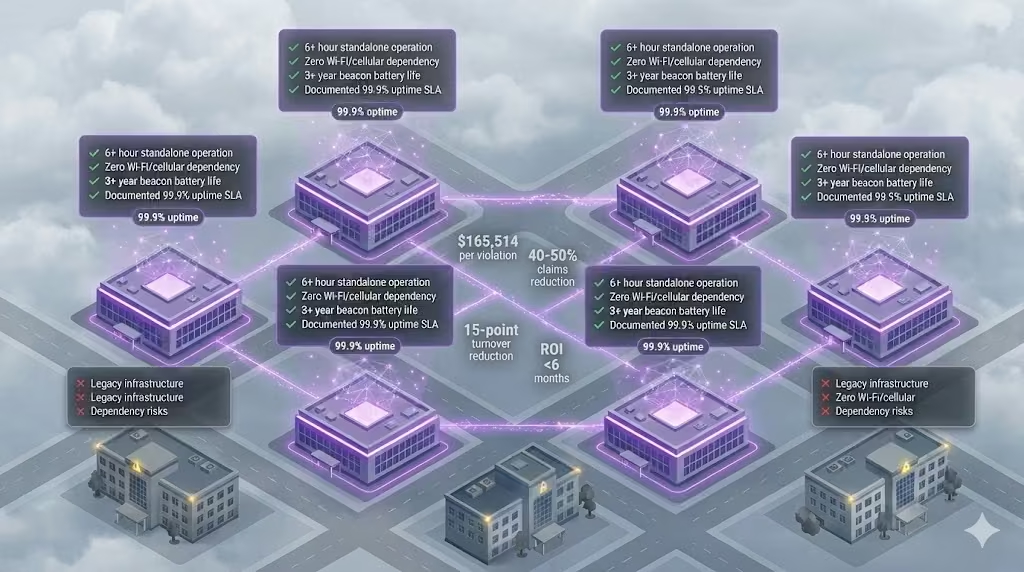
  • Four specifications now separate validated solutions from procurement risk: 6+ hour device operation, zero network dependency, 3-year beacon batteries, and documented outage performance with 99.9% uptime.
  • CTOs who require these standards position themselves as strategic enablers of operational resilience, defending their organizations against regulatory exposure and accreditation risks that follow system failures.

The Emerging Standard: What Peer Organizations Now Require

Enterprise health systems have begun requiring standalone power resilience as a procurement prerequisite—not a premium feature. In documented RFP cycles across behavioral health and integrated health systems, four specifications now appear as minimum requirements. Organizations still evaluating these capabilities as optional face a widening gap with peer institutions.

Healthcare workers face violence at five times the rate of other industries [1]. In behavioral health settings, 83% of nurses report experiencing violence in the preceding 12 months. Peer CTOs have recognized that the conditions generating incidents—storms, high-census events, infrastructure failures—are the same conditions that compromise Wi-Fi-dependent safety systems. This correlation has driven the shift toward standalone architecture requirements.

PEER STANDARDS

What are other CTOs requiring?

Four specifications now appear as minimum requirements in peer RFPs. See where you stand.

The four specifications appearing in peer RFPs:

1. Device operation without building power: 6+ hours minimum. In one documented deployment at an integrated health system, a four-hour power outage produced zero coverage gaps because devices operated independently on battery. Fully charged devices demonstrated 6–8 hours of continuous operation.

2. Network independence: Zero Wi-Fi or cellular dependency. Staff working in basements, stairwells, and parking garages—areas with poor Wi-Fi coverage—are often the most vulnerable to violence [2]. Standalone BLE mesh architecture eliminates this dependency entirely, providing 100% facility coverage including traditional dead zones.

3. Beacon battery life: 3+ years. Three-year batteries reduce total cost of ownership and eliminate rotating dead zones across multi-site deployments.

4. Documented outage performance: Real customer case studies. Validated solutions demonstrate 99.9% uptime verified by SLA, with 93% of incidents resolved in under two minutes. Customer retention rates of 99–99.5% on multi-year contracts signal sustained operational satisfaction.


The Gap: Where Most Organizations Fall Short

Organizations that have not updated procurement requirements face measurable exposure. The regulatory environment has shifted: $165,514 per willful OSHA violation [3], up to $75,000 per Joint Commission finding [4], and $2–5 million in annual funding at risk from accreditation loss.

The financial case peer organizations have used to close this gap centers on claims reduction data. Deployments demonstrate 40–50% reduction in workers’ compensation claims tied to violence and injury. At one behavioral health facility, claims decreased 24% in year one, contributing to a MOD score improvement of nearly 50%. A national behavioral health provider achieved 50% reduction in compensation claims within six months of deployment.

Concerned about the 44.8% gap? Let’s discuss how to close it

The turnover economics reinforce the business case. Each 1% reduction in RN turnover saves hospitals $263,000 annually in recruitment, training, and labor costs [5]. In one multi-site deployment, staff considering leaving due to safety concerns dropped from 22% to 7%—a 15 percentage point reduction in turnover intent. The cost to replace a single bedside RN reaches $61,110.

The capex efficiency supports straightforward approval. Documented deployments show $182 per staff member for complete solution implementation—a fraction of the $22,300 average cost per lost-time injury claim. Time to value under six months with 200% average first-year ROI provides board-defensible metrics.


Closing the Gap: How to Align with Peer Standards

When presenting to governance bodies, the peer-evidence approach proves effective. Leading health system technology leaders no longer evaluate power resilience as a premium feature—they require it as a procurement prerequisite, and their boards are approving the investment based on quantified returns.

Evidence from peer deployments warrants attention: standalone safety architecture operating during a documented four-hour facility outage with zero coverage gaps. Response times of 25–36 seconds for critical incidents. Customer retention of 99–99.5% across multi-year contracts.

A reasonable starting point: before the next contract renewal, validate current system behavior under simulated outage conditions. Disconnect facility power and Wi-Fi, then verify whether alerts still route to security. Document the results against the four specifications peer organizations now require.

WIDENING GAP

Peer CTOs already require this. Do you?

$165K per OSHA violation. $75K per Joint Commission finding. The standard has shifted.


Procurement Implications

The gap between organizations requiring these standards and those treating them as optional continues to widen. Peer CTOs who have adopted these requirements report stronger board support for safety infrastructure investments—the specifications provide objective criteria that shift the conversation from “should we invest more in safety?” to “does our current system meet the standard?”

Download the Power Resilience Benchmark Summary to share with your leadership team before your next vendor evaluation.

Concerned about the 44.8% gap? Let’s discuss how to close it


References

  1. CDC NIOSH – Occupational Violence
  2. Centegix – When Wearable Safety Solutions Become a Security Risk
  3. OSHA – Penalties
  4. Joint Commission – Preventing Workplace Violence Standards
  5. NSI Nursing Solutions – 2025 National Health Care Retention Report

19.2% of Nurses Leave After Workplace Violence. That’s Your Shortage.

Retention funnel showing 100 nurses at top, narrowing to 22 nurses considering leaving due to safety concerns (22%), then a $199 per-person safety intervention point, narrowing further to only 7 nurses considering leaving (7%), resulting in 15 nurses retained and $916,650 in avoided turnover costs at the bottom.

Key Takeaways

  • The behavioral health workforce shortage is a retention crisis disguised as a pipeline problem—19.2% of nurses leave after experiencing violence, and 60% have considered it.
  • One health system cut staff intent-to-leave from 22% to 7% not by recruiting harder, but by deploying safety infrastructure that delivers sub-2-minute response times.
  • Fixing safety fixes retention—and at $61,110 per lost nurse, the ROI on preventing exits dwarfs the cost of any recruiting campaign.

The workforce shortage conversation in behavioral health has been framed wrong for years. The dominant narrative centers on pipeline: not enough nursing school graduates, too few psychiatry residencies, aging demographics. All of these factors are real. None of them explain why you’re losing the nurses you already have.

The data tells a different story. According to the National Nurses United 2024 report, 19.2% of nurses have left their positions specifically after experiencing workplace violence [1]. That same study found 60% of nurses have changed jobs, left the profession, or considered leaving due to violence [1]. When nearly one in five departures trace directly to violence—and six in ten are considering the same exit—the math becomes inescapable. You cannot recruit your way out of a safety crisis.

The Violence-Turnover Math Most Workforce Strategies Ignore

Behavioral health facilities operate at the epicenter of healthcare violence. Industry data indicates 83% of mental health nurses experienced violence in the preceding 12 months. Over a career, between 24% and 80% of psychiatric nurses will be physically assaulted. Nurses in psychiatry face assault risk 20 times higher than their counterparts in public health units.

This violence does not stay on the unit. It follows staff into their decision to stay or leave. The 2025 NSI National Health Care Retention & RN Staffing Report places the average cost of replacing a single bedside registered nurse at $61,110 [2]. At that rate, every 1% reduction in RN turnover saves hospitals $289,000 annually in recruitment, training, and labor costs [2].

Consider what this means for a 100-nurse behavioral health unit. If 19.2% are leaving due to violence, you are hemorrhaging approximately $1.17 million annually in preventable turnover—before accounting for agency staffing premiums, overtime, reduced bed capacity, or the degradation of therapeutic continuity that comes with constant staff churn.

The recruitment machine cannot outpace this exit rate. As workforce analysts increasingly acknowledge, the traditional model is structurally broken. The supply pipeline cannot replace the experienced clinicians walking out the door.

The Intent-to-Leave Signal That Predicts Actual Turnover

Before nurses resign, they signal. Staff surveys consistently capture “intent to leave”—the percentage of employees actively considering departure. This metric is predictive. It is also actionable, which makes it far more valuable than tracking resignations after they occur.

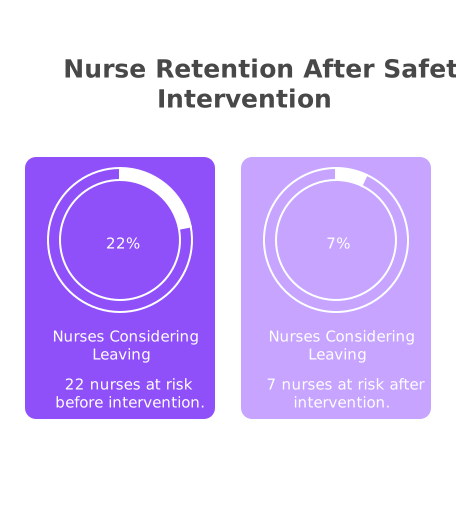
In one multi-site health system deployment, a pilot study of wearable safety technology captured this leading indicator. Prior to the intervention, 22% of staff indicated they would consider leaving their positions due to safety concerns. This is not an abstract sentiment. These are employees actively weighing whether their physical safety justifies continued employment.

Four months later, that figure dropped to 7%. A 15-percentage-point reduction in retention risk—achieved not through wage increases or wellness programs, but through a single infrastructure decision: deploying a staff duress system that ensured help arrived in under two minutes.

The mechanism is straightforward. When staff feel unprotected, the psychological contract with their employer fractures. In documented customer environments, staff rated the importance of safety at 4.75 out of 5, but their satisfaction with existing safety processes averaged only 3.55 out of 5. That 1.2-point gap represents failed expectations. When organizations close that gap, retention follows.

Post-deployment, 76% of staff reported feeling “very prepared” to respond to an incident—up from 38% before implementation. Nearly 80% reported increased confidence in handling safety concerns.

What $61,110 Per Lost Nurse Actually Buys in Prevention

The comparison that reframes this conversation is not recruitment spend versus retention spend. It is the cost of inaction versus the cost of infrastructure.

Investment ComparisonCostOutcome
One RN departure$61,110Single replacement cycle (recruitment, hiring, orientation)
Staff duress system (per employee)$182Up to 38-point increase in safety sentiment; 15-point drop in intent to leave
1% turnover reduction$289,000 annual savings
15-point intent-to-leave reduction (100-nurse unit)~$19,900 infrastructure investmentPotential avoidance of $916,650 in turnover costs

These figures come from documented behavioral health deployments. The operating expenditure per staff member averaged $182. That investment delivered 200% average ROI in the first year across behavioral health facilities.

At one comprehensive behavioral health center, staff satisfaction rose from 57% to 73% within three months of deployment. The facility documented a 39% drop in violent incidents in the first quarter. Workers’ compensation claims declined 24%, driving their experience modification (MOD) score down nearly 50%—resulting in six-figure insurance savings.

The financial ROI compounds. Workers’ compensation claims for assault-related lost-time injuries average $58,000 per incident [3]. Documented customer facilities have achieved 40–50% reductions in claims post-deployment. The annual cost of workplace violence to U.S. hospitals reaches $18.27 billion—a figure that includes turnover, liability, and treatment [4].

The Regulatory Floor Is Rising

The business case for safety infrastructure now intersects with regulatory mandate. Illinois Senate Bill 1435, effective July 1, 2025, requires hospitals to ensure all employees have a panic button attached to their staff identification card [5]. This is not a recommendation—it is a licensing requirement.

The Joint Commission’s new workplace violence prevention requirements, also effective July 2025, mandate leadership oversight, reporting systems, and post-incident support across accredited facilities [6]. OSHA continues to enforce the General Duty Clause aggressively following violent incidents. Maximum penalties for willful violations now reach $165,514 per occurrence in 2025 [7].

Organizations that wait for a mandate or an incident to act face compounding risks: regulatory penalty, litigation exposure, and—most critically—continued workforce attrition during the delay. Joint Commission accreditation loss alone jeopardizes $2–5 million annually in Medicare and Medicaid funding for a typical hospital [6].

Retention Strategy Starts With the Staff You Already Have

The workforce shortage in behavioral health is real. The pipeline constraints are real. But the highest-leverage intervention available to CNOs and CHROs in 2025 is not a new recruitment campaign. It is preventing the 19.2% of departures that trace directly to violence.

The data from facilities that have made this investment is consistent:

  • Staff who feel protected stay. In one documented deployment, intent to leave dropped from 22% to 7%. At another behavioral health center, satisfaction rose 16 points in three months. Across multiple customer environments, staff safety sentiment has increased up to 38 points.
  • Response time determines outcomes. 93% of alerts across documented facilities result in help arriving in under two minutes. At one hospital, a response to an agitated patient occurred in 25 seconds, preventing escalation to a reportable assault.
  • Violence prevention pays for itself. The 200% first-year ROI documented across behavioral health deployments comes from a combination of reduced workers’ comp claims, lower insurance premiums, and avoided turnover costs—not from incremental efficiency gains.

The workforce strategy question for 2025 is not how to find more nurses. It is how to stop losing the ones you have. Violence is the preventable cause. Safety infrastructure is the available lever. The organizations that recognize this shift will stabilize their workforce. The organizations that continue to focus on recruitment alone will continue to watch experienced clinicians walk out the door—at $61,110 per departure.

Get Started

Ready to take the next step?

Schedule a personalized demo to see how our solution can help transform your business operations.


References

External sources only. Internal/customer data attributed inline.

  1. National Nurses United – Workplace Violence Report, 2024
  2. NSI Nursing Solutions – National Health Care Retention & RN Staffing Report, 2025
  3. Bureau of Labor Statistics – Workplace Violence in Healthcare, 2018
  4. American Hospital Association – Violence Cost Report, 2025
  5. Illinois General Assembly – Senate Bill 1435, 2025
  6. The Joint Commission – Workplace Violence Prevention Standards, 2025
  7. OSHA – 2025 Annual Penalty Adjustments

Every Nurse You Lose to Violence Costs $61,110. Here’s What Stops the Bleeding.

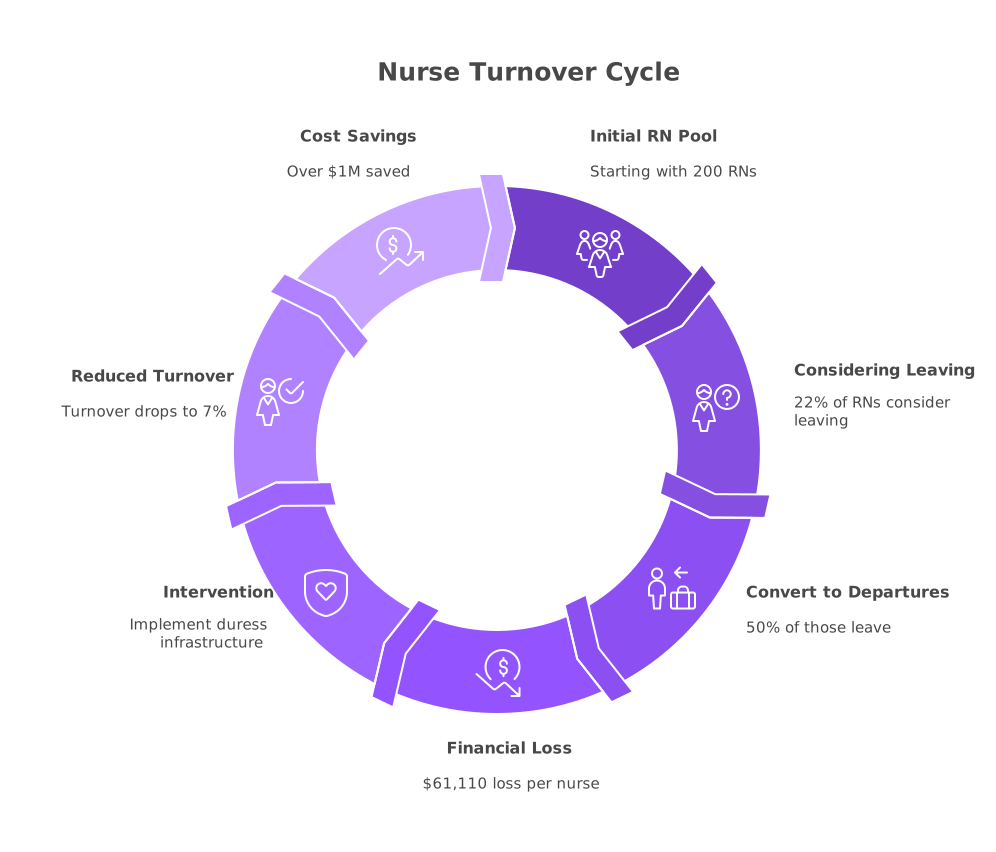
Funnel diagram showing behavioral health nurse turnover cascade: 200 RNs narrow to 44 at risk (22% considering leaving), then to 22 actual departures (50% conversion), multiplied by $61,110 per departure, resulting in $1.35M annual loss. An intervention arrow labeled "duress infrastructure" redirects the funnel, reducing intent-to-leave from 22% to 7% and saving over $1M.Retry

Key Takeaways

  • Behavioral health nurses face the highest violence exposure in healthcare, and when 22% of staff are considering leaving over safety concerns, the turnover math becomes catastrophic at $61,110 per RN departure.
  • Behavioral health organizations are shifting from individual training programs to infrastructure investments that cut violent incidents by 39% and slash intent-to-leave from 22% to 7% within months.
  • The result is a stabilized workforce, reduced workers’ comp claims by 40–50%, and a CFO-ready business case that reframes safety spending as retention strategy.

Your behavioral health nurses absorb more violence than almost any other role in healthcare. They’re also among your highest-turnover positions. These two facts are connected, and the connection is costing you far more than you’re tracking.

The average cost to replace a single bedside RN reached $61,110 in 2024, an 8.6% increase from the prior year [1]. In behavioral health settings, where violence rates dwarf general acute care, that number compounds rapidly. A 10-nurse departure over 12 months represents $611,100 in replacement, training, and productivity loss—before accounting for the institutional knowledge walking out the door.

The question CNOs and CHROs should be asking: how much of that turnover traces directly to safety?

The 22% Warning Sign

In behavioral health environments, staff don’t leave primarily for compensation or scheduling. They leave because they don’t feel protected.

Prior to deploying dedicated safety infrastructure, one behavioral health organization found that 22% of staff were actively considering leaving due to safety concerns [[2](ROAR Customer Outcomes)]. Not dissatisfaction with management. Not burnout from patient acuity. Safety—specifically, the perception that when something goes wrong, help won’t arrive fast enough.

That 22% figure aligns with national data. A 2024 survey from National Nurses United found that 19.2% of nurses had already changed or left their jobs due to workplace violence, with another 37.2% considering it [3]. In psychiatric and substance abuse settings, violence rates run more than 43 incidents per 10,000 full-time workers—among the highest of any healthcare environment [4].

When staff believe violence is inevitable and response is inadequate, intent-to-leave spikes. The downstream cost appears in your turnover reports six months later.

Why Individual Training Fails at Enterprise Scale

The standard response to nursing safety concerns is more de-escalation training. The logic seems sound: teach staff to manage volatile situations before they escalate.

The problem is that training addresses individual behavior, not system-level failures. When 81.6% of nurses report experiencing at least one form of workplace violence annually [3], and only 31.7% say their employer provides a clear way to report incidents [3], the gap isn’t skill—it’s infrastructure.

Consider what happens when a nurse faces an escalating patient in a stairwell at 2 AM:

  • De-escalation training provides verbal techniques
  • It does not summon a response team
  • It does not provide location tracking if the situation turns physical
  • It does not create a record for workers’ comp documentation

Training is a component of violence prevention. It is not a substitute for response infrastructure. Organizations that treat training as the primary intervention are solving for compliance, not outcomes.

What 39% Incident Reduction Looks Like Operationally

Behavioral health organizations that invest in dedicated duress systems—wearable panic buttons with real-time location tracking and guaranteed response times—see measurably different results.

One behavioral health provider documented a 39% reduction in violent incidents within the first three months of deployment [[5](ROAR Customer Outcomes)]. The mechanism isn’t complex: when staff can summon help with a single button press and responders know exactly where to go, situations de-escalate faster and incidents resolve before they become injuries.

The downstream effects compound:

Staff preparedness perception shifted from 38% feeling “very prepared” to handle safety incidents to 76% feeling prepared post-deployment [[6](ROAR Customer Outcomes)]—a 38-point swing that directly correlates with retention.

Intent-to-leave dropped from 22% to 7% [[2](ROAR Customer Outcomes)]. That 15-point reduction, applied to a 200-RN behavioral health workforce at the $61,110 per-departure benchmark, represents roughly $183,330 in avoided turnover costs annually.

Workers’ comp claims fell 40–50% in facilities with dedicated duress infrastructure [[7](ROAR Customer Outcomes)]. Given that the average medically consulted workplace injury costs $43,000 [8], the insurance savings alone often exceed the infrastructure investment within the first year.

Response times improved to under 2 minutes for 93% of alerts in ROAR deployments [[7](ROAR Customer Outcomes)]. Note: response times vary based on facility layout, staffing levels, and protocol design; some organizations see faster times while others may require additional optimization.

Building the Investment Case for Your CFO

The CFO conversation around staff safety typically stalls on ROI uncertainty. Safety investments get categorized as compliance costs rather than retention strategies, and budget allocation reflects that framing.

Reframe the ask. The relevant comparison isn’t “safety system cost vs. no cost”—it’s “safety system cost vs. turnover cost.”

MetricBefore InfrastructureAfter InfrastructureFinancial Impact
Intent-to-leave (safety-related)22%7%15-point reduction
Turnover cost per bedside RN$61,110$61,110
10-RN annual departure$611,100Avoided if retention improves
Workers’ comp claimsBaseline40–50% reduction~$43K per avoided claim
Incident response timeVariable<2 minutes (93% of alerts)Reduced severity, lower claim cost

The business case becomes straightforward: if your behavioral health network employs 200 RNs, and 22% are considering leaving due to safety concerns, you’re looking at potential turnover exposure of approximately $2.69 million annually (200 × 22% × $61,110 = $2,688,840). A 15-point reduction in intent-to-leave—demonstrated in actual deployments—changes the math entirely.

What CNOs Should Do Next

  1. Calculate your current RN turnover rate and segment by exit interview reason. If safety concerns appear in more than 10% of departures, you have a retention problem masquerading as a safety problem.
  2. Benchmark your response time data. If you can’t produce average incident response times by unit, you lack the infrastructure to demonstrate improvement—to staff, to the board, or to regulators.
  3. Frame your next budget request around workforce stability, not security hardware. The CFO who won’t approve a “safety system” may approve a “retention investment” with documented ROI from peer organizations.

The $61,110 per-departure cost isn’t going down. The question is whether you address the safety perception driving turnover before or after your next budget cycle.

Get Started

Ready to take the next step?

Schedule a personalized demo to see how our solution can help transform your business operations.


References

  1. NSI Nursing Solutions, 2025 National Health Care Retention & RN Staffing Report — $61,110 figure applies specifically to bedside RN turnover
  2. ROAR Customer Outcomes — Intent-to-leave reduction (22% → 7%)
  3. National Nurses United, Workplace Violence Survey 2024
  4. Trends in workplace violence for health care occupations and facilities over the last 10 years, Health Affairs Scholar, 2024
  5. ROAR Customer Outcomes — 39% incident reduction in first 3 months
  6. ROAR Customer Outcomes — Staff preparedness improvement (38% → 76%)
  7. ROAR Customer Outcomes — Workers’ comp claims reduction (40–50%), response time data
  8. National Safety Council, Work Injury Costs 2023 — $43,000 average cost per medically consulted injury

The CNO’s Strategic Guide to Workplace Safety: Your Best Retention Strategy

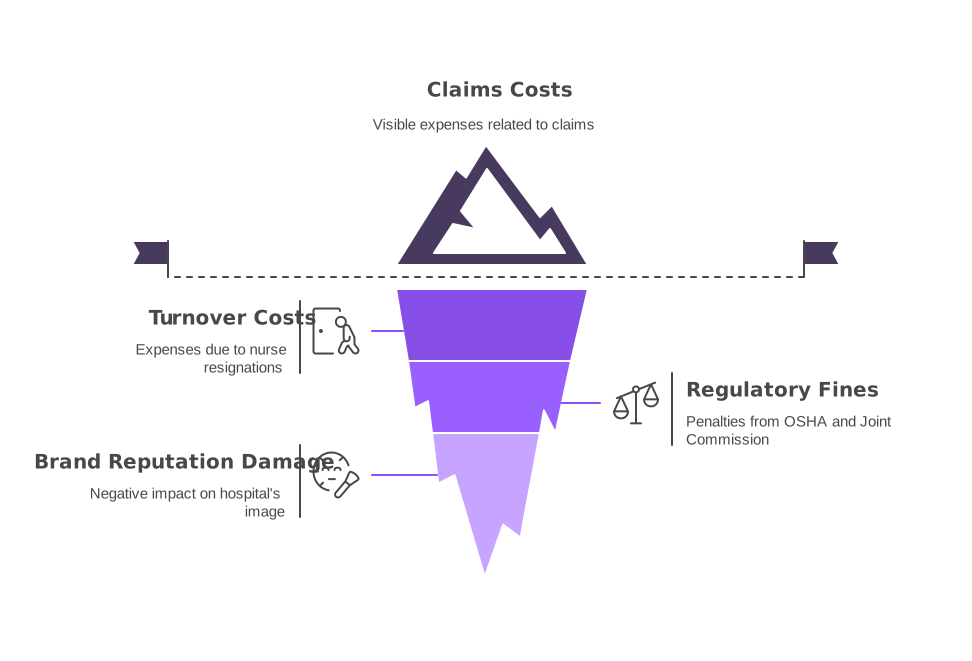
An iceberg diagram showing the true financial cost of workplace violence. The small tip above the water is labeled 'Medical Claims Costs (Visible expenses).' The massive, hidden costs below the water are labeled: 'Turnover Costs ($61,110 per nurse),' 'Regulatory Fines (OSHA and Joint Commission Penalties),' and 'Brand Reputation Damage.'

TLDR;

  • Staff safety is no longer just a compliance box to check—it is now the single biggest factor in stopping nurses from walking out the door.
  • Leaders can finally bypass year-long IT delays by choosing wireless systems that protect staff instantly rather than waiting for complex installations.
  • This approach proves that protecting the budget and protecting your people are the same goal, securing finance approval without sacrificing care.

To the Enterprise CNO, the pressure is immense. You are tasked with leading staff, ensuring patient care, and managing budget, all while facing industry-high rates of violence across your network.

You know that violence damages morale, but the real cost isn’t emotional: it’s financial and existential.

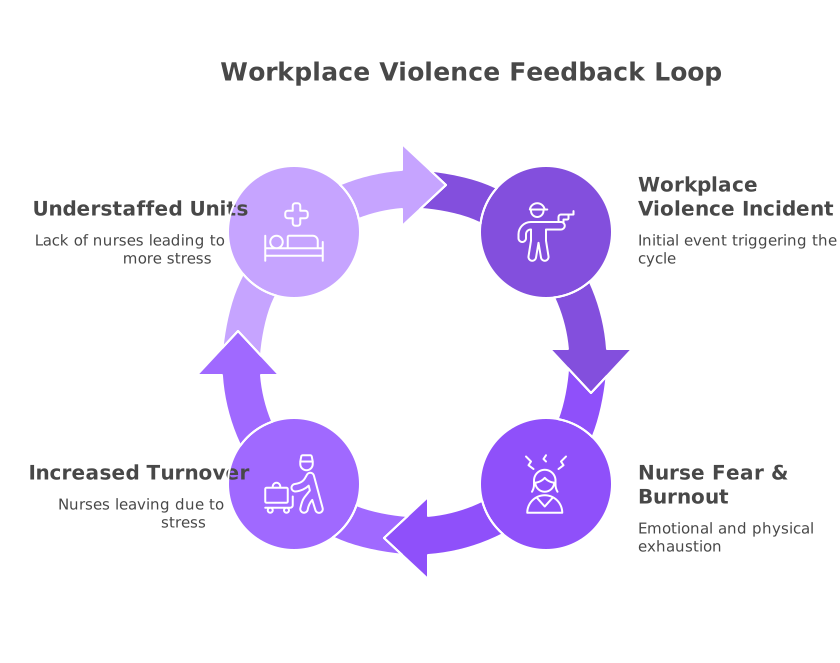
The core problem is simple: Every safety failure pushes staff toward the exit, compounding your staffing shortage and increasing organizational risk.

Data confirms that 19.2% of nurses leave their positions specifically after experiencing workplace violence [2]. This leads directly to understaffing, which, in turn, creates a more volatile environment.

To break this loop, the CNO must treat safety as a strategic investment in retention, not just a cost.

Anchor Metric: The Cost of Inaction

The average cost of turnover for a single bedside RN is $61,110 [3]. For a multi-site network, a small safety-related turnover spike costs hundreds of thousands, quickly dwarfing the cost of intervention.

To win budget, the CNO needs a single solution that provides three strategic levers.

The Financial Lever: Stopping the Revenue Leak

When presenting to the CFO or Board, the CNO’s conversation must be about cost avoidance. You need solutions that directly mitigate liability and regulatory risk.

Ending the Claims Bleed

A passive response system allows incidents to escalate, leading to severe injuries and high-dollar claims (up to $58,000 per serious assault).

  • The Goal: Invest in systems that enable staff to intervene before violence occurs.
  • The Result: Behavioral health facilities have achieved a 40–50% reduction in workers’ compensation claims related to violence [8].

Securing Accreditation and Funding

Regulatory compliance is revenue protection. Non-compliance is expensive, threatening both fines and your ability to operate.

  • The Risk: Loss of accreditation status due to safety deficiencies can jeopardize $2–5 million annually per facility in Medicare/Medicaid funding [6].
  • The Standard: The CNO’s solution must provide auditable data to prove readiness for The Joint Commission and OSHA, reducing the risk of a willful violation fine of up to $165,514 [4].

The Operational Lever: Bypassing the IT Barrier

The CNO’s mandate is fast deployment, but IT integration creates the biggest project delay. Complex systems requiring cabling, server integration, and firewalls can stall critical safety projects for over a year.

The Strategic Pivot: Eliminate the integration barrier.

Focus on independent infrastructure that requires minimal IT support and avoids Wi-Fi dependency. Look for features that enable rapid deployment:

  • No Wiring: Battery-powered, “peel-and-stick” components (with anti-ligature safety devices for high-acuity environments).
  • Guaranteed Coverage: Patented mesh networks that ensure 100% coverage in stairwells and dead zones where facility Wi-Fi fails.
  • Time-to-Value: By bypassing infrastructure hurdles, systems can be deployed across multi-site enterprises in weeks, not months.

The Clinical Lever: Guaranteeing Confidence and De-escalation

At the point of care, safety equals speed. The goal is to move beyond passive alert systems (pagers, code phones, two-way radios) that lead to confusion and patient agitation.

Modern enterprise panic button systems must provide speed and reliability:

  • Fast reliability: Data shows that 93% of alerts receive a responder in under 2 minutes [7].
  • Silent De-escalation: Instant, discreet activation ensures help is on the way before an incident escalates further, empowering staff to safely de-escalate.

Reliability and speed directly contribute to staff morale, resulting in up to a 38-point increase in safety sentiment and dramatically improving nurse retention [7].

Conclusion: Leading with Enterprise Data

As CNO, you stand at the intersection of clinical quality and operational sustainability. You do not need to choose between protecting your budget and protecting your staff.

By framing workplace violence prevention through the lens retention ROI ($61k/nurse), regulatory assurance (100% audit pass), and claims reduction (20-50% drop), you build a business case that is bulletproof.

Safety is the foundation of care. It’s time to build it on a foundation of data.

Get Started

Ready to take the next step?

Schedule a personalized demo to see how our solution can help transform your business operations.

Sources & References

  1. Violence frequency in psychiatric vs. public health settings. Journal of Psychosocial Nursing and Mental Health Services
  2. Workplace Violence and Nursing Retention Report
  3. National Health Care Retention & RN Staffing Report
  4. Annual Adjustments to Civil Penalties
  5. Workplace Violence Prevention Standards
  6. The Cost of Non-Compliance in Healthcare
  7. Aggregated anonymized data from active behavioral health deployments. View Case Studies
  8. Workers’ Compensation Trends in Behavioral Health