
19.2% of Nurses Leave After Workplace Violence. That’s Your Shortage.
Key Takeaways
- The behavioral health workforce shortage is a retention crisis disguised as a pipeline problem—19.2% of nurses leave after experiencing violence, and 60% have considered it.
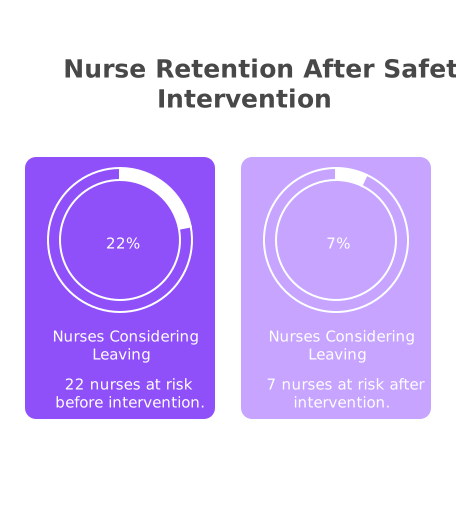
- One health system cut staff intent-to-leave from 22% to 7% not by recruiting harder, but by deploying safety infrastructure that delivers sub-2-minute response times.
- Fixing safety fixes retention—and at $61,110 per lost nurse, the ROI on preventing exits dwarfs the cost of any recruiting campaign.
The workforce shortage conversation in behavioral health has been framed wrong for years. The dominant narrative centers on pipeline: not enough nursing school graduates, too few psychiatry residencies, aging demographics. All of these factors are real. None of them explain why you're losing the nurses you already have.
The data tells a different story. According to the National Nurses United 2024 report, 19.2% of nurses have left their positions specifically after experiencing workplace violence [1]. That same study found 60% of nurses have changed jobs, left the profession, or considered leaving due to violence [1]. When nearly one in five departures trace directly to violence—and six in ten are considering the same exit—the math becomes inescapable. You cannot recruit your way out of a safety crisis.
The Violence-Turnover Math Most Workforce Strategies Ignore
Behavioral health facilities operate at the epicenter of healthcare violence. Industry data indicates 83% of mental health nurses experienced violence in the preceding 12 months. Over a career, between 24% and 80% of psychiatric nurses will be physically assaulted. Nurses in psychiatry face assault risk 20 times higher than their counterparts in public health units.
This violence does not stay on the unit. It follows staff into their decision to stay or leave. The 2025 NSI National Health Care Retention & RN Staffing Report places the average cost of replacing a single bedside registered nurse at $61,110 [2]. At that rate, every 1% reduction in RN turnover saves hospitals $289,000 annually in recruitment, training, and labor costs [2].
Consider what this means for a 100-nurse behavioral health unit. If 19.2% are leaving due to violence, you are hemorrhaging approximately $1.17 million annually in preventable turnover—before accounting for agency staffing premiums, overtime, reduced bed capacity, or the degradation of therapeutic continuity that comes with constant staff churn.
The recruitment machine cannot outpace this exit rate. As workforce analysts increasingly acknowledge, the traditional model is structurally broken. The supply pipeline cannot replace the experienced clinicians walking out the door.
The Intent-to-Leave Signal That Predicts Actual Turnover
Before nurses resign, they signal. Staff surveys consistently capture "intent to leave"—the percentage of employees actively considering departure. This metric is predictive. It is also actionable, which makes it far more valuable than tracking resignations after they occur.
In one multi-site health system deployment, a pilot study of wearable safety technology captured this leading indicator. Prior to the intervention, 22% of staff indicated they would consider leaving their positions due to safety concerns. This is not an abstract sentiment. These are employees actively weighing whether their physical safety justifies continued employment.
Four months later, that figure dropped to 7%. A 15-percentage-point reduction in retention risk—achieved not through wage increases or wellness programs, but through a single infrastructure decision: deploying a staff duress system that ensured help arrived in under two minutes.
The mechanism is straightforward. When staff feel unprotected, the psychological contract with their employer fractures. In documented customer environments, staff rated the importance of safety at 4.75 out of 5, but their satisfaction with existing safety processes averaged only 3.55 out of 5. That 1.2-point gap represents failed expectations. When organizations close that gap, retention follows.
Post-deployment, 76% of staff reported feeling "very prepared" to respond to an incident—up from 38% before implementation. Nearly 80% reported increased confidence in handling safety concerns.
What $61,110 Per Lost Nurse Actually Buys in Prevention
The comparison that reframes this conversation is not recruitment spend versus retention spend. It is the cost of inaction versus the cost of infrastructure.
| Investment Comparison | Cost | Outcome |
|---|---|---|
| One RN departure | $61,110 | Single replacement cycle (recruitment, hiring, orientation) |
| Staff duress system (per employee) | $182 | Up to 38-point increase in safety sentiment; 15-point drop in intent to leave |
| 1% turnover reduction | — | $289,000 annual savings |
| 15-point intent-to-leave reduction (100-nurse unit) | ~$19,900 infrastructure investment | Potential avoidance of $916,650 in turnover costs |
These figures come from documented behavioral health deployments. The operating expenditure per staff member averaged $182. That investment delivered 200% average ROI in the first year across behavioral health facilities.
At one comprehensive behavioral health center, staff satisfaction rose from 57% to 73% within three months of deployment. The facility documented a 39% drop in violent incidents in the first quarter. Workers' compensation claims declined 24%, driving their experience modification (MOD) score down nearly 50%—resulting in six-figure insurance savings.
The financial ROI compounds. Workers' compensation claims for assault-related lost-time injuries average $58,000 per incident [3]. Documented customer facilities have achieved 40–50% reductions in claims post-deployment. The annual cost of workplace violence to U.S. hospitals reaches $18.27 billion—a figure that includes turnover, liability, and treatment [4].
The Regulatory Floor Is Rising
The business case for safety infrastructure now intersects with regulatory mandate. Illinois Senate Bill 1435, effective July 1, 2025, requires hospitals to ensure all employees have a panic button attached to their staff identification card [5]. This is not a recommendation—it is a licensing requirement.
The Joint Commission's new workplace violence prevention requirements, also effective July 2025, mandate leadership oversight, reporting systems, and post-incident support across accredited facilities [6]. OSHA continues to enforce the General Duty Clause aggressively following violent incidents. Maximum penalties for willful violations now reach $165,514 per occurrence in 2025 [7].
Organizations that wait for a mandate or an incident to act face compounding risks: regulatory penalty, litigation exposure, and—most critically—continued workforce attrition during the delay. Joint Commission accreditation loss alone jeopardizes $2–5 million annually in Medicare and Medicaid funding for a typical hospital [6].
Retention Strategy Starts With the Staff You Already Have
The workforce shortage in behavioral health is real. The pipeline constraints are real. But the highest-leverage intervention available to CNOs and CHROs in 2025 is not a new recruitment campaign. It is preventing the 19.2% of departures that trace directly to violence.
The data from facilities that have made this investment is consistent:
- Staff who feel protected stay. In one documented deployment, intent to leave dropped from 22% to 7%. At another behavioral health center, satisfaction rose 16 points in three months. Across multiple customer environments, staff safety sentiment has increased up to 38 points.
- Response time determines outcomes. 93% of alerts across documented facilities result in help arriving in under two minutes. At one hospital, a response to an agitated patient occurred in 25 seconds, preventing escalation to a reportable assault.
- Violence prevention pays for itself. The 200% first-year ROI documented across behavioral health deployments comes from a combination of reduced workers' comp claims, lower insurance premiums, and avoided turnover costs—not from incremental efficiency gains.
The workforce strategy question for 2025 is not how to find more nurses. It is how to stop losing the ones you have. Violence is the preventable cause. Safety infrastructure is the available lever. The organizations that recognize this shift will stabilize their workforce. The organizations that continue to focus on recruitment alone will continue to watch experienced clinicians walk out the door—at $61,110 per departure.
Get Started
Ready to take the next step?
Schedule a personalized demo to see how our solution can help transform your business operations.
References
External sources only. Internal/customer data attributed inline.
- National Nurses United - Workplace Violence Report, 2024
- NSI Nursing Solutions - National Health Care Retention & RN Staffing Report, 2025
- Bureau of Labor Statistics - Workplace Violence in Healthcare, 2018
- American Hospital Association - Violence Cost Report, 2025
- Illinois General Assembly - Senate Bill 1435, 2025
- The Joint Commission - Workplace Violence Prevention Standards, 2025
- OSHA - 2025 Annual Penalty Adjustments