
The CNO’s Strategic Guide to Workplace Safety: Your Best Retention Strategy
TLDR;
- Staff safety is no longer just a compliance box to check—it is now the single biggest factor in stopping nurses from walking out the door.
- Leaders can finally bypass year-long IT delays by choosing wireless systems that protect staff instantly rather than waiting for complex installations.
- This approach proves that protecting the budget and protecting your people are the same goal, securing finance approval without sacrificing care.
To the Enterprise CNO, the pressure is immense. You are tasked with leading staff, ensuring patient care, and managing budget, all while facing industry-high rates of violence across your network.
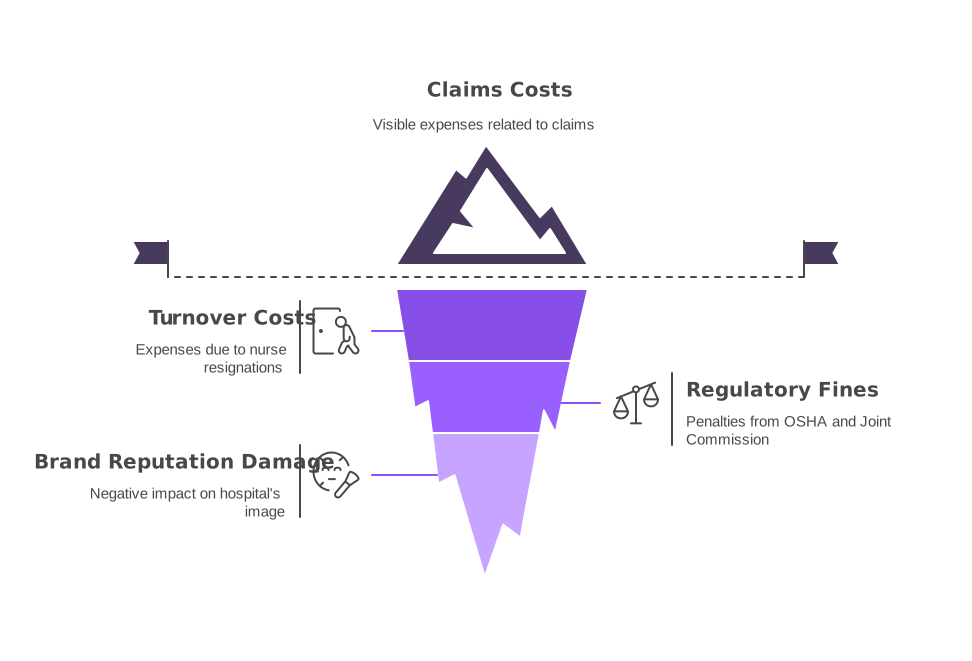
You know that violence damages morale, but the real cost isn't emotional: it's financial and existential.
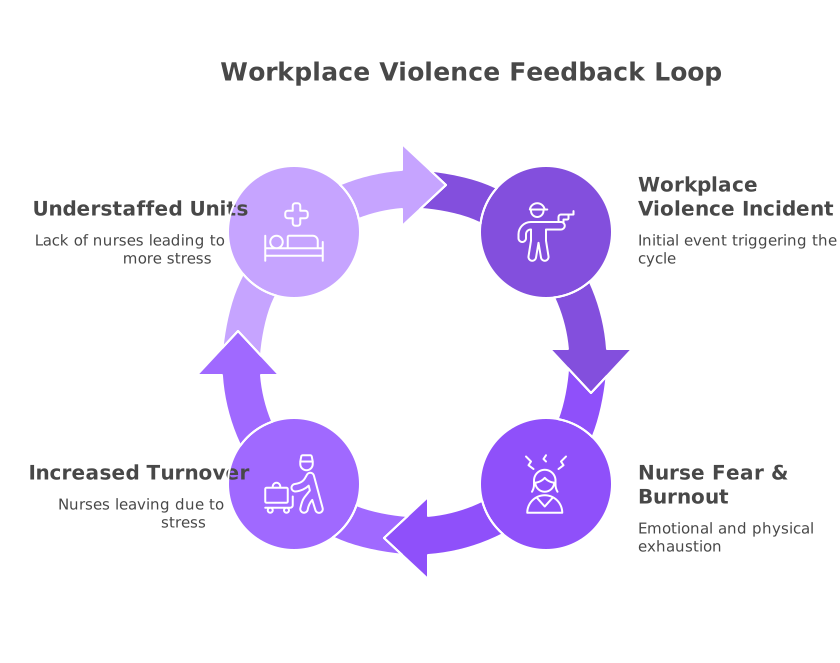
The core problem is simple: Every safety failure pushes staff toward the exit, compounding your staffing shortage and increasing organizational risk.
Data confirms that 19.2% of nurses leave their positions specifically after experiencing workplace violence [2]. This leads directly to understaffing, which, in turn, creates a more volatile environment.
To break this loop, the CNO must treat safety as a strategic investment in retention, not just a cost.
Anchor Metric: The Cost of Inaction
The average cost of turnover for a single bedside RN is $61,110 [3]. For a multi-site network, a small safety-related turnover spike costs hundreds of thousands, quickly dwarfing the cost of intervention.
To win budget, the CNO needs a single solution that provides three strategic levers.
The Financial Lever: Stopping the Revenue Leak
When presenting to the CFO or Board, the CNO's conversation must be about cost avoidance. You need solutions that directly mitigate liability and regulatory risk.
Ending the Claims Bleed
A passive response system allows incidents to escalate, leading to severe injuries and high-dollar claims (up to $58,000 per serious assault).
- The Goal: Invest in systems that enable staff to intervene before violence occurs.
- The Result: Behavioral health facilities have achieved a 40–50% reduction in workers’ compensation claims related to violence [8].
Securing Accreditation and Funding
Regulatory compliance is revenue protection. Non-compliance is expensive, threatening both fines and your ability to operate.
- The Risk: Loss of accreditation status due to safety deficiencies can jeopardize $2–5 million annually per facility in Medicare/Medicaid funding [6].
- The Standard: The CNO's solution must provide auditable data to prove readiness for The Joint Commission and OSHA, reducing the risk of a willful violation fine of up to $165,514 [4].
The Operational Lever: Bypassing the IT Barrier
The CNO's mandate is fast deployment, but IT integration creates the biggest project delay. Complex systems requiring cabling, server integration, and firewalls can stall critical safety projects for over a year.
The Strategic Pivot: Eliminate the integration barrier.
Focus on independent infrastructure that requires minimal IT support and avoids Wi-Fi dependency. Look for features that enable rapid deployment:
- No Wiring: Battery-powered, "peel-and-stick" components (with anti-ligature safety devices for high-acuity environments).
- Guaranteed Coverage: Patented mesh networks that ensure 100% coverage in stairwells and dead zones where facility Wi-Fi fails.
- Time-to-Value: By bypassing infrastructure hurdles, systems can be deployed across multi-site enterprises in weeks, not months.
The Clinical Lever: Guaranteeing Confidence and De-escalation
At the point of care, safety equals speed. The goal is to move beyond passive alert systems (pagers, code phones, two-way radios) that lead to confusion and patient agitation.
Modern enterprise panic button systems must provide speed and reliability:
- Fast reliability: Data shows that 93% of alerts receive a responder in under 2 minutes [7].
- Silent De-escalation: Instant, discreet activation ensures help is on the way before an incident escalates further, empowering staff to safely de-escalate.
Reliability and speed directly contribute to staff morale, resulting in up to a 38-point increase in safety sentiment and dramatically improving nurse retention [7].
Conclusion: Leading with Enterprise Data
As CNO, you stand at the intersection of clinical quality and operational sustainability. You do not need to choose between protecting your budget and protecting your staff.
By framing workplace violence prevention through the lens retention ROI ($61k/nurse), regulatory assurance (100% audit pass), and claims reduction (20-50% drop), you build a business case that is bulletproof.
Safety is the foundation of care. It’s time to build it on a foundation of data.
Get Started
Ready to take the next step?
Schedule a personalized demo to see how our solution can help transform your business operations.
Sources & References
- Violence frequency in psychiatric vs. public health settings. Journal of Psychosocial Nursing and Mental Health Services
- Workplace Violence and Nursing Retention Report
- National Health Care Retention & RN Staffing Report
- Annual Adjustments to Civil Penalties
- Workplace Violence Prevention Standards
- The Cost of Non-Compliance in Healthcare
- Aggregated anonymized data from active behavioral health deployments. View Case Studies
- Workers' Compensation Trends in Behavioral Health