
Every Nurse You Lose to Violence Costs $61,110. Here’s What Stops the Bleeding.
Key Takeaways
- Behavioral health nurses face the highest violence exposure in healthcare, and when 22% of staff are considering leaving over safety concerns, the turnover math becomes catastrophic at $61,110 per RN departure.
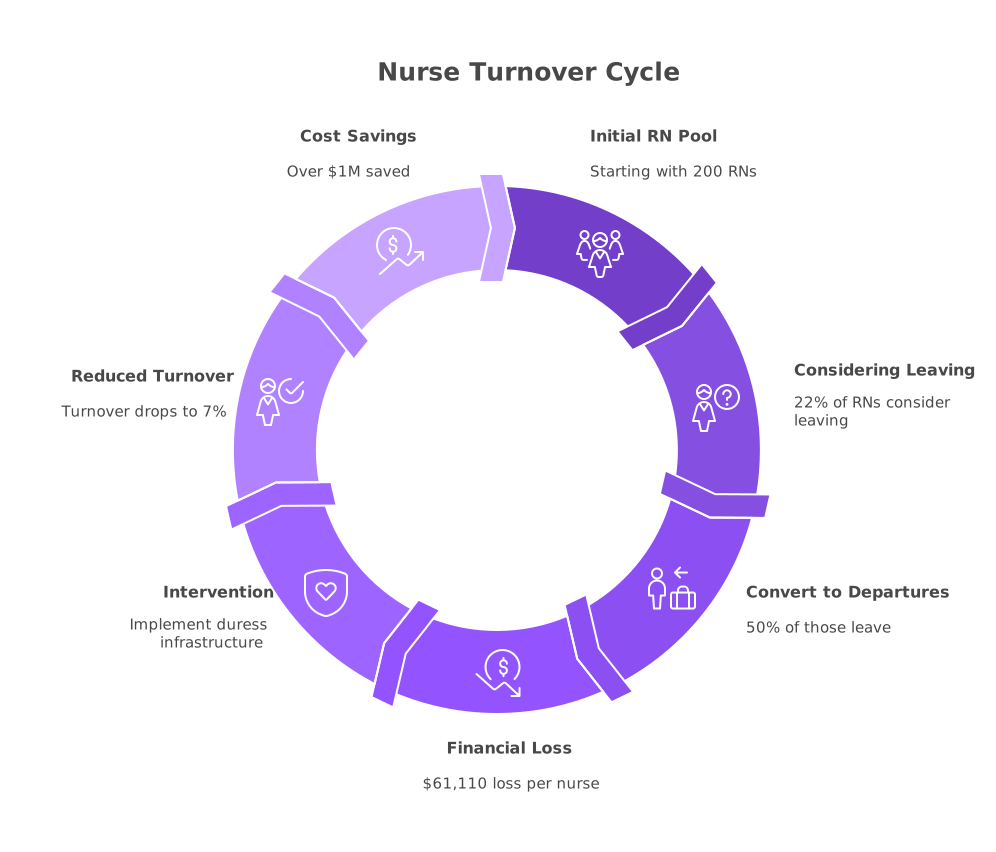
- Behavioral health organizations are shifting from individual training programs to infrastructure investments that cut violent incidents by 39% and slash intent-to-leave from 22% to 7% within months.
- The result is a stabilized workforce, reduced workers' comp claims by 40–50%, and a CFO-ready business case that reframes safety spending as retention strategy.
Your behavioral health nurses absorb more violence than almost any other role in healthcare. They're also among your highest-turnover positions. These two facts are connected, and the connection is costing you far more than you're tracking.
The average cost to replace a single bedside RN reached $61,110 in 2024, an 8.6% increase from the prior year [1]. In behavioral health settings, where violence rates dwarf general acute care, that number compounds rapidly. A 10-nurse departure over 12 months represents $611,100 in replacement, training, and productivity loss—before accounting for the institutional knowledge walking out the door.
The question CNOs and CHROs should be asking: how much of that turnover traces directly to safety?
The 22% Warning Sign
In behavioral health environments, staff don't leave primarily for compensation or scheduling. They leave because they don't feel protected.
Prior to deploying dedicated safety infrastructure, one behavioral health organization found that 22% of staff were actively considering leaving due to safety concerns [[2](ROAR Customer Outcomes)]. Not dissatisfaction with management. Not burnout from patient acuity. Safety—specifically, the perception that when something goes wrong, help won't arrive fast enough.
That 22% figure aligns with national data. A 2024 survey from National Nurses United found that 19.2% of nurses had already changed or left their jobs due to workplace violence, with another 37.2% considering it [3]. In psychiatric and substance abuse settings, violence rates run more than 43 incidents per 10,000 full-time workers—among the highest of any healthcare environment [4].
When staff believe violence is inevitable and response is inadequate, intent-to-leave spikes. The downstream cost appears in your turnover reports six months later.
Why Individual Training Fails at Enterprise Scale
The standard response to nursing safety concerns is more de-escalation training. The logic seems sound: teach staff to manage volatile situations before they escalate.
The problem is that training addresses individual behavior, not system-level failures. When 81.6% of nurses report experiencing at least one form of workplace violence annually [3], and only 31.7% say their employer provides a clear way to report incidents [3], the gap isn't skill—it's infrastructure.
Consider what happens when a nurse faces an escalating patient in a stairwell at 2 AM:
- De-escalation training provides verbal techniques
- It does not summon a response team
- It does not provide location tracking if the situation turns physical
- It does not create a record for workers' comp documentation
Training is a component of violence prevention. It is not a substitute for response infrastructure. Organizations that treat training as the primary intervention are solving for compliance, not outcomes.
What 39% Incident Reduction Looks Like Operationally
Behavioral health organizations that invest in dedicated duress systems—wearable panic buttons with real-time location tracking and guaranteed response times—see measurably different results.
One behavioral health provider documented a 39% reduction in violent incidents within the first three months of deployment [[5](ROAR Customer Outcomes)]. The mechanism isn't complex: when staff can summon help with a single button press and responders know exactly where to go, situations de-escalate faster and incidents resolve before they become injuries.
The downstream effects compound:
Staff preparedness perception shifted from 38% feeling "very prepared" to handle safety incidents to 76% feeling prepared post-deployment [[6](ROAR Customer Outcomes)]—a 38-point swing that directly correlates with retention.
Intent-to-leave dropped from 22% to 7% [[2](ROAR Customer Outcomes)]. That 15-point reduction, applied to a 200-RN behavioral health workforce at the $61,110 per-departure benchmark, represents roughly $183,330 in avoided turnover costs annually.
Workers' comp claims fell 40–50% in facilities with dedicated duress infrastructure [[7](ROAR Customer Outcomes)]. Given that the average medically consulted workplace injury costs $43,000 [8], the insurance savings alone often exceed the infrastructure investment within the first year.
Response times improved to under 2 minutes for 93% of alerts in ROAR deployments [[7](ROAR Customer Outcomes)]. Note: response times vary based on facility layout, staffing levels, and protocol design; some organizations see faster times while others may require additional optimization.
Building the Investment Case for Your CFO
The CFO conversation around staff safety typically stalls on ROI uncertainty. Safety investments get categorized as compliance costs rather than retention strategies, and budget allocation reflects that framing.
Reframe the ask. The relevant comparison isn't "safety system cost vs. no cost"—it's "safety system cost vs. turnover cost."
| Metric | Before Infrastructure | After Infrastructure | Financial Impact |
|---|---|---|---|
| Intent-to-leave (safety-related) | 22% | 7% | 15-point reduction |
| Turnover cost per bedside RN | $61,110 | $61,110 | — |
| 10-RN annual departure | $611,100 | — | Avoided if retention improves |
| Workers' comp claims | Baseline | 40–50% reduction | ~$43K per avoided claim |
| Incident response time | Variable | <2 minutes (93% of alerts) | Reduced severity, lower claim cost |
The business case becomes straightforward: if your behavioral health network employs 200 RNs, and 22% are considering leaving due to safety concerns, you're looking at potential turnover exposure of approximately $2.69 million annually (200 × 22% × $61,110 = $2,688,840). A 15-point reduction in intent-to-leave—demonstrated in actual deployments—changes the math entirely.
What CNOs Should Do Next
- Calculate your current RN turnover rate and segment by exit interview reason. If safety concerns appear in more than 10% of departures, you have a retention problem masquerading as a safety problem.
- Benchmark your response time data. If you can't produce average incident response times by unit, you lack the infrastructure to demonstrate improvement—to staff, to the board, or to regulators.
- Frame your next budget request around workforce stability, not security hardware. The CFO who won't approve a "safety system" may approve a "retention investment" with documented ROI from peer organizations.
The $61,110 per-departure cost isn't going down. The question is whether you address the safety perception driving turnover before or after your next budget cycle.
Get Started
Ready to take the next step?
Schedule a personalized demo to see how our solution can help transform your business operations.
References
- NSI Nursing Solutions, 2025 National Health Care Retention & RN Staffing Report — $61,110 figure applies specifically to bedside RN turnover
- ROAR Customer Outcomes — Intent-to-leave reduction (22% → 7%)
- National Nurses United, Workplace Violence Survey 2024
- Trends in workplace violence for health care occupations and facilities over the last 10 years, Health Affairs Scholar, 2024
- ROAR Customer Outcomes — 39% incident reduction in first 3 months
- ROAR Customer Outcomes — Staff preparedness improvement (38% → 76%)
- ROAR Customer Outcomes — Workers' comp claims reduction (40–50%), response time data
- National Safety Council, Work Injury Costs 2023 — $43,000 average cost per medically consulted injury