
Safety Board Presentation: Accreditation Evidence Guide

Safety board presentation evidence gap - surveyor hand reaching for purple metrics folder bypassing thick policy binder

Key Takeaways

  • A board-ready safety presentation covers four areas: response capability, incident trending, staff readiness, and governance reporting.
  • Framing safety technology as risk mitigation and workforce retention resonates with boards more than compliance language.
  • A five-item pre-presentation checklist helps CEOs verify they can back up every slide with documented evidence.

Accreditation survey windows create board questions. When your board asks whether the organization is ready, a safety board presentation built on documented evidence gives you a fundamentally different conversation than one built on policy summaries. This brief gives you the structure, the metrics, and the checklist to walk in prepared.

Why Your Board Needs to See This

Accreditation loss suspends Medicare and Medicaid billing. For behavioral health systems, that puts millions in annual revenue at risk [1]. Joint Commission surveyors now verify that violence prevention programs produce documented outcomes, and they expect leadership to show personal engagement with those outcomes [2].

Your board evaluates you partly on your ability to prepare the organization for successful surveys [3]. This presentation gives them the evidence that you have.

The Evidence Your Board Should See

Your safety board presentation should cover four evidence areas. These are the same categories surveyors evaluate during accreditation visits, translated into board-level metrics.

Evidence AreaWhat to PresentWhy It Matters to the Board
Response capabilityAverage response time data by unit and shiftShows the program works with measurable speed, not just policies
Incident trendingQuarter-over-quarter data showing incident volume and resolution patternsDemonstrates whether the program is improving outcomes over time
Staff readinessTraining completion rates with competency verificationProves staff can demonstrate capability when surveyors interview them
Governance reportingQuarterly review records showing leadership engagement with safety dataSatisfies the Joint Commission requirement that incidents reach governance [2]

Facilities with documented safety systems can produce this evidence in minutes [4]. If your team needs days to compile the same data, that gap is worth addressing before your next survey window.

See how one behavioral health provider documented these results across their facilities.

How to Frame It for Your Board

Boards respond to three lenses. Structure your safety board presentation around them:

  • Risk mitigation. Accreditation protection is insurance language boards understand. OSHA penalties for willful workplace violence violations now exceed $165,000 per violation [5]. Position documented safety systems as protection against regulatory and financial exposure.
  • Program effectiveness. Facilities with documented safety technology show measurable incident reduction in the first year [4]. Present before-and-after data that demonstrates your program produces outcomes, not just compliance artifacts.
  • Workforce stability. Staff who feel protected stay longer. Each percentage point change in RN turnover costs roughly $289,000 annually [6]. Documented safety systems show measurable improvement in staff confidence [4], and that connection between safety investment and retention resonates with boards watching staffing costs.

When a board member asks the follow-up question about what happens if you pass accreditation but still have an incident, the answer is straightforward: documented evidence shows you had a functioning system when it occurred.

“When a board member asks what happens if you pass accreditation but still have an incident, the answer is straightforward: documented evidence shows you had a functioning system when it occurred.”

Want to see what board-ready accreditation evidence looks like for your facility?

Request a Demo

Your Pre-Presentation Checklist

Before you present to your board, verify you can back up every claim:

  • Pull response time data for the most recent quarter. Can you produce it in under 5 minutes, broken out by unit?
  • Check your incident trending data. Does it show quarter-over-quarter patterns, or just a snapshot?
  • Confirm training completion rates include competency verification, not just attendance records.
  • Review your governance reporting trail. Can you show the board has received quarterly safety updates with documented discussion?
  • Test the 6-month lookback: pick a random incident from 6 months ago and reconstruct the full timeline. How long does it take?

If any of those checks stall, you’ve found the gap to close before your next safety board presentation. Start with the response time pull. That single test tells you whether your evidence infrastructure is ready or whether you’re presenting promises instead of proof.

ACCREDITATION READINESS

Present Documented Evidence at Your Next Board Meeting

Behavioral health facilities with documented safety systems pass Joint Commission surveys with confidence. See what board-ready evidence looks like.

References

  1. Facilio. “Healthcare CMMS for Joint Commission Compliance in 2025.” https://facilio.ae/blog/healthcare-joint-commission-compliance/
  2. The Joint Commission. “R3 Report 42: Workplace Violence Prevention in Behavioral Health Care and Human Services.” https://www.jointcommission.org/en-us/standards/r3-report/r3-report-42/
  3. American Hospital Association. “Effective CEO Performance Evaluation and Board Governance.” https://trustees.aha.org/effective-ceo-performance-evaluation
  4. ROAR for Good. Internal Data, 2024.
  5. Safety + Health Magazine. “OSHA and MSHA Civil Penalty Amounts Going Up.” January 2025. https://www.safetyandhealthmagazine.com/articles/26317-osha-and-msha-civil-penalty-amounts-going-up
  6. NSI Nursing Solutions, Inc. “2025 National Health Care Retention & RN Staffing Report.” March 2025. https://www.nsinursingsolutions.com/documents/library/nsi_national_health_care_retention_report.pdf


Peer CEO Safety Insights: Survey Preparation Benchmarks

Peer CEO survey readiness benchmark showing prepared executives versus empty seat

Key Takeaways

  • Peer behavioral health CEOs who pass accreditation surveys consistently can produce documented evidence of their violence prevention program on demand, not just policy binders.
  • The gap between organizations that pass with confidence and those that scramble comes down to whether evidence generates continuously or gets compiled under pressure.
  • A five-item readiness self-check helps CEOs benchmark their preparation against peers before their next survey window.

Your board chair calls four months before the Joint Commission survey window opens. The question is simple: can you prove your violence prevention program works? Peer CEO safety insights from behavioral health organizations that consistently pass point to the same thing: it comes down to what evidence you can produce when someone asks.

The CEO Accountability Shift

Behavioral health CEOs used to delegate survey preparation to compliance teams and check the box before the visit. That approach worked when surveyors mainly reviewed policy binders in conference rooms.

The stakes have changed. Accreditation loss can suspend Medicare and Medicaid billing immediately, and for behavioral health systems that depend on those revenue streams, that threatens the organization’s survival [1]. OSHA penalties for willful workplace violence violations now exceed $165,000 per violation [2]. Peer CEOs who’ve absorbed these realities treat survey readiness as a board-level priority, not something that lives in an operations report.

The shift is straightforward: boards now ask CEOs to demonstrate that safety investments produce measurable outcomes. Peer CEOs who can pull response time data, incident trends, and audit logs on demand have a fundamentally different board conversation than those who point to policies and training sign-in sheets.

How Peer CEOs Prepare Differently

Evidence availability. Leading programs have safety systems that create the documentation surveyors need, automatically. When a surveyor requests incident trending data, peer CEOs produce it within minutes. Most programs start compiling manually, a process that can take days when surveyors are already on-site [3].

Governance reporting. Peer CEOs present safety data to their boards quarterly, treating violence prevention metrics the same way they treat financial performance or patient satisfaction. Most programs report safety metrics reactively, usually only when an incident forces the conversation.

Delegation clarity. Peer CEOs maintain named accountability for every survey deliverable: who owns what, by when, with specific timelines. Most programs assume someone owns each piece without confirming it. Survey readiness breaks down the moment everyone assumes someone else has a deliverable covered.

Implementation approach. Leading programs deploy safety technology that requires no hospital network dependency and minimal operational disruption. Peer behavioral health systems with 8-15 facilities achieve enterprise deployment within 4-6 months while maintaining normal operations [4]. Most programs approach technology implementation as a multi-year capital project.

The Peer Benchmark

The clearest difference between peer-leading programs and average ones shows up in how fast evidence reaches a surveyor’s hands.

Evidence AreaPeer-Leading ProgramsMost Programs
Incident trend analysisAutomated dashboard exportable in minutesManual compilation requiring days
Response time documentation93% resolved under 2 minutes, system-documented [4]Anecdotal estimates with no supporting data
Continuous monitoring proofExportable audit logs covering 90+ daysSnapshots from the last audit prep
Staff awareness recordsVerified training completion above 95%Incomplete training records with gaps
Investigation follow-throughDocumented root cause, corrective action, and outcome for each incidentInitial report filed, follow-up trail goes cold

See how one behavioral health provider documented these results across their facilities.

“The organizations that pass surveys with confidence aren’t better at preparing. They’re better at generating evidence continuously so preparation becomes unnecessary.”

Peer CEO safety insights point to one consistent pattern: the organizations that pass surveys with confidence aren’t better at preparing. They’re better at generating evidence continuously so preparation becomes unnecessary.

Board-Ready Preparation

Peer CEOs who present safety investment with confidence at the board level frame it through three lenses:

  • Risk mitigation. Accreditation protection is the language boards understand. A single serious incident that triggers regulatory citations, litigation, and potential accreditation loss threatens revenue streams worth millions annually [1]. Safety technology is insurance against that cascade.
  • Regulatory alignment. Documented safety systems check the boxes surveyors care about: continuous monitoring, incident tracking, and leadership accountability [5]. Peer CEOs present technology as something that reduces citation risk, not as equipment.
  • Workforce stability. Staff who feel protected stay longer. Each percentage point change in RN turnover costs the average hospital roughly $289,000 annually [6]. Organizations with documented safety systems report measurable improvement in “I feel safe at work” sentiment [4], and that connection between safety investment and retention resonates with boards watching staffing costs climb.

When a board member asks whether the organization is ready for the next survey, peer CEOs answer with documented outcomes. That conversation is fundamentally different from reassuring the board that policies are in place.

Want to see how your organization compares to peer benchmarks for survey readiness?

Request a Demo

Your Readiness Self-Check

Before your next survey window, test yourself against peer benchmarks:

  • Pull your incident trending data for the past 90 days. Does it take minutes or days to produce?
  • Ask your CNO whether night-shift staff can articulate violence prevention protocols without checking a reference card.
  • Review the last 5 incident investigations. Does each one show documented root cause analysis, corrective action, and outcome, or does the trail stop at the initial report?
  • Check whether your board has received quarterly safety metrics in the past 12 months, with trend data showing program impact.
  • Verify that your delegation framework names specific owners for every survey deliverable, with timelines attached.

If more than one of those gave you pause, you’ve identified the gaps a surveyor would find.

Start with the 90-day data pull. That single number, how long it takes to produce incident trending data on demand, tells you more about your survey readiness than any policy review. Peer CEO safety insights from leaders who’ve been through this come down to one thing: fix the evidence speed first, and the rest follows.

SURVEY READINESS

Benchmark Your Survey Preparation Against Peer CEOs

Organizations with documented safety systems pass Joint Commission surveys with confidence. See what peer-level evidence looks like at your facility.

References

  1. Facilio. “Healthcare CMMS for Joint Commission Compliance in 2025.” August 5, 2025. https://facilio.ae/blog/healthcare-joint-commission-compliance/
  2. Safety + Health Magazine. “OSHA and MSHA Civil Penalty Amounts Going Up.” January 9, 2025. https://www.safetyandhealthmagazine.com/articles/26317-osha-and-msha-civil-penalty-amounts-going-up
  3. Barrins & Associates. “Evidence Production Timelines in Healthcare Accreditation.” https://www.barrinsandassociates.com/
  4. ROAR for Good. “Internal Data.” 2024.
  5. The Joint Commission. “R3 Report 42: Workplace Violence Prevention in Behavioral Health Care and Human Services.” https://www.jointcommission.org/en-us/standards/r3-report/r3-report-42/
  6. NSI Nursing Solutions, Inc. “2025 National Health Care Retention & RN Staffing Report.” March 2025. https://www.nsinursingsolutions.com/documents/library/nsi_national_health_care_retention_report.pdf

Executive Safety Guide: Accreditation Survey Prep

Top-down view of a polished mahogany boardroom table featuring a purple leather portfolio, scattered audit documentation, and a tablet displaying green compliance checkmarks, all illuminated by warm late afternoon sunlight.

Key Takeaways

  • Your role during a survey isn’t to know every protocol detail but to show personal engagement with violence prevention outcomes, demonstrate leadership accountability, and present evidence to governance.
  • Survey readiness requires clear delegation with specific owners, timelines, and verification questions. The CEO who tries to own everything ends up proving nothing.
  • The gap between having a program and proving it works is where accreditation risk lives, and closing it means building systems that generate evidence continuously.

A surveyor asks for incident trending data from last quarter. The quality director looks at the CNO. The CNO looks at the technology team. Forty-five minutes later, someone’s pulling records from three different systems while the surveyor makes notes. That gap between “we have a program” and “we can prove it works” is where citations live, and it’s the CEO’s job to make sure the executive safety guide for your organization starts with clear ownership so no one is scrambling when the surveyor shows up.

What Your Role Actually Is

Surveyors don’t expect you to know every protocol detail. They expect you to show personal engagement with violence prevention outcomes. Specifically, they want to see that you can present incident trending data, articulate your investment rationale, describe how leadership rounding informs program improvements, and show that governance receives regular updates on program effectiveness. [2]

That’s leadership accountability, one of the four evidence categories surveyors assess. Your CMO, CNO, and CSO own the other three (staff awareness, response capability, incident tracking). Your job is making sure they can deliver, and that the board sees the results.

The stakes are real. Accreditation loss can suspend Medicare and Medicaid funding worth millions annually for behavioral health systems. [3] Surveyors know behavioral health facilities face the highest workplace violence rates in healthcare, [4] and they arrive expecting programs that match that reality.

The Delegation Framework

Survey readiness breaks down the moment everyone assumes someone else owns a deliverable. The fix is a delegation table with names, not departments.

DeliverableOwnerTimeline
Gap analysis against current standardsChief Quality OfficerMonths 1–2
Staff training audit with competency verificationCNOMonths 2–3
Mock survey coordination and corrective action planChief Quality OfficerMonths 3–4
Response capability testing and coverage verificationCSO / COOMonths 3–4
Audit log export demonstration and uptime recordsCTOMonths 3–4
Board communication on survey readinessYouMonth 6

Preparation takes 6 to 12 months ideally, though compressed timelines work with focused prioritization. [6] The key is starting with the gap analysis. Everything else builds from what it finds.

For multi-site systems, corporate leadership owns system-wide policy standards and technology platform decisions. Facility leaders own local execution, site-specific training completion, and staff interview readiness. Surveyors may visit any facility in your system, and inconsistency across sites is a common citation area.

Where CEOs Get Cited

Two deficiency patterns show up most often in behavioral health surveys: 56% cite inadequate training records and 55% cite leadership oversight gaps. [8] The training gap is your CNO’s problem to fix. The leadership gap is yours.

GapWhat Surveyors FindWhat to Do
Leadership accountabilityNo evidence of board updates, no documented roundingEstablish quarterly board reports, document leadership safety observations
Governance reportingQuality committee slides with no discussion or action itemsMinutes must show actual deliberation and decisions
Response capabilityNo response time data, coverage gaps in low-traffic areasWork with your CSO to verify documented technology with automated tracking
Training recordsAttendance without competency verificationCNO implements pre/post assessments with passing thresholds

Leadership accountability gaps are the ones surveyors hold you personally responsible for. If your board hasn’t received a violence prevention update in the past quarter, that’s your citation.

If your survey window is approaching and you need help building a delegation framework, we can walk you through it.

Contact Us

What Documented Technology Changes

Facilities with documented safety technology produce the evidence surveyors request within 30 minutes. [5] Manual systems take 6+ hours to compile the same records. That efficiency gap matters when a surveyor is standing in your facility making notes.

Facilities with documented response times show 93% of incidents resolved in under 2 minutes. [1] They’ve passed every Joint Commission and OSHA inspection in tracked deployments. [1] Beyond compliance, facilities show 39% reduction in patient-staff incidents in the first 3 months. [1]

But technology alone won’t fix a culture that discourages reporting or leadership that treats safety as a compliance checkbox. The technology produces the records. You have to make sure the organization actually acts on what those records show.

See how one behavioral health provider documented these results across their facilities.

Your Pre-Survey Verification

Complete these 30 days before your survey window opens:

  • Records production test. Ask your team to generate any requested evidence within 30 minutes. Time it. If they can’t, that’s your biggest gap.
  • Board minutes review. When did the board last receive a violence prevention update? Pull the minutes and verify documented discussion, not just slides.
  • Staff readiness spot-check. Walk to any unit and ask 3 staff members: “What happens if de-escalation fails?” Their answers tell you everything.
  • Response time data. Know your average incident response time this quarter. If you can’t answer that question, your systems aren’t producing what surveyors expect.
  • Mock survey results. Hospitals conducting mock surveys report 20–30% reduction in official survey findings. [7] If you haven’t done one, schedule it now.

Survey readiness shouldn’t require a sprint. When evidence generates continuously, any unannounced visit finds your team ready. Your executive safety guide is the delegation framework above, the verification checks in this section, and the confidence that comes from knowing your organization can prove what its program delivers.

ACCREDITATION READINESS

Lead Your Next Survey with Evidence

Facilities with documented safety systems have passed every Joint Commission and OSHA inspection in tracked deployments. See what survey-ready evidence looks like for your organization.

References

  1. ROAR for Good. Internal Data, 2024.
  2. The Joint Commission. Workplace Violence Prevention Program Standards. https://www.jointcommission.org/en-us/knowledge-library/workforce-safety-and-well-being-resource-center/workplace-violence-prevention/workplace-violence-prevention-program
  3. Facilio. Healthcare CMMS for Joint Commission Compliance in 2025. https://facilio.ae/blog/healthcare-joint-commission-compliance/
  4. Sheps Center at University of North Carolina. Workplace Violence Brief. https://www.shepscenter.unc.edu/wp-content/uploads/2025/01/Y10.01_Brief-1.pdf
  5. Barrins & Associates. https://pmc.ncbi.nlm.nih.gov/articles/PMC11554392/
  6. Checkpoint EHR / CARF Guidance. https://checkpointehr.com/practice-operations/what-is-carf-a-guide-for-therapists/
  7. The Joint Commission. Mock Surveys. https://www.jointcommission.org/en-us/products-and-services/advisory-services/accreditation-preparation/mock-surveys
  8. The Joint Commission. Workplace Violence Update, July 2024. https://circabehavioral.com/releases-workplace-violence-update-july-2024/

Safety Investment Confidence: Survey Readiness Proof

Binder stack versus oversized stopwatch proving readiness, purple evidence tab, conceptual editorial photo.

Key Takeaways

  • The hardest question a CEO faces before a survey is whether their organization can prove its violence prevention program works, and most can’t answer it with confidence.
  • Accreditation loss doesn’t just trigger regulatory consequences. It threatens the funding, the clinical programs, and the staff retention you’ve spent years building.
  • Confidence comes when evidence generates continuously, so the board chair’s question stops being a source of dread and becomes a conversation you welcome.

Your board chair calls before the quarterly meeting. “The Joint Commission survey window opens in four months. Are we ready?” You pause. You have policies. You have training records. But can you show that your violence prevention program actually works? That pause is where safety investment confidence lives or dies, and closing it requires more than a binder update.

Why Your Numbers Won’t Hold Up

You review incident logs before your quality committee meeting. Twelve incidents over 6 months in your highest-acuity unit. The number feels low because it is.

81% of workplace violence incidents go unreported by healthcare workers who experienced them. [4] Only about a third of nurses say their employer gives them a clear way to report incidents. [5] The reasons are consistent: staff believe nothing will change, so they stop documenting.

That means the data you’re presenting to your board represents a fraction of reality. Surveyors know this pattern. When they review your incident logs and the numbers don’t match your facility’s acuity level, they probe. And the answers staff give in confidential interviews will tell a different story than your logs.

You have policies. What you’re missing is documented proof that those policies produce results. And that’s the gap your board will ask about if accreditation is lost.

“You have policies. What you’re missing is documented proof that those policies produce results. And that’s the gap your board will ask about if accreditation is lost.”

What You Think You’re ShowingWhat Surveyors Actually See
Low incident numbers = safe facilityLow numbers = underreporting problem
Policy binder = program complianceBinder without evidence = paper program
Training sign-in sheets = prepared staffSign-in sheets without competency proof = attendance records
“We respond quickly” = response capabilityNo timestamps = unverifiable claim

What Surveyors Ask You Personally

Surveyors don’t just evaluate your team. They evaluate you. They expect the CEO to show personal engagement with violence prevention outcomes: present incident trending data, articulate the investment rationale, describe how leadership rounding informs improvements, and demonstrate that governance receives regular updates. [1]

This is the accountability moment other leaders don’t face the same way. Your CNO answers for nursing readiness. Your CSO answers for security evidence. But when the surveyor asks about leadership oversight and governance reporting, they’re looking at you.

The stakes are personal. When Joint Commission removes accreditation, the designation that lets you bill Medicare and Medicaid terminates immediately. Your facility can’t bill during the gap until CMS completes separate certification. [2] For behavioral health systems, that’s millions in suspended revenue, followed by patient census decline and the staff exodus that accompanies institutional crisis. [3]

Your board will ask one question: “How did we not see this coming?”

If your board is asking about survey readiness and you need help building the evidence, we can walk you through it.

Contact Us

What Confidence Looks Like at the Board Level

The shift happens when you can answer the board chair’s question with evidence instead of assurance. Facilities with documented safety technology have passed every Joint Commission and OSHA inspection in tracked deployments. [6] The reason is straightforward: when surveyors ask for evidence, these facilities produce it in minutes.

That changes your board conversation completely. Instead of presenting compliance status, you’re presenting outcomes:

  • Response capability: documented response times showing consistent performance across units and shifts
  • Incident trending: data showing whether violence rates are declining, stable, or rising, with context for each
  • Staff readiness: preparedness metrics showing your team can demonstrate capability when asked
  • Leadership engagement: governance records showing the board receives regular updates with actual discussion, not just slides

Beyond survey outcomes, facilities show roughly 40% reduction in violent incidents within the first year. [6] That’s the kind of outcome that translates directly into the governance language your board understands: risk reduction with measurable proof.

See how one behavioral health provider documented these results across their facilities.

The Board Chair’s Question, Answered

If your survey window opens in 4 months, four checks tell you whether you’re ready:

  • Pull 90 days of incident data by unit. Can you do it in under 5 minutes? If it takes longer, or if any unit shows zeros, you have a problem.
  • Find proof leadership reviewed trends monthly. Not slides. Committee minutes showing actual discussion where someone asked a hard question.
  • Ask 2 random staff from any unit: “What happens if de-escalation fails?” Listen for hesitation.
  • Check your response time data. Does it exist, or are you guessing?

The gaps you find now are the gaps surveyors will find in 4 months. The difference is whether you discover them with time to act.

Safety investment confidence means knowing your program generates the evidence that makes survey preparation unnecessary, because the proof exists continuously. When the board chair asks “are we ready,” the answer is built on documented outcomes, not reassurance.

BOARD CONFIDENCE

Answer the Board Chair's Question with Evidence

Facilities with documented safety systems have passed every Joint Commission and OSHA inspection in tracked deployments. See what board-ready survey evidence looks like.

References

  1. Joint Commission. Workplace Violence Prevention Program. https://www.jointcommission.org/en-us/knowledge-library/workforce-safety-and-well-being-resource-center/workplace-violence-prevention/workplace-violence-prevention-program
  2. CMS. Medicare Conditions of Participation – Hospital Standards. https://www.cms.gov/medicare/health-safety-standards/conditions-coverage-participation
  3. Joint Commission. What is Federal Deemed Status? https://www.jointcommission.org/en-us/knowledge-library/support-center/survey-or-review-preparation/deemed-status
  4. Agency for Healthcare Research and Quality (AHRQ) PSNet. Addressing Workplace Violence and Creating a Safer Workplace. 2023. https://psnet.ahrq.gov/perspective/addressing-workplace-violence-and-creating-safer-workplace
  5. National Nurses United. High and Rising Rates of Workplace Violence. 2024. https://www.nationalnursesunited.org/sites/default/files/nnu/documents/0224_Workplace_Violence_Report.pdf
  6. ROAR for Good. Internal Data, 2024.

15 States, 9 Deadlines in 2025: Your Multi-State Violence Prevention Compliance Map

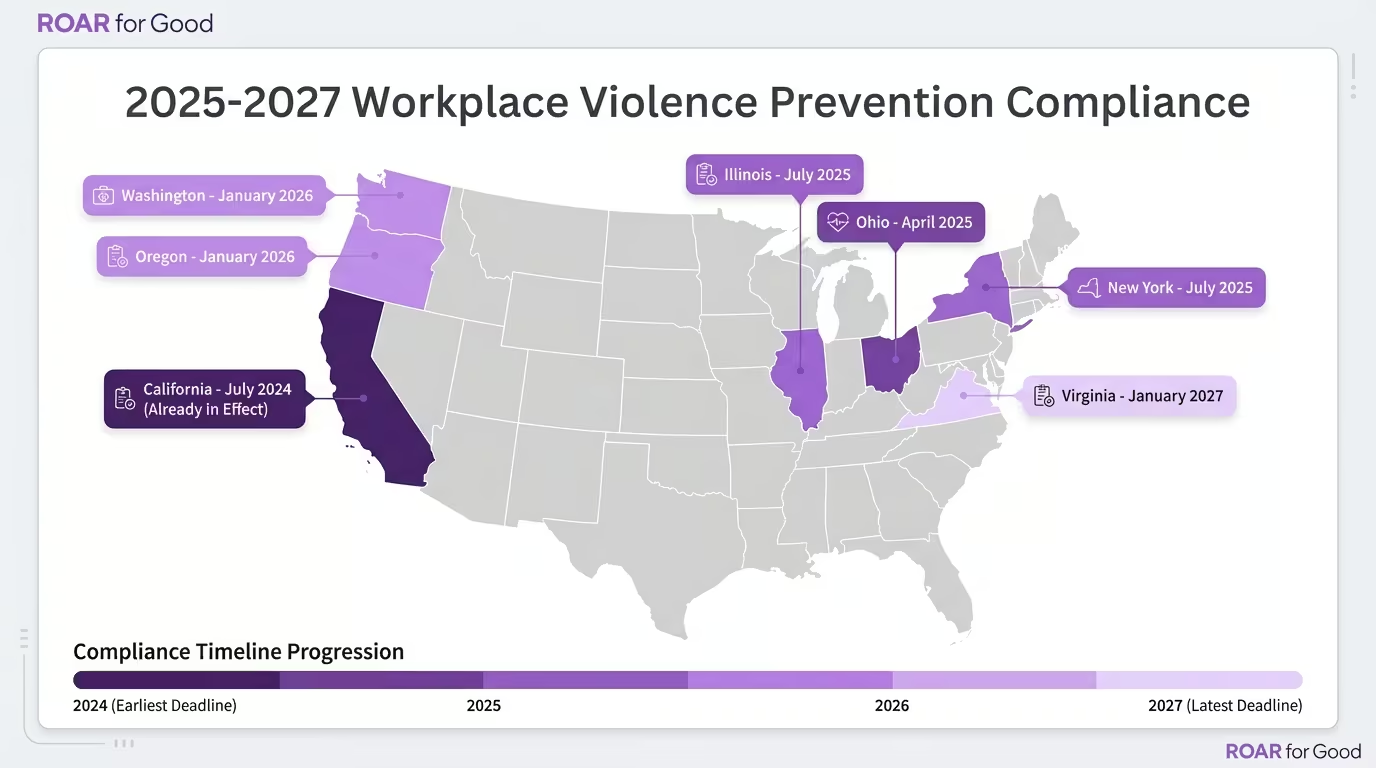
State-by-state Key Workplace Violence Prevention Law Deadlines

Key Takeaways

  • State workplace violence laws have shifted from advisory guidelines to enforceable mandates with real deadlines—Ohio’s requirements took effect April 2025, Illinois demands panic buttons by July, and nine more deadlines land before 2027.
  • Building infrastructure to meet the strictest standard (Illinois SB1435) automatically satisfies less prescriptive requirements in Ohio, California, Washington, and beyond—one investment covers the patchwork.
  • Getting ahead of the compliance wave protects your facilities from compounding penalties while positioning your system as a safety leader that attracts and retains staff.

The 2025 Enforcement Wave: What Changed

Until 2024, most state workplace violence laws were advisory or lacked enforcement teeth. That’s over.

Ohio became the first state to sign comprehensive hospital violence prevention into law on January 8, 2025, following a nurse’s death in Dayton [6]. Illinois followed with the nation’s first panic button mandate for hospital employees [2]. Washington enhanced its existing framework with annual plan reviews and detailed incident reporting [3].

The shift: requirements now come with deadlines, reporting obligations, and—in some cases—direct penalties for non-compliance.


2025-2027 Compliance Calendar

DeadlineStateLawKey Requirements
April 9, 2025OhioHB 452Security plans, incident reporting, de-escalation training in ED/psych, employee input required [1]
July 1, 2025IllinoisSB 1435Panic buttons attached to staff ID cards for all hospital employees [2]
July 1, 2024CaliforniaSB 553WVPP for all employers, incident logs (5-year retention), annual training [7]
July 1, 2025New YorkA203Violence prevention programs; security personnel in high-volume EDs [8]
January 1, 2026WashingtonHB 1162Annual plan reviews, enhanced incident data reporting, safety committee oversight [3]
January 1, 2026OregonHB 2552Safety committees, incident data reporting to state, grant program for prevention [9]
January 1, 2027VirginiaHB 1919WVPP required for employers with 100+ employees [9]
TBD 2025-2026FederalOSHA StandardProposed rule for healthcare; comment period expected [10]
PendingFederalH.R.2531Workplace Violence Prevention for Healthcare Workers Act—would mandate OSHA standard [5]

MULTI-STATE SYSTEMS

One investment. Every state covered.

OSHA fined a Florida healthcare company $100K+ in 2024—before any formal standard existed. Know where you stand.

Compliance Tiers: Mandatory vs. Advisory

Not all state requirements carry equal weight. Here’s how to prioritize:

Tier 1: Mandatory + Specific Requirements

StateWhat’s RequiredEnforcement Mechanism
IllinoisPanic buttons on staff ID cardsHospital licensing requirements [2]
OhioSecurity plans, incident reporting, trainingMandatory compliance; civil immunity provisions [1]
CaliforniaWritten WVPP, logs, trainingCal/OSHA enforcement; penalties per violation [7]
TexasPrevention committees, annual plan reviewLicensing agency enforcement [11]

Tier 2: Mandatory Framework, Flexible Implementation

StateWhat’s RequiredNotes
WashingtonPrevention plans, safety committees, annual reviewsEnhanced from 2019 law; takes effect January 2026 [3]
New YorkPrevention programs, security in high-volume EDsDensity-based requirements (1M+ population areas) [8]
OregonSafety committees, data reportingGrant funding available through Oregon Health Authority [9]

Tier 3: Advisory or Emerging

StateStatusTimeline
VirginiaHB 1919 signed; takes effect 2027Large employers (100+) only [9]
PennsylvaniaHealthcare Workplace Violence Prevention Act passed House May 2025Awaiting Senate action [12]
AlaskaSB 49 prefiledEmployer protective orders [8]
MassachusettsHD.1856, HD.2124Risk assessments, home healthcare focus [9]

The Penalty Stack: Multi-Jurisdictional Exposure

For health systems operating across state lines, compliance failures compound.

Penalty TypeMaximum ExposureApplicable Jurisdiction
OSHA willful violation$165,514 per violationAll states [4]
OSHA serious violation$16,550 per violationAll states [4]
Joint Commission sanctionsUp to $75,000 per caseAll accredited facilities [4]
Medicare/Medicaid funding$2-5M annually at riskAccreditation-dependent [4]
Cal/OSHA citationPer-violation basisCalifornia operations [7]
Federal criminal (pending)Up to 20 years imprisonmentSave Healthcare Workers Act if enacted [13]

OSHA fined a Florida healthcare company over $100,000 in May 2024 for violence prevention failures—using the General Duty Clause before any formal standard existed [10].


Illinois Sets the Standard: What Panic Button Mandates Mean

Illinois SB1435 is the first state law to explicitly require wearable panic buttons for hospital employees [2]. The bill amends both the University of Illinois Hospital Act and Hospital Licensing Act, requiring that all employees have a panic button attached to their staff identification card by July 1, 2025.

Why this matters for multi-state systems: Infrastructure deployed to meet Illinois requirements—wearable devices with location tracking and instant alerting—will satisfy the less prescriptive “prevention plan” requirements in Ohio, California, Washington, and other states. Building to the highest standard eliminates re-work as other states follow Illinois’s lead.

MULTI-STATE SYSTEMS

One investment. Every state covered.

OSHA fined a Florida healthcare company $100K+ in 2024—before any formal standard existed. Know where you stand.


What Modern Infrastructure Satisfies

The common thread across state requirements: rapid response, facility-wide coverage, and documented incident tracking.

Requirement CategoryStates RequiringInfrastructure Solution
Written prevention planCA, OH, WA, TX, NY, VAPlan development + technology documentation
Incident reporting/logsCA, OH, WA, ORAutomated logging with 5-year retention
Employee trainingAll Tier 1 & 2 statesIntegrated onboarding + annual refreshers
De-escalation personnelOH (ED/psych), NY (high-volume ED)Trained staff + alert routing to responders
Panic buttons/alert devicesIL (explicit mandate)Wearable BLE devices with room-level accuracy
Safety committees with employee inputOH, WA, OR, PA (pending)Committee reporting + analytics dashboards

Systems that deploy network-independent alert technology—operating without Wi-Fi or cellular dependency—satisfy the reliability requirements implied across all state frameworks while eliminating coverage gaps that create liability exposure.

References

  1. Ohio Legislature: House Bill 452
  2. LegiScan: Illinois SB1435 – Hospital Employee Panic Button
  3. Washington State Legislature: Chapter 49.19 RCW – Safety in Health Care Settings
  4. ROAR for Good: Industry Statistics and Regulatory Data
  5. U.S. Congress: H.R.2531 – Workplace Violence Prevention for Health Care and Social Service Workers Act
  6. Nurse.org: Ohio Governor Signs Landmark Workplace Safety Bill
  7. Cal/OSHA: Workplace Violence Prevention Requirements
  8. ROAR for Good: Healthcare Workplace Violence Prevention Laws by State
  9. Ogletree Deakins: States Ramp Up Workplace Violence Prevention Efforts with New Legislation in 2025 (March 2025)
  10. Ogletree Deakins: OSHA Slated to Deliver Proposed Workplace Violence Prevention Standard (December 2024)
  11. Ogletree Deakins: Under SB 240, Texas Healthcare Facilities Will Be Required to Adopt Workplace Violence Prevention Plans (May 2023)
  12. Campus Safety Magazine: Multiple States Pass Hospital Workplace Violence Bills (May 2025)
  13. HIPAA Journal: Save Healthcare Workers Act 2025 (June 2025)

Operating across multiple states? Contact us to map your compliance exposure and identify which requirements your current infrastructure already satisfies.