
15 States, 9 Deadlines in 2025: Your Multi-State Violence Prevention Compliance Map
Key Takeaways
- State workplace violence laws have shifted from advisory guidelines to enforceable mandates with real deadlines—Ohio's requirements took effect April 2025, Illinois demands panic buttons by July, and nine more deadlines land before 2027.
- Building infrastructure to meet the strictest standard (Illinois SB1435) automatically satisfies less prescriptive requirements in Ohio, California, Washington, and beyond—one investment covers the patchwork.
- Getting ahead of the compliance wave protects your facilities from compounding penalties while positioning your system as a safety leader that attracts and retains staff.
The 2025 Enforcement Wave: What Changed
Until 2024, most state workplace violence laws were advisory or lacked enforcement teeth. That's over.
Ohio became the first state to sign comprehensive hospital violence prevention into law on January 8, 2025, following a nurse's death in Dayton [6]. Illinois followed with the nation's first panic button mandate for hospital employees [2]. Washington enhanced its existing framework with annual plan reviews and detailed incident reporting [3].
The shift: requirements now come with deadlines, reporting obligations, and—in some cases—direct penalties for non-compliance.
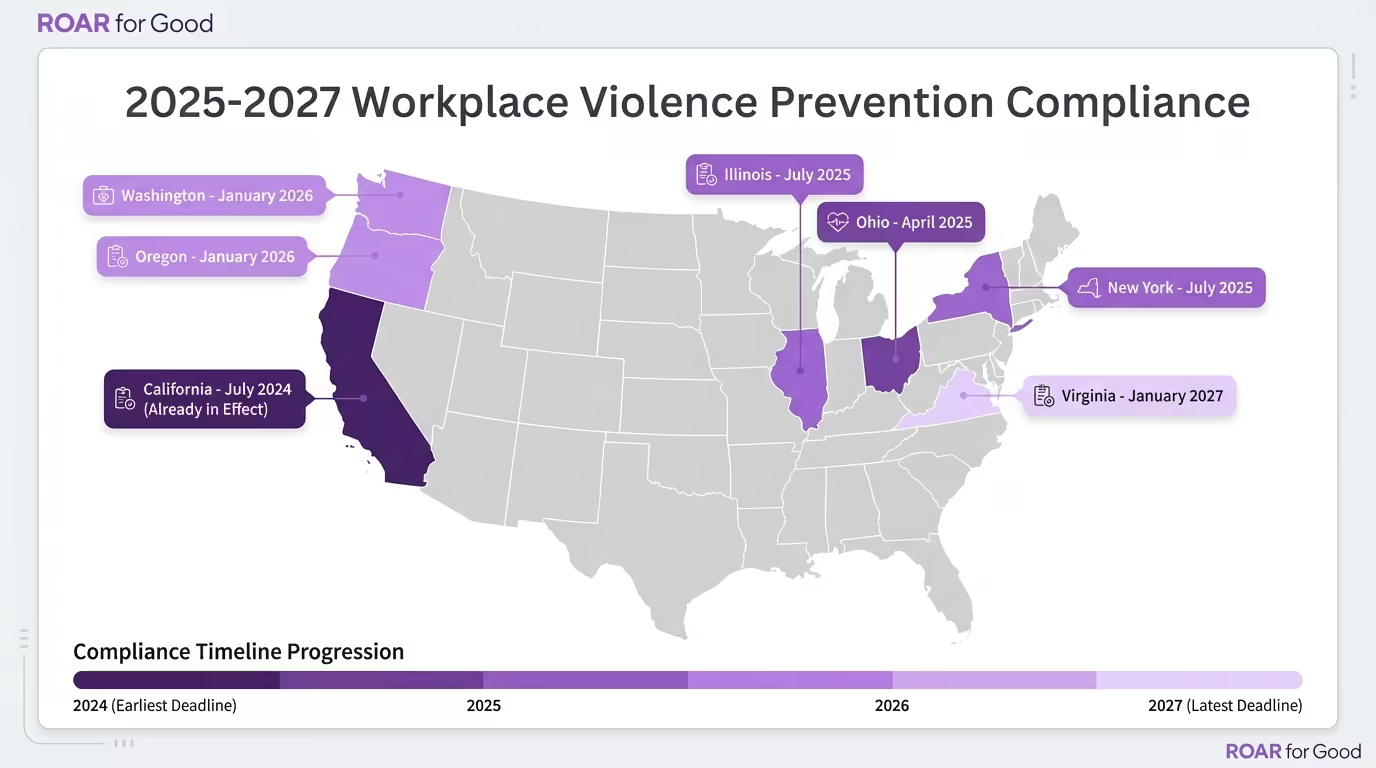
2025-2027 Compliance Calendar
| Deadline | State | Law | Key Requirements |
|---|---|---|---|
| April 9, 2025 | Ohio | HB 452 | Security plans, incident reporting, de-escalation training in ED/psych, employee input required [1] |
| July 1, 2025 | Illinois | SB 1435 | Panic buttons attached to staff ID cards for all hospital employees [2] |
| July 1, 2024 | California | SB 553 | WVPP for all employers, incident logs (5-year retention), annual training [7] |
| July 1, 2025 | New York | A203 | Violence prevention programs; security personnel in high-volume EDs [8] |
| January 1, 2026 | Washington | HB 1162 | Annual plan reviews, enhanced incident data reporting, safety committee oversight [3] |
| January 1, 2026 | Oregon | HB 2552 | Safety committees, incident data reporting to state, grant program for prevention [9] |
| January 1, 2027 | Virginia | HB 1919 | WVPP required for employers with 100+ employees [9] |
| TBD 2025-2026 | Federal | OSHA Standard | Proposed rule for healthcare; comment period expected [10] |
| Pending | Federal | H.R.2531 | Workplace Violence Prevention for Healthcare Workers Act—would mandate OSHA standard [5] |
MULTI-STATE SYSTEMS
One investment. Every state covered.
OSHA fined a Florida healthcare company $100K+ in 2024—before any formal standard existed. Know where you stand.
Compliance Tiers: Mandatory vs. Advisory
Not all state requirements carry equal weight. Here's how to prioritize:
Tier 1: Mandatory + Specific Requirements
| State | What's Required | Enforcement Mechanism |
|---|---|---|
| Illinois | Panic buttons on staff ID cards | Hospital licensing requirements [2] |
| Ohio | Security plans, incident reporting, training | Mandatory compliance; civil immunity provisions [1] |
| California | Written WVPP, logs, training | Cal/OSHA enforcement; penalties per violation [7] |
| Texas | Prevention committees, annual plan review | Licensing agency enforcement [11] |
Tier 2: Mandatory Framework, Flexible Implementation
| State | What's Required | Notes |
|---|---|---|
| Washington | Prevention plans, safety committees, annual reviews | Enhanced from 2019 law; takes effect January 2026 [3] |
| New York | Prevention programs, security in high-volume EDs | Density-based requirements (1M+ population areas) [8] |
| Oregon | Safety committees, data reporting | Grant funding available through Oregon Health Authority [9] |
Tier 3: Advisory or Emerging
| State | Status | Timeline |
|---|---|---|
| Virginia | HB 1919 signed; takes effect 2027 | Large employers (100+) only [9] |
| Pennsylvania | Healthcare Workplace Violence Prevention Act passed House May 2025 | Awaiting Senate action [12] |
| Alaska | SB 49 prefiled | Employer protective orders [8] |
| Massachusetts | HD.1856, HD.2124 | Risk assessments, home healthcare focus [9] |
The Penalty Stack: Multi-Jurisdictional Exposure
For health systems operating across state lines, compliance failures compound.
| Penalty Type | Maximum Exposure | Applicable Jurisdiction |
|---|---|---|
| OSHA willful violation | $165,514 per violation | All states [4] |
| OSHA serious violation | $16,550 per violation | All states [4] |
| Joint Commission sanctions | Up to $75,000 per case | All accredited facilities [4] |
| Medicare/Medicaid funding | $2-5M annually at risk | Accreditation-dependent [4] |
| Cal/OSHA citation | Per-violation basis | California operations [7] |
| Federal criminal (pending) | Up to 20 years imprisonment | Save Healthcare Workers Act if enacted [13] |
OSHA fined a Florida healthcare company over $100,000 in May 2024 for violence prevention failures—using the General Duty Clause before any formal standard existed [10].
Illinois Sets the Standard: What Panic Button Mandates Mean
Illinois SB1435 is the first state law to explicitly require wearable panic buttons for hospital employees [2]. The bill amends both the University of Illinois Hospital Act and Hospital Licensing Act, requiring that all employees have a panic button attached to their staff identification card by July 1, 2025.
Why this matters for multi-state systems: Infrastructure deployed to meet Illinois requirements—wearable devices with location tracking and instant alerting—will satisfy the less prescriptive "prevention plan" requirements in Ohio, California, Washington, and other states. Building to the highest standard eliminates re-work as other states follow Illinois's lead.
MULTI-STATE SYSTEMS
One investment. Every state covered.
OSHA fined a Florida healthcare company $100K+ in 2024—before any formal standard existed. Know where you stand.
What Modern Infrastructure Satisfies
The common thread across state requirements: rapid response, facility-wide coverage, and documented incident tracking.
| Requirement Category | States Requiring | Infrastructure Solution |
|---|---|---|
| Written prevention plan | CA, OH, WA, TX, NY, VA | Plan development + technology documentation |
| Incident reporting/logs | CA, OH, WA, OR | Automated logging with 5-year retention |
| Employee training | All Tier 1 & 2 states | Integrated onboarding + annual refreshers |
| De-escalation personnel | OH (ED/psych), NY (high-volume ED) | Trained staff + alert routing to responders |
| Panic buttons/alert devices | IL (explicit mandate) | Wearable BLE devices with room-level accuracy |
| Safety committees with employee input | OH, WA, OR, PA (pending) | Committee reporting + analytics dashboards |
Systems that deploy network-independent alert technology—operating without Wi-Fi or cellular dependency—satisfy the reliability requirements implied across all state frameworks while eliminating coverage gaps that create liability exposure.
References
- Ohio Legislature: House Bill 452
- LegiScan: Illinois SB1435 - Hospital Employee Panic Button
- Washington State Legislature: Chapter 49.19 RCW - Safety in Health Care Settings
- ROAR for Good: Industry Statistics and Regulatory Data
- U.S. Congress: H.R.2531 - Workplace Violence Prevention for Health Care and Social Service Workers Act
- Nurse.org: Ohio Governor Signs Landmark Workplace Safety Bill
- Cal/OSHA: Workplace Violence Prevention Requirements
- ROAR for Good: Healthcare Workplace Violence Prevention Laws by State
- Ogletree Deakins: States Ramp Up Workplace Violence Prevention Efforts with New Legislation in 2025 (March 2025)
- Ogletree Deakins: OSHA Slated to Deliver Proposed Workplace Violence Prevention Standard (December 2024)
- Ogletree Deakins: Under SB 240, Texas Healthcare Facilities Will Be Required to Adopt Workplace Violence Prevention Plans (May 2023)
- Campus Safety Magazine: Multiple States Pass Hospital Workplace Violence Bills (May 2025)
- HIPAA Journal: Save Healthcare Workers Act 2025 (June 2025)
Operating across multiple states? Contact us to map your compliance exposure and identify which requirements your current infrastructure already satisfies.