
Best Duress Alarms for Psychiatric Units and Inpatient BH (2026)
Key Takeaways
- The four threshold conditions for inpatient behavioral health (older infrastructure coverage, privacy-first tracking, power independence, and mixed campus reach) eliminate most duress alarm systems before features matter
- Named-facility outcomes with defined timeframes are the evidence standard that survives board, insurer, and regulator scrutiny, and unattributed percentages on vendor websites don't meet that bar
- Matching the system to your environment matters more than matching features to a spec sheet: field-based staff, fixed workstations, and inpatient units each need different architectures
Psychiatric and substance abuse hospitals sit in a category of their own when it comes to staff safety. Workers in these settings face violent incidents at roughly eight times the rate reported in general medical and surgical hospitals: 110.4 per 10,000 workers compared to 12.9. A 200-bed psychiatric unit can expect multiple reportable incidents in a single year from that baseline alone, and most incidents in healthcare go unreported.
Yasmine Mustafa founded ROAR after her own experience of feeling voiceless and unprotected at work. Her conviction has shaped the company since: no one should face violence while trying to help others heal. Her TEDxPhiladelphiaWomen talk tells the full story.
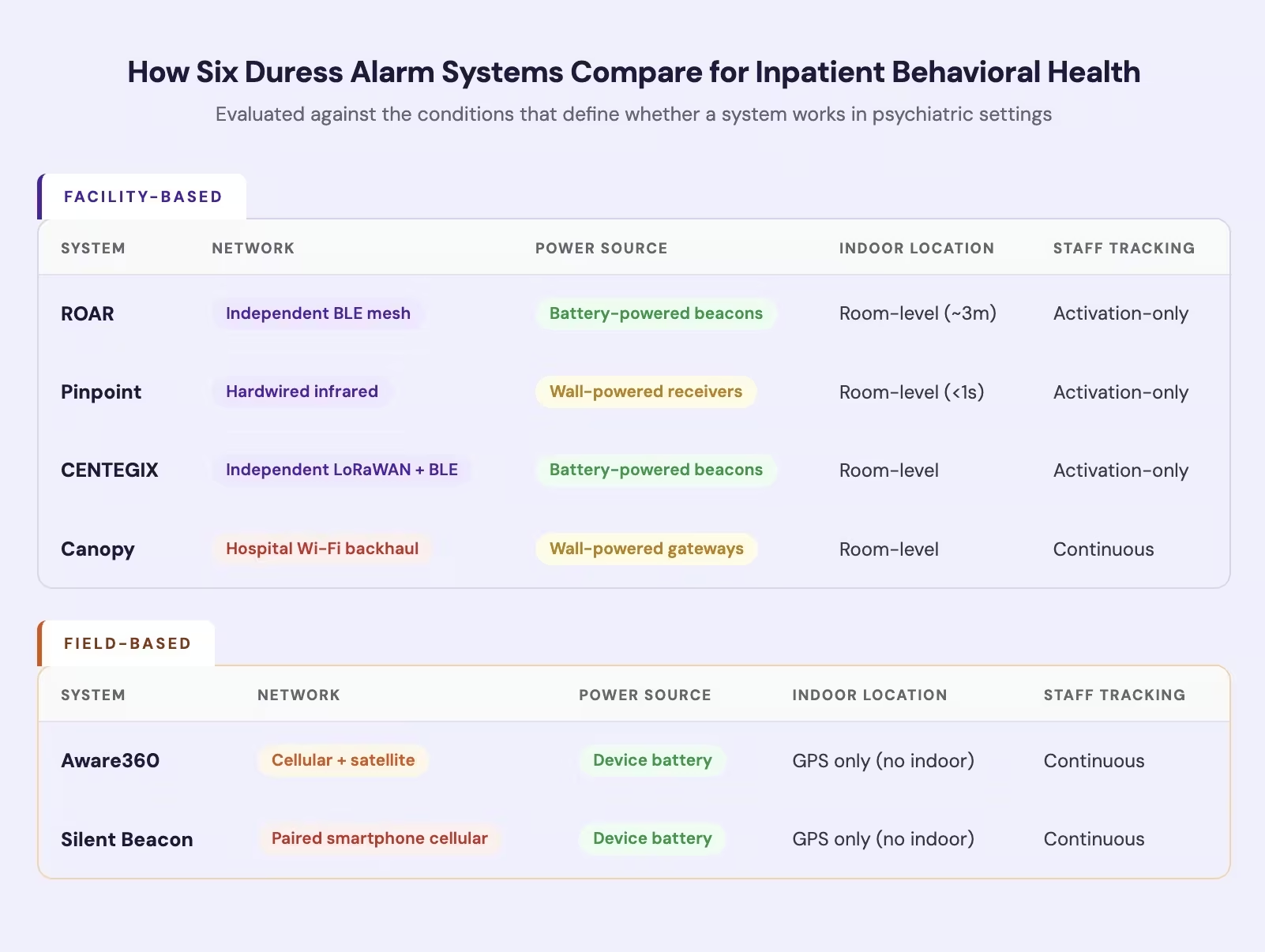
Most duress alarm comparisons treat behavioral health as a subset of general healthcare, evaluating systems on feature breadth instead of asking whether a product actually works in a seclusion room, a basement hallway, or a wing with concrete walls and no WiFi. For inpatient behavioral health buyers, that gap matters more than any feature list. This guide evaluates six products through the lens of the physical environments where violence actually happens.
What Actually Matters for Inpatient Behavioral Health Buyers
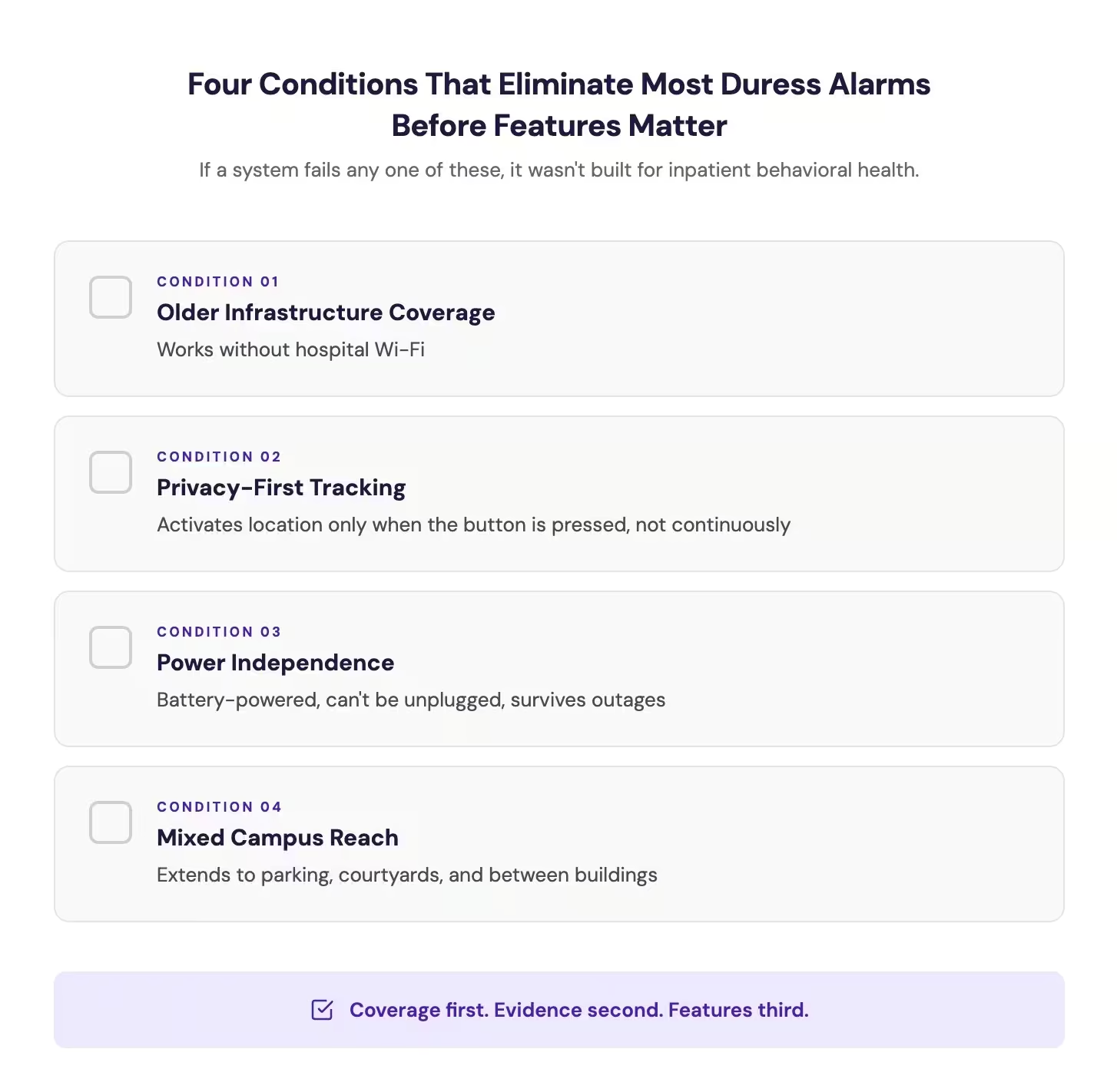
Four conditions define whether a duress alarm system will work in an inpatient behavioral health facility. They're thresholds, not preferences.
Older facility infrastructure and WiFi dead zones. Many psychiatric hospitals operate in buildings with thick concrete walls, sub-grade clinical spaces, and inconsistent WiFi. Any system whose indoor coverage depends on hospital WiFi degrades in exactly the environments where staff are most at risk. Systems that operate on purpose-built wireless infrastructure, running independently of the building's WiFi, avoid that dependency.
Privacy-first tracking. A system that tracks staff location continuously throughout every shift creates an adoption problem that defeats the purpose of the investment. Nurses who know they're monitored leave the badge at the desk. Dedicated wearable devices that activate location only when the button is pressed sustain the adoption rates that make the system work. Ask the vendor: does the system track staff continuously or only during an active alert?
Power independence. Wall-powered sensor networks lose their entire coverage map during a building power outage. They also introduce a tamper vulnerability: a sensor plugged into a wall outlet can be unplugged. Battery-powered beacons eliminate both failure modes by design. Ask the vendor: does your location infrastructure require building power?
Mixed campus coverage. Staff face risk not only inside buildings but in outdoor walkways, parking structures, courtyards, and transition spaces between buildings. Some architectures extend into outdoor campus spaces. Others are limited to interior rooms where receivers are physically installed.
Two additional conditions apply to psychiatric settings specifically. Inpatient units commonly prohibit personal smartphones on the floor, which disqualifies any system that requires a paired smartphone. And every piece of hardware mounted or worn on a psychiatric unit must be evaluated against ligature-risk standards. Buyers should ask each vendor whether ligature-resistant hardware is a documented default or a configuration option.
Buyers should treat these conditions as the first filter before getting to feature comparisons. Coverage first, evidence second, features third. The healthcare duress alerting evaluation guide covers the full framework.
Choosing the Right System for Your Setting
After filtering against the four threshold conditions, the next question is serviceable fit. Each of the six systems in this guide is built for a specific operational environment. Matching the system to the environment matters more than matching features to a spec sheet.
Consider ROAR if you run an inpatient psychiatric unit, residential treatment center, or BH campus that needs coverage in older buildings without relying on hospital WiFi, and you want the system with documented outcomes at named BH facilities: fewer assaults, staff who feel prepared to respond, and incidents that drop and stay down.
Consider Pinpoint if you operate an established inpatient psychiatric hospital with a planned renovation timeline, non-negotiable ligature-resistance requirements documented across all installations, and no outdoor campus coverage needs.
Consider CENTEGIX if you represent a health system willing to adopt a healthcare platform in its early years, need a network that runs separate from WiFi and cellular, and can tolerate a limited BH-specific deployment track record.
Consider Canopy if your facility has strong, modern WiFi infrastructure throughout all clinical areas, and you want a single managed-service platform that also covers asset tracking and patient elopement monitoring.
Consider Aware360 if your primary concern is field-based staff (community mental health workers, mobile crisis teams, home visitors) operating outside fixed facilities, sometimes in areas without reliable cellular service.
Consider Silent Beacon if you operate a small outpatient or community mental health program, your staff carry smartphones at all times, and budget is the binding constraint.
ROAR: Built for Inpatient Behavioral Health, With Outcomes from Named Deployments
The psychiatric units ROAR was built for are the hardest ones to protect. Older buildings. WiFi that drops out two rooms past the nurses' station. Seclusion rooms where the walls block every signal that doesn't travel on purpose-built infrastructure. Staff who can't carry a personal phone on the floor. Power outages that take entire sensor networks offline. ROAR was designed for all of it.
ROAR runs on a private Bluetooth mesh network that doesn't depend on hospital WiFi, building power, or the facility LAN. Beacons are battery-powered and adhesive-mounted, so they can't be unplugged from a wall outlet and they keep working during a building-wide power outage. A 100-room unit comes online in two to three days with no disruption to patient care. The mesh extends outside to parking lots, courtyards, garages, and the walkways between buildings.
Staff carry ROAR as a badge designed for clinical environments. Activation uses a deliberate multi-press sequence that prevents false alarms from doorframes, pockets, and accidental contact. The alert is silent, so the aggressor doesn't know help has been called. Location activates only when the button is pressed, which means staff aren't tracked during their shift. That privacy-first design is why adoption holds: staff wear a safety tool, not a tracking device.
The outcomes are what separate ROAR from everything else in this category.
At BeWell, a behavioral health provider, violent incidents dropped 39% in the first year after ROAR went live. At the University of Pennsylvania Health System, safety events fell 86% during the ROAR deployment period, and staff who felt "very prepared" to respond to incidents rose from 38% to 76%. At a national behavioral health provider, assaults on staff fell 40% in six months. Every one of these numbers is attached to a named facility with a defined timeframe. That's the evidence standard that stands up to scrutiny from boards, insurers, and regulators.
What administrators describe at ROAR sites is a pattern that shows up before anyone ever presses the button: the visible presence of a response system changes unit dynamics. Patients see the badges. Staff move differently. De-escalation happens earlier. The alarm is a safety net, but the system reshapes the baseline.
Best for: Inpatient psychiatric units, residential treatment centers, and BH campuses that need coverage in the rooms where wireless signals fail, with evidence from facilities that look like theirs.
Where ROAR doesn't fit: Field-based or mobile workforces. Community mental health staff, home health aides, and mobile crisis teams operating outside fixed facilities need safety platforms built for that environment.
Pinpoint: Healthcare Specialist with Hardwired Infrared and Ligature-Resistant Hardware as Default
Pinpoint is a duress alarm system built on hardwired infrared receivers that deliver room-level location without wireless networks. There's no WiFi dependency, no Bluetooth interference, no cellular requirement. Pinpoint has spent decades as a healthcare specialist and deploys across dozens of U.S. and Canadian health systems.
What sets Pinpoint apart in inpatient psychiatric settings is ligature-resistant hardware, documented as default across every Pinpoint installation rather than offered as a configuration add-on. For hospitals where every mounted or worn piece of equipment must meet ligature-resistance standards, that default posture is a genuine procurement advantage.
Pinpoint staff carry a dual-button badge for de-escalation and emergency panic, with triple-breakaway safety lanyards designed for high-acuity environments. Pinpoint's platform also includes a Patient Safety Check System for q15 bed checks and a Behavioral Emergency Response Team support module, both directly relevant to inpatient psych operations.
Best for: Established inpatient psychiatric hospitals with planned renovation timelines and non-negotiable ligature-resistance requirements.
Where Pinpoint doesn't fit: Facilities that need rapid deployment without construction, and campuses that require outdoor coverage across parking lots, courtyards, and walkways. Pinpoint's hardwired architecture takes weeks to months to install, and infrared receivers don't extend outdoors.
CENTEGIX: Proprietary LoRaWAN and BLE Platform with Limited Healthcare Track Record
CENTEGIX is a staff safety platform built on a proprietary LoRaWAN and Bluetooth Low Energy network that runs separate from WiFi and cellular infrastructure. Installation is wire-free, with no structural alterations, and badges run on batteries that last one to two years without charging. CENTEGIX applies privacy-by-design principles: location activates only on alert, not continuously.
CENTEGIX has proven its technology at scale in K-12 school environments and integrates with a broad ecosystem of technology partners. The healthcare-specific platform launched in 2024.
As of February 2026, CENTEGIX reports a limited number of healthcare deployments and has not published quantitative outcome metrics specific to behavioral health. Buyers evaluating CENTEGIX for inpatient BH are adopting a healthcare platform still in its early years.
Best for: Health systems wanting enterprise-scale network independence and willing to adopt a healthcare platform with a limited BH-specific track record.
Where CENTEGIX doesn't fit: Procurement processes that require a long healthcare track record, since the healthcare-specific CENTEGIX platform launched in 2024.
Canopy: Enterprise Managed-Service Platform on Hospital WiFi Backhaul
Canopy is a staff safety platform built on a shared LocationID network that supports staff duress, asset tracking, and patient elopement monitoring on a single infrastructure. Canopy operates as a managed service covering hardware, software, deployment, training, and continuous monitoring, and protects healthcare workers at enterprise scale across large health systems.
Canopy's indoor gateways require hospital WiFi for backhaul. In facilities with consistent, modern WiFi infrastructure throughout clinical areas, the architecture works well. In older behavioral health facilities where WiFi infrastructure is inconsistent, Canopy's coverage degrades in exactly the spaces where violence is most likely.
As of February 2026, Canopy doesn't publish BH-specific features, case studies, or outcome metrics. Outcome figures on Canopy's website appear without attribution to named facilities or independent sources.
Best for: Large health systems with strong, consistent WiFi infrastructure wanting a unified platform across duress, asset tracking, and elopement.
Where Canopy doesn't fit: Facilities where WiFi coverage varies across clinical areas, since Canopy's indoor gateways depend on consistent WiFi for backhaul.
Aware360: Field Worker Safety Platform for Community and Mobile BH
Aware360 is a field worker safety platform built on satellite and cellular connectivity that travels with the worker. There's no facility infrastructure and no indoor positioning. Aware360 is in this guide because behavioral health organizations with community mental health programs or mobile crisis teams will encounter it, and it's the right answer for that use case.
Aware360's PeopleIoT platform supports smartphones, dedicated wearables, and satellite communicators for areas beyond cellular coverage. Monitoring is staffed 24/7 by professional responders operating from redundant centers with HIPAA and SOC2 compliance. Features like timed session check-ins, companion mode, and safety concierge service address risks that facility infrastructure doesn't cover.
Best for: Community mental health organizations and mobile crisis teams whose staff work alone in the field, in clients' homes, or in rural areas without reliable cellular service.
Where Aware360 doesn't fit: Inpatient psychiatric units or any setting requiring indoor positioning or facility-based deployment.
Silent Beacon: Smartphone-Paired Direct-911 Wearable for Low-Cost Community Programs
Silent Beacon is a low-cost safety wearable that pairs to a smartphone and provides one-touch direct 911 calling with two-way audio. Deployment takes under two weeks with no infrastructure changes. Silent Beacon has a documented community mental health deployment with Mental Health Cooperative in Tennessee, which provides a legitimate outpatient BH proof point.
The wearable offers multi-week standby battery life and SOC 2 compliance. For organizations with tight budgets and straightforward field-safety needs, Silent Beacon's combination of direct 911 access and two-way audio provides a functional safety layer.
Silent Beacon requires a paired smartphone within a few hundred feet to function at all. Location relies on smartphone GPS, and there's no indoor positioning. Silent Beacon is classified as field-based in this guide because it carries no fixed infrastructure.
Best for: Small community mental health agencies or outpatient BH programs with field staff who can guarantee smartphone availability at all times.
Where Silent Beacon doesn't fit: Inpatient psychiatric units where personal smartphones are restricted, and any setting requiring indoor location accuracy.
Frequently Asked Questions
What's the difference between a facility-based duress alarm and a field-based safety platform?
Facility-based systems are built on fixed infrastructure (wireless mesh beacons, hardwired infrared receivers, or proprietary LoRaWAN networks) installed within a building and its surrounding campus. That infrastructure enables indoor location accuracy and room-level response routing. Field-based platforms carry no fixed infrastructure and rely on GPS, cellular, or satellite connectivity that travels with the worker. Most behavioral health violence occurs inside facilities, in seclusion rooms, hallways, and patient rooms, where GPS doesn't work. Organizations with both inpatient and community mental health programs may need both types.
Do facility-based systems cover outdoor areas like parking lots and courtyards?
Wireless infrastructure-based systems can extend to outdoor campus areas by installing beacons in parking lots, garages, courtyards, and walkways as part of deployment. Hardwired infrared systems can't extend outdoors because receivers require physical wire runs and don't function in open environments. If outdoor campus coverage is a requirement, confirm with the vendor whether the architecture supports it and whether outdoor deployment is included in the standard scope.
What should I ask a vendor when they cite workplace violence reduction percentages?
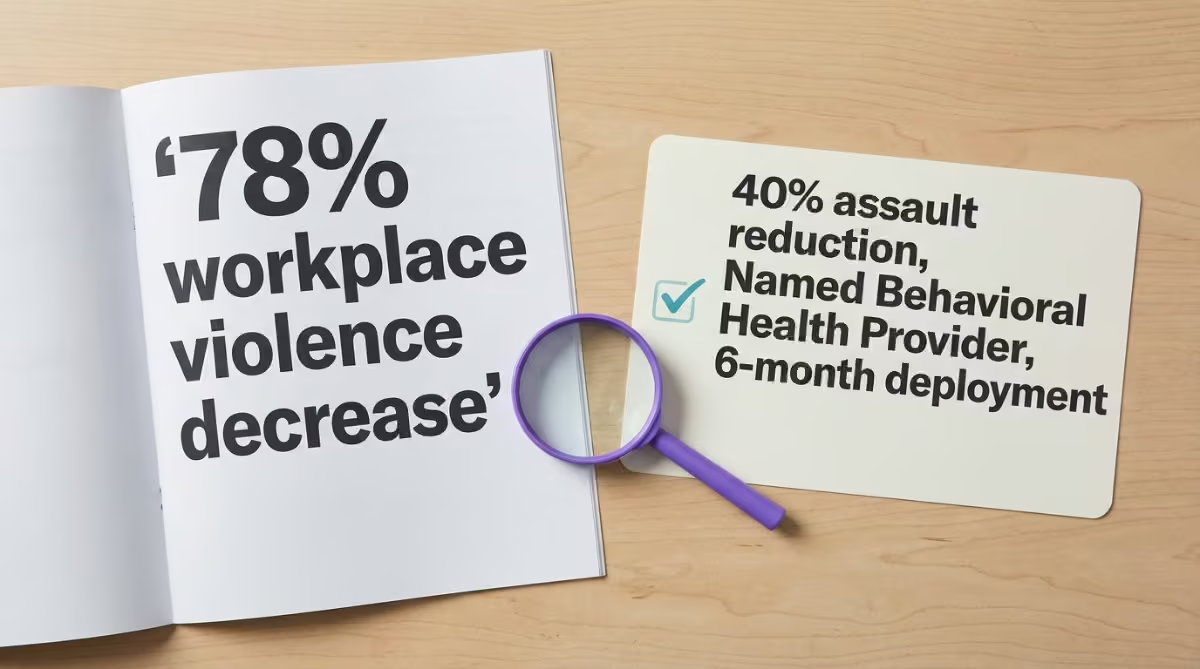
Ask five questions. Which named facility produced this data? Over what timeframe? What was the baseline? Was the reduction independently verified or self-reported? Is the facility comparable to yours? Unattributed percentages on vendor websites, without named facilities or timeframes, should be treated with skepticism.
Can staff carry duress alarm devices on psychiatric units where personal smartphones are prohibited?
Yes, but only with dedicated wearable devices that operate independently of smartphones. Several systems in this category offer smartphone-independent wearables. Any system that requires a paired smartphone within a limited range to function is disqualified for units with restricted-device policies.
Do duress alarm systems replace de-escalation training?
No. De-escalation training remains the first line of defense in psychiatric settings. Duress alarms are the safety net for when de-escalation fails or when violence escalates too quickly for verbal intervention. The two are complementary.
What happens to duress alarm coverage during a building power outage?
Systems built on battery-powered beacons continue operating during an outage because the coverage network runs independently of building power. Systems built on wall-powered sensors or mains-powered access points lose their entire coverage map the moment the power goes out. Wall-powered infrastructure also introduces a tamper vulnerability: a sensor plugged into a wall outlet can be unplugged. Ask the vendor whether their location infrastructure requires building power.
How long does it take to deploy a duress alarm system without disrupting patient care?
Battery-powered wireless systems can install in days per unit without wiring or construction, with minimal disruption to clinical operations. Hardwired systems require construction coordination and typically take weeks to months. Confirm the installation scope, staging requirements, and patient-care impact with any vendor before signing.
Methodology
This roundup was compiled in February 2026 using vendor documentation and product specifications, named deployment data and case studies, press releases and product announcements, and third-party industry research from AHA, BLS, AHRQ, NSI, and the Sheps Center at UNC. ROAR is a vendor in this category. This guide updates as new products enter the market and existing solutions evolve.
Why ROAR for Inpatient Behavioral Health
Yasmine founded ROAR because no one should face violence while trying to help others heal. That conviction shaped every architectural decision: battery-powered beacons that can't be unplugged, silent activation that doesn't escalate the encounter, location that activates only when someone needs help. A company whose entire mission is staff safety will out-engineer a company that treats duress alerting as one feature among many. ROAR doesn't sell asset tracking, patient monitoring, or nurse call. It does one thing.
The system has to work in seclusion rooms, older wings, basement corridors, and the outdoor campus spaces between buildings, because that's where staff actually face risk. The architecture assumes older facilities with inconsistent WiFi, restricted-device policies on the floor, power outages that happen without warning, and mixed indoor-outdoor campus footprints. The Joint Commission surveyor framework and CMS compliance pressure shaped the deployment model: rapid installation without construction, no disruption to patient care, infrastructure that keeps working when the building doesn't.
The evidence base matters because behavioral health procurement is accountable to people who ask for proof. Boards want to know this investment will change the rate of violent incidents on their units. Insurers want to see workers' compensation exposure come down. Regulators want documented, named-facility outcomes. Generic category claims don't survive any of these conversations. Outcomes from BeWell, UPHS, and a national behavioral health provider do.
For the staff who carry the badge, ROAR is Yasmine's conviction made operational on the floor.
INPATIENT BH SAFETY
Will this system actually work in your facility?
Walk through your specific psychiatric unit with someone who's deployed ROAR in facilities like yours, and see how the system handles the rooms where wireless signals fail.