
Duress Badges for Healthcare Staff: Activation Methods and What to Test
Key Takeaways
- The activation mechanism on a duress badge determines false alarm rates, responder trust, and whether the system earns credibility or becomes background noise over time
- Five architectural markers separate a clinical-grade duress badge from a consumer tracker repackaged for healthcare: network independence, room-level location, privacy-first tracking, multi-year battery life, and silent activation
- Before committing to any badge vendor, run walk-tests in your dead zones, stress-test activation with gloves and shaking hands, and ask for false alarm data the vendor can back up
You've decided on a wearable duress badge for your staff. That's the right call for mobile clinical teams who move across rooms, floors, and buildings throughout a shift. The harder question is which badge, and most buyers get the filter wrong. They start with form factor and price. Start with the activation mechanism instead. The badge your staff clip on every morning looks identical across vendors. One badge sends a room-level alert through an independent network. Another rides the same Wi-Fi your EHR competes for.
What a Duress Badge Is and Who It's Built For
A duress badge is a single-purpose, body-worn alerting device. When a staff member activates it, the system sends an alert with the wearer's location to the people who can respond. No phone calls, no apps to unlock, no desk to reach.
The form factor exists because clinical staff move. The alternatives can't keep up:
- A fixed desk button only covers one station
- A smartphone app requires reaching, unlocking, and tapping under stress
- An overhead code alerts the aggressor along with everyone else
OSHA's guidelines on workplace violence list panic buttons and handheld alarms among recommended engineering controls [1]. The logic is simple: if your staff aren't stationary, their safety device can't be either.
Regulatory momentum is catching up. Illinois Senate Bill 1435 requires healthcare employers to provide wearable panic buttons to hospital staff. If you've already decided on a wearable form factor, you're ahead of the curve. If you haven't, the full evaluation framework covers that ground.
Form Factors and Activation Methods Compared
Badge-style devices come in clip-on, lanyard-mounted, and wristband configurations. The physical form affects comfort, but the activation mechanism is the design choice that makes or breaks the system.
| Activation Type | False Alarm Risk | Usability Under Stress |
|---|---|---|
| Single press | High (accidental triggers common) | High (fastest to activate) |
| Multi-press sequence | Low (requires deliberate action) | High (gross motor, works under adrenaline) |
| Sustained hold | Low (intentional only) | Moderate (requires maintained grip) |
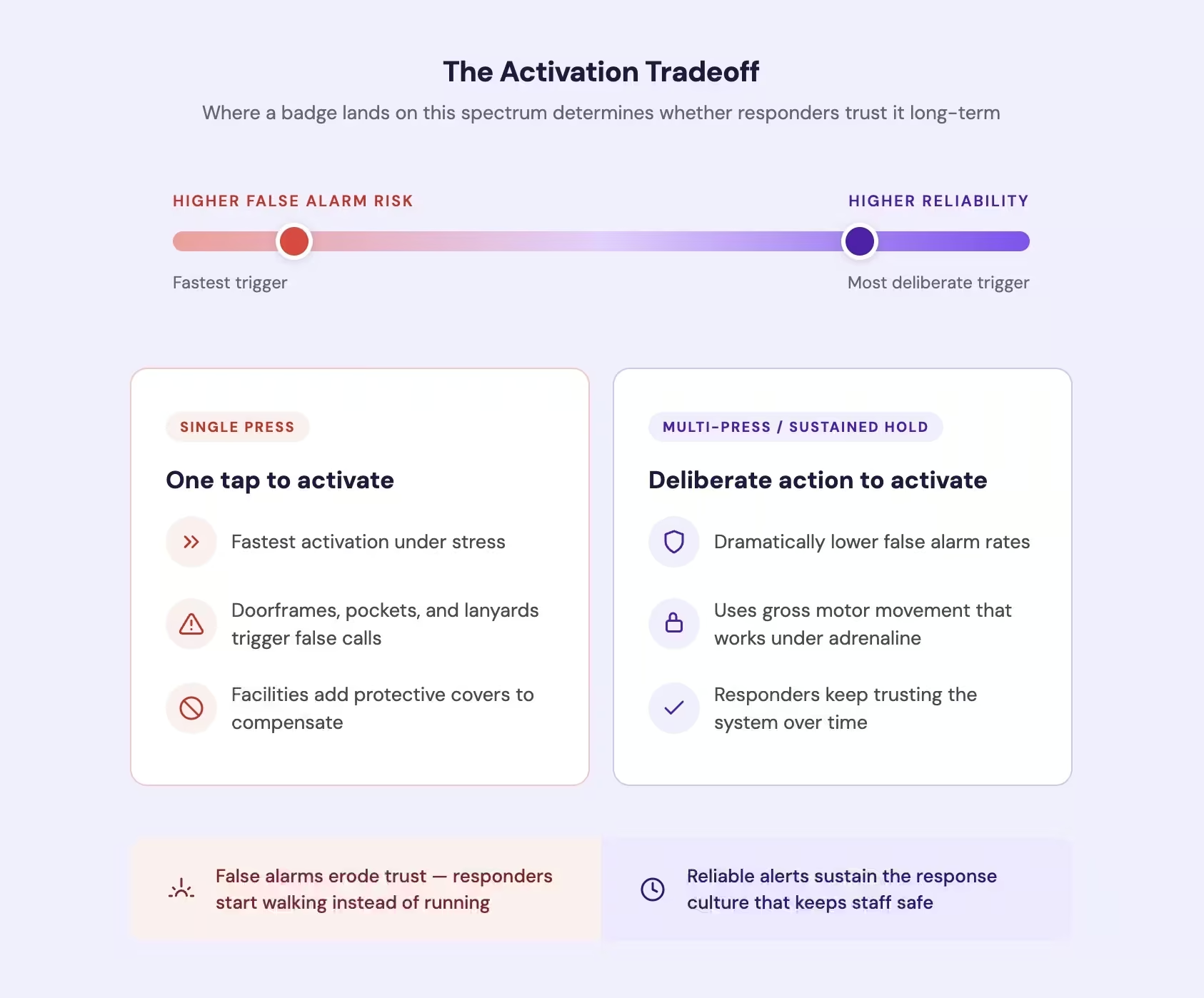
A single-press badge will erode your response culture within months. Studies of single-press emergency buttons in clinical settings show high rates of false calls [2]. Facilities resort to adding protective covers to compensate. A wearable badge bouncing against a doorframe faces the same physics.
Multi-press and sustained-hold designs require deliberate action. A three-press sequence uses gross motor movement that works when your hands are shaking and fine motor skills are gone. That's the balance: intentional enough to prevent false triggers, simple enough to execute under adrenaline.
Every false alarm trains responders to stop trusting the system. After enough false calls, the team that should come running starts walking. Silent activation adds another layer: the alert should reach responders without the aggressor knowing it was sent.
See how a duress badge with deliberate activation and silent alerting works in practice
What Separates a Clinical-Grade Duress Badge from a Consumer Tracker
Two badges can look identical on a lanyard and deliver completely different outcomes. The difference lives in five architectural markers.
| Marker | What It Means |
|---|---|
| Independent network path | The badge operates on its own network, not the facility's Wi-Fi. Wi-Fi drops in stairwells, gets throttled during peak hours, and goes down during updates. A duress system sharing that infrastructure fails when the building does. |
| Room-level, floor-certain location | Standalone BLE sensor networks deliver accuracy within about three meters and reliably identify which floor the alert came from [3]. Wi-Fi-based location can place an incident on the wrong floor [3]. Responders sent to the wrong floor aren't responding. They're searching. |
| Location only when activated | You can't track your staff continuously and expect them to wear the badge. In one urban emergency department, the majority of clinical staff didn't wear their duress alarms [4]. Continuous tracking accelerates the problem. Staff who know they're monitored leave the badge at the desk. A badge nobody wears protects nobody. |
| Battery life measured in years | Rechargeable badges needing daily charging create a maintenance burden that compounds across hundreds of devices. Coin-cell batteries with multi-year life eliminate that failure mode. |
| Silent activation | An audible alarm tells the aggressor help has been called. A silent alert brings help without escalating the situation. |
Our duress badge runs on an independent wireless network with room-level location that activates only when pressed.
Contact UsWhere Duress Badge Systems Fit and Where They Don't
Badges are the right answer for mobile clinical staff inside a facility with infrastructure coverage. They aren't the right answer for every role.
A receptionist who never leaves the front desk is better served by a fixed-mount button. A community mental health worker doing home visits needs a GPS-based field device. GPS can identify general location but can't pinpoint a floor or room inside a building [3].
Most health systems have all three contexts:
- Campus-based mobile staff: wearable badges that travel with the person
- Fixed-workstation roles: static buttons mounted at desks and counters
- Field workers: GPS-based devices for off-campus home visits
Ask whether the vendor's platform covers all three on the same system. Fragmented coverage across multiple vendors means fragmented alerting, fragmented training, and fragmented accountability. The full evaluation framework covers fixed-button and field-based options. Behavioral health units present unique constraints that the psychiatric unit duress guide addresses separately.
What to Test Before You Commit
Spec sheets describe ideal conditions. Your facility has stairwells, parking garages, basements, and older wings that don't match.
Walk the dead zones. Parking structures and basements are where concrete and metal block most wireless signals [5]. Test the badge in:
- Every stairwell and basement corridor
- Parking levels at shift-change volume
- Lead-lined imaging rooms
- Older wings with dense construction
If the badge can't send an alert from the parking garage at shift change, it can't protect your staff when they need it most.
Test activation under stress. Can staff activate the badge with gloves on? While moving quickly? With shaking hands? Simulate real conditions, not a conference room demo.
Request false alarm data. A vendor confident in their design shares their rates openly. If they won't share, that tells you what the numbers look like.
Verify location floor by floor. Test at room-to-room transitions, hallway intersections, floor crossings, and elevator lobbies.
Review privacy documentation. Ask what data the badge collects, when tracking is active, and what gets logged. If the answer is "always," expect adoption resistance from day one.
Validate battery claims. Ask about replacement intervals and what happens when a badge dies mid-shift.
Start with the walk-test. The duress badge that works in your stairwells, your parking garage, and your oldest wing is the one worth buying.
DURESS BADGES
Test the Badge in Your Facility
Ask us to run a walk-test in your stairwells, parking structures, and oldest wings before you commit.
References
- OSHA. "Guidelines for Preventing Workplace Violence for Healthcare and Social Service Workers." https://www.osha.gov/sites/default/files/publications/OSHA3153.pdf
- Critical Care and Resuscitation (PMC). "False Code Blue Calls and Physical Design Controls." https://pmc.ncbi.nlm.nih.gov/articles/PMC10692528/
- Campus Safety Magazine. "Healthcare Violence: Comparing 4 RTLS Technologies That Enhance Duress Alert Accuracy." https://www.campussafetymagazine.com/insights/healthcare-violence-comparing-4-rtls-technologies-that-enhance-duress-alert-accuracy/
- Journal of Emergency Nursing (PubMed). "Staff Duress Alarm Adoption in an Urban Emergency Department." https://pubmed.ncbi.nlm.nih.gov/37150562/
- Belden. "Improve In-Building Wireless Dead Zones for Safety." https://www.belden.com/blog/improve-in-building-wireless-dead-zones-for-safety