
Silent Panic Buttons for Offices and Businesses: What to Know Before You Buy
Key Takeaways
- Silent panic buttons represent a distinct design philosophy, not a volume setting. Understanding the architecture behind silent alerting helps you evaluate vendors with sharper, more specific questions
- The environments where silent activation matters most share a common trait: face-to-face contact with the public in confined indoor spaces where audible alarms could escalate danger
- A credible silent system meets four markers that most buyers overlook, and those markers translate directly into a practical checklist you can carry into any vendor conversation to separate credible from cosmetic
If you're shopping for a silent panic button for office or business use, you've probably already decided that an audible alarm isn't the right fit. That instinct is correct. But "silent" means different things to different vendors. The gap between a purpose-built silent system and a consumer device with the sound turned off is wider than most buyers expect. This guide covers how silent systems work, when they're the right choice, and what to look for when comparing options.
How Silent Panic Buttons Actually Work
The reason silent activation exists comes down to one principle: an aggressor who knows help is coming changes behavior, and that change makes things worse. When an alarm sounds or a light flashes, the person causing the threat has new information. They know the window is closing. That gives them a reason to escalate before responders arrive.
A purpose-built silent panic button removes that information entirely. No sound. No flashing light. The building never knows. The only person who knows the button was pressed is the person who pressed it, confirmed by a small indicator visible only to them.
The user presses one button. A digital signal travels to designated responders carrying the user's location, typically at room level. Purpose-built BLE mesh systems relay signals in milliseconds. The full path from press to alert delivery completes in under a second.
That speed matters because the person pressing the button can't wait. They also can't navigate a screen, unlock a phone, or complete multiple steps. A credible silent system is designed for one press under stress, when your hands are shaking and you can't think straight.
The wireless panic button systems guide covers the signal path architecture in detail.
When Silent Activation Is the Right Choice
Think about the moments in your workplace where staff are closest to risk. A receptionist alone at a front desk after hours. A social worker meeting a client behind a closed door. A retail employee handling a cash register on a late shift. These scenarios share two traits: face-to-face contact with the public, and a confined indoor space where sound carries.
| Factor | Silent Activation | Audible Alarm |
|---|---|---|
| Best environment | Confined indoor spaces with face-to-face threats | Outdoor areas where bystander attention helps |
| Aggressor awareness | Aggressor doesn't know help has been called | Alarm may provoke escalation to silence it |
| Responder coordination | Targeted alert to designated responders with location | General attention-drawing with no directed response |
| Regulatory trend | Mandated in banking, schools, and expanding to retail | Required for evacuation, fire, and outdoor scenarios |
Audible personal alarms work primarily outdoors, where the noise draws bystanders who can help [1]. Indoors, in confined settings with a face-to-face threat, the calculus flips. A high-decibel alarm can provoke an assailant to intensify an attack in an attempt to silence it.
This principle isn't new. Federal banking regulations under the Bank Protection Act require every banking office to maintain a robbery alarm [2]. That alarm must transmit a signal "not detectable by unauthorized persons." Banks figured this out decades ago. The principle applies to any office where staff face threats from the public.
The regulatory trend is expanding. Multiple states now mandate silent panic alert technology in schools. Forthcoming laws will require retailers with large workforces to equip late-shift and cash-handling staff with silent response buttons.
When audible is the better fit. Silent activation isn't universal. Outdoor environments where bystander attention helps, evacuation scenarios, and fire emergencies all call for audible alerts. If your staff work fixed positions with no public-facing interaction, an under-desk button may serve better. The wearable panic button guide and the under-desk guide cover form-factor decisions for those environments.
ROAR's silent panic button activates with one press, delivers room-level location to responders in under a second, and runs on a network independent of your facility's WiFi.
Contact UsWhat Separates a Credible Silent Panic Button
"Silent" is easy to claim. Any device can have its volume turned off. The question is whether the system behind that silence was built for the job. Four markers separate credible systems from cosmetic ones.
Network independence. If the alert travels over your building's WiFi or cellular network, it depends on infrastructure that can fail. An intruder, a power outage, or simple congestion can take it down. Nearly all first responders have reported dead spots inside commercial structures [3]. A credible silent system carries the alert on its own dedicated network.
Institutional alert routing with location. Most consumer mobile alert devices delay reaching 911. In one case, a device located the user in a different country, with monitoring-center answer times stretching to minutes [4]. That's what happens when "silent" is just a muted consumer device. A credible system delivers room-level location directly to designated responders on button press.
Privacy-first design. Systems that activate location only on press see higher adoption. Staff can request help without feeling monitored during their shift. This isn't a privacy nicety. It's the design choice that determines whether people actually keep the button accessible or stow it in a drawer.
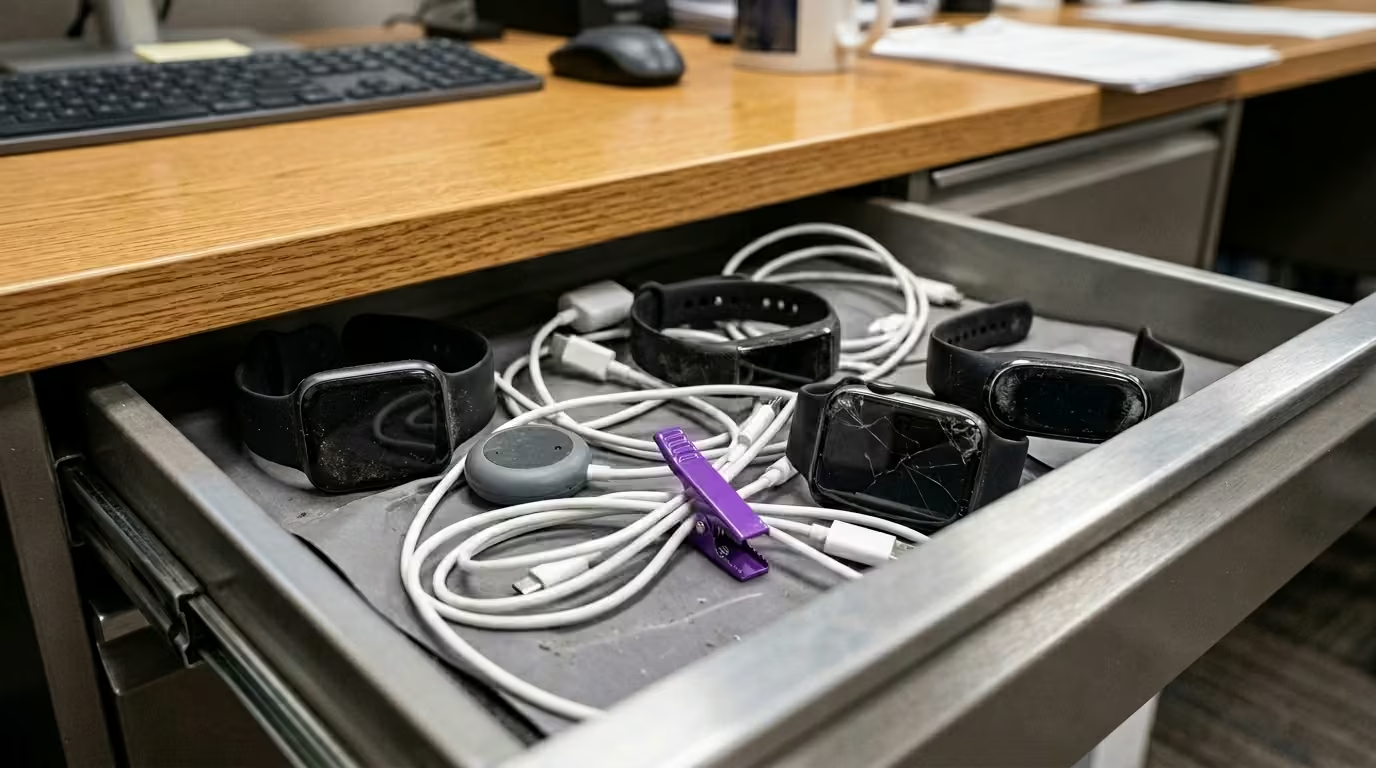
Battery architecture. A system requiring daily charging will have dead devices within weeks. In one documented deployment, the majority of staff didn't even wear the device [5]. Bulky design and unreliable response were the top barriers. Multi-year battery life eliminates the most common adoption killer.
If the system you're evaluating doesn't meet all four markers, the silence is cosmetic.
See how ROAR's silent panic button delivers all four credibility markers on an independent network.
Evaluating Silent Panic Buttons for Your Office
Take these questions into any vendor conversation. Each maps to a credibility marker above.
Alert path: Does the alert travel on a network independent of your building's WiFi and cellular service? What happens during an outage?
Activation: How many steps does it take to send an alert? Can it be done with one press, under stress, without looking at a screen?
Location: Does the system deliver room-level location to responders on button press? Does the person in danger have to do anything beyond press?
Privacy: Does location data activate only when the button is pressed, or does the system track staff continuously?
Battery and maintenance: What's the battery model? Daily charging, weekly, or multi-year? What happens when devices aren't charged on schedule?
Adoption history: What do existing customers report about sustained use after the first 90 days?
The full vendor evaluation framework in the buyer's guide covers category-level criteria beyond the silent sub-type. These six questions are the silent-specific filter. A vendor who answers all six clearly is worth a deeper conversation.
Your next step: evaluate specific products against these criteria. Start with how the alert travels and what happens when you press the button. A silent panic button for office environments earns its name through architecture, not a mute switch.
SILENT ACTIVATION EVALUATION
Ready to See a Silent System Built for Real Conditions?
ROAR's silent panic button runs on an independent Bluetooth mesh network. One-press activation. Room-level location in every alert. Multi-year battery life. No WiFi dependency. No sound, no light, no escalation risk.
References
- Crime Science (BioMed Central). "Systematic Review of Personal Safety Interventions." https://crimesciencejournal.biomedcentral.com/articles/10.1186/s40163-017-0073-1
- Federal Reserve Bank of Dallas (Fraser/St. Louis Fed archive). "Bank Protection Act Circular." https://fraser.stlouisfed.org/files/docs/historical/frbdal/circulars/frbdallas_circ_19690016_no69-014.pdf
- Belden. "Building Connectivity and First Responder Communications." https://www.belden.com/blogs/smart-building/building-connectivity-first-responders
- Star Tribune. "Investigative Test of Mobile Medical-Alert Devices." https://www.startribune.com/article/510624942
- Duke University Scholars. "Evaluation of Staff Duress Alarm." https://scholars.duke.edu/publication/1575648